
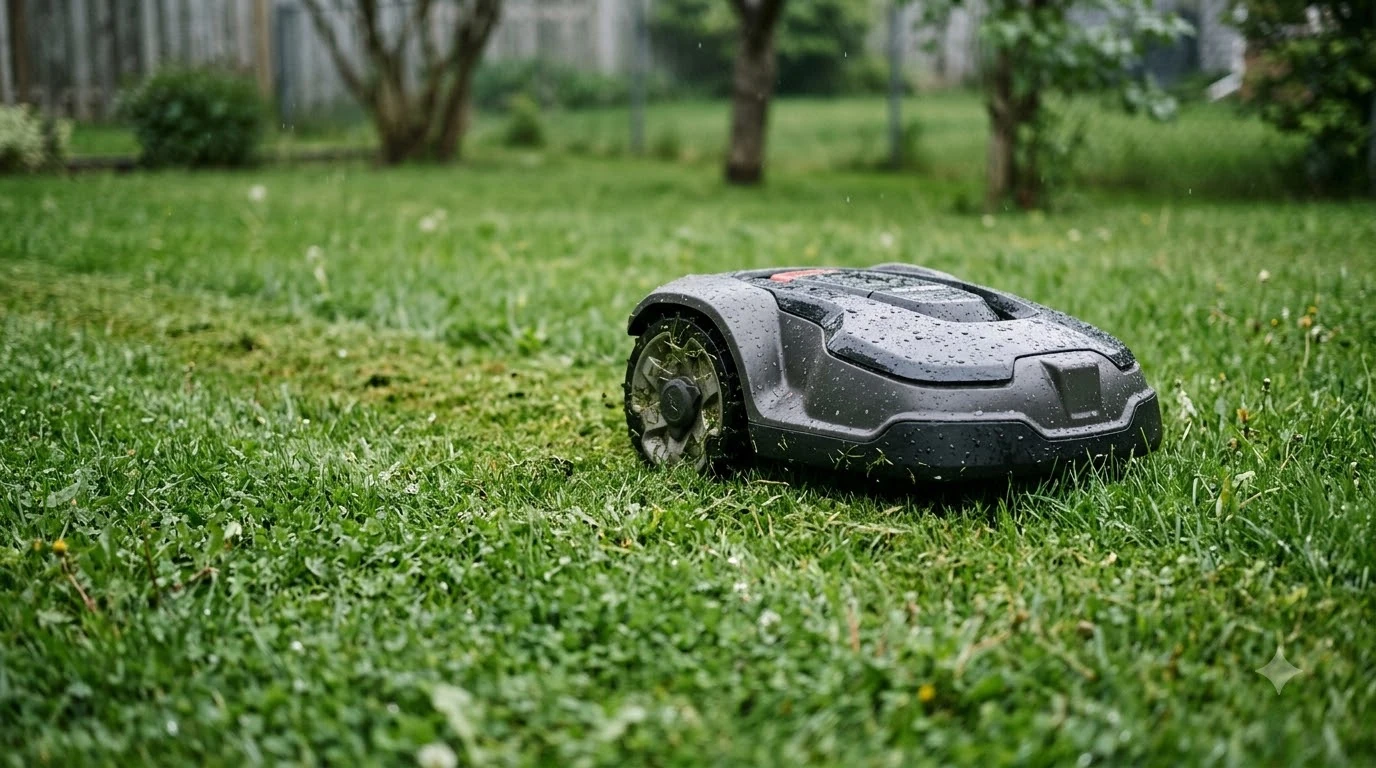

A robot mower for a lawn with heavy morning coastal fog works reliably only if you delay its daily schedule until the marine layer burns off, choose an IPX5- or IPX6-rated chassis, and pair all-wheel drive with satellite or boundary-wire navigation rather than camera-only guidance. Dense coastal fog saturates grass blades without triggering standard rain sensors, creating a slick surface where wet clippings clump under the cutting deck and optical lenses lose contrast. Adjusting run windows, deck hygiene, and navigation settings turns a soggy coastal yard into an easy automated route.
The short answer
- Rain sensors miss fog: Capacitive rain plates require liquid droplets to bridge contacts, meaning a robot mower will roll right out into dripping, fog-soaked grass unless you restrict morning hours in the app.
- Wet turf raises disease and clumping risks: According to University of Wisconsin-Madison Extension turf guidelines, mowing wet grass increases leaf wetness duration and spreads fungal pathogens while matting clippings inside the mower shroud.
- Camera-only navigation struggles in mist: Pure AI-vision mowers rely on clear visual contrast between turf and borders, whereas RTK satellite, LiDAR, or buried boundary wire systems keep tracking through low-visibility marine air.
- Ingress protection and traction matter: Coastal humidity and salt-laden mist demand at least an IPX5 or IPX6 water-resistance rating, sealed charging contacts, and wide-tread or all-wheel-drive wheels on sloped yards.
Why heavy coastal fog fools standard robot mower sensors
Most automated mowers treat foggy mornings like dry sunny days because condensed mist settles on grass blades rather than pooling on the chassis rain sensor.
Standard rain sensors use two small metal contacts on top of the mower shell that close a circuit when a raindrop lands between them. Fine coastal fog particles drift horizontally and coat turfgrass leaves with heavy moisture without forming large droplets on the sensor plate. As a result, a mower programmed for dawn operation leaves its dock on schedule and immediately drives into soaked turf.
Once inside wet grass, two mechanical problems compound quickly. First, wet clippings stick to the underside of the cutting deck and around the spinning blade discs, forming dense mats that restrict airflow and trigger blade motor overload errors. Second, University of Wisconsin-Madison Extension research on cool-season turf diseases notes that mowing wet grass and prolonging leaf wetness between May and November encourages fungal outbreaks such as leaf spot and melting out. University of Missouri Extension turfgrass pathology guides similarly link heavy morning dew, high humidity, and prolonged canopy moisture to dollar spot and red thread.

How navigation systems behave in low-visibility marine air
Boundary-wire and RTK-GNSS mowers maintain accurate positioning inside thick fog, while camera-first systems can lose edge contrast or suffer lens condensation.
Wire-free robot mowers rely on four primary positioning methods: RTK-GNSS satellite correction, 3D LiDAR laser scanning, stereo AI vision cameras, and hybrid sensor fusion. Each reacts differently when a marine layer rolls across a coastal property and drops visibility to a few yards.
According to Anker’s technical overview of LiDAR robot lawn mower navigation, laser-based sensors emit thousands of pulses to map yard boundaries in low light without needing daylight, though dense airborne water droplets can scatter weak beams at longer ranges. Camera-only models depend on high-contrast edges—such as dark mulch or stone pavers next to green grass—which wash out in gray mist, and rapid overnight temperature swings can cause temporary fogging behind camera lenses. By contrast, buried perimeter wires and RTK satellite setups with a clear sky view follow fixed coordinates regardless of ground-level visibility.
| Navigation Type | Behavior in Dense Coastal Fog | Coastal Yard Suitability |
|---|---|---|
| RTK-GNSS + Multi-Sensor Fusion | Radio correction signals pass through fog; onboard inertial sensors bridge brief dips. | High, provided the reference antenna has an unobstructed view of the sky. |
| Buried Boundary Wire | Electromagnetic loop signal is completely unaffected by mist, humidity, or darkness. | High for simple yards, though salt soil can corrode poorly sealed wire splices. |
| 3D LiDAR | Operates independent of sunlight, though heavy mist can shorten effective scan range. | Moderate to high when paired with fixed yard walls, fences, or trees. |
| Camera-Only AI Vision | Low contrast in gray fog and moisture droplets on the lens can blur turf borders. | Low during foggy hours; requires delaying schedules until bright afternoon sun. |
Hardware features that survive coastal moisture and salt air
A coastal-ready robot mower needs sealed electronics rated IPX5 or IPX6, corrosion-resistant charging contacts, and high-grip tires for slick turf.
Coastal fog carries more than fresh water; fine marine aerosols deposit trace salt and minerals onto exposed metal terminals and wheel bearings. When evaluating hardware specs, check the International Protection (IP) code first. Models rated IPX4 only resist light splashing from any direction, whereas IPX5 and IPX6 enclosures withstand low- and high-pressure water jets, allowing you to rinse salty grass paste off the deck with a garden hose without flooding the mainboard.
Traction is equally critical on coastal bluffs and rolling lawns. Damp grass reduces tire grip noticeably compared to dry turf, causing two-wheel-drive mowers with narrow tires to spin, dig ruts, or slide off perimeter boundaries on moderate inclines. All-wheel-drive models with deep paddle-style treads distribute torque across all four corners so the chassis climbs damp slopes without tearing shallow coastal roots.
Heads up
Never hose down the underside of a robot mower while it is flipped upside down unless the manufacturer manual explicitly permits inverted washing; water can bypass drainage channels and reach the battery or blade motor seals.
Setting up a fog-smart schedule and maintenance routine
Shifting your active mowing window to midday and cleaning the undercarriage weekly prevents wet-clumping errors and protects turf health.
Rather than relying on default dawn-to-dusk automation, build your schedule around local marine-layer burn-off times. On most Pacific and New England coastlines, fog lingers through mid-morning and returns near sunset, leaving a dry afternoon window where turf blades stand upright for a clean shear.
- Shift active hours to late morning and afternoon. Program the mower to stay docked until 11:00 AM or noon and finish by 4:30 PM so sunlight and coastal breezes dry the canopy before cutting begins.
- Raise the cutting height slightly. Set the deck toward the upper half of your grass species’ recommended range—typically 2.5 to 3.5 inches for cool-season coastal fescues and ryegrass—so the blades clip dry tips rather than soggy lower thatch.
- Increase mowing frequency during peak growth. Run the mower four to six times per week during cool, humid spring and fall stretches so it shaves off tiny dry tips that mulch cleanly instead of heavy wet ribbons.
- Scrape the deck and wipe contacts weekly. Power off the unit, wear cut-resistant gloves, and clear dried grass paste from the blade discs, wheel wells, and charging strips with a plastic putty knife and dry cloth.
- Check camera lenses and sensor windows before afternoon runs. If your mower uses optical obstacle avoidance, wipe off residual mist droplets or salt film with a microfiber lens cloth so object detection stays sharp.
Frequently asked questions
Can a robot mower run safely in heavy morning coastal fog?
Mechanically, an IPX5- or IPX6-rated robot mower can operate in fog without electrical damage, as the moisture level is lighter than steady rain. However, mowing soaked grass causes heavy deck clumping, reduces tire traction on slopes, and spreads turf fungal diseases, so delaying the start time until the fog clears produces much better results.
Why does my robot mower start mowing when the grass is dripping wet from fog?
Most robot mowers use exposed metal contact sensors that only trigger when liquid raindrops bridge the gap between two pins. Fine fog condenses directly onto grass leaves without forming large drops on top of the mower, so the software assumes the weather is dry unless you block morning hours in the schedule.
Does coastal salt fog corrode a robot mower charging station?
Over time, salt-laden marine mist can oxidize exposed charging strips and boundary wire connectors if they stay damp without maintenance. Placing the dock under a ventilated mower garage and wiping the metal charging contacts every week or two prevents voltage drop and docking errors.
Which navigation system works best when fog blocks visibility?
RTK-GNSS satellite navigation paired with inertial sensors and buried boundary-wire systems perform most consistently in thick fog because radio and magnetic signals pass straight through water vapor. Camera-only vision mowers rely on visible color contrast between grass and borders, which becomes unreliable in gray mist.
Sources
- Helminthosporium Turf Diseases (University of Wisconsin-Madison Extension): used for cool-season turf mowing height guidance and leaf-wetness disease risks when cutting wet grass.
- Turfgrass Disease Control (University of Missouri Extension): used for environmental conditions linking heavy morning dew, high humidity, and fungal turf pathogens.
- LiDAR Robot Lawn Mower Guide: Is It Right for Your Garden? (Anker): used for how LiDAR, RTK, and camera-based navigation systems operate in low-light and reduced-visibility conditions.
- How Do Husqvarna Automower Weather Timer & Sensors Work? (Husqvarna): used for growth-based weather timer behavior and sensor operation on damp lawns.
 Up next8 min readBy YardChoosing and Running a Robot Mower for a Lawn with Sweetgum Spiky Seed BallsUpdated Nov 19, 2026
 8 min readBy YardChoosing and Running a Robot Mower for a Lawn with Black Walnut Trees and HullsUpdated Nov 19, 2026
 9 min readBy YardChoosing and running a robot mower for a lawn with crabgrass and dallisgrassUpdated Nov 19, 2026
 9 min readBy YardBest Robot Mower for a Coastal Yard With Salty Air: What to CheckUpdated Nov 12, 2026
 7 min readBy YardRobot Mower for a Lawn With Heavy Clay Soil: Timing and HeightUpdated Nov 14, 2026
 8 min readBy YardRobot Mower for Yard With Heavy Tree Canopy: What to CheckUpdated Nov 11, 2026