
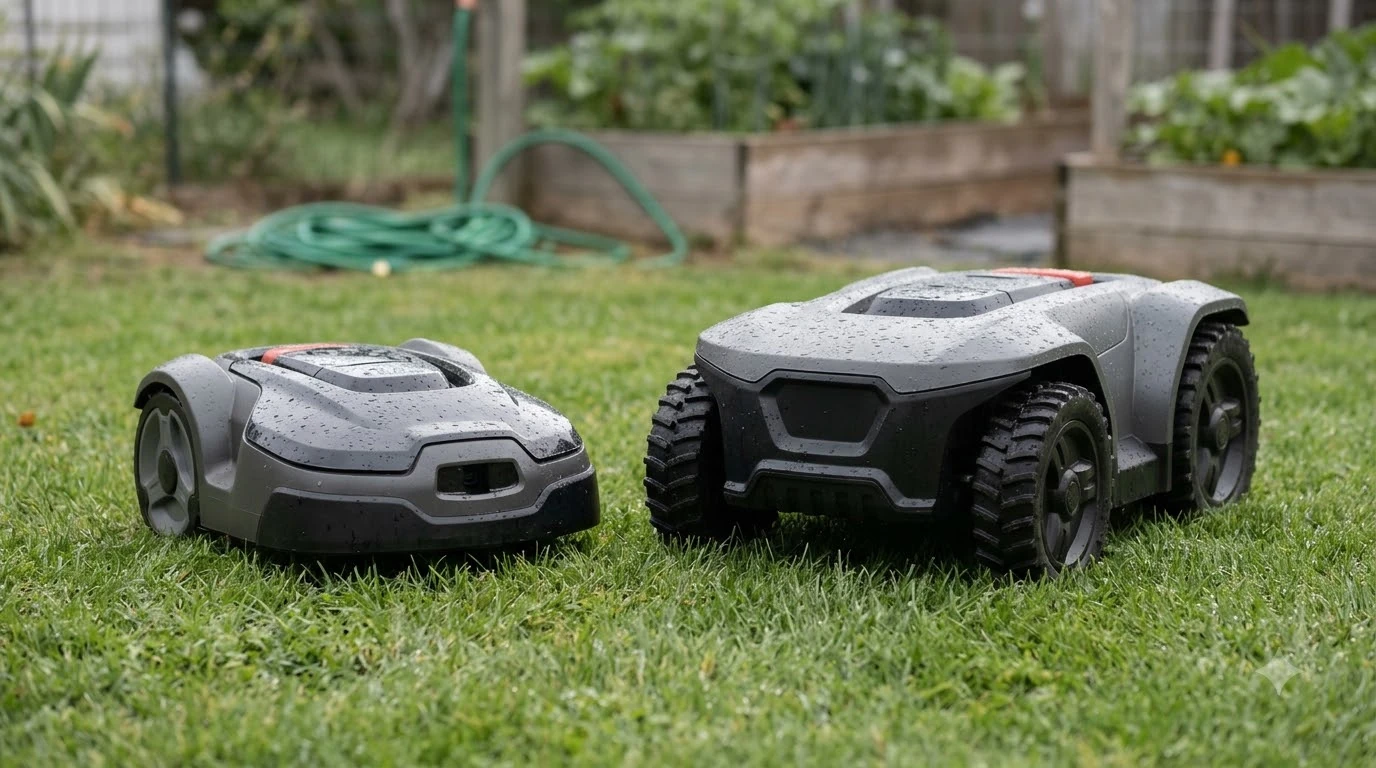

A robot mower for a yard with decorative river rock borders works well when you keep its wheels and blades off the loose stones through strict boundary placement or a flush mowing strip. Because loose river rock shifts under drive wheels and can chip spinning razor blades, the border itself acts as a hazard rather than a drivable surface. Choosing the right boundary technology and setting accurate perimeter offsets lets the machine trim reliably without stranding itself in the rock bed.
The short answer
- Keep wheels out of loose stone: According to Anker’s setup guidance, deep gravel and rounded pebbles let mower wheels dig in and lose traction when turning.
- Respect manufacturer edge offsets: Standard boundary-wire manuals such as the Husqvarna Automower 410iQ/420iQ/440iQ operator’s manual specify placing wires 12 to 14 inches back from edges and obstacles, which leaves an uncut grass strip unless you add a hard mower edge.
- Match navigation to your yard layout: Physical boundary wires hold exact lines under heavy tree cover, while RTK-GPS, LiDAR, and AI-vision models let you adjust virtual borders in an app as rocks shift.
- Install a flush stone buffer: Laying a flat row of pavers or steel edging level with the turf lets one wheel ride safely on solid ground so the cutting deck reaches the grass edge.
- Inspect blades regularly: Displaced pebbles kicked onto the lawn edge will dull or nick small pivoting blades, making routine blade checks essential.
Why decorative river rock borders challenge robot mowers
Decorative river rock creates three distinct mechanical headaches for autonomous mowers: wheel entrapment, blade strikes, and elevation drop-offs.
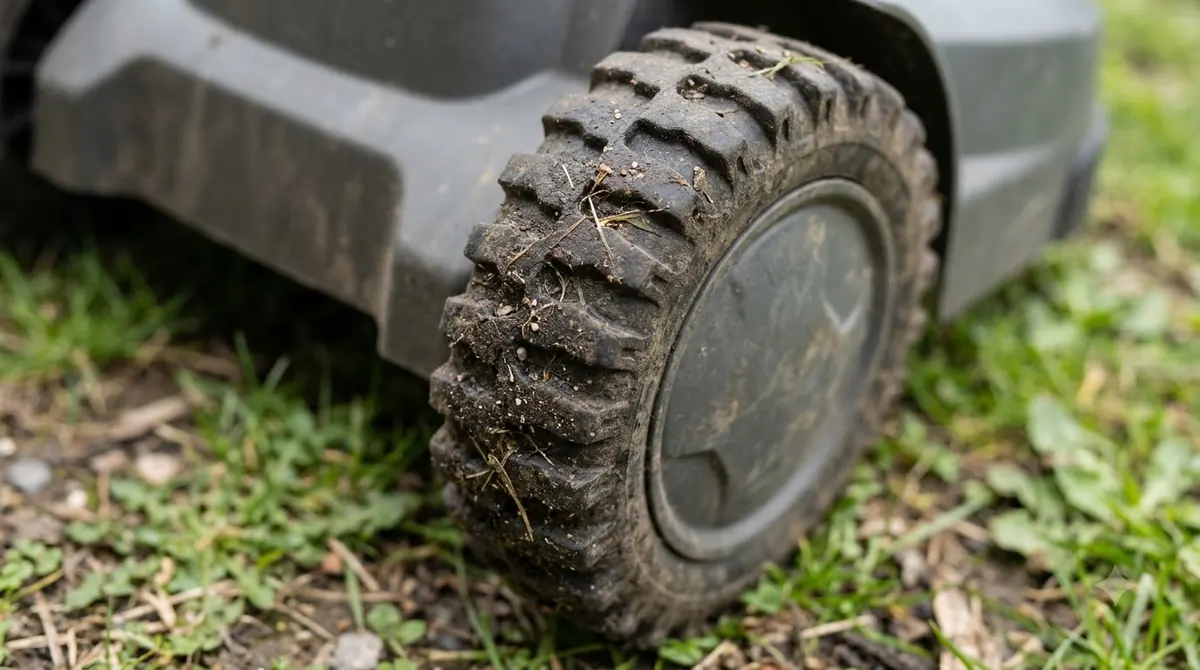
Unlike compact turf or poured concrete, rounded river stones roll and shift under torque. When a two-wheel-drive robot reaches the end of a mowing pass and pivots to turn around, its drive tires push loose stones aside and sink. Once the chassis bottoms out on the rock bed, lift or tilt sensors trigger an error and halt the mowing cycle until you carry the machine back onto grass.
Blade clearance creates a second risk. Most residential robotic mowers use lightweight, free-pivoting razor blades mounted to a spinning disc at cutting heights between roughly 1 and 4 inches. If a stray stone migrates onto the turf edge or a wheel slips over the border, the spinning blades strike the rock, causing audible clangs, chipped steel, or an unbalanced cutting disc that vibrates excessively.
Border construction also dictates how close the mower can safely approach. River rock beds installed with a deep trench and no rigid retaining wall create a sudden drop-off at the grass line. A front caster wheel dropping into that trough will beach the mower immediately, whereas a raised stone curb higher than 2 inches acts as a hard wall that bumper sensors must rebound against.
Comparing navigation systems along rock edges
Buyers choosing a robot mower for a yard with decorative river rock borders can pick between buried boundary wires, satellite RTK-GPS, and camera or LiDAR vision systems, each handling rock perimeters differently.
| Navigation Type | How It Reads River Rock Borders | Edge Accuracy | Main Trade-Off Near Stone |
|---|---|---|---|
| Physical boundary wire | Follows a low-voltage signal buried or staked in the turf at a fixed setback from the rock edge | High and repeatable regardless of shade | Moving or expanding a rock bed requires digging up and splicing wire |
| RTK-GPS (wire-free) | Uses satellite positioning and a base station to enforce a virtual map boundary | Centimeter-level in open sky | Dense trees or tall walls near borders can cause slight GPS drift toward rocks |
| AI vision and LiDAR | Cameras or laser pulses distinguish green turf texture and 3D depth from loose stone | High in good lighting or 3D scan range | Dirty camera lenses or low-contrast dormant grass can blur the edge line |
| Hybrid (RTK + vision or wire) | Combines satellite mapping with optical edge detection or localized wire loops | Very high across mixed shade and open edges | Higher system complexity and setup calibration |
According to Mammotion’s boundary technology overview, modern wire-free mowers pair RTK-GPS with onboard cameras and inertial sensors to maintain virtual borders without trenching, while hybrid setups allow localized boundary wire along tricky beds. If your river rock borders wrap beneath mature shade trees where satellite signals weaken, a physical wire or a LiDAR-equipped model prevents positional drift from nudging the mower onto the stones.
How to set up a yard with river rock borders
Preparing the transition zone between your lawn and river rock eliminates almost all manual rescues and reduces weekly string-trimming.
- Add a flush mowing strip. Install a 4- to 10-inch-wide border of flat pavers, brick, or flagstone set completely flush with the soil surface between the grass and the river rock. This gives the mower’s outer wheel a firm, level track to drive on without sinking.
- Measure the required perimeter setback. Check your owner’s manual for exact border distances. For example, Husqvarna Automower installation guides specify placing boundary wire 14 inches (35 cm) from raised obstacles taller than 2 inches, or 12 inches (30 cm) from edges where the mower cannot safely drive over.
- Map or lay the boundary line conservatively. During initial wire installation or virtual app mapping, keep the boundary line far enough inside the turf so the front wheels never drop into the loose rock bed during a pivot turn.
- Run a supervised edge test. Send the mower on a perimeter follow or edge-cut pass and watch every curve and corner. Adjust virtual map nodes or shift wire pegs outward an inch at a time only where the wheels stay firmly on turf or flush pavers.
- Clear migrated stones before mowing cycles. Walk the border periodically to toss stray river rocks back into the bed and trim any grass blades creeping between stones.

Heads up
Never use a river rock border as a cross-path between two separate lawn zones unless you lay two flush rows of solid pavers or a bonded-stone bridge across it. Loose rounded rocks will trap the mower mid-crossing and prevent it from returning to its charging dock.
Hardware features that protect against stray stones
Beyond boundary accuracy, specific chassis and cutting-deck designs determine how forgiving a robot mower is when it encounters an errant pebble.
- Offset edge-cutting decks: Some models position the blade disc closer to one side of the chassis or extend it outward during perimeter passes, reducing the uncut grass strip along paver-lined rock borders.
- Pivoting razor blades vs. fixed blades: Free-swinging razor blades fold backward upon hitting a hard stone rather than snapping or bending a motor shaft, though they still require prompt replacement once nicked.
- All-wheel drive and high-traction treads: Four-wheel-drive chassis with deep-lug tires recover much more reliably if one wheel briefly slips onto a shallow gravel edge on a sloped yard.
- Floating or suspended cutting decks: A deck that rises and dips independently of the main body prevents the blade guard from snagging on uneven turf transitions near stone edging.
- Adjustable electronic cutting height: Raising the cut height to 3 inches or higher during dry months keeps spinning blades well above small pebbles resting on the soil surface.
Frequently asked questions
Can a robot lawn mower drive over river rock borders?
No, standard robot lawn mowers should not drive over loose river rock borders. Rounded stones shift under the drive wheels, causing the mower to dig in, lose traction, or trigger tilt sensors, while spinning blades risk severe damage from striking loose rocks.
How far from a river rock bed should I place a robot mower boundary wire?
Most manufacturers require placing boundary wire 12 to 14 inches (30 to 35 cm) inside the lawn edge depending on whether the rock border sits flush or rises above 2 inches. Always verify the exact setback measurement in your specific model’s installation manual before staking or burying wire.
How do I stop a robot mower from leaving an uncut grass strip next to river rocks?
Install a flat, flush border of paving stones or brick between the grass and the river rock bed. Because the mower can safely drive one wheel onto the solid pavers, you can set the boundary closer to the rock edge so the cutting deck trims right up to the grass line.
Are wire-free AI vision mowers better than boundary-wire mowers for yards with rock borders?
AI vision and RTK-GPS mowers make it easier to fine-tune virtual boundaries in an app if your rock border shifts, and optical sensors can recognize stone versus grass. However, if your rock borders sit under dense tree canopy that blocks satellite signals, a physical boundary wire provides more consistent edge accuracy.
Sources
- Husqvarna Automower 410iQ/420iQ/440iQ Operator’s Manual (Husqvarna): Used for official boundary wire setback distances from raised obstacles and non-drivable edges.
- Can Robot Lawn Mower Cross Path? A Practical Setup Guide (Anker): Used for guidance on loose gravel and rounded pebble traction issues and flush paver bridge setup.
- Do All Robot Lawn Mowers Need a Boundary Wire? (Mammotion): Used for comparison of boundary wire, RTK-GPS, vision, and hybrid navigation performance near borders and shade.
- Robot Lawn Mower Common Faults & Solutions (LawnMaster / Cleva): Used for sensor error triggers, blade disc balance, and uneven terrain troubleshooting.
 Up next9 min readBy YardChoosing and Setting Up a Robot Mower for a Yard With Flagstone Walkways Set in GrassUpdated Nov 19, 2026
 9 min readBy YardChoosing and Setting Up a Robot Mower for a Yard With an Outdoor AC Condenser UnitUpdated Nov 19, 2026
 9 min readBy YardChoosing and Setting Up a Robot Mower for a Yard With a Wooden Boardwalk PathUpdated Nov 19, 2026
 8 min readBy YardChoosing and Setting Up a Robot Mower for a Yard With a Pool Deck Coping LipUpdated Nov 19, 2026
 9 min readBy YardChoosing and Setting Up a Robot Mower for a Yard With a Split-Rail Wooden FenceUpdated Nov 19, 2026
 9 min readBy YardChoosing and Setting Up a Robot Mower for a Yard With an Above-Ground Pool LadderUpdated Nov 19, 2026