


A robot mower for a yard with a wooden boardwalk path works reliably when the decking sits flush with the soil or connects through mapped transit channels, whereas raised walkways with steep lips or open railings require separate zones. Wooden planks introduce three mechanical variables that differ from standard grass lawns: vertical step height at the board edge, traction loss when morning dew settles on timber, and spacing between boards or railings. Choosing between a boundary-wire model and a satellite-guided multi-zone unit comes down to whether your mower needs to drive over the boardwalk or treat it as a hard border.
The short answer
- Flush-mounted boardwalks: Mowers can roll straight across level timber paths as long as the vertical lip between soil and wood stays under roughly 1 to 1.2 inches (2.5 to 3 cm) and deck fasteners sit below the wood surface.
- Raised boardwalks with edges or railings: Treat the walkway as an obstacle or zone divider, using either buried boundary wire loops or app-mapped transit channels to move the mower around or across a ramped section.
- Wet timber traction: Smooth, damp cedar or pressure-treated planks reduce wheel grip, so scheduling cuts after morning dew dries or picking high-traction tread tires prevents wheel spin.
- Multi-zone wire-free navigation: RTK-GPS and vision-assisted mowers simplify crossing a boardwalk because you can draw a virtual transport channel across a flat bridge without cutting grooves into wood for wires.
- Edge trimming expectations: Even when a mower rides along a flush plank edge, most spinning blade discs sit inset from the outer chassis, leaving a narrow grass strip along raised timber curbs.
How boardwalk construction changes robot mower navigation
The physical profile of a wooden boardwalk—specifically its height relative to the turf, board gap width, and edge framing—determines whether a robot mower crosses over it or bounces off it like a wall.
In residential yards, wooden paths generally fall into two designs: ground-level sleeper paths bedded directly into gravel or soil, and elevated pier-and-beam walkways built to bridge damp ground, roots, or gentle slopes. According to manufacturer installation manuals from Sunseeker Robotics and standard residential mower documentation, most autonomous mowers tolerate a vertical step or pathway height change of up to 3 cm (about 1.2 inches) before bump sensors trigger or the front caster wheels hang up. When a boardwalk sits higher than that threshold, the mower treats the timber edge as a solid barrier.
Board spacing and fastener hardware matter just as much as height. Standard deck gaps around a quarter-inch pose no issue for wide mower drive wheels, though narrow front swivel casters can occasionally catch in wide, uneven plank joints if the boards have warped. Protruding screw heads or proud nail pops pose a direct hazard to spinning razor blades if the cutting deck dips while transitioning from soft turf onto rigid lumber.
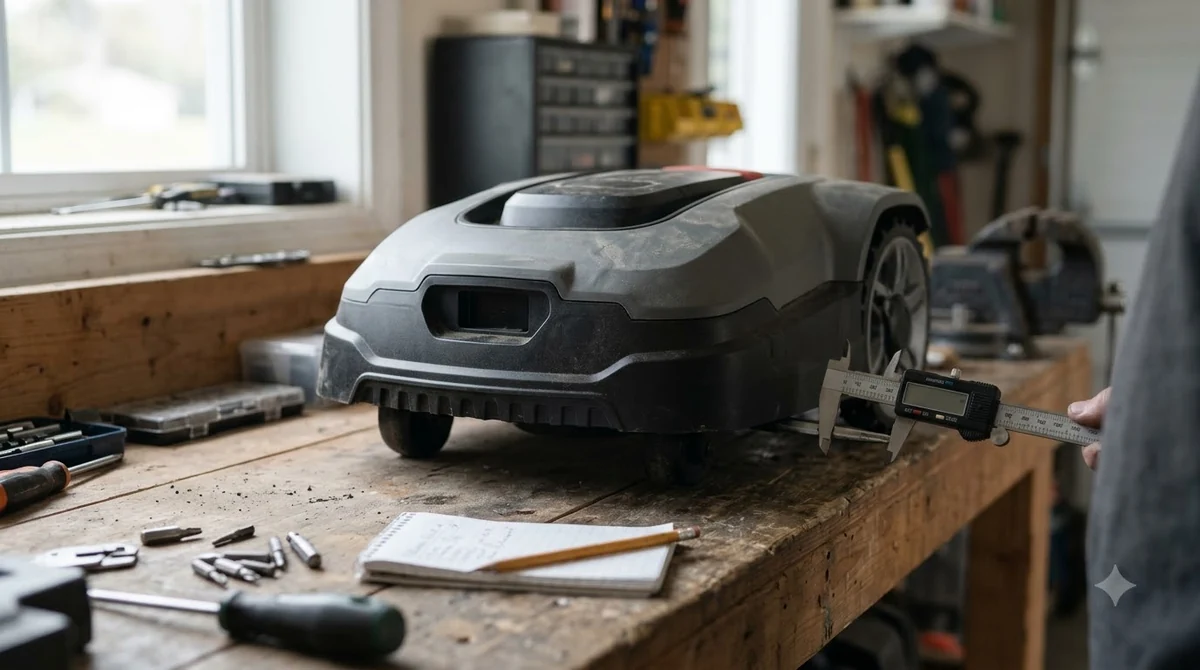
Flush paths versus raised walkways: choosing a setup strategy
Matching your installation layout to the elevation of your wood path prevents stalled mowers, scraped undercarriages, and damaged blades.
| Boardwalk style | Vertical lip height | Recommended mower behavior | Setup requirement |
|---|---|---|---|
| Flush ground-level planks | Under 1.2 inches (3 cm) | Mow directly across the path | Countersink all screws; keep grass level with wood |
| Low-step walkway with ramps | 1.2 to 2 inches | Cross only at designated ramps | Build gentle wood or soil transitions; map a transit lane |
| Elevated boardwalk without rails | Over 2 inches | Treat as a hard boundary | Set boundary wire or virtual border 12 to 14 inches back |
| Elevated boardwalk with railings | Over 2 inches plus posts | Bypass via separate zones | Route wire underneath or map a non-mowing channel around |
For flush ground-level paths, letting the mower drive straight across the boards keeps the layout simple and allows the cutting disc to overlap the wood edge, reducing hand-trimming. In boundary-wire setups, installers typically tuck the cable into the soil seam right beside the timber or route it underneath a plank gap so the mower crosses freely while cutting both lawn sections as one continuous zone.
Raised walkways require strict perimeter separation. Standard mower safety guidelines recommend holding boundary wires roughly 30 to 35 cm (12 to 14 inches) away from raised steps, slabs, or drop-offs higher than 5 cm (2 inches) so the chassis does not overhang an edge or drop a drive wheel off the side. If a raised boardwalk splits your yard into two separate lawns, you will need either a connecting gate path at ground level or a small wooden transition ramp wide enough for the mower to cross safely.
Heads up
Never rely on a robot mower’s ultrasonic or camera obstacle sensors alone to stop it from driving off an elevated boardwalk edge without railings. Drop-off detection varies widely across models, and a wheel slipping off a 4-inch timber ledger will strand the machine.
Boundary-wire routing vs. wire-free RTK mapping
Buyers choosing a robot mower for a yard with a wooden boardwalk path can pick between traditional buried-wire systems and wire-free RTK-GPS or LiDAR models, each handling timber crossings differently.
With a perimeter-wire mower, crossing a narrow gap or wooden bridge between two lawn zones requires careful spacing. According to Husqvarna Automower support documentation, boundary wires running through a narrow passage generally require at least 60 cm (about 2 feet) of separation between left and right boundary cables, with the central guide wire kept at least 30 cm (12 inches) from either boundary wire. On larger all-wheel-drive models, recommended passage widths expand to around 2 meters (6 feet 6 inches). Running guide wires underneath a wooden boardwalk works well because low-voltage boundary signals pass easily through dry or damp lumber, provided you staple the wire neatly to the underside of the joists so it cannot sag or snag.
Wire-free mowers using RTK-GPS paired with onboard vision—such as the Segway Navimow i-Series or Mammotion LUBA lines—eliminate physical cable routing altogether. Instead of cutting grooves or stapling wire under planks, you walk or joystick-drive the mower across a flush boardwalk or ramp once to record a virtual transport channel. During regular operation, the mower turns off its cutting blades while traversing that wooden channel between zones, saving battery and preventing blade contact with uneven wood grain.

Step-by-step setup for a boardwalk crossing
Preparing the transition zones before you map boundaries or stake down wire keeps the mower from bottoming out or losing traction on wood.
- Inspect and countersink deck hardware. Walk the entire boardwalk and drive any raised deck screws or nails flush below the wood surface so spinning blades cannot strike metal.
- Grade the soil-to-wood transition. Pack topsoil and grass seed along the outer edges of flush boardwalks so the turf sits within 1 inch of the top plank face, eliminating sudden wheel drops.
- Measure passage clearance. Confirm your crossing path meets your mower manual’s minimum corridor width—typically at least 24 inches between boundary lines for compact wire mowers or wider for large multi-zone chassis.
- Route wires underneath or map a blade-off channel. Secure boundary and guide wires beneath the boardwalk framing with insulated staples, or use your app’s channel tool to record a straight, non-mowing transit path across the planks.
- Test-run the crossing in dry and damp conditions. Send the mower across the wooden path manually via the app to verify that front caster wheels clear board gaps and drive wheels do not slip on the timber grain.
Managing wet wood traction, moss, and blade wear
Wooden walkways behave differently than concrete sidewalks after rain or overnight dew, creating slip and maintenance factors that affect daily schedules.
Pressure-treated pine, cedar, and composite boards develop a slick surface film when wet, particularly in shaded yards where algae or moss can grow between grain lines. When a robot mower turns sharply on damp wood, smooth plastic front casters may slide sideways while rear drive wheels spin in place, triggering wheel-slip error codes or scuffing softer cedar boards. Programming your mowing schedule to start late in the morning after sun and airflow dry the planks—or enabling rain-sensor delays—cuts down on wet-timber traction loss.
Checking the underside of the mower deck once a month also prevents buildup. Damp sawdust, pollen, and fine wood fibers from weathered boards can mix with wet grass clippings around the blade hub, requiring a quick brush-off during routine blade swaps.
Frequently asked questions
Can a robot mower drive over a wooden boardwalk without damaging the wood?
Yes, most residential robot mowers weigh roughly 18 to 35 pounds and roll on soft rubber or composite tread that will not dent pressure-treated lumber or composite decking. The main risk of surface marks comes from wheel spin on wet, moss-covered cedar or from a low-hanging cutting deck scraping high spots if the boardwalk is warped.
How wide does a wooden boardwalk bridge need to be for a robot mower to cross?
For boundary-wire mowers using a central guide wire, installation guides typically call for at least 24 inches (60 cm) between boundary lines, meaning the physical walkway should be roughly 30 to 36 inches wide so wheels stay safely away from the edges. Wire-free RTK and vision mowers can often navigate slightly narrower bridges if mapped as a straight transit channel, though a 36-inch width gives a safer margin against GPS drift.
Will boundary wire signals work if stapled underneath a wooden boardwalk?
Yes, standard low-voltage electromagnetic boundary and guide signals pass cleanly through wood decking up to standard 1.5-inch (2×6) thickness. Staple the cable tightly against the underside of the planks or joists to keep it away from yard tools and animals, and avoid coiling excess wire underneath the crossing.
What if my wooden boardwalk has steps instead of a flat transition?
A robot mower cannot climb vertical steps taller than roughly 1 to 1.2 inches. If your boardwalk sits on raised posts with steps at each end, either treat the areas on each side as separate manually carried zones or install a sturdy, low-angle wooden ramp with side curbs wide enough for the mower’s wheelbase.
Sources
- How to create a passage in an Automower boundary wire installation (Husqvarna Support): referenced for minimum boundary-to-guide wire spacing (30 cm / 12 in), minimum passage width guidance, and systematic passage mowing behavior.
- Sunseeker Robotic Lawn Mower Instruction Manual (Sunseeker Robotics): referenced for maximum pathway step height clearance (3 cm / ~1.2 in).
- Navimow i Series Product Documentation (Segway Navimow): referenced for RTK and vision-assisted multi-zone channel mapping and ride-on versus standard boundary edge modes.
- How to Create Channel (Mammotion Tech Support): referenced for manual joystick channel mapping across non-mowing pathways connecting separate task zones.
 Up next9 min readBy YardChoosing and Setting Up a Robot Mower for a Yard With a Split-Rail Wooden FenceUpdated Nov 19, 2026
 9 min readBy YardChoosing and Setting Up a Robot Mower for a Yard With an Outdoor AC Condenser UnitUpdated Nov 19, 2026
 8 min readBy YardChoosing and Setting Up a Robot Mower for a Yard With Decorative River Rock BordersUpdated Nov 19, 2026
 9 min readBy YardChoosing and Setting Up a Robot Mower for a Yard With Flagstone Walkways Set in GrassUpdated Nov 19, 2026
 8 min readBy YardChoosing and Setting Up a Robot Mower for a Yard With a Pool Deck Coping LipUpdated Nov 19, 2026
 9 min readBy YardChoosing and Setting Up a Robot Mower for a Yard With an Above-Ground Pool LadderUpdated Nov 19, 2026