
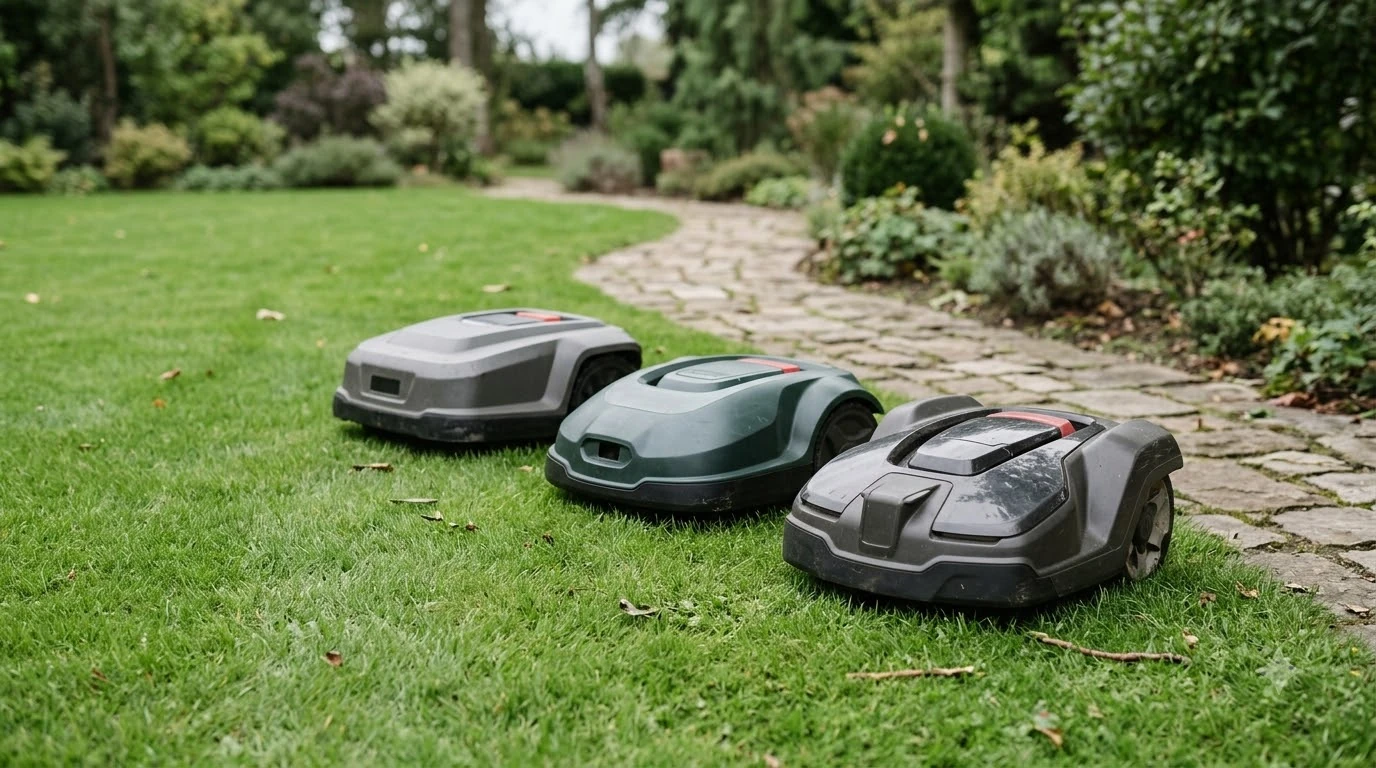

Can a robot mower mow around a pool safely? Yes, if its boundary wire keeps it a set distance back from the water. The wire is the main safeguard, not the mower’s sensors, so the setback, the wire route and a physical buffer do most of the work. Published distances differ between manufacturer and retailer guidance, so this guide lists the sourced numbers, where they disagree, and what to check in your own manual.
The short answer
- Conditions: a wired mower needs a boundary wire routed away from the pool edge, or a no-go zone drawn in the app for wire-free models.
- Setback: a pond guide from Robomow uses about 35 cm (14 inches). A pool guide from Unicorn Floats uses 30 to 50 cm, adjustable by model.
- Sensors: lift and collision sensors do not reliably stop a mower at a water edge on their own.
- Charging station: keep it at least 1 m from the pool, in a rain-protected spot.
- After a fall: switch the power off first. Do not treat the mower as waterproof for submersion.
Can a robot mower mow around a pool safely? Why the wire decides
A wired robot mower finds its work area by reading a signal from a wire buried in the lawn. Robomow describes the wire as a stop signal that helps keep the robot from driving over the cable, mowing unwanted areas, or accidentally landing in a garden pond. The receiver picks up the signal at a laying depth of up to 7 cm, so the wire’s route, not the mower’s own map, sets the real edge of the work area. A garden pond raises the same wire question, covered in how a robot mower handles a pond.
Placement is where the setup can go wrong. The general robot mower description on Wikipedia says the user sets up a border wire around the lawn, and the robot uses that wire to find the edge of the work area. Wire-free models are the exception, as covered in whether robot mowers need a boundary wire. So can a robot mower mow around a pool safely? It mostly comes down to that wire. Our reading is that a pool with a hard coping edge should be treated as an obstacle that needs its own wire clearance, not as the lawn’s natural boundary.
How far the wire should sit from the water
Sources disagree on the exact pool setback, so treat the figures below as starting points and use the manual for your model before you lay wire.
| Source | Type | Distance or rule |
|---|---|---|
| Robomow, pond guidance | Manufacturer blog | About 35 cm from a pond, with additional obstacles to stop the robot from falling in |
| Robomow, beds and paths | Manufacturer blog | About 10 cm from beds or hedges, and about 10 cm from slabs and paths that sit at or below lawn level |
| Unicorn Floats, pool guide | Retailer blog | 30 to 50 cm from the pool edge, adjustable depending on the model |
At these distances, safety depends on the wire following the same rules. The pond figure from Robomow is the closest manufacturer number to a pool, but it is not a pool specification. The Unicorn Floats guide also says to route the wire around the coping, the pump and any technical room, so the setback has to cover those structures too. Because the retailer range is not attributed to a manufacturer, we do not treat it as a rule for any particular model.
Heads up
Narrow gaps are a separate problem. Robomow notes that narrow passages can cause signal interference, and advises a passage wider than 70 cm for remote start points. A strip of lawn between a pool and a fence can fall under both limits, so measure it before you commit to a layout.
Can a robot mower mow around a pool safely on sensors alone?
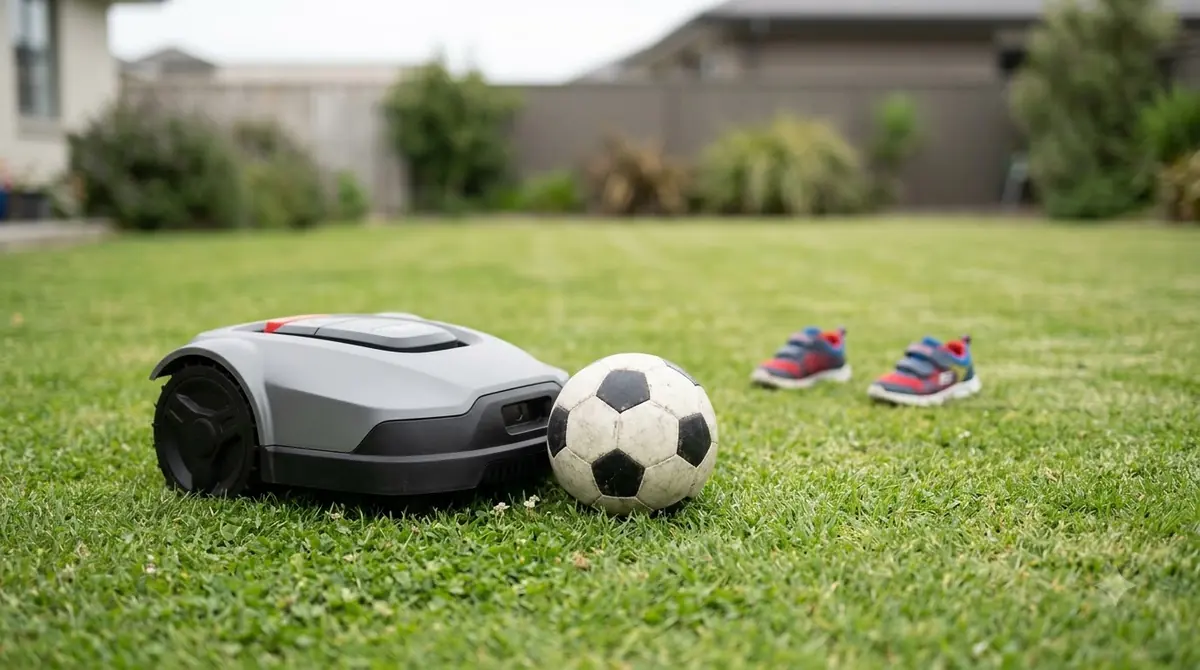
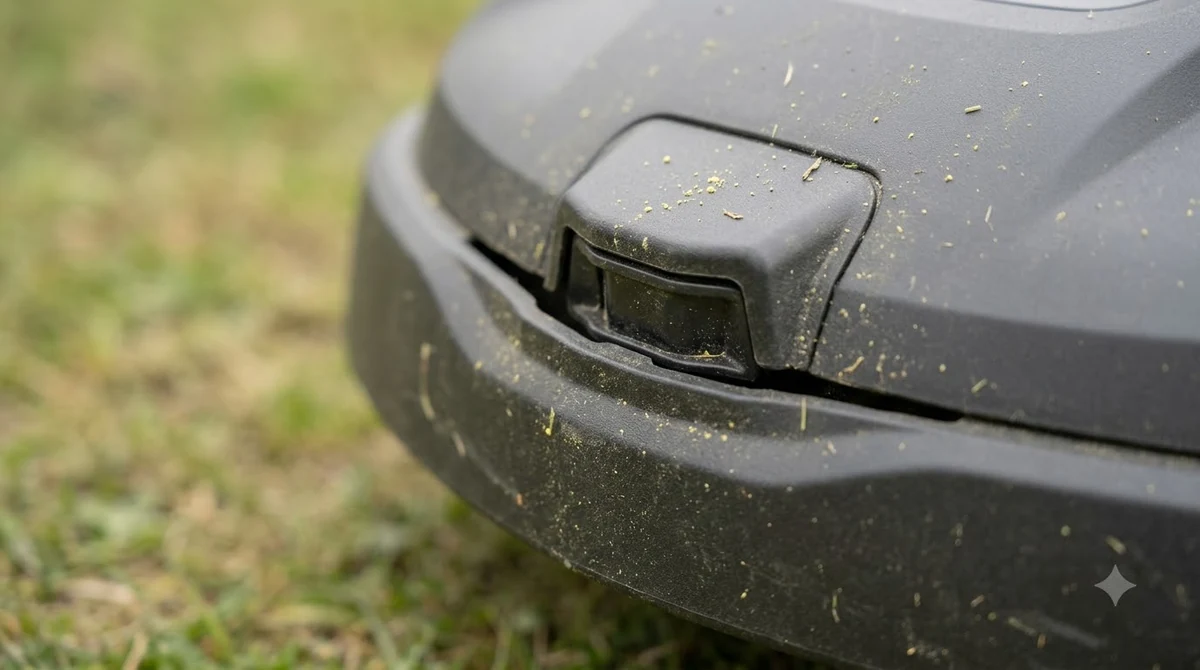
Sensors help, but they are a second layer. Lift and collision sensors stop or turn the mower when it hits something or is picked up. The Unicorn Floats guide says most models have these sensors, and that the blades stop when the mower is lifted or hits an obstacle. Navimow says its i2 and X4 models detect and avoid pets, children and garden decorations, which is obstacle avoidance rather than water detection.
Some vendors claim more. Unicorn Floats reports that the Mammotion Yuka Mini 2 “spots pool edges, stairs and steep drops on its own.” We did not confirm that claim from a manufacturer page, so treat it as a vendor statement. Our reading is that any sensor-based edge detection adds margin on top of the wire, and does not replace it.
Slope matters too, and only within the rating. Navimow lists a maximum slope of 45% (24 degrees) for its i2 AWD, 55% (29 degrees) for its i2 LiDAR Pro and 84% (40 degrees) for its X4. If the ground drops toward the pool, check the rating against the real slope before you set the zone.
Setup steps for mowing safely around a pool
A pool setup is only as good as its zone, so set the no-go zone first. Then keep mowing away from swim times and add a buffer strip where grass would fall into the water. The steps below combine the Unicorn Floats guidance with the manufacturer distances above.
- Measure the setback. Use your model’s ruler or the figure in its manual. The 30 to 50 cm range is a retailer starting point, not a rule.
- Route the wire around every structure. Include the coping, the pump and any technical room, as the Unicorn guide advises.
- Place the charging station. Put it at least 1 m from the pool, in a spot that stays dry in rain.
- Draw the zone in the app. Wire-free models set the no-go zone in the app (see how to set up no-go zones on a robot mower), and our reading is that the same setback should apply.
- Keep a buffer strip. Unicorn Floats says a stone or deck strip between lawn and pool solves most grass-in-the-water problems.
- Watch the first runs. Our recommendation is to supervise the first week and confirm the mower turns at the wire every time.
Schedule mowing outside swim times as well. Unicorn Floats notes that clippings can end up in the pool and the skimmer, which is a cleaning problem even when the mower never enters the water. For household rules around children and pets, see robot mower safety around kids and pets.
Water ratings and what to do after a fall
An IP rating describes how well an enclosure resists water, and it is a test standard, not a promise about a pool. IEC 60529 defines the IP code, and the levels that matter here are the ones below. For how ratings are used on mowers, see robot mower IP ratings explained.
| Rating | What the test covers |
|---|---|
| IPX4 | Splashing water from any direction has no harmful effect |
| IPX5 | Water from a 6.3 mm nozzle, from any direction, has no harmful effect |
| IPX6 | Powerful water jets from a 12.5 mm nozzle have no harmful effect |
| IPX7 | Immersion up to 1 m for 30 minutes, with no harmful water ingress |
| IPX8 | Continuous immersion under conditions the manufacturer specifies |
Can a robot mower mow around a pool safely if it gets wet? Not on IP rating alone. Unicorn Floats says robot mowers must not be submerged. If the mower falls into the pool, which the guide describes as a wire failure, it advises switching off the power immediately before any electrical checks. Our reading is that a high rating in the table does not make a pool a safe place for a mower, so the wire and the setback remain the real protection.
When a pool is a poor fit for a robot mower
Can a robot mower mow around a pool safely in a narrow strip? Usually not. A pool is a poor fit when the lawn strip beside it is narrower than the wire clearance, when the passage to the lawn is too narrow for a clean signal, or when the ground falls toward the water beyond the mower’s slope rating. In those cases, a manual push mower or a reel mower on that strip is the simpler choice. Our reading is that the decision depends on the layout, not on the brand.
Frequently asked questions
Can a robot mower mow around a pool safely without falling in?
It should not if the boundary wire is set back from the edge and the wire works. Robomow describes the wire as a stop signal that helps prevent the robot from landing in a garden pond. Check the wire after storms or digging, because a broken wire removes that protection.
How far from a pool should the boundary wire be?
The published figures differ. Robomow gives about 35 cm from a pond, and Unicorn Floats gives 30 to 50 cm from a pool edge. Use the manual for your model, and make the setback cover the coping, pump and other structures.
Do robot mowers stop at pool edges on their own?
Most sources describe lift and collision sensors, not water detection. Unicorn Floats reports that one model, the Mammotion Yuka Mini 2, claims to spot pool edges and steep drops. We did not confirm that claim from a manufacturer page, so do not rely on it in place of a wire.
Should I mow around a pool during swim times?
It is better to schedule mowing outside swim times. Unicorn Floats notes that clippings can end up in the pool and the skimmer. A stone or deck strip between the lawn and the pool also keeps most grass out of the water.
Can a robot mower mow around a pool safely in your yard? Start with the setback in your manual, route the wire around every pool structure, and supervise the first week of runs. If the strip beside the pool is narrow or steep, a manual or reel mower may be the simpler choice.
Sources
- Laying the lawn boundary wire (Robomow): stop-signal role, 7 cm laying depth, 35 cm pond and 10 cm bed distances, 70 cm passage width.
- Are smart lawn mowers safe for pets and children? (Navimow): obstacle avoidance and maximum slope ratings for listed models.
- Top 5 robot lawn mowers for 2026 (Unicorn Floats): pool setback, charging station distance, swim-time scheduling, sensor and vendor claims. Retailer source.
- IP Code (IEC 60529): definitions of IPX4 to IPX8.
- Robotic lawn mower (Wikipedia): general description of the boundary wire and obstacle sensors.
 Up next9 min readBy YardHow to Lay Boundary Wire Around Trees and ObstaclesUpdated Nov 11, 2026
 8 min readBy YardRobot Mower Around Flower Beds: How to Keep It OutUpdated Nov 11, 2026
 8 min readBy YardCan a Robot Mower Mow a Drainage Ditch?Updated Nov 11, 2026
 7 min readBy YardCan a Robot Mower Mow Multiple Separate Lawns?Updated Nov 11, 2026
 9 min readBy YardHow Long Does a Robot Mower Take to Mow an Acre?Updated Nov 11, 2026
 9 min readBy YardRobot Mower and Dog Poop: Should You Let It Mow Over Waste?Updated Nov 11, 2026