
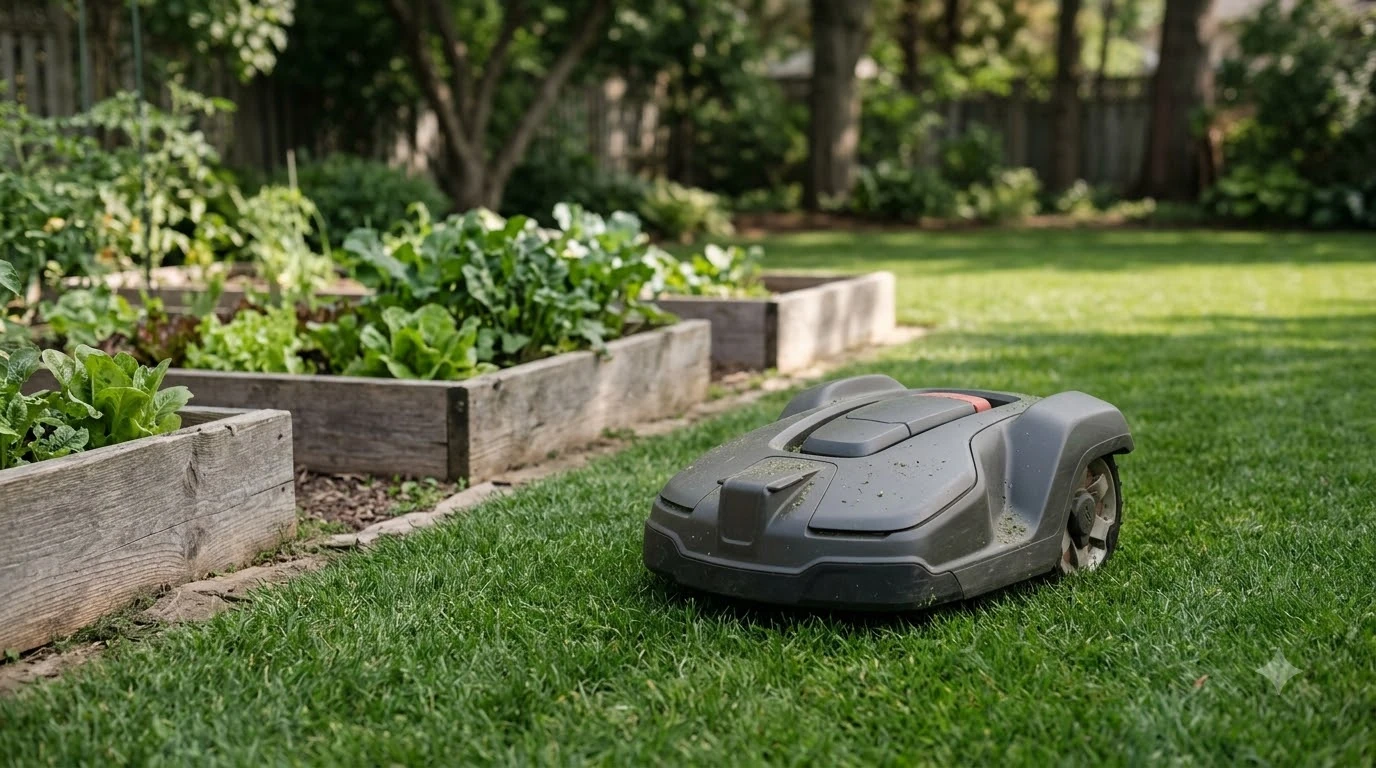

There is no single best robot lawn mower for new construction homes, because the yard decides the answer. A new yard usually has freshly graded soil, newly laid sod or seed that has not rooted yet, and a surface that is still settling. In that state, the first cut and the layout of the boundary matter more than the model. Get the lawn to a rooted, level state first, then match the mower to the slope, the lot size, and the way you plan to set up the wire.
The short answer
- Wait for the lawn to root. Extension guides tie the first cut to grass height and root hold, not to a calendar date.
- Finish grading and topsoil first. Penn State Extension calls for several inches of topsoil and a gentle fall away from the foundation.
- Check slope limits before you lay the wire. Husqvarna rates standard models at 25 to 50 percent slope, and boundary limits are lower than work-area limits.
- Pin the wire before you bury it. Anker suggests a 2 to 3 week test with the wire on the surface, then burial at 3 to 5 cm.
What the best robot lawn mower for new construction homes needs first
A robot mower cannot fix a lawn that is not ready to be cut. Extension guides give the same first rule for new lawns: wait until the grass reaches the starting height. Illinois Extension says to mow a new cool-season lawn once the grass reaches 3 to 4 inches, with the first cut set to 2.5 to 3 inches. Rutgers gives the same starting height and a cutting range of 2.5 to 3.5 inches, and says never go below 2 inches.
North Carolina State Extension gives a useful rule for the first mow: start when the grass is about 50 percent taller than the height you want to keep. The one-third rule applies to every mow after that. Illinois, NC State, and UC IPM say to remove no more than one third of the leaf surface at a time. Rutgers goes a little looser, saying never more than half and one third if possible. A sharp blade matters on new sod, because a dull blade tears and pulls the turf loose, as the University of Arkansas Division of Agriculture notes.
Grading and topsoil come before the robot mower
Grading is the first job on a new build, and it sets the path your mower will follow. Penn State Extension says site preparation begins after construction activity has stopped, and that the subgrade should be lowered to make room for topsoil. The same guide calls for a subgrade that is free of depressions where water can collect, a finished topsoil depth of at least 4 to 6 inches, and a surface that slopes gently away from the foundation at 1 to 4 percent. It also says to remove large rocks, stumps, lumber, and big roots before tilling.
Our reading is that a robot mower should not go on the lawn until these steps are finished. Ruts, soft spots, and low pockets can change where the mower turns and how the wire lies, so it is cheaper to fix the grade first.
First cut height for new sod and seed
The first cut is the one most often set too low. The table below puts the extension figures side by side. Use the lowest number only after the lawn has settled, and keep the mower’s own minimum height in mind.
| Lawn stage | Height to start or cut | Source |
|---|---|---|
| Cool-season sod, first mow | Begin at 3 to 4 inches | Illinois Extension; Rutgers |
| Cool-season sod, first cut | 2.5 to 3 inches (Illinois); 2.5 to 3.5 inches, never below 2 inches (Rutgers) | Illinois Extension; Rutgers |
| Seeded lawn, first mow | Start near 3 inches; first cut 2 to 2.5 inches | Iowa State Extension |
| Warm-season lawn, new | Cut on the higher end of the species range | UC IPM |
How long sod and seed take to root
Rooting time sets the earliest safe date for the first mow, so it matters more than the calendar. Illinois Extension says sod should begin rooting within 14 days, and that a tug test on the rolls shows when the sod has taken hold. The University of Arkansas gives a similar window of 10 to 14 days for most grasses if the lawn is watered properly, with daily irrigation until the lawn is well rooted.
Penn State Extension says the sod watering period may take up to 4 weeks, depending on site and weather. Warm-season sod is slower again. NC State Extension says warm-season roots form only when soil temperature stays above 55 F for several weeks. Cool-season sod can be laid any time the ground is not frozen. For a new build, that means the calendar date matters less than the soil temperature and the weather over the next month.
Boundary wire on new ground
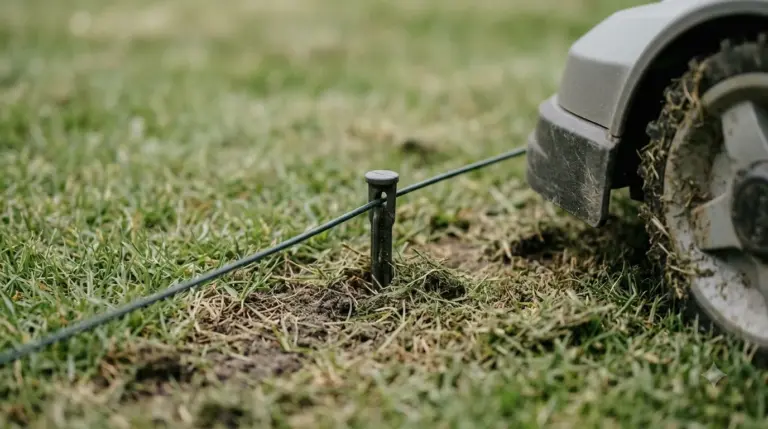
New ground is the best time to test a wire layout, because nothing is buried yet. Anker’s installation guidance says to lay the wire on the surface and run the mower for 2 to 3 weeks before burying it, and to treat a 3-week window as the time to bury. It also gives spacing from obstacles: keep the wire about 30 to 35 cm from walls, fences, and raised beds, and about 10 to 15 cm from flower beds and hedges. Anker also says to cut the grass below 6 cm before installing.
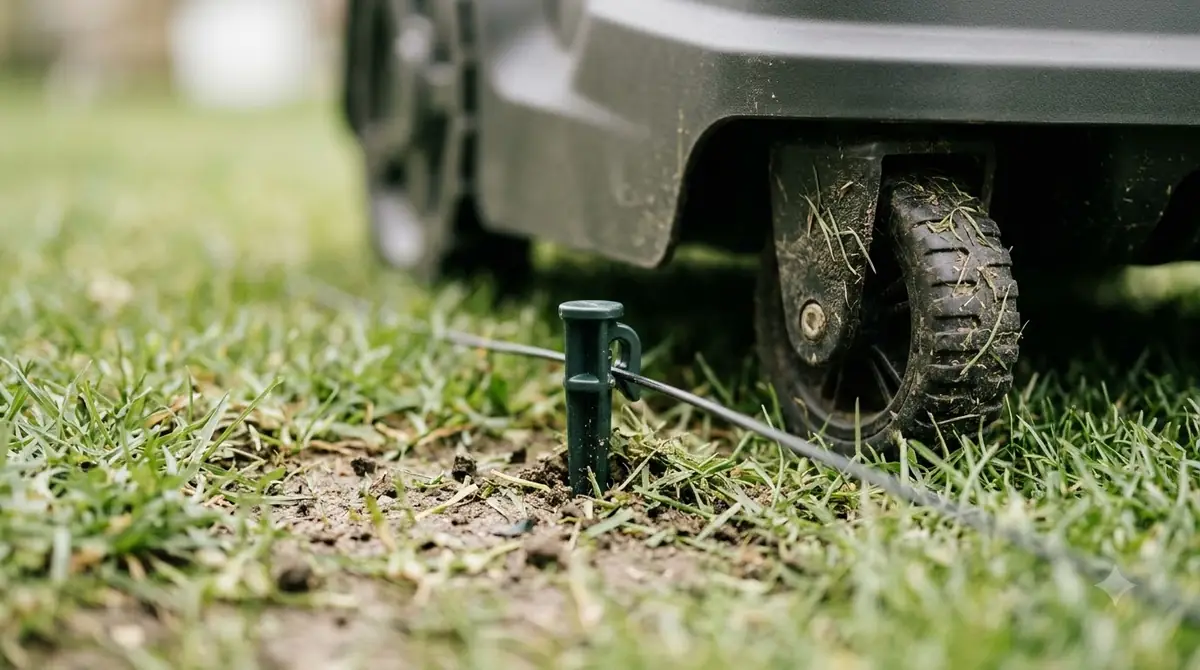
Robomow’s guidance gives the burial depth as 3 to 7 cm, with 4 to 5 cm as the usual target. Too shallow, and the wire can surface during scarifying. Its receiver picks up the wire signal only to about 7 cm of depth. Robomow also says burial is optional, and that a wire laid on the surface can be moved if the layout changes. On a new lot, where drives, fences, and beds may still move, that flexibility is worth keeping.
Slope limits to check before you buy
Grading often leaves a new yard with more slope than the lot plan suggests. Husqvarna’s slope guidance gives the formula used by most manufacturers: slope percent equals vertical rise divided by horizontal run, times 100. A 15 cm rise over a 100 cm run is 15 percent. Husqvarna rates standard models at 25 to 50 percent, and the AWD model at up to 70 percent, but the limit applies differently to the work area and to the area near the boundary wire.
| Husqvarna model group (as listed) | Work-area slope limit | Boundary slope limit |
|---|---|---|
| 105 | 25 percent | 15 percent |
| 305, 310, 315 | 40 percent | 15 percent |
| 320 NERA, 430X NERA, 450X NERA | 50 percent | 25 percent |
| 435X AWD | 70 percent | 50 percent |
Our reading is that the boundary number is the one to plan around. Husqvarna says areas that are too steep must be excluded, and it describes isolating them with boundary wire islands or stay-out zones. Check the slope of the lot after grading, not the slope on the plan, and do not assume a higher rating on a brochure fits your site.
A practical order for a new-construction yard
Put the work in an order that lets each step settle before the next one starts. For a new build, the best robot lawn mower for new construction homes is the one set up after the lawn is ready. This is our reading of the extension guidance above, not a manufacturer schedule.
- Finish grading and topsoil. Remove debris and fill depressions before planting or laying sod.
- Establish the lawn. Wait until the sod has rooted or the seed has reached the first-mow height, then make the first cut at 2.5 to 3 inches.
- Measure the slope. Check the work area and the boundary zones against the model limits.
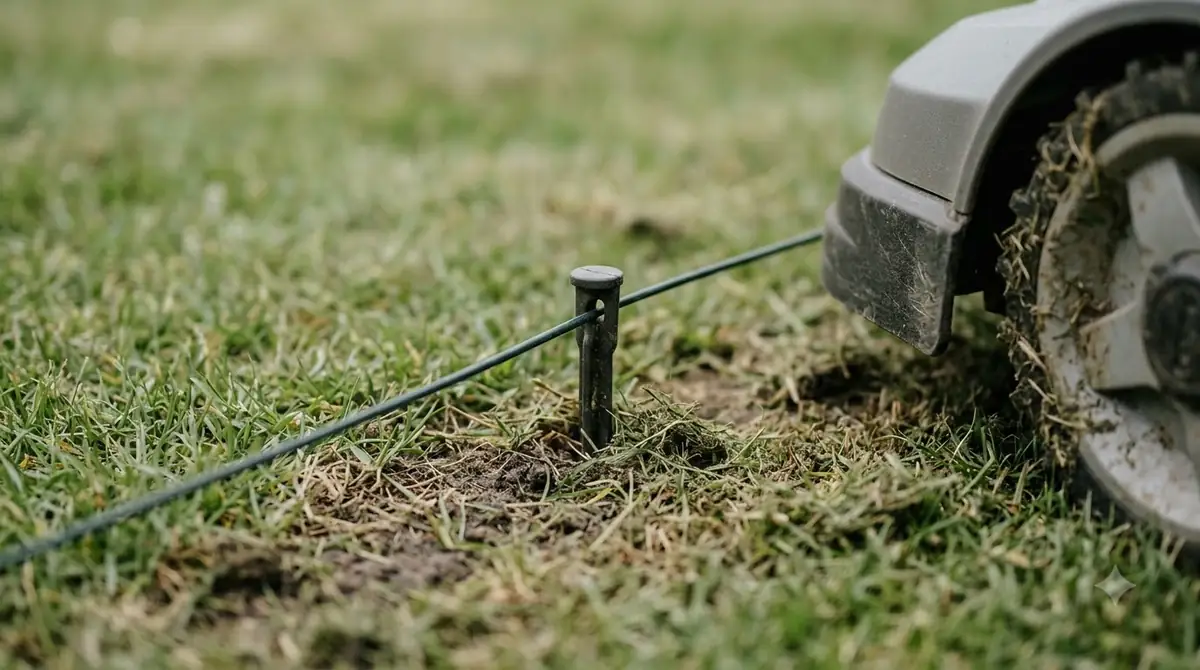
- Pin the wire. Lay the boundary on the surface, run a test for 2 to 3 weeks, and move it if needed.
- Bury the wire last. Bury at about 4 to 5 cm once the layout is final.
Frequently asked questions
Can a robot mower run on new sod right away?
The extension guides read for this article say no. They say to wait until the grass reaches 3 to 4 inches and the roots have taken hold. The pages read do not give a day count for robot mowers on new sod, so the wait should follow the rooting test, not a fixed date.
How do I know sod has rooted?
Illinois Extension recommends a tug test on the rolls. If the sod resists when lifted gently, the roots have begun to hold. Rooting usually takes about 14 days when the lawn is watered properly.
Should I bury the boundary wire on a new lawn?
Our reading is to pin the wire on the surface first. Anker suggests a 2 to 3 week test before burial, and Robomow says burial is optional. Burial at 3 to 5 cm, with 7 cm as the maximum in Anker’s guidance, protects the wire from the scarifier but makes it harder to locate and repair later.
How steep can a new yard be for a robot mower?
Husqvarna rates standard models at 25 to 50 percent, depending on the model, and its AWD model at up to 70 percent. The boundary limit is lower than the work-area limit, so check both. Penn State Extension suggests a gentle fall of 1 to 4 percent away from the foundation when grading the lot.
Sources
- Planting a New Lawn (University of Illinois Extension): first mow height, first cut height, sod rooting window and tug test.
- Rutgers FS104 (Rutgers NJAES): starting height, cutting range, watering after sodding, one-third rule.
- Extension Gardener Handbook, Lawns (NC State Extension): first-mow starting rule, warm-season rooting temperature, cool-season sod timing.
- Lawn Establishment (Penn State Extension): site preparation, subgrade, topsoil depth, debris removal, slope away from foundations.
- Establishing a Lawn from Sod (University of Arkansas Division of Agriculture): rooting window, watering, sharp mower.
- Mowing Warm-Season Turf (UC IPM): mowing height range for warm-season lawns.
- When should I start mowing a newly seeded lawn? (Iowa State Extension): seeded lawn first mow and first cut height.
- How to optimise an Automower installation for steep slopes (Husqvarna): slope limits, slope formula, boundary and work-area figures.
- Robot lawn mower boundary wire installation (Anker, manufacturer guide): surface test, burial depth, obstacle distances.
- How deep must the boundary wire be laid (Robomow, manufacturer blog): burial depth range and optimum.
 Up next8 min readBest Robot MowersBest Robot Lawn Mower for New Jersey Lawns: What to Check FirstUpdated Nov 14, 2026
 8 min readBest Robot MowersBest Robot Lawn Mower for Suburban Homes: What to Check FirstUpdated Nov 11, 2026
 8 min readBest Robot MowersBest Robot Lawn Mower Easiest to Set Up: What Affects Setup TimeUpdated Nov 10, 2026
 8 min readBest Robot MowersWire-Free vs Boundary Wire Robot Mowers: Which Setup Fits Your YardUpdated Nov 11, 2026
 8 min readBest Robot MowersBest Robot Lawn Mower for New England Lawns: 3 ChecksUpdated Nov 14, 2026
 8 min readBest Robot MowersHow to Calibrate a LiDAR Robot Mower: What Setup InvolvesUpdated Nov 16, 2026