
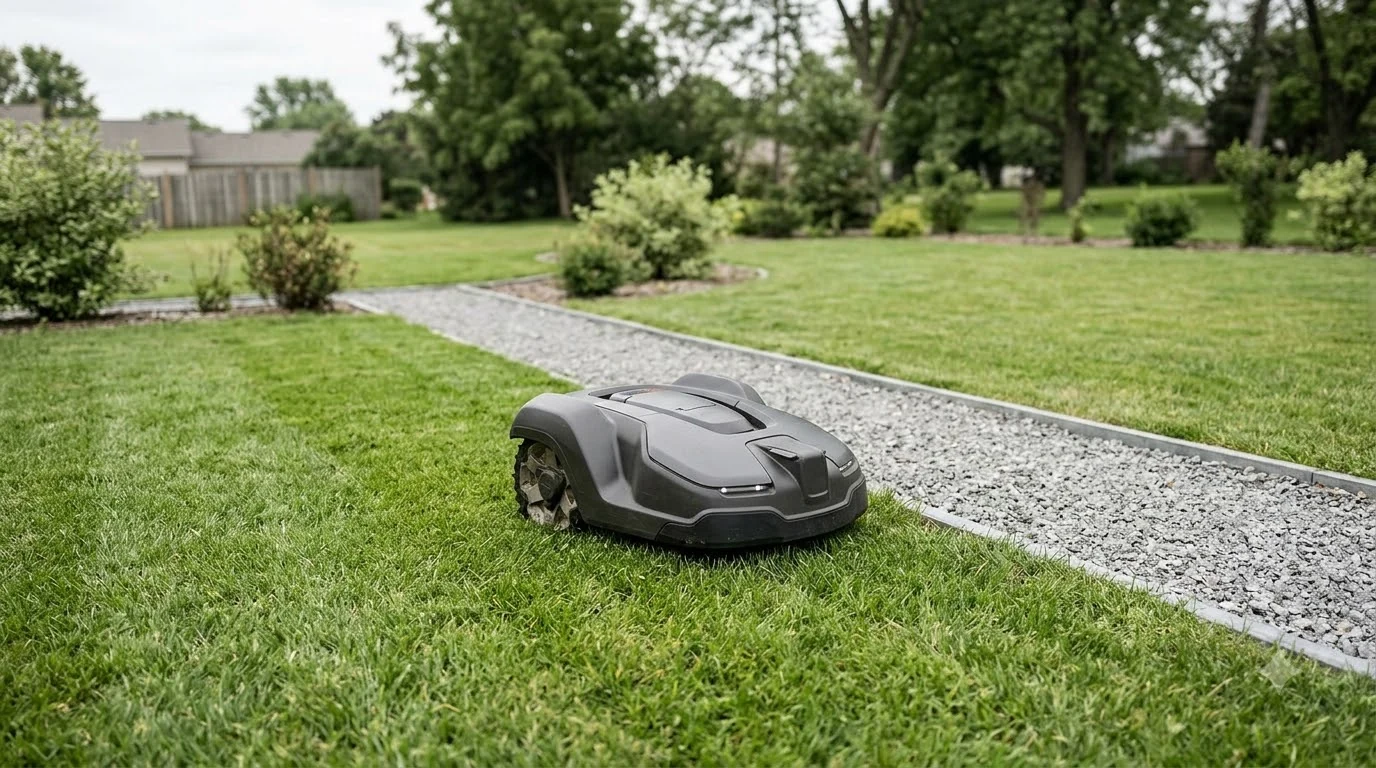

Can a robot mower work in a yard split by a driveway? Yes, provided the mower can reach every section. In practice there are three ways to do it: a passage that joins both sections on one boundary wire, a secondary area that the owner moves the mower into by hand, or a second charging station. Which one fits depends on the width of the driveway, the wire layout and the model you own.
The short answer
- Passage: if the driveway can be crossed on a flat, firm path, the mower can run both sections on one wire. Robomow describes passages of about one meter.
- Secondary area: with no passage, Husqvarna’s secondary area needs one charging station and one boundary wire, but you carry the mower to the far side yourself.
- Second charger: a second station or a signal transmitter gives the far section its own dock, though the transmitter is not offered on every model.
- Return trip: a robot mower working in a yard split by a driveway must find its charger from every connected section, so test each crossing before you leave it to work alone.
Can a robot mower work in a yard split by a driveway? The layout question
A driveway is a gap in the lawn, and a robot mower working in a yard split by a driveway only knows about it through the boundary wire. If the wire runs in one loop around both sections, the mower can travel between them through a passage. If it cannot, the two sections need separate handling, and the mower’s behavior in each section changes.
Our reading is that the charging station should be placed first. Every section has to be reachable from the station, or from a second station, so the dock position limits every other choice. Sketch the lot, mark the driveway width, and decide where the station will sit before buying cable or stakes.
Option 1: a passage that links both sections
For a robot mower working in a yard split by a driveway, a passage keeps both sections on one boundary wire, and the mower returns to a single charger from either side. Husqvarna’s guidance for a passage with a guide wire sets a minimum of 60 cm (24 in) between boundary wires. Without a guide wire, the minimum rises to 2 m (6 ft 6 in). The guide wire itself must sit at least 30 cm (12 in) from the boundary wire.
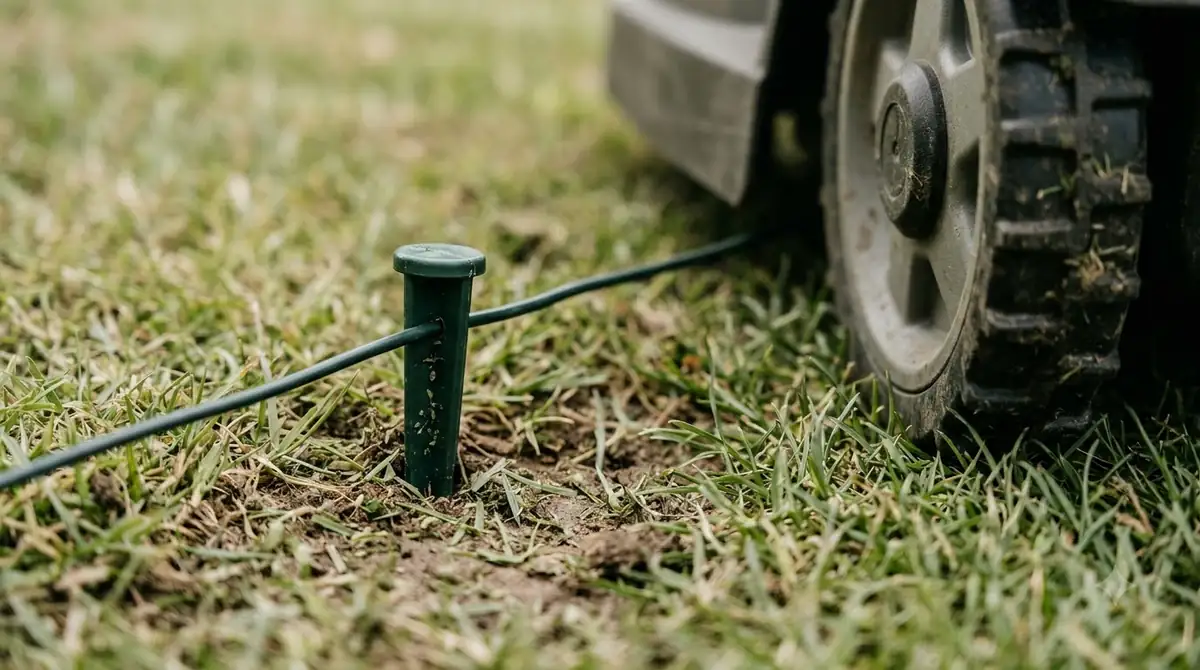
Robomow describes a passage as roughly one meter wide, and it advises placing the wire that marks the crossing in the joints of the paving or under cobblestones. That detail matters on a driveway, because the wire is what keeps the mower off the edge of the pavement. Husqvarna also notes that a mower that gets stuck in a passage can have its corridor-width setting adjusted, so a narrow crossing is not always a dead end.
A passage works best when the driveway is flat, the crossing is short and both ends have a clear view. A long, narrow opening with a curb or a step is harder to set up, even if the wire spacing looks correct on paper.
Option 2: a secondary area with one charging station
If a passage cannot be built, Husqvarna’s secondary area lets one installation cover a yard split by a driveway. The setup does not need a passage. It needs one charging station and one boundary wire laid in a loop around the entire work area. Husqvarna recommends a maximum wire length of 800 m (2,600 ft). The Aspire R4 has a lower limit of 300 m (980 ft).
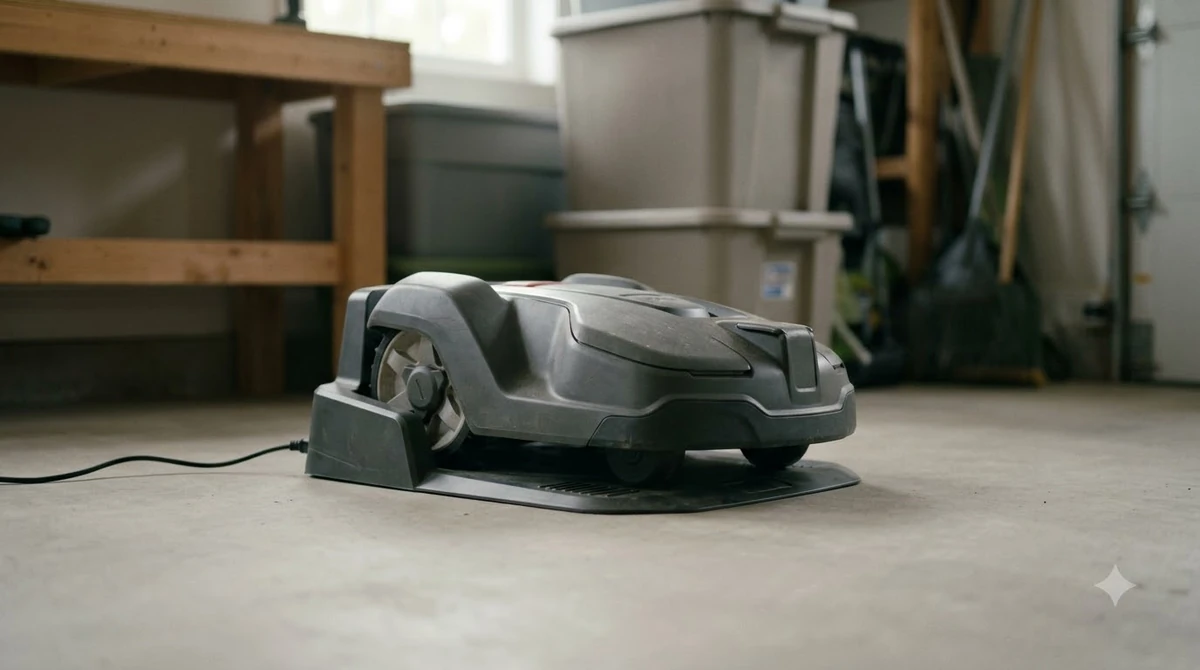
The trade-off is that the mower does not look for its charger in secondary mode. You carry or drive it to the far section, select Secondary area on the display or in the Automower Connect app, and the mower works for a set time or until the battery runs out. When it finishes, you place it on the charger by hand. Set the mower back to Main area mode before docking it, or it will not resume its normal schedule.
Our reading is that this setup suits a far section that is small or needs only occasional mowing. It is not hands-off. If you want both sides mowed automatically every week, a passage or a second charger is the better fit.
Option 3: a second charging station or signal transmitter
Robomow lists three ways to reach a separate zone that has no physical connection: a separate route, a second charging station, or a signal transmitter. The transmitter is not available on every model, so the choice depends on the mower you own. A second station can need the mower to relearn the signal each time it moves between docks.
Robomow also notes that you can place the mower in another zone by hand. The mower may not reliably detect that it has changed zones, and it will mow only the area it was programmed for. That makes a second charger a more automatic option than Option 2, but it still needs setup care.
Husqvarna’s multiple-location setup is a different approach, aimed at separate properties rather than one yard. Models such as the 405X, 415X and 435X AWD allow up to 10 installations, managed in the Automower Connect app. Other models allow up to 3, managed on the mower display. The Aspire R4 does not support profiles at all.
Wire spacing and the return trip
The crossing needs enough clearance for the mower to pass without catching the wire, but the more important rule is the return trip. Anker advises that the mower must be able to find its charging station from every connected zone, not only reach the far lawn. It also recommends a supervised run in each direction before you let the mower work unattended.
Husqvarna’s wire-free transport path follows a different logic. Its start point must sit at least 1 m (3.3 ft) inside the work area, and the path needs a point inside each work area it enters. The mower does not mow while it follows a transport path, and it returns to its dock after each area. A transport path is useful when the driveway is wide or the lawns are not connected by a passage, but it adds setup steps.
Surfaces and transitions the crossing needs
The surface under the crossing decides how easy the trip is. Anker ranks concrete, asphalt and flat paving as the easiest surfaces for a robot mower to cross, and it advises removing level changes and loose material from the route.
- Flat paving: concrete, asphalt and smooth pavers give the most predictable crossing.
- Level transition: the grass-to-paving edge should have no lip, curb or step that can catch a wheel.
- Loose material: gravel, loose stone and mulch are harder to cross. Our reading is that they should be avoided on the route.
- Clear sight line: a short, visible crossing helps the mower stay on course.
Can a robot mower work in a yard split by a driveway? What to check before you buy
Choose the setup by two questions: how far apart the sections are, and how much hands-on moving you are willing to do. The table below summarizes the options covered above.
| Setup | Fits when | What to check |
|---|---|---|
| Passage on one wire | The driveway is narrow, flat and crossable | Passage width (about 1 m per Robomow); 60 cm with guide wire or 2 m without (Husqvarna) |
| Secondary area | The far section is small or mowed occasionally | Wire up to 800 m (300 m on Aspire R4); you move the mower by hand; Main area mode before return |
| Second charging station | Both sections should mow automatically | Signal relearning; whether your model supports a transmitter |
| Separate installations | Sections belong to separate properties | Installation limit: up to 10 on listed models, up to 3 on others (Husqvarna) |
Before you buy a robot mower for a yard split by a driveway, check the manual for your exact model. Passage widths, transmitter support and installation limits differ by line, and manufacturer pages are the best source for those numbers.
Frequently asked questions
Can a robot mower cross a driveway to reach the other half of the yard?
Often yes, if a flat passage links both sections on one boundary wire. Robomow describes passages of about one meter, and the crossing should be flat with no curb or loose material. Check your model’s manual for the exact width it needs.
Do I need two charging stations if a robot mower works in a yard split by a driveway?
Not always. Husqvarna’s secondary area uses one charging station and one boundary wire, but you move the mower to the far section by hand. A second station gives automatic docking on each side, although Robomow notes the signal may need relearning.
How far apart should the boundary wires be for a gap?
Husqvarna gives a minimum of 60 cm (24 in) between boundary wires when a guide wire is used, and 2 m (6 ft 6 in) without one. The guide wire itself should sit at least 30 cm (12 in) from the boundary wire.
Will the mower find its charger if it is on the far side of the driveway?
It should, and Anker advises that the mower must be able to find its charging station from every connected zone. Run a supervised test in each direction before you leave the mower to work on its own.
Sources
- Husqvarna support: how to create a secondary area in an Automower installation (manufacturer): one charging station, wire length, manual moves and Main area mode.
- Husqvarna support: how to create a passage in an Automower boundary wire installation (manufacturer): wire spacing with and without a guide wire.
- Robomow: Can the robotic lawnmower mow multiple areas or zones? (manufacturer): passage width, separate-zone options and manual placement.
- Robomow: Can a robotic lawnmower cross paths? (manufacturer): wire placement in paving joints or under cobblestones.
- Anker: Can Robot Lawn Mower Cross Path? A Practical Setup Guide (manufacturer): surface ranking, level transitions, return-to-charger rule and supervised testing.
- Husqvarna support: using an Automower at multiple locations (manufacturer): installation limits by model and profile support.
 Up next7 min readBy YardBest Robot Mower for a Yard Split by a Creek: Planning GuideUpdated Nov 14, 2026
 9 min readBy YardChoosing and Setting Up a Robot Mower for a Yard With a Split-Rail Wooden FenceUpdated Nov 19, 2026
 8 min readBy YardCan a Robot Mower Cross a Driveway?Updated Nov 11, 2026
 7 min readBy YardRobot Mower for a Lawn With a Gravel Driveway: Keep It Off the DriveUpdated Nov 14, 2026
 7 min readBy YardCan a Robot Mower Work in a Yard With Multiple Small Patches?Updated Nov 10, 2026
 8 min readBy YardCan a Robot Mower Work in a Yard With No Wifi in the Back?Updated Nov 10, 2026