
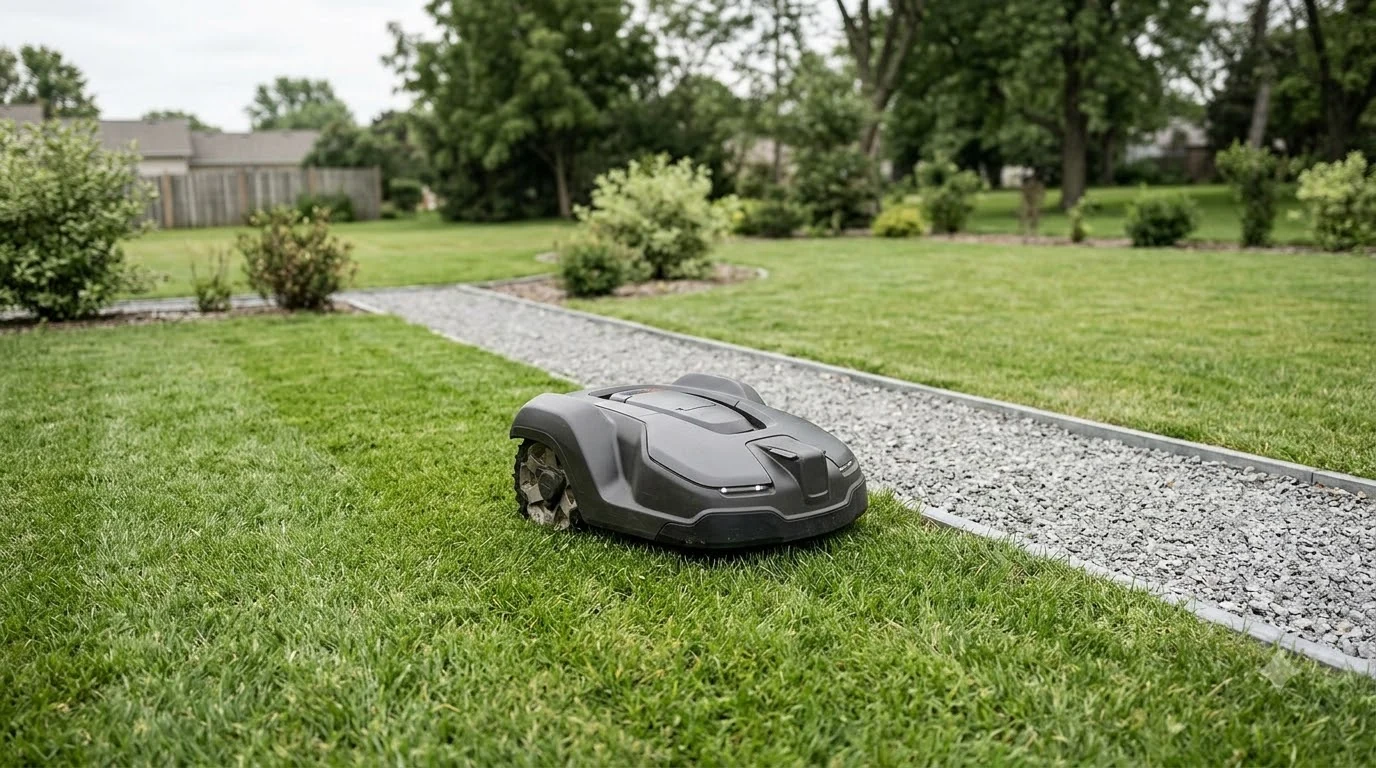

Can a robot mower cross a driveway? Yes, when the crossing is flat, firm, and set up on purpose. Paved surfaces such as concrete and asphalt are the simplest case, while loose gravel and bark mulch are harder to manage. Whether the mower ever tries the crossing depends mainly on how the boundary wire or the wire-free map is set up.
The short answer
- Surface: concrete, asphalt, and flat paving are the easiest to cross, according to Anker’s setup guide.
- Loose material: loose stones shift under the wheels, and bark or wood chips are rarely reliable.
- Wire spacing: Husqvarna’s passage guidance uses at least 2 m (6 ft 6 in) between boundary wires, or 60 cm (24 in) when a guide wire is used.
- Height: the transition should be level, with no curb or step that can catch the mower.
- Check: test the crossing in both directions and confirm the mower returns to its charger.
Can a robot mower cross a driveway that is paved?
Paved, flat driveways are the easiest case when a robot mower has to cross a driveway. Anker describes paving slabs, concrete, and asphalt as “usually the most straightforward surfaces,” and Robomow calls paved areas with a flat surface “unproblematic.” Both guides agree on the surface, but neither gives a size limit for the driveway itself.
A driveway is usually long and wide, so the practical question is less about the pavement and more about the edges and the wire. Neither guide gives exact driveway dimensions, so measure your own space before you decide on a layout. If you also have separate grass areas to link, our guide on whether a robot mower can mow multiple separate lawns covers that side of the setup.
| Surface | What the guides say | Our reading |
|---|---|---|
| Concrete, asphalt, flat paving | Most straightforward surfaces (Anker); unproblematic when flat (Robomow) | Best case. Still set up a passage with wire. |
| Firmly compacted fine gravel | May be crossed, but loose stones can shift under the wheels (Anker) | Possible, but test it before you rely on it. |
| Deep gravel or rounded pebbles | Described as difficult (Anker); driving over gravel “not always advisable” (Robomow) | Expect a higher risk of slipping. Route around it if you can. |
| Bark mulch or wood chips | Rarely reliable (Anker); faster wear and damage to the path (Robomow) | Avoid crossing, and keep the wire outside it. |
| Flat paving slabs | Most straightforward (Anker); stones laid level with the lawn avoid catching the mower (Robomow) | Good option when the slabs are level with the grass. |
How to set up a passage across a driveway
A boundary-wire mower follows the wire, so a robot mower can cross a driveway only through a passage that the wire defines. Husqvarna describes a passage as a narrow section of the work area with boundary wire on each side that connects two parts of the work area.
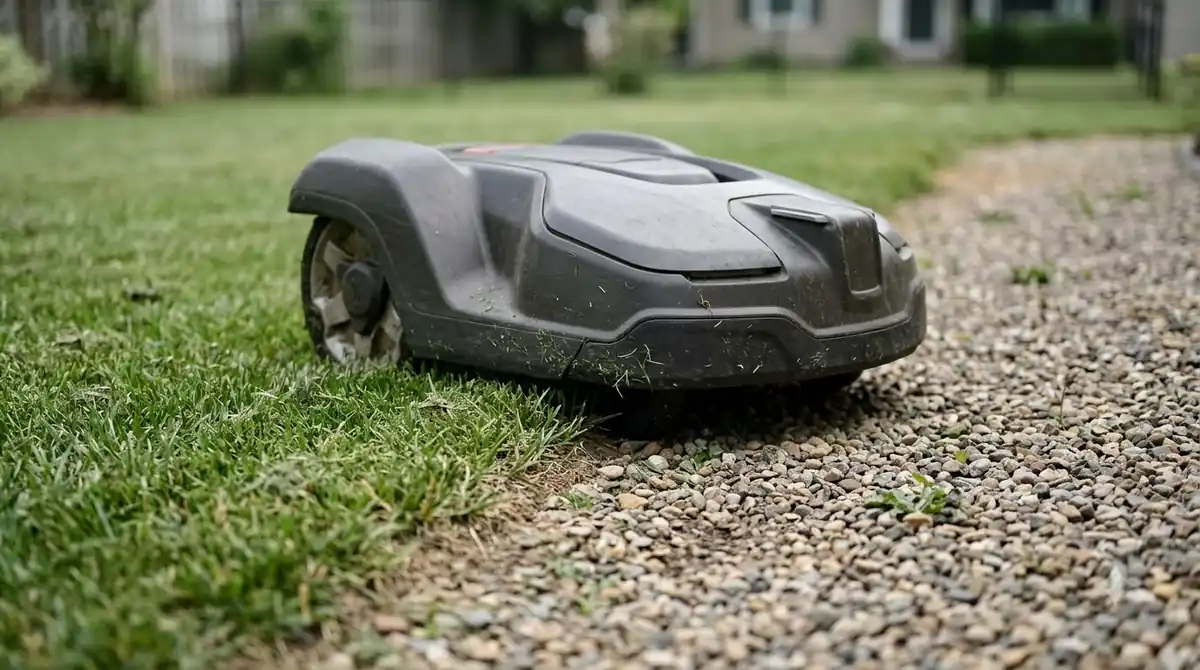
- Choose the shortest suitable route. Anker advises the shortest private route with good visibility, so the mower can see where it is going.
- Make the transition level. Anker says to remove level changes and loose material and to make the grass-to-path transition level.
- Place the wire in the joints or under the stones. Robomow says to place the perimeter wire that marks the passage “in the joints or under the cobble stones.”
- Keep the passage wide enough. Robomow sets a minimum of 1 m (about 3 ft 3 in), and the width should match your model’s manual.
- Test both directions. Anker recommends a supervised run in each direction, then a check that the mower can return to its charger from every connected zone.
Our reading is that the passage is the part that needs the most care when a robot mower has to cross a driveway. If this is your first wire job, read how to install a robot mower boundary wire first. A flat driveway with a poorly placed wire can still trap the mower, while a narrow but well-placed passage on firm pavement is often easier to manage.
Width, clearance, and guide wires
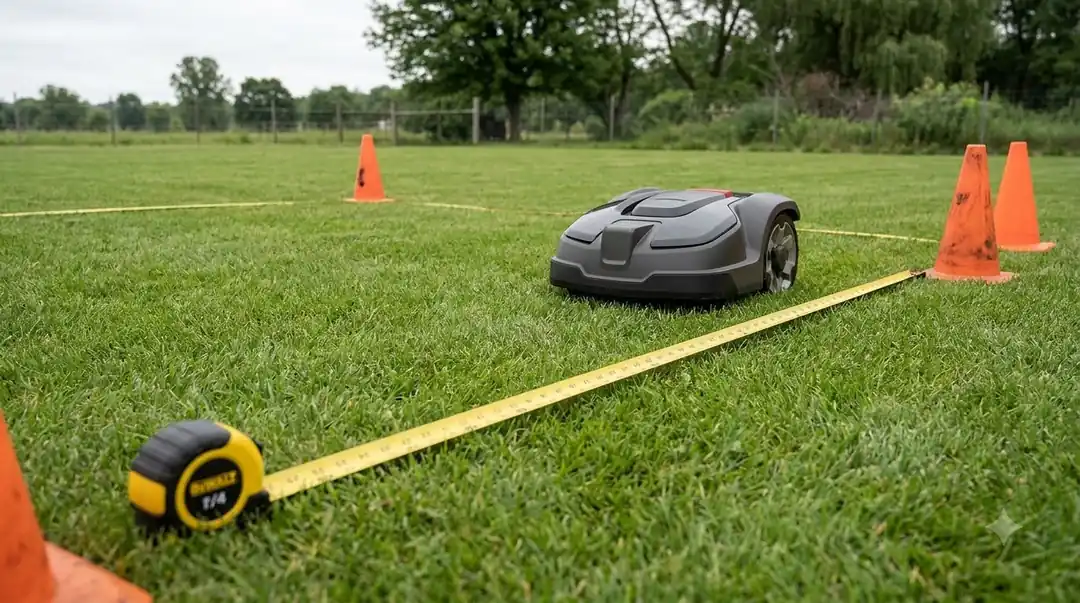
How wide a passage must be for a robot mower to cross a driveway depends on the brand, so the manufacturer’s figure should always win over a general rule. Husqvarna’s passage guidance sets boundary wires at least 2 m (6 ft 6 in) apart when there is no guide wire, and at least 60 cm (24 in) apart when there is one.
The guide wire itself should stay at least 30 cm (12 in) away from the boundary wire, and Husqvarna recommends a 2 m passage for its 435X AWD and 535 AWD models to get a good cutting result. A narrow neck between two lawn sections also shows up in an L-shaped lawn, covered in can a robot mower work in an L-shaped yard.
Anker gives a different starting point. It suggests around 80 to 100 cm of clearance on both sides as a useful starting point for many gardens. Husqvarna also notes that if the mower gets stuck in a passage, the corridor width can be adjusted.
Robomow adds that a tunnel circuit or small loops of wire on each side can keep the mower from mowing the passage itself. The same tight-space logic applies to a robot mower for narrow side yard passages.
Heads up
Spacing figures differ between brands, as Husqvarna’s 2 m and Robomow’s 1 m above show. Do not copy a width from one brand’s guide to another brand’s mower without checking its installation manual.
Curbs, steps, and height changes
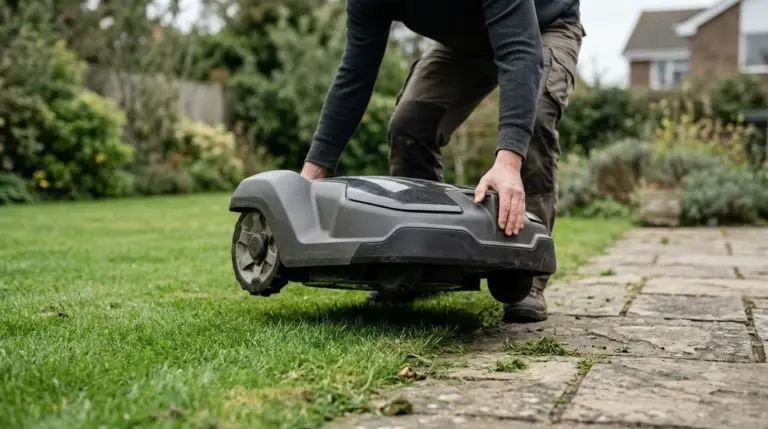
The main risk when you ask can a robot mower cross a driveway is usually a raised edge rather than the pavement itself. Anker warns against raised curbs or steps, and describes a high curb, step, or gap as something that could catch the mower.
None of these guides gives a numeric step height for a robot mower. Robomow says the stones should sit level with the ground surface where possible, and if they sit higher, the edge can be backfilled with soil so the mower can climb onto it. Our reading is that any visible lip is a reason to fix the edge or choose another route, and that you should confirm the maximum climb height in your model’s specifications before you buy.
How wire-free mowers handle a driveway path
Wire-free models change how a robot mower crosses a driveway, because they do not use a buried wire to mark the passage. Anker says that for these models you map both lawn areas and create the transit pathway in the app. The mower then learns the route as a defined path between the zones.
The app setup does not remove the physical requirement. The transition still needs to be flat, free of loose material, and clear of curbs, because the mower can only follow a route its wheels can climb.
Can a robot mower cross a driveway safely? How to test it
A single successful run does not prove that a robot mower can cross a driveway reliably. Anker recommends a supervised test in both directions and a check that the mower can return to the charger from every zone it is connected to.
Watch the first few crossings closely, because the answer to can a robot mower cross a driveway at your house comes from your own surface and edges. Look for wheel slip on the surface, a deck that catches on the edge, and any stop where the mower turns back or loses its position. Our reading is that a short supervised test on a dry day tells you more than a long unattended run in the first week.
Frequently asked questions
Can a robot mower drive over a gravel driveway?
Anker says firmly compacted fine gravel may be crossed, but loose stones can shift under the wheels. Robomow says driving over gravel is possible but not always advisable, so test the surface before you commit to the route. Robomow also says loose stones can jam the blades, and suggests fencing gravel paths off with the boundary wire. For rough ground in general, see whether a robot mower will get stuck on a rocky yard.
Does a robot mower need a guide wire to cross a driveway?
It depends on the model and the setup. Husqvarna’s passage guidance gives a 60 cm (24 in) spacing with a guide wire, compared with 2 m (6 ft 6 in) without one. Check your mower’s manual to see which method it supports.
How wide should a passage across a driveway be?
Robomow sets a minimum of 1 m (about 3 ft 3 in) for a passage, and says the perimeter wire can run in the joints or under the cobble stones. Husqvarna recommends 2 m for its 435X AWD and 535 AWD models for good cutting results. The manufacturer’s minimum for your model is the figure to follow.
What if the driveway is higher than the lawn?
Anker advises against raised curbs or steps that could catch the mower. Robomow suggests backfilling with soil so the mower can climb the edge, while Anker says that if a step or barrier cannot be crossed safely, you should treat the lawns as separate areas instead of building an improvised ramp. None of the guides gives a numeric step height, so check the climb specification for your model.
Sources
- Husqvarna support: how to create a passage in an Automower boundary wire installation (manufacturer): wire spacing, guide wire distances, and passage definition.
- Robomow: Can a robotic lawnmower cross paths? (manufacturer): surface types, minimum passage width, and wire placement in joints or under stones.
- Anker: Can Robot Lawn Mower Cross Path? A Practical Setup Guide (manufacturer): surface ranking, transition level, clearance starting point, and testing steps.
 Up next8 min readBy YardCan a Robot Mower Cross a Sidewalk?Updated Nov 11, 2026
 8 min readBy YardRobot Mower for Yard With Heavy Tree Canopy: What to CheckUpdated Nov 11, 2026
 8 min readBy YardWill a Robot Mower Get Stuck on a Clay Soil Lawn That Stays Wet?Updated Nov 11, 2026
 8 min readBy YardWhat Yards Are Not Good for Robot Mowers?Updated Nov 11, 2026
 9 min readBy YardCan a Robot Mower Work in an L-Shaped Yard?Updated Nov 11, 2026
 8 min readBy YardRobot Lawn Mower for Bumpy Uneven Lawn: What to Check FirstUpdated Nov 11, 2026