
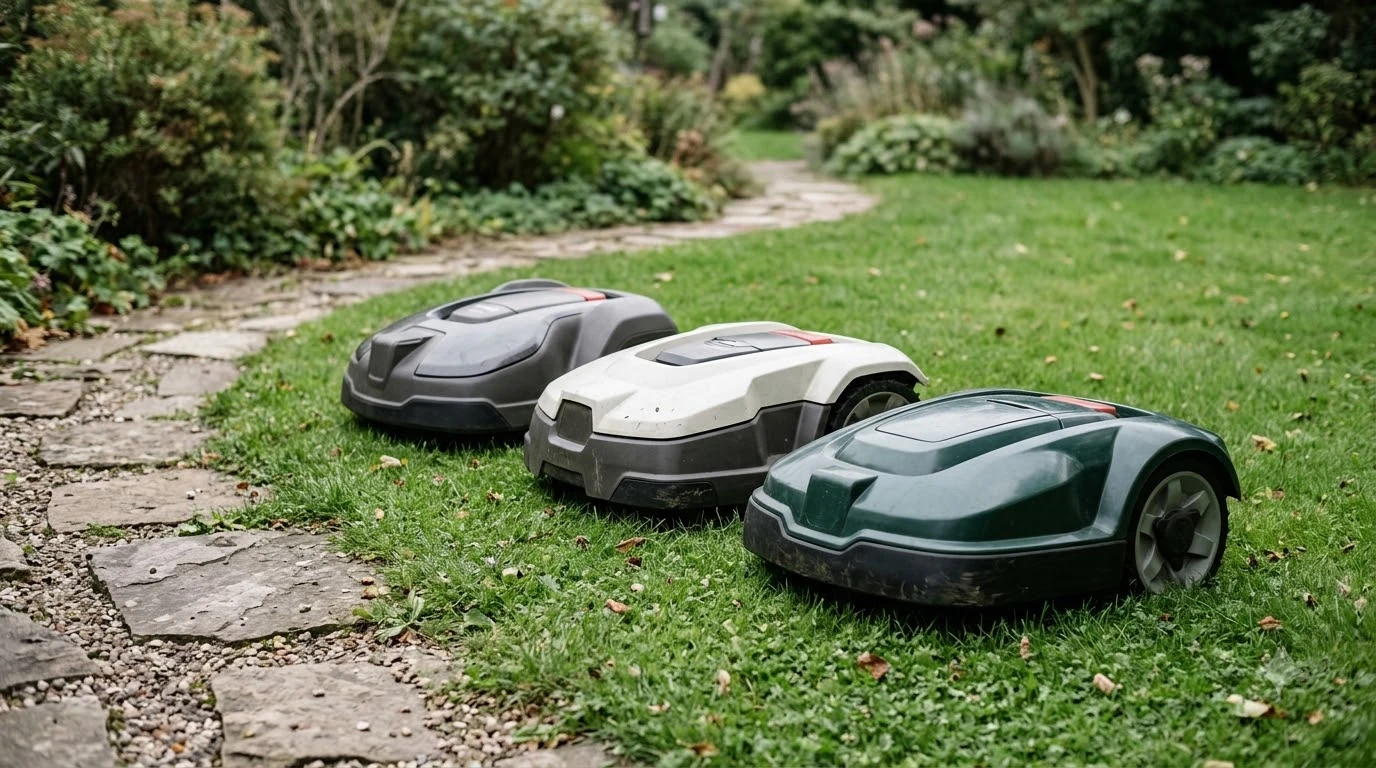

Can a robot mower cross a sidewalk? Yes, many can, when the sidewalk is flat and flush with the lawn and the crossing is set up on purpose. A boundary-wire mower needs a defined corridor to reach the other side, and a wire-free mower needs a mapped passage. Surface, passage width and navigation type decide whether it works.
The short answer
- Default: a plain perimeter wire keeps the mower on the lawn and does not cross a sidewalk on its own.
- Wired mowers: need a correctly laid corridor or guide wire, depending on the model.
- Wire-free mowers: can use a passage drawn in the app, if the software offers one.
- Surface: flat paving is the easiest crossing, while loose gravel and bark need more caution.
Why a sidewalk is treated like the edge of the lawn
The mower does not recognize a sidewalk as a special place. It follows the wire or the map, so the boundary decides where it goes. Anker’s installation guidance advises placing the wire 10 to 15 cm from flower beds, hedges, or paths that are level with the grass, which keeps the cutting path clear of the hard edge. Our reading is that the wire layout matters more than the surface itself.
Robomow’s guidance also notes that a path at ground level is, in principle, no problem for a robot mower to drive over. The same guide adds that the boundary wire can be used to leave out a gravel path, so the mower does not cut it. That gives you two options: a passage the mower uses, or a path it avoids entirely.
A sidewalk differs from a driveway in one practical way: it is often a public walkway beside a street. That makes the crossing a safety question as well as a mowing question, and both are covered below. If you are comparing the two, see whether a robot mower can cross a driveway.
Can a robot mower cross a sidewalk with a boundary wire?
A wired passage is a corridor that the mower can follow, and it only works when the wire leads the mower across the gap. Robomow’s guidance says to place the perimeter wire that marks the passage in the joints or under the cobblestones. It also suggests a tunnel circuit, or a small loop on each side of the entrance, to narrow the gap so the mower arrives head-on.
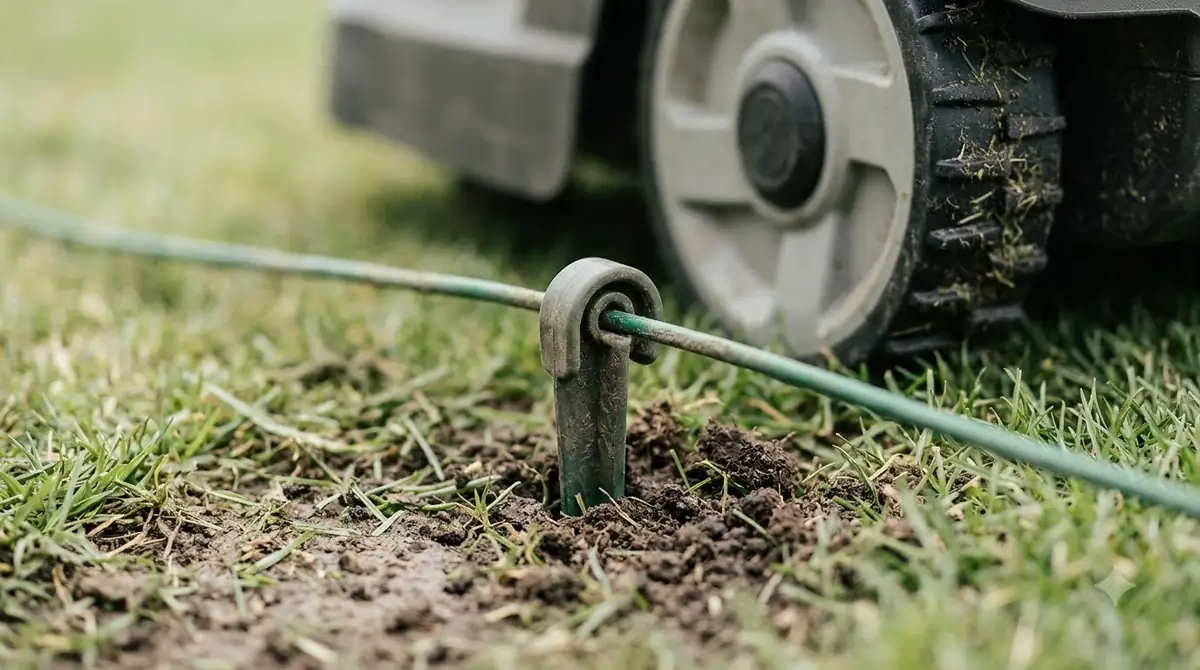
The mower only passes reliably when it approaches the gap head-on, so the entrance geometry matters as much as the wire itself. Our reading is that you should test the route with the mower on a slow, supervised run before you rely on it.
Passage width and wire spacing
Vendor figures for passage width differ, so the minimum for your model should come from its manual, and our guide to robot mower narrow passage width covers the numbers in more detail. Robomow’s blog says the passage should be at least one meter wide, so the signals on both sides do not interfere. Anker describes a width of about 80 to 100 cm as a useful starting point for many gardens, and advises checking the minimum that your model needs.
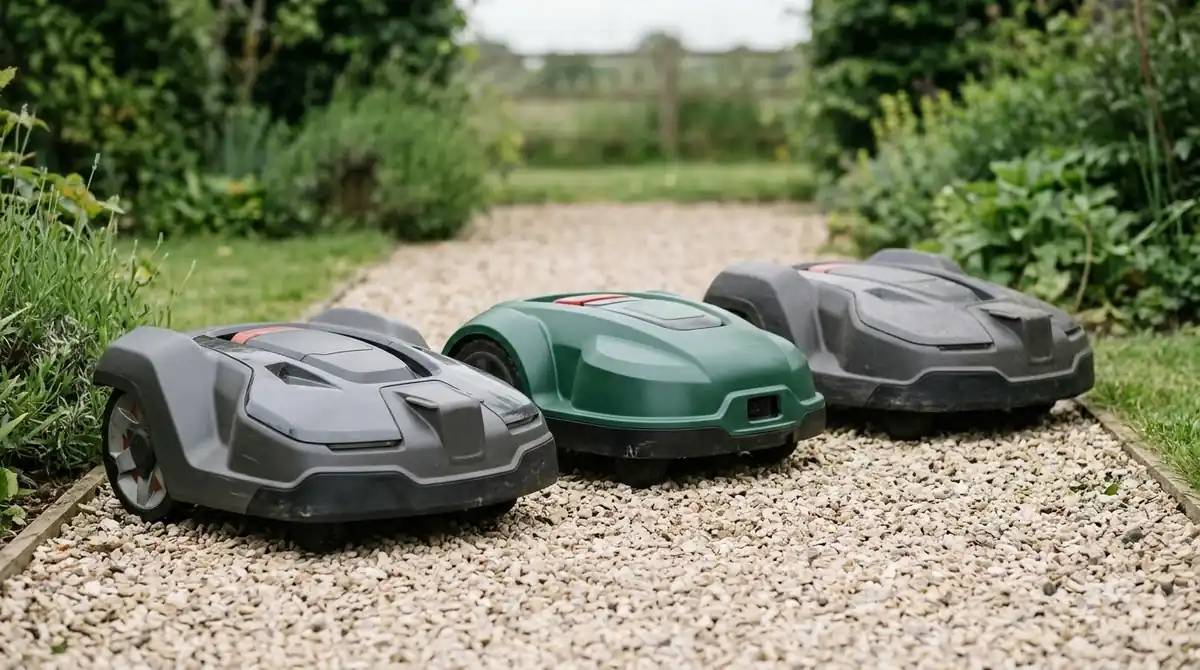
Use the steps below to set up a sidewalk passage. None of them replace the installation section of your model’s manual.
- Confirm the minimum. Check the passage width in your model’s manual before you cut any wire.
- Level the edge. Robomow’s guidance says the lawn edge and the pavement should be the same height, with stones laid level to the ground.
- Lay the wire. Follow your manual for spacing. Anker’s installation guide gives 10 to 15 cm from paths level with the grass, and Robomow says to place the wire that marks a passage in the joints or under the cobblestones. See whether to bury or peg boundary wire for the options.
- Narrow the entrance. Add a small loop on each side so the mower meets the gap head-on.
- Check the return. Confirm the mower can find its charging station from every zone it can reach.
Which sidewalk surfaces work
Flat paving is the easiest surface to cross, and Robomow describes flat paved areas as unproblematic. Gravel and bark are much less reliable, so the surface type should guide where you accept a crossing at all. For gravel in particular, read about a yard with gravel path crossings.
| Surface | What the vendor sources say | Our reading |
|---|---|---|
| Flat concrete or asphalt | Robomow calls flat paved areas unproblematic. Anker calls concrete and asphalt the most straightforward surfaces. | Best choice when the edge is level with the lawn. |
| Flat stone slabs | Robomow says stones should be laid level with the ground surface. | Workable when the joints are tight and level. |
| Loose gravel | Robomow says it is possible but not always advisable, because a stone can catch and damage the blades. | Avoid for a regular crossing. |
| Bark or wood chips | Robomow urges caution with bark mulch. Anker says bark and wood chips are rarely reliable crossings. | Avoid. |
Height is the surface risk people miss. Robomow’s guidance says the lawn edge and the pavement should be identical in height, so level the edge before you lay the wire.
Wire-free mowers and mapped passages
Can a robot mower cross a sidewalk without a wire? Wire-free mowers can use a passage drawn in the app, but they depend on a clear view of the sky. Mammotion says these systems use RTK-GPS with cameras and inertial sensors, and that virtual boundaries and keep-out zones can be drawn in the app. The same vendor warns that accuracy drops under heavy canopy or close to tall buildings, which matters for a sidewalk running beside a house or under trees.
Anker’s guidance says to map a crossing as a non-mowing connection where the software offers that choice. Our reading is that a mapped passage should be tested on the actual route, because a vendor’s accuracy claim does not tell you how the mower behaves beside your house wall.
Safety when the sidewalk is public
Can a robot mower cross a sidewalk safely? Only when nobody can step onto the path, because a public sidewalk carries pedestrians and cyclists. Anker’s guidance says not to run the mower where cars, bicycles, or pedestrians could enter unexpectedly.
Heads up
Anker advises stopping the mower during tests if it scrapes, slips, or repeatedly recalculates its route.
Anker also advises against forcing a crossing over a barrier. Its guidance is to treat the two areas as physically separate rather than improvising an unsupported ramp.
Our reading is that a crossing of a public walk is a poor choice for an unattended mower. A route that stays on your own lawn, away from the street, is the safer design, and you should check your local rules before you let a machine cross a public path.
What to check before you buy
Can a robot mower cross a sidewalk at your address? The crossing method is a spec you can compare across models before the wire goes in the ground. Look for these points in the manual and the product spec sheet.
- A documented crossing method: guide wire, corridor, or mapped passage.
- A stated minimum passage width for the model.
- Support for keep-out or non-mowing zones in the app.
- A clear rule for gravel, bark, and loose surfaces.
- Charger return from every zone the mower can reach.
We recommend checking these points before purchase, not after the wire is laid.
Frequently asked questions
Can a robot mower cross a sidewalk without a guide wire?
Usually not with a plain perimeter wire. Robomow describes narrowing loops and a head-on approach for a corridor, and some wire-free models can use a mapped passage. Check your model’s manual before you assume it will cross.
How wide should a sidewalk passage be?
Vendor figures differ. Robomow’s blog says at least one meter so the signals on both sides do not interfere, while Anker suggests about 80 to 100 cm as a starting point for many gardens. Use the minimum in your own model’s manual.
Is gravel a good surface for a mower crossing?
Not for a regular crossing. Robomow says gravel can be driven over but is not always advisable, since a stone can catch and damage the blades. Flat paving is the safer choice for a route the mower uses often.
How far should the wire sit from a sidewalk?
Anker’s installation guidance suggests 10 to 15 cm from paths that are level with the grass. Keep the wire at that distance from the hard edge.
Sources
- Robomow blog on crossing paths (manufacturer, page dated 2021-05-18): passage width, wire placement, and gravel and bark cautions.
- Anker guide to robot lawn mower crossings (manufacturer, dated 2026-10-26): passage width starting point, surfaces, and safety caveats.
- Anker boundary wire installation guide (manufacturer, dated 2026-10-26): wire spacing of 10 to 15 cm from paths.
- Mammotion guide on boundary wires (manufacturer, dated 2026-05-24): wire-free RTK navigation, virtual boundaries, and accuracy limits.
 Up next8 min readBy YardCan a Robot Mower Cross a Driveway?Updated Nov 11, 2026
 8 min readBy YardCan a Robot Mower Handle a Lawn Full of Weeds?Updated Nov 11, 2026
 8 min readBy YardHow Do Robot Mowers Deal With Narrow Paths?Updated Nov 11, 2026
 8 min readBy YardDo Robot Mowers Work on Bumpy Lawns? What to Know FirstUpdated Nov 11, 2026
 8 min readBy YardHow to Prepare Your Yard for a Robot MowerUpdated Nov 11, 2026
 7 min readBy YardDo Robot Mowers Tip Over on Hills?Updated Nov 11, 2026