
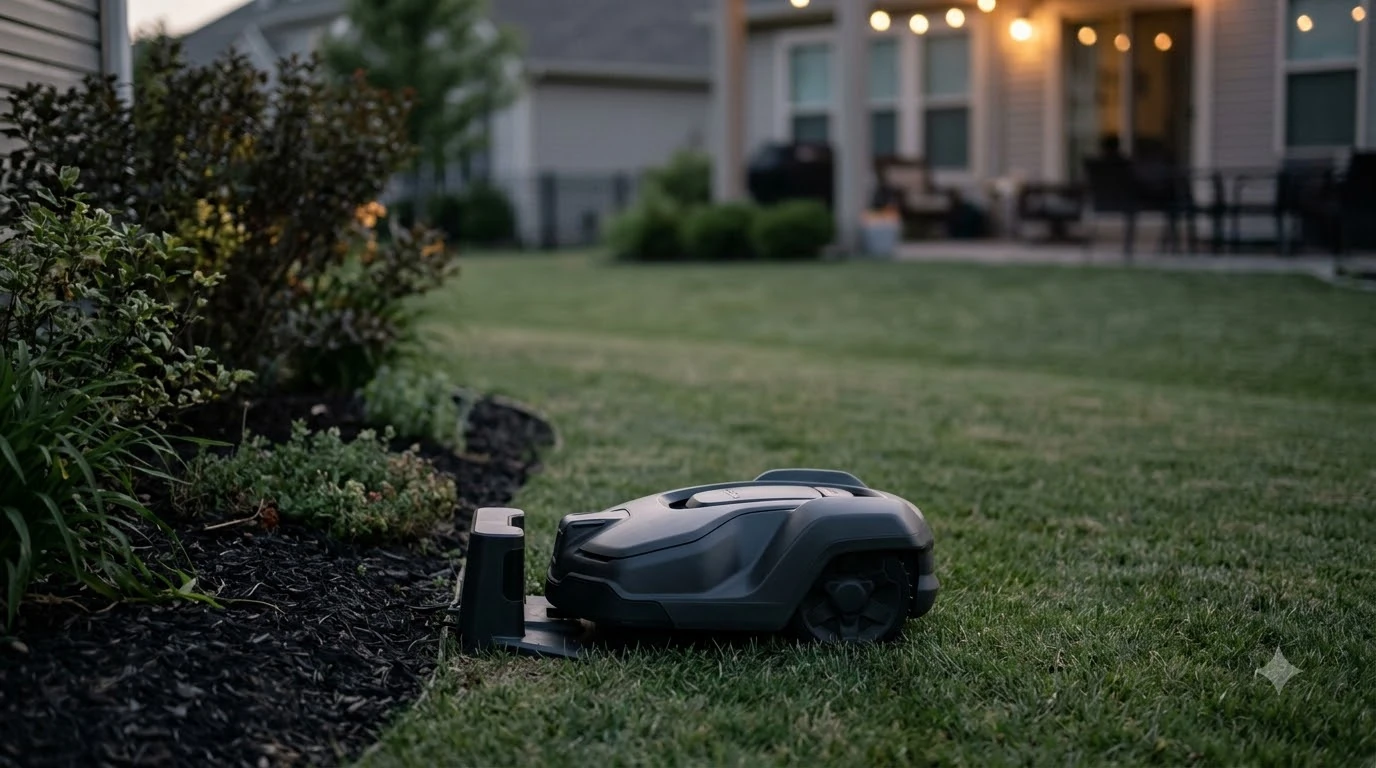

Can a robot mower work in a unfenced front yard? Yes, if the mower has a defined boundary. A fence is not the requirement, because the mower needs to know where its mowing area ends, not whether a fence stands there. The mower needs a boundary wire, a satellite-based virtual boundary, or both, around the lawn and any obstacles it should avoid. Husqvarna’s guide says the mower “stays within your yard using either a physical boundary wire or virtual satellite-based boundaries.”
The short answer
- Fence not needed: the boundary defines the mowing area, not a fence.
- Two boundary types: a buried or pegged wire, or a satellite (GPS or RTK) virtual boundary drawn in the app.
- Weak spots: open sky matters for satellite setups, and the sources we read do not cover curbs or street edges.
- Check first: your lawn’s slope rating, sky view, and how the mower handles the edge facing the street.
Can a robot mower work in a unfenced front yard without a fence?
For a robot mower in a unfenced front yard, the question is whether it can find its edge. It does not need a physical barrier to know where to stop.
Husqvarna describes two ways to keep its Automower inside the lawn: a physical boundary wire, or virtual boundaries based on satellite positioning. Either one can work in an open front yard with no fence at all. A fence can help as a visual edge, but it is only one possible boundary, and it does not replace a defined mowing area. Our reading is that most people asking whether a robot mower can work in a unfenced front yard are really asking how to define the edge, and that is the part to plan.
Boundary options compared
The two main approaches differ mainly in installation work and in what conditions they tolerate. The table below summarizes what the sources we read say about each one.
| Boundary type | How it defines the lawn | Main limit named by sources |
|---|---|---|
| Physical boundary wire | A wire placed or buried around the edge and any obstacles | Needs installation work along every edge and obstacle |
| Virtual satellite boundary | Mapped in the app with GPS or RTK positioning | Needs clear satellite visibility; accuracy drops near dense trees or tall buildings |
| Hybrid | Satellite navigation plus short wired sections in trouble spots | More installation than satellite-only, less than full wiring |
Boundary wire on an open front lawn
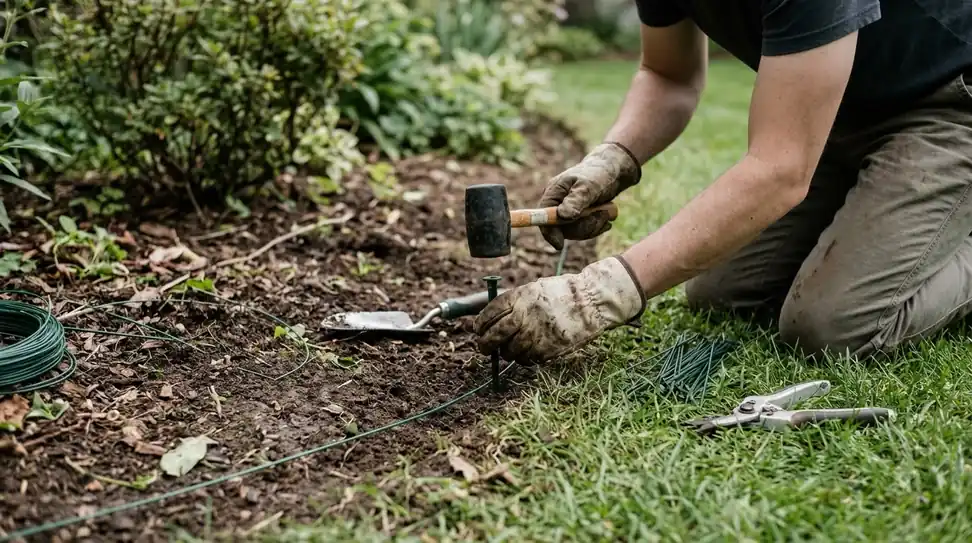
A wire boundary on a unfenced front lawn follows the lawn’s edge and any obstacles, such as a flower bed, a tree, or a walkway. Husqvarna’s guide wire rule is useful here: keep at least 30 cm (12 in) between a guide wire and the boundary wire, and never let the guide wire cross the boundary wire. Mammotion advises burying wire 1 to 2 inches deep to prevent cuts from aeration or edging tools. Those depth figures come from a vendor blog, so check them against your model’s manual.
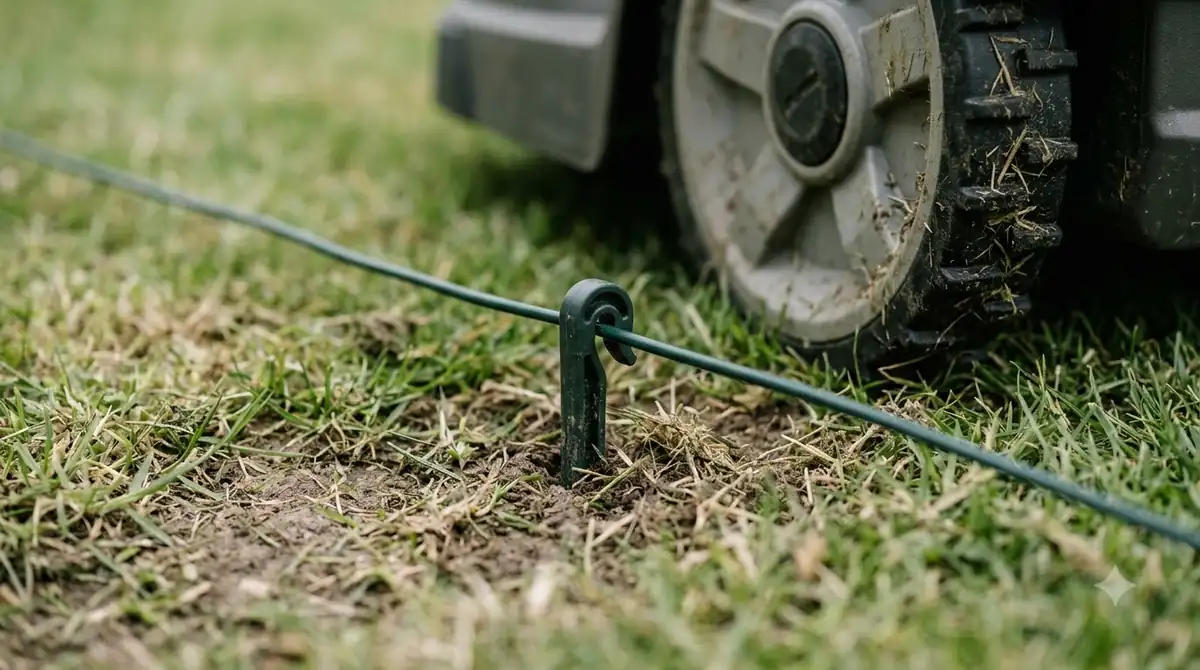
Where a front lawn has a few awkward spots, a hybrid setup can keep the wire short. A robot mower can work in a unfenced front yard with fewer trenches this way. Mammotion describes it as combining GPS navigation with small sections of boundary wire for tricky areas such as flower beds, ponds, and steep slopes. Our reading is that this approach suits front yards with one or two problem corners better than a fully wired lawn.
Virtual boundaries and satellite limits
A virtual boundary removes the need for buried wire, but it depends on the sky. For a robot mower working in a unfenced front yard, sky view is often the deciding factor. Mammotion says its wire-free systems “depend on clear satellite visibility,” and that accuracy “drops under heavy canopy or close to tall buildings.” A front yard lined with mature trees or tall houses is therefore a weaker fit for satellite-only navigation than an open lawn.
Husqvarna gives the fallback directly: where satellite coverage is poor, you can install and bury a physical boundary wire. Before buying, check your front yard’s sky view and plan a wire fallback for any corner that is shaded or close to a building.
Edge facing the street or sidewalk: the limit for a unfenced front yard
The edge that touches a street, curb, or public sidewalk is the part of an unfenced front yard that needs the most care. The sources we read do not say how a robot mower behaves at a curb or street edge, and they do not say whether a satellite boundary holds accurately along a curb. Treat that as a scope boundary: do not assume the mower will stop at the curb without checking the manual for your model.
Our reading is that a wired edge along the street side gives you a physical limit you can see and test. If you choose a satellite-only setup, leave a clear strip of grass between the mowing zone and the curb, and watch the first few runs closely.
Safety around people and pets
Front yards are where children, pets, and passersby are most likely to be close to the mower. Husqvarna says its sensors “allow the mower to detect objects in its path, slow down, and steer away before a collision occurs,” and it describes this as protecting “pets, children, and garden furniture.” When the mower is lifted or tipped over, its blades shut off immediately.
Those features reduce risk but do not replace a boundary. A robot mower working in a unfenced front yard still needs the boundary to keep it off the street side, whatever its sensors detect. Sensors detect objects in the mower’s path, and the boundary defines where the mower is allowed to go. Keep the mower’s schedule outside times when children or pets are playing on the lawn, and keep the blade shutoff features working.
Slope on a front lawn
Many front lawns slope toward a driveway, a street, or a drainage path, so the slope rating matters. Husqvarna says standard Automower models can typically handle slopes of 20% to 40%, and its AWD models can manage inclines up to 70%, or about 35 degrees. Measure the steepest part of the front lawn before choosing a model, and compare the result with the rating on the spec sheet rather than the marketing headline.
What to check before you decide about a unfenced front yard
- Map the edge. Walk the front lawn and mark where the grass meets the street, curb, sidewalk, driveway, and beds.
- Check the sky. Note any tall trees or buildings that block the view of the sky over the front lawn.
- Measure the slope. Find the steepest part and compare it with the model’s rated slope.
- Decide the boundary. Choose a buried wire along the street side if you want a physical limit, or a satellite boundary if the sky is clear.
- Confirm the curb behavior. Check the manual for how the mower handles the curb edge before you rely on it.
Frequently asked questions
Does a robot mower need a fence to work in a unfenced front yard?
No. A robot mower needs a defined boundary, either a buried or pegged boundary wire or a virtual boundary based on satellite positioning. Husqvarna describes both options for keeping the mower inside the lawn.
Can a wire-free robot mower work in a unfenced front yard?
It can, if the front yard has a clear view of the sky. Mammotion says wire-free systems depend on clear satellite visibility and lose accuracy near dense trees and tall buildings. A shaded corner usually needs a short wired section.
How deep should boundary wire be buried in a front lawn?
Mammotion advises burying wire 1 to 2 inches deep to prevent cuts from aeration or edging. That is a vendor recommendation, so check the depth in your model’s installation manual.
Will the mower stop at the curb?
The sources we read do not say how a robot mower behaves at a curb or street edge. Check your model’s manual, and consider a wired edge along the street side or a clear strip of grass before the curb.
Sources
- How do Automower robotic lawn mowers work? (Husqvarna): boundary wire and virtual boundary options, sensors, blade shutoff, slope ratings.
- How to lay a guide wire in a boundary wire Automower installation (Husqvarna support): 30 cm minimum spacing between guide wire and boundary wire.
- Do robot lawn mowers need a boundary wire? (Mammotion, vendor blog): satellite visibility limits, wire placement and burial depth, hybrid setups.
 Up next8 min readBy YardRobot Mower for Front and Back Yard: What WorksUpdated Nov 11, 2026
 9 min readBy YardRobot Mower for a Sloped Front Yard: Limits, Edges and SetupUpdated Nov 11, 2026
 7 min readBy YardRobot Mower for a Sloped Front Yard and Flat BackyardUpdated Nov 14, 2026
 7 min readBy YardBest Robot Mower for Front and Back Yard Multiple ZonesUpdated Nov 13, 2026
 8 min readBy YardCan a Robot Mower Work in a Yard With a 2 Foot Wide Passage?Updated Nov 10, 2026
 8 min readBy YardCan a Robot Mower Work in a Yard With No Wifi in the Back?Updated Nov 10, 2026