
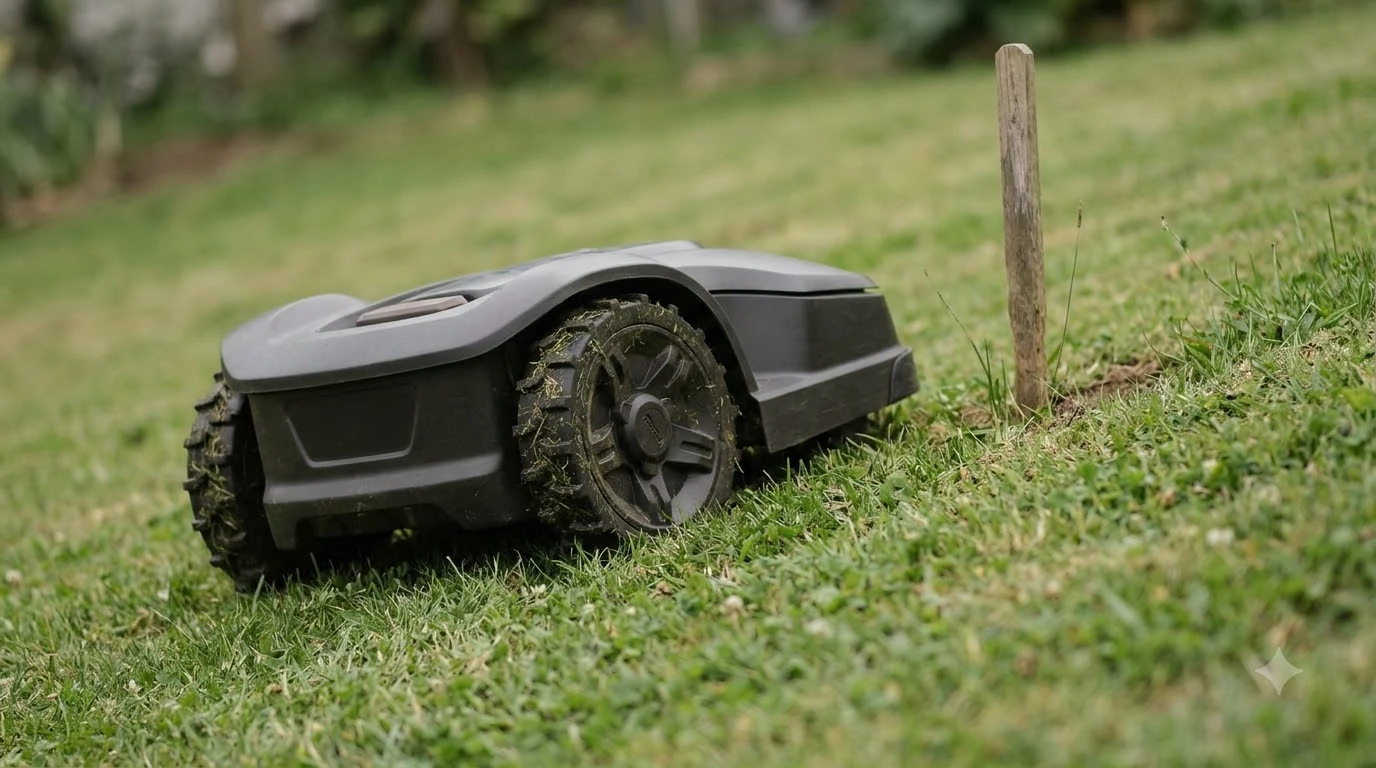

A robot mower for a lawn with a sloped front yard and flat backyard can cover both areas, but the slope decides which model and which boundary layout you need. Manufacturers rate slopes as a percentage, and the steepest part of the lawn sets the limit for the whole installation. This guide explains how to measure the front slope, how to read the rating, and how to keep the flat backyard and the hill on one wire without losing traction.
The short answer
- Measure the steepest section of the front yard, not the average. The worst patch decides the rating you need.
- Check the rating against the slope percentage. Husqvarna support says standard Automower models manage slopes of about 25 to 50 percent, and AWD models are rated higher.
- Use one boundary loop when a narrow passage joins the two areas. Use two zones only when the mower cannot cross the slope comfortably.
- Keep the charging station on flat ground, usually in the backyard, so the mower starts each run from level footing.
Robot mower for a lawn with a sloped front yard and flat backyard: the setup plan
A flat backyard is easy for almost any robot mower. The front yard is where the setup gets harder, because the mower must climb, turn on the incline, and come back down without spinning its wheels. Traction drops on wet grass, and a steep section can keep the mower from reaching the far edge of the lawn. The front half of this plan follows the sloped front yard setup basics, which cover the grade in more depth. A mixed yard still needs a mower that can handle the slope, and the hill-friendly mowers for split yards give examples.
The front yard also tends to be the first place a robot mower meets curbs, driveways, and the street. Husqvarna’s installation guidance for steep lawns advises placing the boundary with the slope in mind, so the wire runs safely away from the road edge and the mower does not try to climb toward it.
How to measure the slope before you buy
Slope is usually given as a percentage. Husqvarna defines it as the vertical height divided by the horizontal distance, multiplied by 100. A rise of 15 cm over 100 cm is a 15 percent slope. Iowa State University Extension also explains that a ratio such as 1:12 means one foot of rise for every 12 feet of run, which works out to about 8.33 percent. Take the measurement first and compare it with how steep a lawn mowers climb before you shop.
To measure the front yard, a level, a straight board, and a tape are enough. Lay the board across the steepest section, set the level on top, and measure the gap under one end. Divide that rise by the board length and multiply by 100. Repeat the check at three or four spots, because a single reading can miss a dip or a bump.
Heads up
Ratings are maximum limits, not targets for daily work. Eufy’s manufacturer guidance notes that running at the top of the rated incline all the time strains the motor, so a front yard close to the limit is a poor fit even if the model technically qualifies.
One loop or two zones
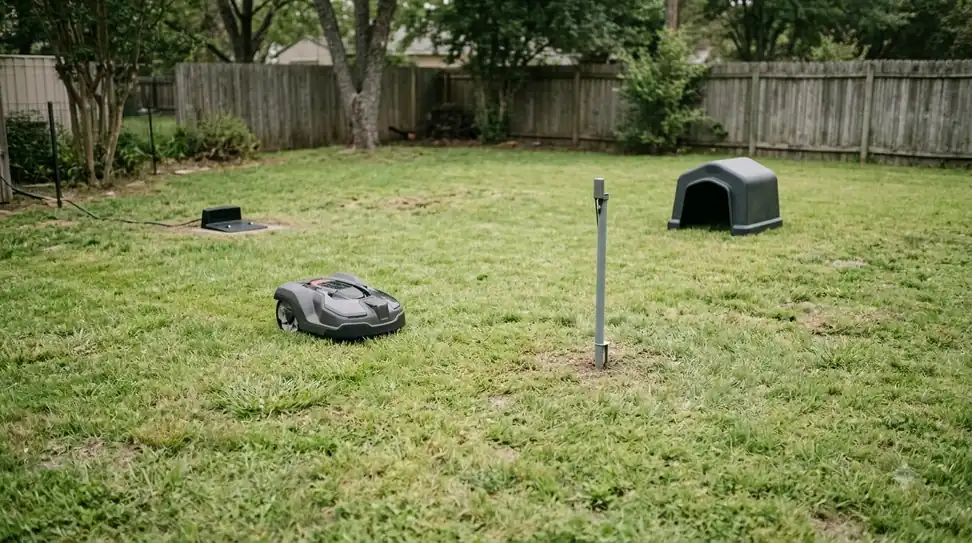
When the flat backyard and the sloped front yard connect through a passage, most owners set up one boundary loop. The mower can then move between the areas on its own, and the charging station can sit on the flat part of the lawn. A wide, gently sloped path is the easiest layout for a single loop. Splitting the property into zones is a common approach, and multi-zone yard layouts explain how it works. Shared lawns also use multiple zones, as covered in mowing a shared condo lawn.
Two zones make sense when the front yard is steep, the passage is narrow, or the front lawn has a separate shape the mower should not cross. Some owners use a separate wire loop for the front and let the mower return to the dock between zones. Check your model’s manual for how it switches between areas, because the setup steps differ by brand.
- Narrow connection: keep the passage wide enough that the mower does not clip the edge and stall.
- Steep front section: consider a separate zone so the mower can work the flat backyard without repeated climbs.
- Charging station: keep it on the level backyard or on the flattest part of the lawn.
Laying boundary wire across the hill and the flat ground
On an incline, lay the wire so it crosses the slope carefully rather than running straight up and down the hill. Robomow’s setup guidance says wire on an incline should be laid diagonally, and corners should be laid in a curve so the mower can turn without hitting the wire at an angle. Where the wire crosses the hill, the hillside lawn boundary wire layout shows how to keep the signal steady.
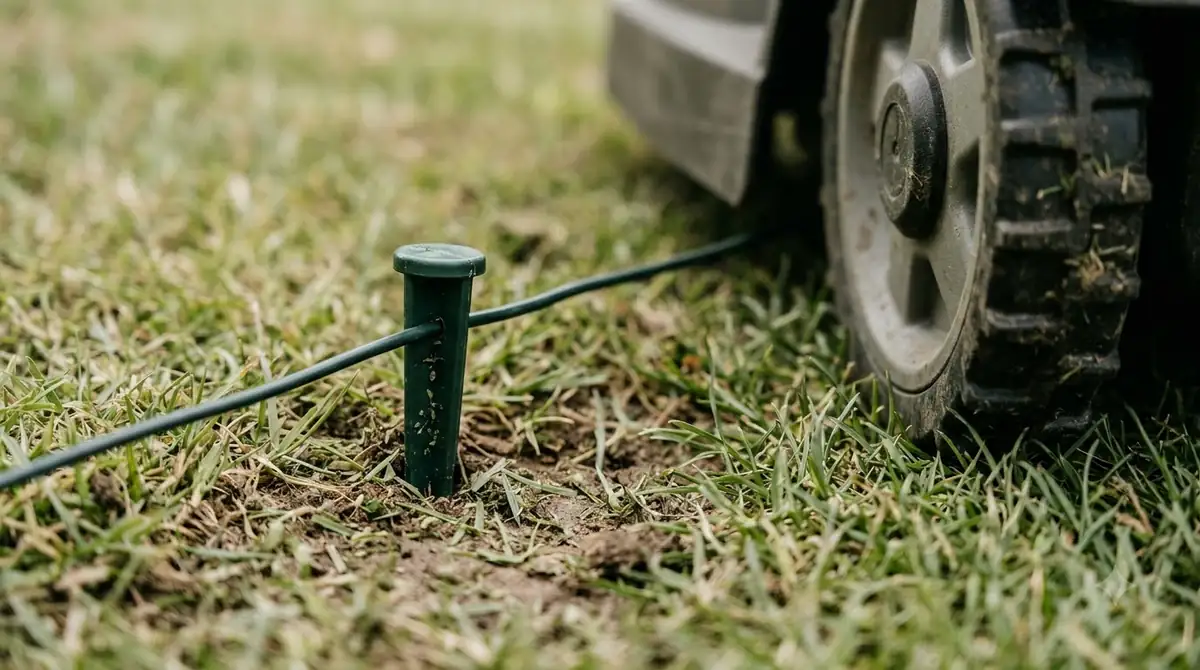
Stakes matter too. A lawnmowers.com setup guide recommends spacing stakes about 50 to 80 cm apart, adding more on curves, and burying the wire 2 to 5 cm. Grass grows over the wire within a few weeks, so check the path each season and reseat any stakes that lift on the slope after heavy rain.
What to check before you buy
Before you buy, write down the slope percentage of the steepest front section, the width of the passage between the two lawns, and whether the front yard is wet for long periods. Then compare the rated slope limit of each model against that number, with a margin for wet grass. Our reading is that a model rated well above your steepest section will climb more reliably in damp weather than one that barely qualifies.
Also check whether the mower’s installation guide lists limits for the boundary as well as the cutting area. Husqvarna notes that the boundary itself can be placed to keep the mower off steep edges, which matters most where the front yard meets the street.
Related reads: For a specific figure, see the mower on a 35 percent slope guide. Pattern choice matters on the sloped part too, and mowing direction on a slope explains how to pick it.
Frequently asked questions
Can one robot mower cut both a sloped front yard and a flat backyard?
Yes, if the steepest front section is within the model’s rated slope and the two areas connect through a passage wide enough for the mower. Measure the steepest section first, then choose a single loop or two zones based on the layout.
How do I convert a slope ratio to a percentage?
Divide the rise by the run and multiply by 100. Iowa State Extension gives 1:12 as one foot of rise for every 12 feet of run, which is about 8.33 percent.
Where should the charging station go with a sloped front yard?
Put it on the flattest ground you have, usually in the backyard. Husqvarna’s charging station guidance says it must sit on a level surface, and a flat start helps the mower leave the dock cleanly on every run.
Does a steep front yard wear out a robot mower faster?
Running near the top of the rated slope for long periods adds strain, according to Eufy’s manufacturer guidance. Choosing a model rated well above your steepest section usually means less strain on the motor and more reliable climbing in damp weather.
Sources
- Husqvarna support: optimising an Automower installation for steep slopes (Husqvarna): slope formula, typical model limits, boundary placement near edges.
- Gardening on Slopes and Hillsides (Iowa State University Extension): ratio to percentage conversion, and wet slopes.
 Up next9 min readBy YardRobot Mower for a Sloped Front Yard: Limits, Edges and SetupUpdated Nov 11, 2026
 7 min readBy YardChoosing a Robot Mower for a Yard with a Sloped Walkout Basement PatioUpdated Nov 19, 2026
 7 min readBy YardBest Robot Mower for Front and Back Yard Multiple ZonesUpdated Nov 13, 2026
 7 min readBy YardCan a Robot Mower Work in a Unfenced Front Yard?Updated Nov 10, 2026
 8 min readBy YardRobot Mower for Front and Back Yard: What WorksUpdated Nov 11, 2026
 8 min readBy YardCan a Robot Mower Work in a Yard With Backyard Chickens?Updated Nov 12, 2026