
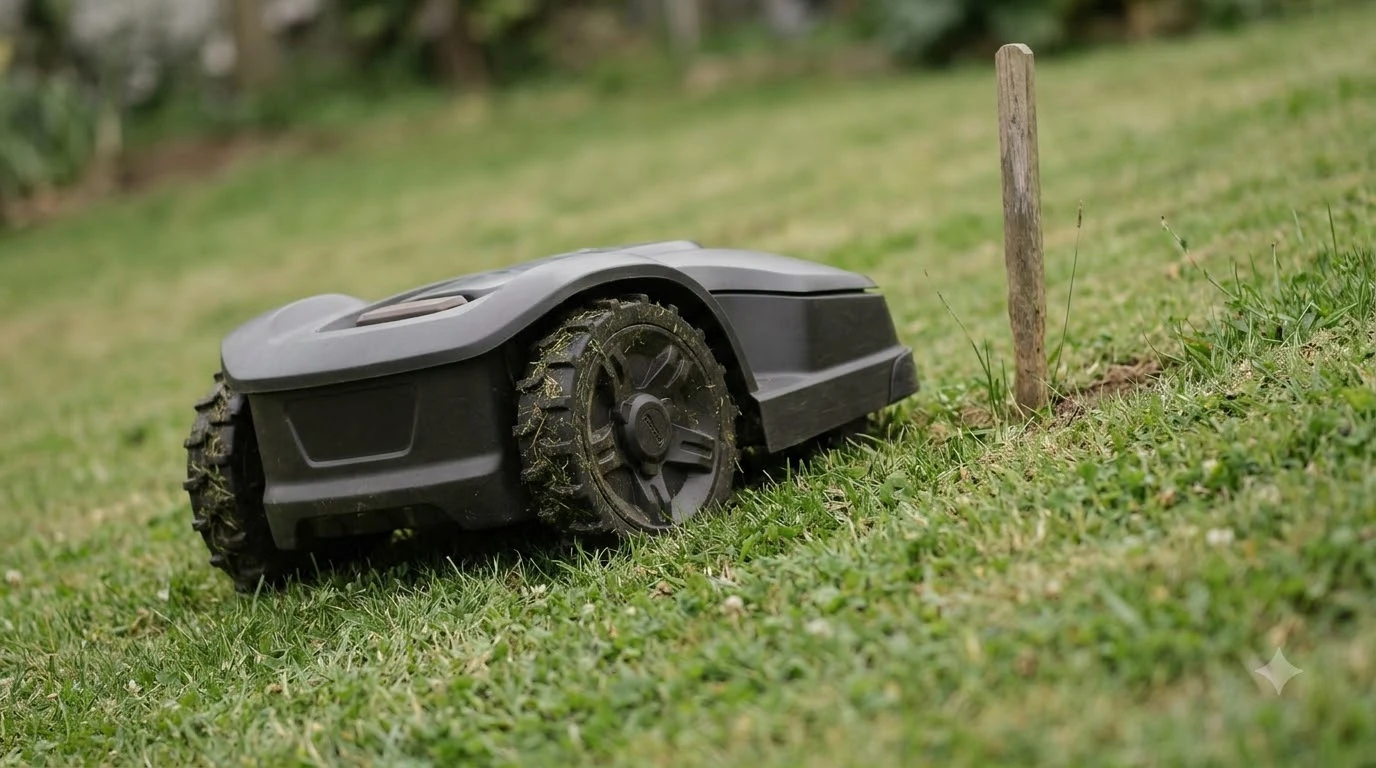

How steep a slope can a robot mower climb depends on the model: most standard robot mowers are rated for about 25% to 50% grade, or 14 to 26 degrees, and all-wheel-drive models are rated higher, up to 70% (about 35 degrees). Those figures are the manufacturer’s maximum for the work area. Boundaries, wet grass and loose soil all lower the safe limit, so plan for less than the number on the box.
The short answer
- Standard models: Husqvarna lists 25% to 50% for the work area, depending on the model.
- AWD models: Husqvarna’s 435X AWD is rated for 70% in the work area and 50% near the boundary.
- Boundary limit: the edge of the lawn is usually rated lower than the middle, so steep edges need extra care.
- Wet grass: damp turf reduces grip, and a mower can slide even within its rating.
- Check first: measure the steepest part of your lawn before you choose a model.
How steep a slope can a robot mower climb: the rating ranges
Manufacturers give slope ratings as a percentage, which is the rise divided by the run multiplied by 100. A 15 cm rise over a 100 cm run is 15%. The table below uses Husqvarna’s support figures for work-area limits, plus a vendor range from Eufy that groups mowers by tier. The degree conversions are our calculation from the percentage. Once you know your slope, the hill-ready mower picks for sloped lawns show which ratings tend to be listed. At the upper end of the range, the mower limits at a 70 percent slope show how few models claim that figure.
| Mower type | Rated slope (work area) | Degrees (approx.) |
|---|---|---|
| Husqvarna 105 (entry) | 25% | 14 |
| Husqvarna 305, 310, 315 | 40% | 22 |
| Husqvarna 320 NERA, 430X NERA, 450X NERA | 50% | 27 |
| Husqvarna 435X AWD | 70% | 35 |
| Eufy basic tier (vendor range) | 10% to 25% | 6 to 14 |
When you measure, take readings at several points along the slope, not only at the bottom and top. A slope that looks even can have a steeper dip or a hump in the middle, and a single reading can miss it. Walk the line where the mower would drive, and record the highest figure you find. Repeat the check after a dry spell and after rain, since the surface changes with the weather. A lawn that is safe on a dry day may be a poor match for the mower after a week of rain.
Two things stand out. First, the rated figure is an absolute limit, not a daily target. Eufy notes that running at the top of the range strains the motor, drains the battery faster and increases tyre slip. Second, the rating applies to the work area. Husqvarna says areas that are too steep must be excluded, using boundary wire islands or stay-out zones.
Percent to degrees: why the numbers look different
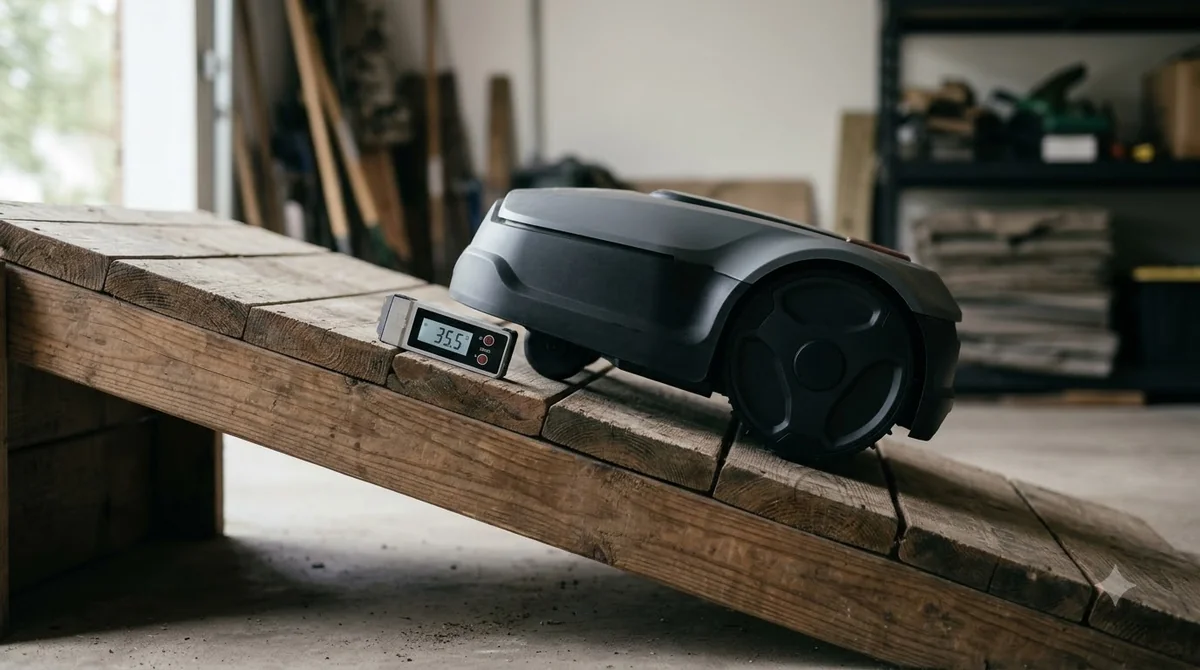
Many buyers compare degrees, while mower specs use percentages, and the two do not convert in a simple way. A 45 degree slope is a 100% grade, and a 25% grade is about 14 degrees. Iowa State University Extension gives the ratio conversion for a 1:12 slope as 8.33%, which is a useful check if you measure with a level and a tape. A phone with a level app can read degrees or percent directly, so compare the reading with the mower’s figure. A gentler grade is within reach of many models, and the mower setup for a 25 percent slope shows what to configure.
Wet grass and boundary limits
The number on the spec sheet assumes dry grass and a clean surface. Eufy and Sunseeker both warn that wet grass, loose soil and steep inclines can cause wheels to slip, and that this is more likely on clay soil, new turf and heavily shaded lawns. A slope that is safe in July can be a problem after rain in spring.
Traction also depends on the tyres and the surface under them. Smooth or worn tyres grip less than tread designed for wet grass, and a bare patch or a worn track on a slope can cause a slip even when the grass is dry. Our reading is that a mower with a higher slope rating and a more aggressive tread is a better choice for a hillside than a model that is only just within its rating for the same slope. Compare the tyre description in the spec sheet rather than the slope figure alone.
The boundary is the other limit. Husqvarna’s standard models rate the boundary wire lower than the work area, from 15% to 25% depending on the model, and the AWD model’s boundary is 50%. A steep edge next to a drop or a driveway needs a lower-slope zone or a wire setup that keeps the mower away from it.
Set up a steep lawn so the mower can climb it
Husqvarna recommends laying the guide wire diagonally across the slope rather than straight up and down. On its AWD models, it also says there should be at least 1.5 meters between the boundary wire and obstacles on slopes up to 50%, and at least 50 cm of level ground between flat areas and steep sections. These are manufacturer rules for those models, so check the manual for your mower before you lay the wire. A front lawn that tilts toward the street needs its own plan, covered in the sloped front yard layout.
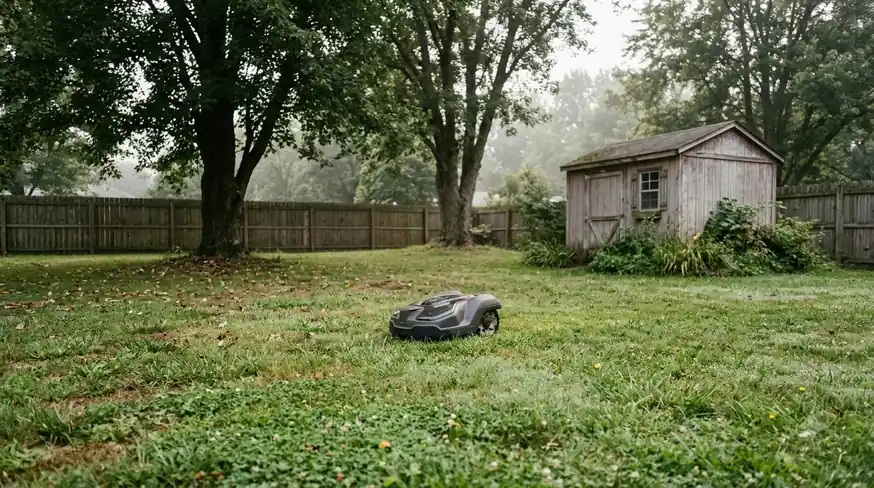
If the steepest area is a small patch and the rest of the lawn is flat, you may not need an AWD model at all. A standard mower with a boundary wire that excludes the steep patch can mow the rest of the lawn, and that patch can be trimmed by hand. This is a common setup for a sloped side yard. It keeps the mower within its rating and avoids paying for a higher rating you do not need.
What to check before you buy
- Steepest point: measure the steepest part of the work area, not the average, and compare it with the work-area rating.
- Boundary edge: check the boundary rating, since it is usually lower.
- Wet conditions: ask how the mower handles damp grass and whether it has traction aids.
- Drive type: AWD models are rated higher, but they cost more and are heavier.
- Battery: steeper inclines shorten runtime per charge, so check the run time on your slope.
Related reads: Readers shopping on a tight budget may prefer the budget-conscious picks for slopes, which list what to check at each tier. Where a slope ends at a wall, the retaining wall edges on a slope guide covers the drop and buffer distance. A mid-range grade is a common question, and the mower use on a 35 percent slope guide covers it.
Frequently asked questions
How steep a slope can a robot mower climb in degrees?
Standard models are rated for about 14 to 26 degrees, based on Husqvarna’s 25% to 50% ratings. An AWD model such as the 435X AWD is rated for about 35 degrees (70%). Treat these as maximums for dry grass, not daily targets.
Is 30% too steep for a robot mower?
It depends on the model. Many standard mowers are rated for 25% to 40%, so a 30% slope may be within the work-area rating for some models but not for others. Check the boundary rating too, because the edge is often lower.
Why does my robot mower slip on a slope?
Wet grass, loose soil, new turf and heavy shade all reduce grip. Eufy notes that wheels can slip even within the rated limit. Mow when the grass is dry, and avoid running at the top of the range for long periods.
Can a robot mower handle a 40% slope?
Some models can. Husqvarna’s 305, 310 and 315 are rated for 40% in the work area, and AWD models go higher. Because the boundary rating is usually lower, measure the edges of the slope as well as the middle.
Sources
- How to optimise an Automower installation for steep slopes (Husqvarna support): work-area and boundary ratings by model, wire layout, AWD clearance rules.
- Gardening on slopes and hillsides (Iowa State University Extension): ratio-to-percent conversion, slope context.
- Robot lawn mower slope limits (Eufy, vendor blog): tier ranges, motor strain at the top of the range, wet grass slip.
 Up next7 min readBy YardBest Robot Mower for Steep Hills and Slopes: Key CriteriaUpdated Nov 18, 2026
 9 min readBy YardChoosing and Setting Up a Robot Mower for a Lawn with Steep Roadside Drainage SwalesUpdated Nov 19, 2026
 8 min readBy YardChoosing and Setting Up a Robot Mower for a Lawn with Steep Culvert Ditch BanksUpdated Nov 19, 2026
 8 min readBy YardHow Steep a Hill Can a Robot Mower Handle?Updated Nov 11, 2026
 8 min readBy YardWhy Does My Robot Mower Stop on a Slope? Causes and FixesUpdated Nov 14, 2026
 6 min readBy YardShould a Robot Mower Cut Across or Up and Down a Slope?Updated Nov 14, 2026