
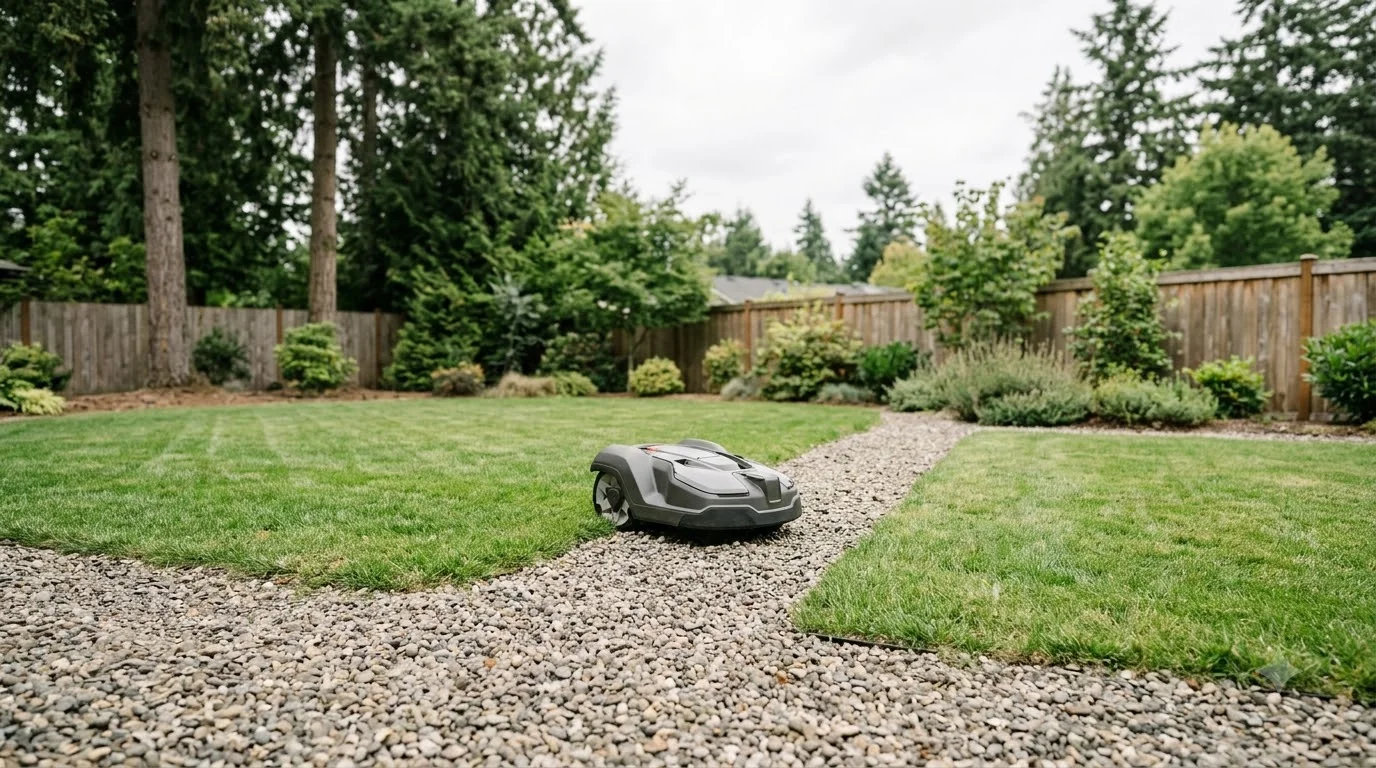

A robot mower for a lawn with steep roadside drainage swales works reliably only when the machine is an all-wheel-drive or tracked model rated for at least a 45 to 80 percent grade and the swale edges are mapped with strict boundary setbacks. Standard two-wheel-drive robot mowers lose traction on damp ditch banks, tear up turf while turning at the bottom of a trench, or slide onto the roadway shoulder. Setting up the boundary correctly—or excluding overly steep sections altogether—keeps the mower safe and stops scalping along sharp grade transitions.
The short answer
- Measure before buying: Check the steepest bank of the swale using a level and ruler; a 3:1 civil engineering side slope equals a 33 percent grade, while steeper roadside ditches often reach 45 to 70 percent.
- Choose AWD or rubber tracks: Standard 2WD robot mowers top out around 25 to 45 percent grades, whereas all-wheel-drive and tracked models handle 70 to 80 percent inclines without wheelspin.
- Respect boundary slope limits: Manufacturers set much lower slope limits near boundary edges—often 10 to 25 percent—so the perimeter must sit on level ground rather than mid-bank.
- Watch for scalping and water: Sharp V-shaped ditch bottoms cause fixed decks to scalp the crests, and standing stormwater will ruin non-submersible electronics.
- Know when to exclude the ditch: If the swale sits in a municipal right-of-way with loose gravel, culvert grates, or grades above 70 percent, keep the robot on the main lawn and trim the ditch manually.
Why roadside drainage swales challenge standard robot mowers
Roadside drainage swales combine steep side walls, abrupt pitch transitions, and periodically saturated soil into one of the hardest obstacles a residential robot mower can face.
Unlike a gentle backyard hill that rises gradually, a roadside swale drops sharply from the front lawn into a narrow trough before rising back toward the street pavement. According to stormwater engineering guidance summarized in University of Vermont Green Schools stormwater plans, vegetated grassed swales are typically designed with side slopes of 3:1 (33.3 percent grade) or flatter to prevent erosion and allow safe mowing. In older neighborhoods or rural frontage, however, roadside ditches frequently settle or erode into 2:1 (50 percent) or steeper banks with a narrow V-shaped bottom.
That geometry creates three distinct mechanical problems for autonomous mowers:
- Loss of rear-wheel traction: Most entry-level and mid-range robot mowers rely on two rear drive wheels and small front caster wheels. When the mower points downhill into a swale, weight shifts onto the unpowered front casters, leaving the rear drive wheels light and prone to spinning or skidding sideways.
- Boundary-turn slippage: A robot mower puts the greatest stress on turf when it reaches a boundary line, brakes, and pivots. Turning on a steep bank tears out grass roots and increases the risk of the chassis sliding past the virtual or wired perimeter into traffic.
- Chassis high-centering and scalping: Even if a mower has enough torque to climb out of a ditch, a rigid wheelbase can bottom out on the top lip of the swale, scalping the turf crest while missing the grass in the trough below.
Matching mower specs to your swale grade
Selecting a robot mower for a lawn with steep roadside drainage swales starts with measuring the steepest face of the ditch and comparing that number against both the machine’s interior slope rating and its boundary slope rating.
Manufacturers express slope ratings in either degrees or percentage grade, where grade equals vertical rise divided by horizontal run multiplied by 100. A 45-degree incline equals a 100 percent grade, while a 35-degree incline equals a 70 percent grade. Residential robot mowers fall into three clear traction tiers, as documented in manufacturer support guides from Husqvarna and Mammotion.
| Drive system | Typical max work-area slope | Typical boundary slope limit | Suitability for roadside swales |
|---|---|---|---|
| Standard 2WD (rear drive + casters) | 25% to 45% (14° to 24°) | 10% to 15% (6° to 8.5°) | Only shallow, wide swales with flat boundary margins |
| All-Wheel Drive (AWD, 4 driven wheels) | 70% to 80% (35° to 38.6°) | 15% to 25% (8.5° to 14°) | Handles steep, well-turfed swales if boundaries sit on flat ground |
| Continuous rubber tracks | 70% to 100% (35° to 45°) | Varies by RTK/vision setup | Best grip on uneven, damp, or rutted ditch banks |
Notice the sharp drop between the work-area slope limit and the boundary slope limit. On Husqvarna Automower models, for example, a machine rated for 50 percent inclines inside the lawn may be restricted to 25 percent grades along the boundary wire, while entry models rated for 25 percent drop to 10 percent at the perimeter. If you place your perimeter line along the roadside slope of the swale, the mower will repeatedly slip past the boundary when attempting to turn around.
How to measure a roadside swale accurately
Eyeballing a roadside ditch almost always underestimates its pitch, so take a five-minute physical measurement along the steepest section before choosing a mower or laying out a map.
- Place a straight level at the top lip. Set a 2-foot or 4-foot carpenter’s level horizontally at the upper edge of the swale so one end rests on the lawn crest and the other extends out over the ditch.
- Measure the vertical drop. Hold a tape measure straight down from the free end of the level to the grass surface below.
- Calculate the grade percentage. Divide the vertical drop in inches by the horizontal length of the level in inches, then multiply by 100. For example, a 12-inch drop over a 24-inch level equals a 50 percent grade (about 26.5 degrees).
- Check the bottom transition radius. Look at how the front slope meets the ditch floor and the opposite roadside bank. A wide, rounded trough lets a floating cutting deck follow the contour, whereas a sharp V-shaped crease will cause blade scalping or chassis grounding.
Installation and boundary rules along a roadside ditch
Proper perimeter placement and mowing direction prevent wheel ruts, boundary escapes, and accidental drops onto the street.
According to Husqvarna’s steep-slope installation guidelines, AWD mowers working on slopes between 50 and 70 percent require at least 5 feet (1.5 meters) of clearance between the bottom of the slope and the boundary line, plus at least 1.6 feet (50 centimeters) of level transition ground where flat turf meets a steep grade. When applied to a roadside swale, those rules dictate two practical setup choices:
- Mowing across the entire swale: If both banks of the swale stay within your mower’s incline rating and the grass extends cleanly to a flat roadside shoulder, place the outer boundary on the level shoulder at least 12 to 18 inches back from the asphalt or curb. Set systematic mowing paths to run straight up and down—or at a 45-degree diagonal—across the swale rather than parallel to the ditch bottom, which reduces sideways crabbing.
- Stopping at the top lip: If the roadside bank is too steep, bordered by loose gravel, or drops into an open culvert, pull the boundary back onto the flat front lawn before the slope begins. Leaving a 1-to-2-foot buffer of level grass before the drop-off ensures the mower completes every turn on flat ground.
Heads up
Roadside swales are often part of a municipal or county right-of-way. Before placing boundary stakes, buried wire, or RTK markers near the street edge, check local right-of-way rules and keep an eye out for utility flags, buried fiber lines, and concrete culvert headwalls that can damage blades or snag a mower chassis.
Weather, drainage, and maintenance habits that protect the mower
Even a high-traction AWD or tracked robot mower will struggle in a drainage swale if you let it mow during wet weather or allow clippings to clog the wheel treads.
Because a swale is engineered to collect and carry stormwater runoff, its soil stays damp long after the upper lawn has dried. Enable the mower’s rain sensor or weather delay so it stays docked during storms and for several hours afterward. Running a robot mower through standing water at the bottom of a ditch risks water intrusion into wheel hub motors and cutting bearings, while spinning tires on wet clay will carve permanent ruts that worsen erosion.
Keep the cutting height set higher in the swale—around 3 to 4 inches—to give the grass blades enough stiffness to slow runoff and resist scalping on uneven spots. Finally, brush dried grass and mud out of the drive wheel treads every week or two, or fit manufacturer terrain wheels with deeper lugs if available for your model.
Frequently asked questions
Can a robot mower cross a drainage swale without getting stuck?
Yes, provided the swale has a wide, rounded bottom, dry turf, and side slopes within the mower’s rated incline limit. Narrow V-shaped ditches or soggy troughs can high-center a low-clearance chassis or cause two-wheel-drive models to lose traction at the base.
Is wire-free RTK/LiDAR or a buried boundary wire safer near a roadside ditch?
Both work well when properly configured, though each has a tradeoff near streets. A physical boundary wire stays immune to tree canopy or passing truck interference, while RTK and LiDAR systems let you adjust virtual no-go zones in an app within minutes if seasonal erosion makes part of the ditch too steep.
Why does my robot mower slip when turning on the bank of a swale?
Turning on an incline forces one wheel to brake while the other pivots, breaking static friction on grass blades. Most manufacturers specify a much lower maximum slope near boundary edges than in the center of the yard for this exact reason, so move the perimeter onto level ground at the top or bottom of the bank.
Should I let my robot mower cut a swale right after heavy rain?
No. Drainage swales concentrate runoff, leaving the soil soft and slippery even when the rest of the yard looks dry. Keep the mower docked until the ditch floor has drained completely to prevent wheel ruts, soil erosion, and moisture damage to the undercarriage.
Sources
- Optimising an Automower installation for steep slopes (Husqvarna Support): used for work-area versus boundary slope limits, transition clearances, and mowing direction on steep inclines.
- AWD Robot Lawn Mower for Slopes: Traction and Limits (Mammotion): used for four-wheel-drive uphill traction, downhill speed control, and slope grade ratings.
- Green Schools Stormwater Design Plans (University of Vermont Sea Grant): used for standard vegetated grassed swale side-slope ratios (3:1 or flatter).
 Up next8 min readBy YardChoosing and Setting Up a Robot Mower for a Lawn with Steep Culvert Ditch BanksUpdated Nov 19, 2026
 9 min readBy YardChoosing and Setting Up a Robot Mower for a Yard with Crushed Granite PathwaysUpdated Nov 19, 2026
 9 min readBy YardChoosing and Setting Up a Robot Mower for a Yard With an Outdoor Kitchen IslandUpdated Nov 19, 2026
 9 min readBy YardChoosing and Setting Up a Robot Mower for a Yard With an Above-Ground Pool LadderUpdated Nov 19, 2026
 10 min readBy YardChoosing and Setting Up a Robot Mower for a Yard with Exposed Septic Cleanout PipesUpdated Nov 19, 2026
 9 min readBy YardChoosing and Setting Up a Robot Mower for a Yard With a Split-Rail Wooden FenceUpdated Nov 19, 2026