
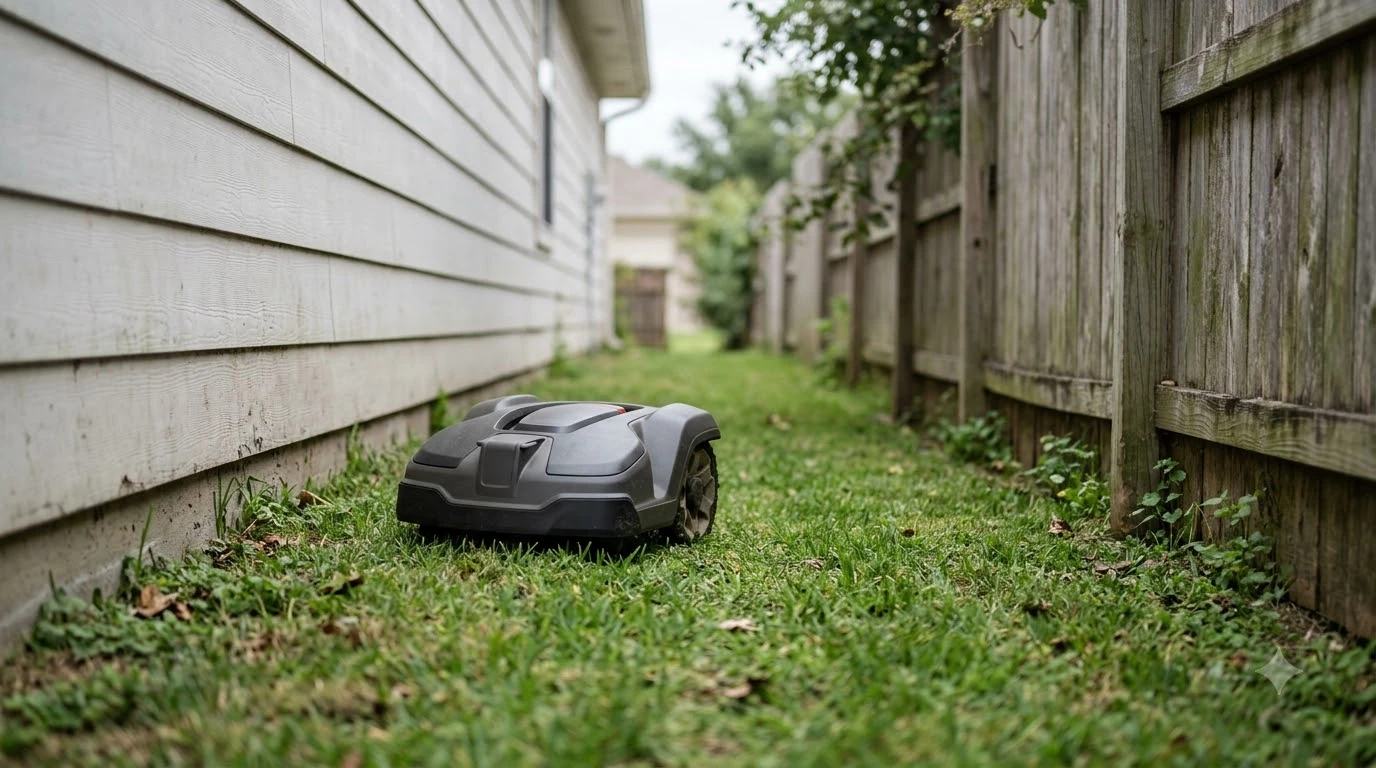

A robot mower for a yard with a sloped walkout basement patio can cut the entire hillside automatically, provided you choose an all-wheel-drive model rated for your steepest grade and set strict perimeter buffers around the patio drop-off and house wall. Walkout lots combine steep side banks, retaining walls, and recessed hardscapes that confuse standard two-wheel-drive bots and block satellite signals near the foundation. Pairing high-traction climbing hardware with careful boundary offsets keeps the chassis out of sunken stairwells while eliminating manual string-trimming on the slope.
The short answer
- Match drive system to incline: Standard two-wheel-drive mowers lose grip on steep side banks, whereas all-wheel-drive (AWD) units handle internal grades up to 70% (35°) or 80% (38.6°).
- Respect boundary slope limits: Manufacturers specify a lower maximum grade along perimeter edges than inside the main lawn, so place turns on flatter ground whenever possible.
- Protect the walkout drop-off: Set your boundary wire or virtual perimeter at least 12 inches (30 cm) back from retaining wall edges, sunken window wells, and recessed patio steps, adding a 6-inch physical barrier where sliding risk is high.
- Account for foundation signal shadows: Two-story walkout rear walls block sky view for RTK antennas, making multi-sensor LiDAR or vision backup essential near the lower patio.
- Dock on level turf: Position the charging base on a flat section with roughly 6.5 feet of clear approach space rather than on the hillside itself.
Why walkout basement lots challenge standard robot mowers
Walkout basement architecture creates a sharp elevation transition from the upper front yard down to a sunken rear patio, introducing three distinct mechanical and navigation hurdles for autonomous mowers.
First, the side yards connecting the upper lawn to the lower patio often feature sustained embankments between 20% and 75% grade. According to Mammotion’s AWD traction guide, gravity shifts weight toward the downhill wheels on steep inclines, causing two-wheel-drive bots to spin their tires, tear damp turf, or slide sideways toward the house foundation.
Second, the lower patio sits directly beneath a tall rear wall that cuts off nearly half the sky. Wire-free mowers relying solely on Real-Time Kinematic (RTK) satellite positioning can lose positional lock when mowing tight against a walkout foundation or under an upper-level deck overhang. Models that pair RTK with 360-degree LiDAR or dual-camera AI vision maintain tracking in these architectural shadows.
Third, walkout patios introduce sudden vertical hazards—retaining walls, egress window wells, exterior basement stairs, and flush stone thresholds—where a momentary wheel slip can send a mower over an edge.
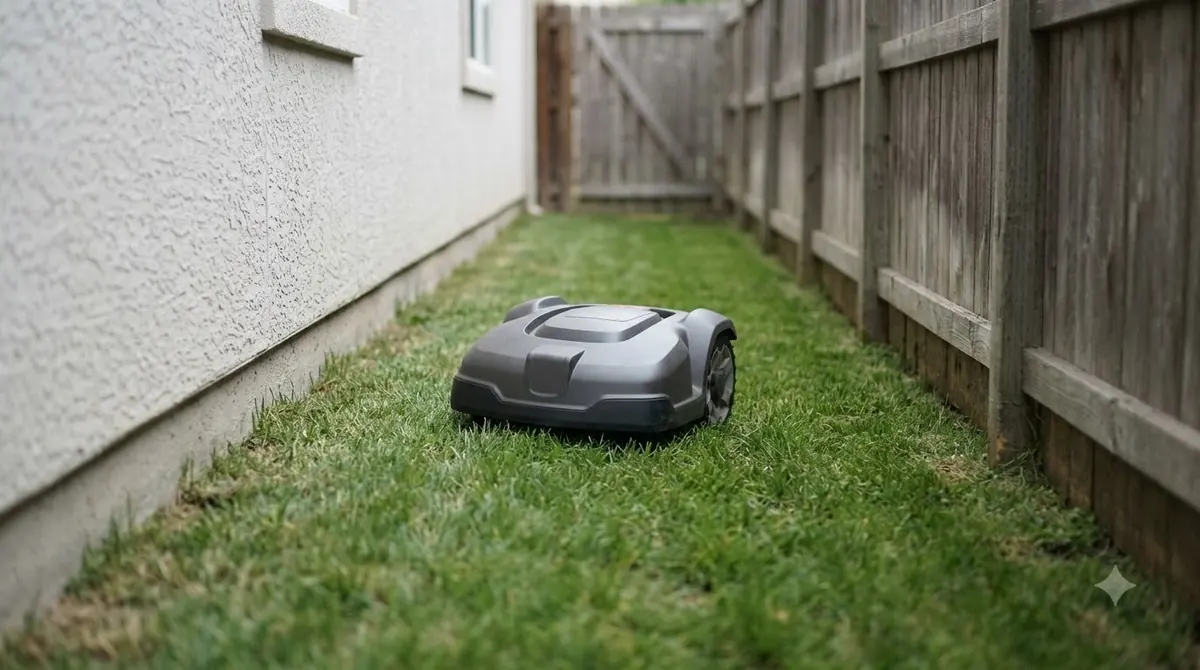
Key hardware specs to check before buying
Selecting the right machine means matching chassis traction, perimeter grade limits, and sensor fusion to the steepest and tightest corners of your walkout lot.
Always measure your steepest side embankment with a digital inclinometer or smartphone level app before comparing spec sheets, noting both degrees and percentage grade. Remember that manufacturers publish two different slope ratings: an internal mowing limit and a stricter boundary-edge limit where the robot must brake and pivot without sliding.
| Yard feature on a walkout lot | Primary risk to mower | Required specification or setup |
|---|---|---|
| Steep side embankment (50%–80% grade) | Wheel slip, turf tearing, sideways drift | All-wheel drive (AWD) rated 70%–80% internal grade |
| Angled perimeter along hillside | Slide-out during boundary turns | Perimeter slope under manufacturer boundary limit (often 50% or less) |
| Tall rear foundation wall & upper deck | RTK GPS multipath or signal drop | Multi-sensor navigation (LiDAR + AI vision + RTK) or physical boundary wire |
| Retaining wall or sunken stair drop-off | Fall damage or high-centering on lip | 12-inch (30 cm) setback plus 6-inch physical edging |
| Flush concrete or paver walkout patio | Blade contact with stone or patio furniture | 4-inch (10 cm) setback for flush edges; 12-inch setback from walls |
Deck width and articulation also matter where a sloped bank meets a flat lower lawn. An articulated rear body or independent suspension keeps all wheels planted across convex crests and concave transitions at the bottom of the hill, preventing the cutting disc from scalping the turf crown.
Heads up
Never install a charging station on a sloped side bank. Manufacturer installation manuals require a flat, level pad with at least 6.5 feet (2 meters) of unobstructed straight clearance in front of the dock so the mower can align its charging contacts reliably.
Setting safe boundaries around the patio and drop-offs
Proper perimeter spacing prevents both physical falls at retaining walls and missed strips of grass along your walkout patio edge.
Installation manuals such as this robot mower operation manual specify distinct setback distances depending on whether the grass meets a flush surface or a vertical obstacle. Treating every edge the same either leaves an unsightly unmowed border or puts the chassis at risk of tumbling onto concrete.
- Measure and mark the steepest boundary zones. Walk the upper and lower perimeters with a slope gauge to ensure the robot never has to execute sharp 90-degree turns on a grade steeper than its boundary rating.
- Set a 4-inch buffer along flush patio pavers. Where the lower lawn sits completely level with concrete or flagstone, place the boundary wire or virtual line 4 inches (10 cm) inside the grass edge so the wheels can ride the stone slightly and trim cleanly.
- Keep a 12-inch buffer from walls and drop-offs. Along the house siding, retaining wall tops, and sunken stairwell curbs, set the perimeter at least 12 inches (30 cm) back so the bumper never scrapes masonry or overhangs an edge.
- Install a rigid 6-inch barrier at steep drop-offs. Where a hillside slopes directly toward an unprotected retaining wall or recessed basement steps, add wood, stone, or metal landscape edging at least 6 inches (15 cm) tall to stop a sliding mower physically.
- Encircle egress window wells as exclusion islands. Route boundary wire around protruding metal window-well grates—or map them as no-go zones—so the front caster wheels cannot drop into the grate openings.
Managing drainage swales and wet hillside turf
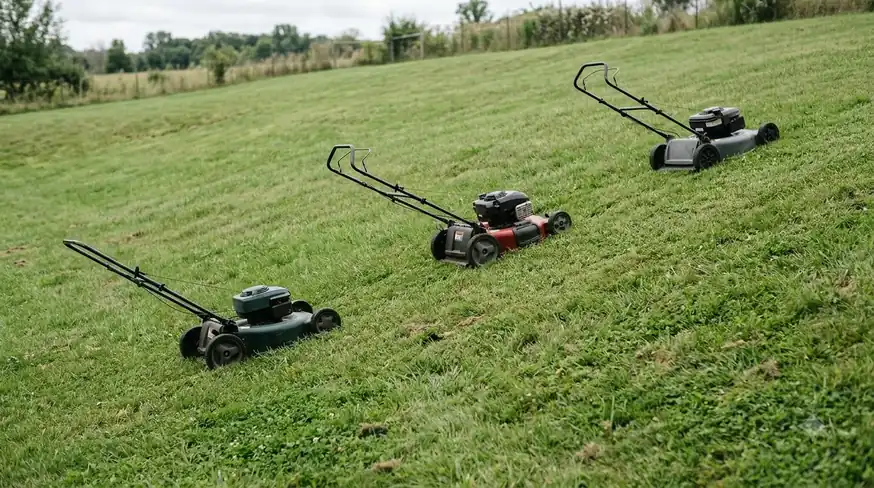
Walkout lots are graded to shed rainwater away from the lower foundation, creating damp drainage swales that require smart scheduling and traction management.
Even an all-wheel-drive mower rated for 70% or 80% dry slopes can lose traction on slick, morning-dew-covered turf or saturated clay swales at the base of the hill. Scheduling mowing sessions for late morning or afternoon gives sunlight and air movement time to dry the embankment, improving tire grip and preventing mud buildup in the wheel treads.
Check the rain-sensor behavior and ingress protection (IP) rating on your shortlist. Models with sensitive rain sensors automatically pause and return to the dock during downpours, protecting both the hillside turf from rutting and the electronics from standing water in low drainage channels.
Frequently asked questions
Can a robot mower climb the steep side hill next to a walkout basement?
Yes, provided you choose an all-wheel-drive model whose slope rating exceeds your steepest grade. Specialized AWD robot mowers handle internal inclines up to 70% (35°) or 80% (38.6°), whereas standard two-wheel-drive bots typically slip on embankments steeper than 35% to 45%.
Will a wire-free GPS robot mower lose signal next to my walkout basement wall?
Pure RTK-GPS mowers can lose satellite lock tight against a tall two-story walkout wall or beneath an elevated deck. Choosing a wire-free model that combines RTK with 360-degree LiDAR or AI vision cameras—or using a traditional boundary-wire system—keeps navigation accurate in foundation shadow zones.
How close to a walkout patio edge can a robot mower cut?
If the patio surface is completely flush with the lawn, most manuals recommend placing the perimeter 4 inches (10 cm) inside the grass edge, allowing the mower’s cutting disc to trim almost flush with the stone. If the patio has a raised curb, wall, or drop-off, keep the boundary at least 12 inches (30 cm) back.
Where should I put the charging station on a sloped walkout yard?
Place the charging dock on a flat, level section of either the upper lawn or the lower yard, never on the connecting slope. Ensure at least 6.5 feet of straight, level clearance in front of the base and verify that outdoor GFCI power and Wi-Fi or cellular signals reach that spot.
Sources
- AWD Robot Lawn Mower for Slopes: Traction & Limits (Mammotion): referenced for AWD weight distribution mechanics and 80% (38.6°) maximum gradient ratings.
- What is the Maximum Slope for a Robot Lawn Mower? (GS Robotic Mowers): referenced for internal (70% / 35°) versus boundary (50%) slope specifications and inclinometer measurement guidance.
- Robot Mower Operation Manual (Manufacturer Documentation via Lowe’s): referenced for 12-inch (30 cm) drop-off/wall setbacks, 4-inch (10 cm) flush-edge spacing, and 6.5-foot level docking clearance.
- Robotic Mower User Guide (Manufacturer Documentation via Home Depot): referenced for supplementing perimeter boundaries with a rigid 6-inch (15 cm) physical barrier near drop-offs.
 Up next7 min readBy YardRobot Mower for a Sloped Front Yard and Flat BackyardUpdated Nov 14, 2026
 9 min readBy YardRobot Mower for a Sloped Front Yard: Limits, Edges and SetupUpdated Nov 11, 2026
 7 min readBy YardRobot Mower for a Lawn With a Sunken Patio: Boundary SetupUpdated Nov 14, 2026
 8 min readBy YardHow Does a Robot Mower Handle a Patio? Wire and Edge RulesUpdated Nov 12, 2026
 7 min readBy YardRobot Mower for a Lawn With a Sloped Ditch: Where to Set the BoundaryUpdated Nov 14, 2026
 9 min readBy YardChoosing and Setting Up a Robot Mower for a Yard With Flagstone Walkways Set in GrassUpdated Nov 19, 2026