
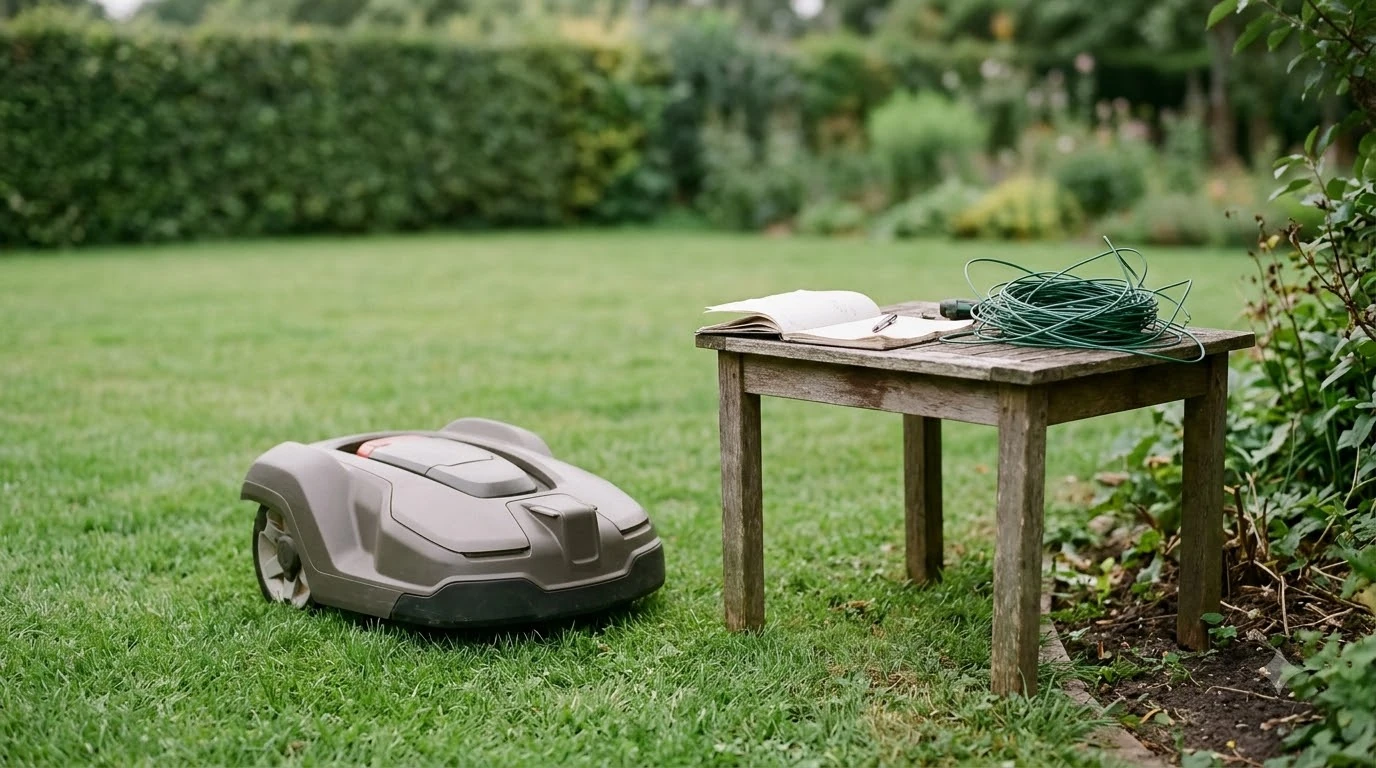

Are robot mowers worth it for small yards? Often not on size alone. They pay off when the lawn is flat and open, and when mowing is a chore you want off your list. The shape of the yard, its gaps and its slopes decide fit more than the square footage does.
The short answer
- Size alone rarely decides it. A small lawn can be cut by hand quickly, so the case for a robot rests on time and convenience.
- Shape decides fit. Open, flat lawns with few beds suit a robot. Narrow gaps, many island beds and steep grades do not.
- Buy for mowing area, not lot size. Manufacturer ratings assume ideal conditions, so plan for headroom.
- Plan the boundary. Physical-wire models need a perimeter installed before the first cut.
How small is a small yard?
There is no official cutoff, but one manufacturer places the entry tier at small, flat lawns under 1,000 m² (about 0.25 acres), according to Dreame’s robot mower buying guide. That guide puts a typical North American suburban mowing area at about 0.2 to 0.5 acres. The number that matters is the area the mower actually cuts, not the total lot.
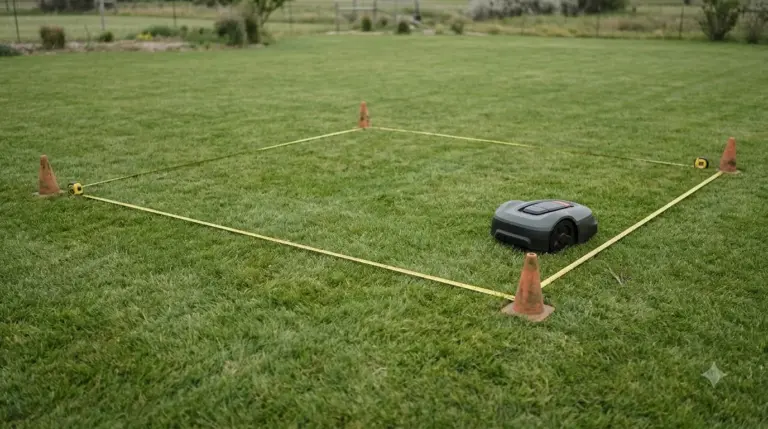
Clemson Extension calls measuring the lawn one of the most crucial steps in managing it, and warns that guessing is unreliable. Its offset method splits an irregular lawn into rectangles, and the closer the offset lines sit, the more accurate the result, according to the Clemson HGIC factsheet on measuring a home lawn. Subtract beds, patios and the driveway before you compare any number with a robot’s rating.
Our reading: a mowing area under about 0.25 acres is where the small-yard question starts. Above that, the case for automation gets easier to make on time alone.
What a small yard changes about the value
For a small lawn, a robot mainly saves time and effort, not much money. A 2023 Digital Trends piece says owners of small yards who do not mind mowing by hand may find the job “might not be very time-consuming,” and it names small, flat backyards with few obstacles as a good fit.
The cost comparison also depends on what you pay now. The same article puts a third-party lawn service at about $45 per bi-weekly visit, or close to $550 for six months a year, and says a mower around $1,200 could pay for itself in as little as one year. Those figures are from 2023, so check current prices. Our reading: if you mow yourself, the saving is your time. If you pay a service, the payback depends on how often you would have booked it.
Smaller batteries are a trade-off to know about. Digital Trends notes that small batteries force more trips back to the charger, which lengthens a single cut. Higher-priced models with bigger batteries avoid that, so a budget model can feel slower even on a small lawn.
Rated coverage is not your real mowing area
A robot’s rated coverage assumes ideal conditions, so the working area is usually smaller than the number on the box. Dreame states that its ratings are calculated for a flat, rectangular lawn with no obstacles, and that you might lose 20 to 30 percent of rated coverage in a real yard. Its example: a mower rated at 0.5 acres realistically covers 0.35 to 0.4 acres in a typical suburban setting.
Husqvarna’s model page lists lawn sizes with a stated tolerance of ±20 percent. Its Automower 410 iQ is listed for up to 0.5 acres, the 420 iQ for up to 1 acre, and the 435X AWD for 0.9 acre. For a small yard, the entry model often has room to spare. Dreame advises sizing up by 30 to 50 percent for reliable full coverage in one run, so plan for the higher end when your mowing area is close to the rating.
Our reading: a 0.1-acre mowing area is about 4,356 square feet. A 0.5-acre rating is more than four times that, so the smallest tier usually fits without buying extra capacity.
Gaps, beds and trees decide more than area
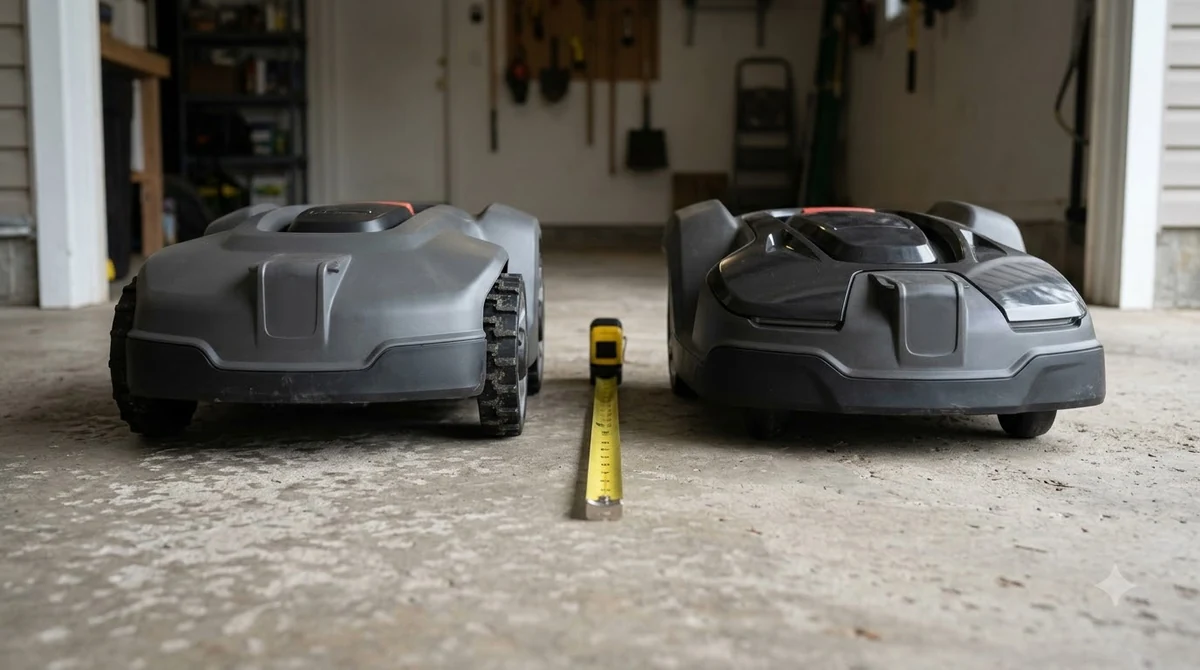
Narrow passages and island beds cause more trouble for small yards than size does. Dreame says that if a passage narrows below 82 cm (32 inches), some models cannot navigate it at all. Trees and beds also cut coverage, because the mower routes around them.
Husqvarna’s support page sets the spacing for a passage: without a guide wire, the boundary wires on each side should be at least 2 m (6 ft 6 in) apart. With a guide wire, the spacing drops to 60 cm (24 in), and the guide wire must sit at least 30 cm (12 in) from the boundary wire. For its 435X AWD and 535 AWD, the company recommends a minimum passage width of 2 m for a good cutting result, per the Husqvarna passage guide.
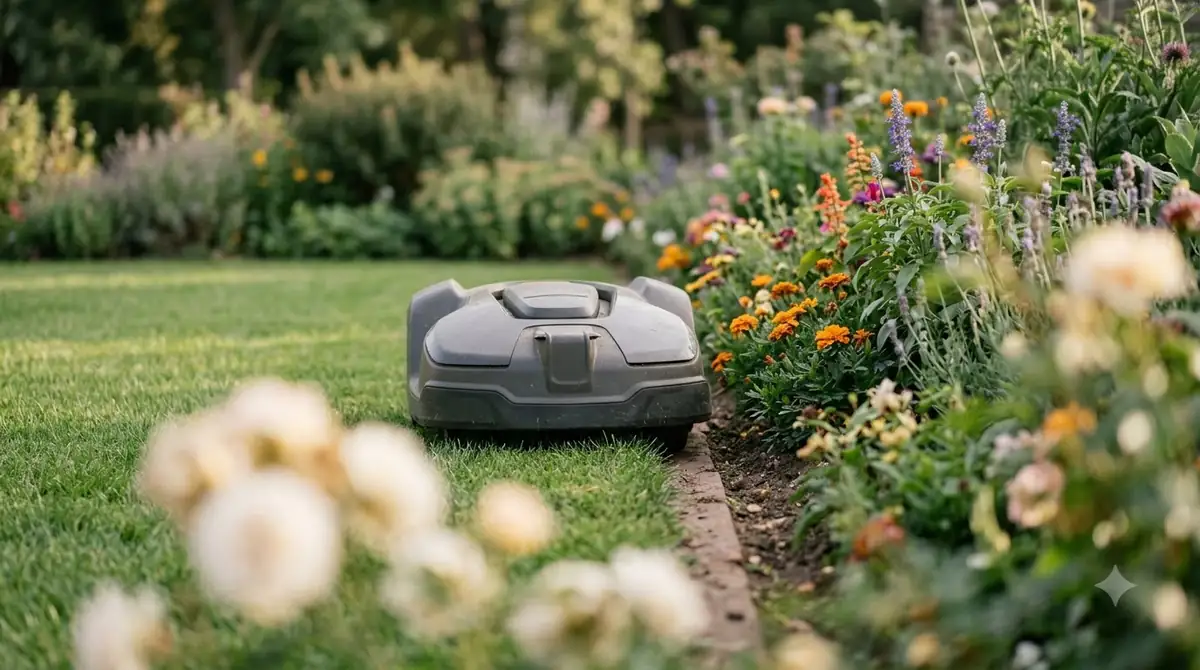
Our reading: a small yard with a side gate, a bed in the middle or a tree near the house can lose a large share of its area to routing, even when the total looks small on paper. Sketch the yard with every bed and gap marked, then measure the narrowest gap.
Slope and drive type
Most of the grades in a small yard are gentle, but a single steep bank can change the choice of model. Dreame advises that if any section runs steeper than about 35 percent, you need an all-wheel-drive model, while standard two-wheel drive is fine below that. Digital Trends says most mowers handle grades up to about 35 percent, and the most rugged handle 70 percent.
Husqvarna’s page names a 70 percent slope limit for its 435 iQ AWD and does not give the same figure for every model. Holes and obstacles slow any mower down, so Digital Trends recommends better grading before buying, whatever the model.
Our reading: a flat small lawn usually does not need AWD. Check the steepest spot with a level or a phone app, and buy for that point rather than for the average.
What setup asks of you
Most robot mowers need a boundary set up around the lawn before the first cut. Digital Trends describes that work as “a bit of preliminary elbow grease,” and it applies to any model that uses a perimeter wire or fence.
Husqvarna lists its models as either physical wire or virtual wire, but its page does not define virtual wire. Read the manual for the model you are considering before you assume it is wire-free.
Our reading: a small lawn has a shorter perimeter, so the wire itself takes less time to lay. Every island bed and narrow gap adds loop length, which is why the sketch from the previous section matters during setup too.
Are robot mowers worth it for small yards? Six checks before you buy
Run through these checks before you compare brands. Each one shows whether the robot fits your yard or whether a manual mower or a lawn service is the better value.
| Check | Why it matters | Source |
|---|---|---|
| Measured mowing area | Ratings assume ideal conditions and flat, obstacle-free lawns | Dreame guide |
| Headroom over area | Size up by 30 to 50 percent for reliable full coverage | Dreame guide |
| Narrowest gap | Below 82 cm (32 in) some models cannot pass | Dreame guide |
| Passage width | 2 m (6 ft 6 in) without guide wire, 60 cm (24 in) spacing with one | Husqvarna support |
| Steepest slope | Above about 35 percent calls for all-wheel drive | Dreame guide |
| Boundary type | Physical wire needs a perimeter; virtual wire is not defined on the page | Husqvarna model page |
A robot is a reasonable buy when the mowing area is modest, flat and open, and mowing is a chore you want gone. If the yard is small but full of beds, gaps and slopes, a manual mower or a lawn service may give better value for the money.
Frequently asked questions
Is a robot mower worth it for a 1,000 square foot lawn?
Often not on time alone. Digital Trends says a small lawn may not be very time-consuming to mow by hand. A robot makes more sense when you want the chore gone or your schedule is tight, and when the lawn is flat with few obstacles.
Do robot mowers work in small yards with many flower beds?
They can, but beds and trees reduce coverage because the mower routes around them. Dreame notes that some models cannot pass a gap narrower than 82 cm (32 inches). Sketch the yard with every bed marked before you buy.
How much coverage headroom should I buy?
Dreame advises sizing up by 30 to 50 percent for reliable full coverage in one run. Its rated coverage is measured under ideal conditions, and real results can be 20 to 30 percent lower. Plan for the higher end if your mowing area is close to the rating.
Do I need a boundary wire?
Models that use physical wire need a perimeter installed before the first cut. Husqvarna lists some models with virtual wire instead, but its page does not define that term. Read the manual for the specific model before you assume it is wire-free.
Sources
- Measuring the Area of a Home Lawn (Clemson Cooperative Extension, HGIC Factsheet 1220): lawn area measurement and the offset method.
- Dreame robot lawn mower buying guide (manufacturer): yard size tiers, rated coverage, headroom, slope and passage guidance.
- Husqvarna robotic mowers (manufacturer): model lawn sizes, the 70 percent slope figure and boundary types.
- Husqvarna passage and boundary wire support page (manufacturer): passage width and guide wire spacing.
- Is a robot lawn mower worth it in 2023? (Digital Trends, Michael Bizzaco, updated April 4, 2023): cost comparison, slope ranges, who benefits.
 Up next8 min readLearnAre Robot Mowers Worth It for Large Yards?Updated Nov 11, 2026
 10 min readLearnAre Robot Mowers Worth It for Seniors? 5 Simple ChecksUpdated Nov 11, 2026
 7 min readLearnAre Robot Lawn Mowers Worth It in 2026? Cost, Time and PaybackUpdated Nov 13, 2026
 8 min readLearnIs a LiDAR Robot Mower Worth the Extra Cost?Updated Nov 12, 2026
 7 min readLearnDoes a Robot Mower Work With a Dog in the Yard?Updated Nov 11, 2026
 10 min readLearnCan Kids Play in the Yard While a Robot Mower Runs?Updated Nov 11, 2026