
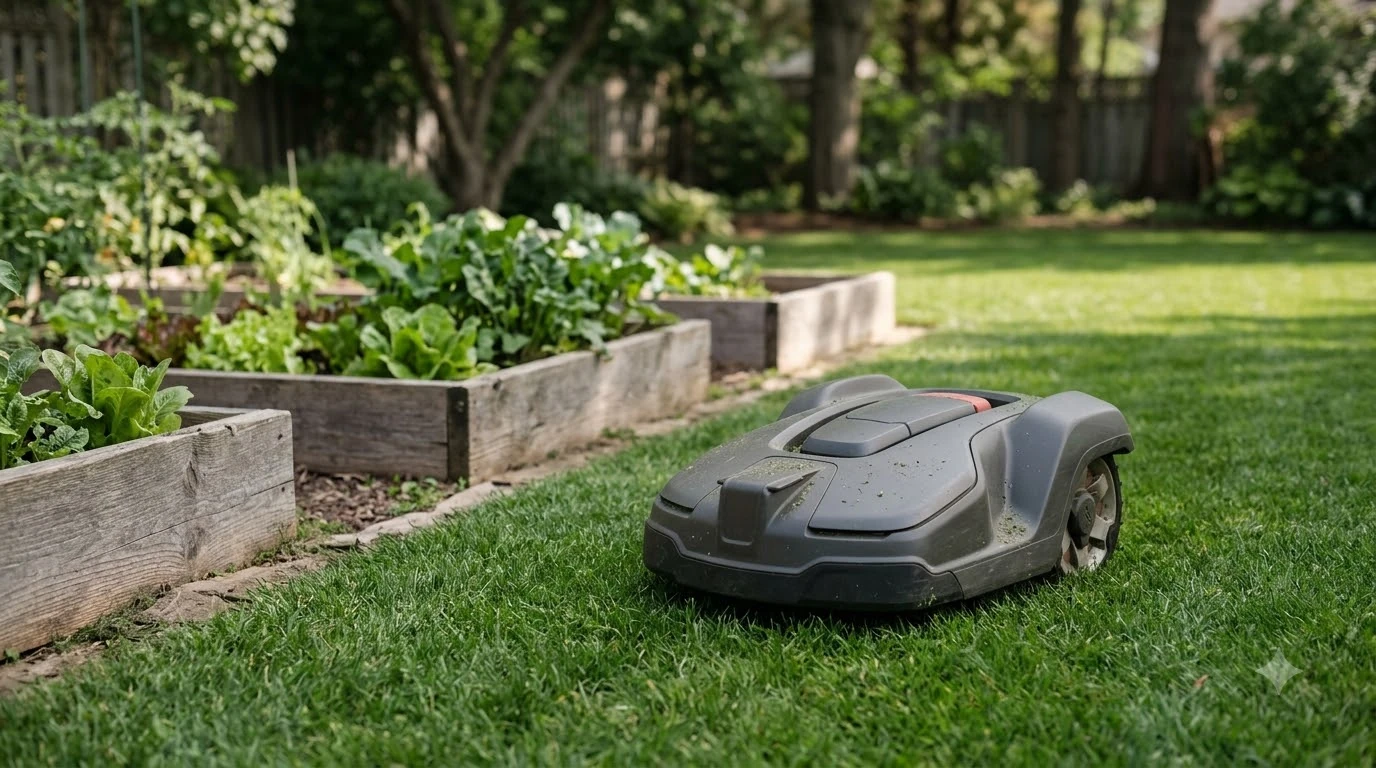

The best RTK GPS robot lawn mower 2026 for your yard depends mainly on whether satellite signals can reach its base station. RTK GPS is a satellite positioning method that robot lawn mowers use to find their place in a yard with far more precision than standard GPS. It relies on a fixed base station that measures satellite errors and sends corrections to the mower. Vendors say this can bring positioning to within a few centimeters, as of November 2026, but those figures are manufacturer claims. This guide explains how the system works, where it struggles, and what to check before you choose an RTK GPS robot lawn mower.
The short answer
- How it works: a base station corrects satellite errors, and the mower applies those corrections.
- Accuracy: vendors quote roughly 1 to 3 centimeters, against 5 to 10 meters for standard GPS.
- Main weakness: trees, walls and roof overhangs can block or reflect signals.
- Before you buy: check the base station site, the fallback sensors and the install effort.
How RTK GPS works on a robot lawn mower
RTK GPS on a robot mower is a method for improving satellite positioning by comparing signals against a reference point with a known location. Standard GPS in a phone or a basic mower can drift by 5 to 10 meters, which is too coarse for a mower that must stay inside a boundary. RTK adds a second receiver on the ground to correct that drift. The explainer on how an RTK robot mower works goes further into the mechanics.

According to Sunseeker’s explainer on RTK technology, the base station calculates satellite error at its exact location and sends those corrections to the mower, usually by radio or Wi-Fi. The mower then applies the correction to its own position. The base station is typically cabled to the charging station and placed a short distance away.
- The base station reads the satellites. It knows its own exact position and works out how far the satellite signals are off.
- It sends the correction. The mower receives the correction over a radio or Wi-Fi link during each mowing run.
- The mower refines its fix. After the first fix, which vendors say takes 3 to 5 minutes, the mower uses corrected positions to follow its map.
How accurate RTK really is
Whichever best RTK GPS robot lawn mower 2026 shortlist you build, note that RTK positioning is usually quoted at about 1 to 3 centimeters, although exact claims vary by brand. Sunseeker says RTK reaches within a few centimeters, another maker quotes 1 to 3 centimeters, and a third states often 1 to 2 centimeters. These numbers come from the vendors that sell the mowers, so treat them as target figures rather than measured results.
We did not find an independent government or university test that compares RTK mowers in real yards as of November 2026. Until one exists, the accuracy figures are best read as the best case in open sky, not the typical result under your trees.
Where RTK struggles: trees, buildings and shade
RTK depends on a clear view of the satellites, so anything that blocks or reflects those signals can weaken it, even on a model that makes a best RTK GPS robot lawn mower 2026 shortlist. Under those conditions, the accuracy claims above are unlikely to hold. The main problem areas are:
- Tree canopy: Mowrator notes that trees block, weaken and reflect satellite signals, an effect called multipath.
- Smooth walls: Sunseeker says reflections from smooth walls can cause multipath, and suggests textured cover such as unpainted wood near the base.
- Roof overhangs: Sunseeker lists walls and roof overhangs among the conditions that weaken accuracy.
- Brief signal loss: Mowrator describes the mower pausing, slowing or correcting its route when the fix is lost.
When RTK drops, mowers typically fall back on other sensors. Yarbo says its machines use vision, an inertial measurement unit and odometry in that case. Our reading is that a yard with heavy shade may depend more on those backup sensors than the RTK figure suggests.
Base station placement and sky view
The base station needs an open, unobstructed spot, and placement is one of the biggest factors in signal quality. ECOVACS says an incorrect placement reduces positioning precision, although the article gives no distance from buildings or trees.
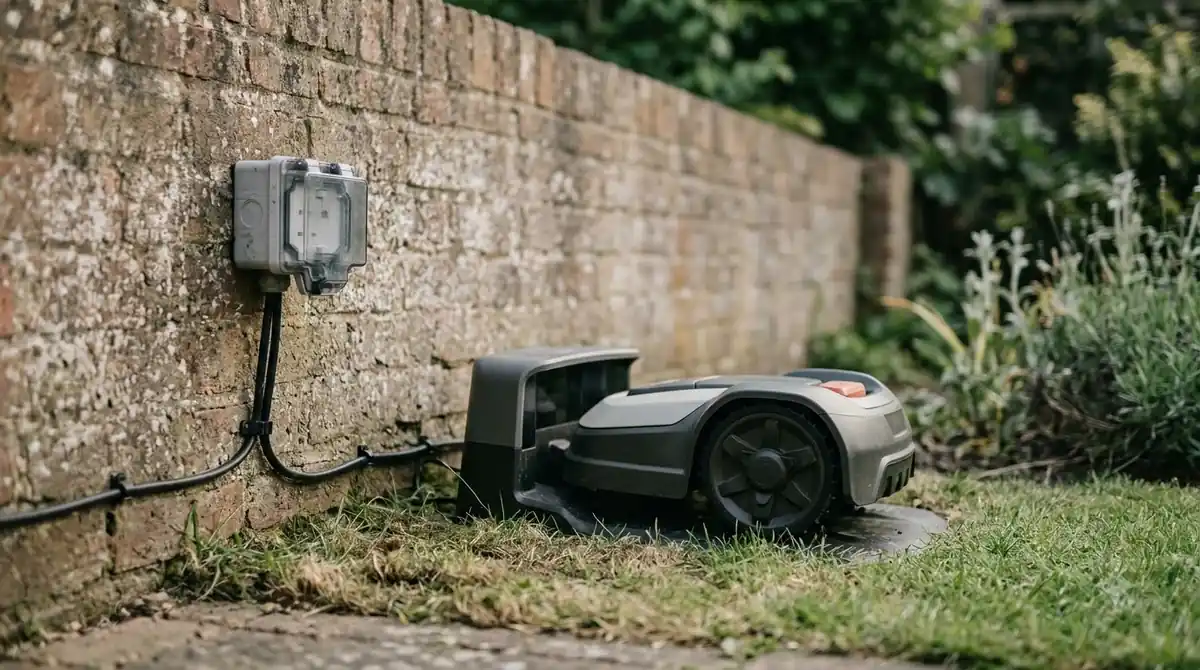
Sunseeker describes a vertical sky view of 160 degrees as the target for its base. Our reading is that this is a practical test to run before installation: stand where the base will sit and check how much of the sky is open above you.
- Avoid: spots directly under trees, beside tall walls or under roof overhangs.
- Consider: textured cover over a smooth wall or fence that sits close to the base.
- Check: the base station’s cable run to the charging station before you commit to a spot.
RTK vs LiDAR and vision: what to compare
RTK, LiDAR and vision navigate in different ways, so each handles a yard differently. The table below summarizes what the vendor sources say, not independent test results.
| Criterion | RTK GPS | LiDAR | Vision |
|---|---|---|---|
| Base station needed | Yes | No | No |
| Under tree cover | Weakened by canopy | Vendor says reliable under trees | Depends on lighting |
| Fog and heavy rain | Not a stated limit | Laser beams may scatter | Depends on weather |
| Obstacle recognition | Basic, depending on model | Detects shapes but does not classify objects alone | Classifies pets, toys and furniture |
ECOVACS describes LiDAR as needing no satellite setup, and says LiDAR-enhanced RTK models keep working under heavy shade or roofs. Those are vendor claims. Many current mowers combine RTK with vision or LiDAR for that reason, so a hybrid is worth checking if your yard has both open lawn and heavy cover. For the other side of the comparison, see RTK vs LiDAR vs vision robot mowers, LiDAR robot lawn mowers without an RTK antenna and how vision robot mowers work.
Price comparisons between these systems conflict across sources. ECOVACS says RTK is generally more budget-friendly than LiDAR, while Sunseeker describes RTK upfront cost as typically higher. We do not state a price winner here, because prices change and the sources disagree.
Best RTK GPS robot lawn mower 2026: what to check first
Before you choose an RTK GPS robot lawn mower, the yard itself matters more than any single spec. Work through these checks, which follow from the vendor guidance above.
- Sky view at the base site. Confirm that the spot you can use for the base has open sky, not just open lawn.
- Tree and wall cover. List every tree, wall and roof overhang that could block the satellites, and mark whether they affect the whole yard or only part of it.
- Fallback sensors. Ask what the mower uses when RTK drops, such as vision or odometry, and whether the vendor describes that behavior in the manual.
- Install effort. ECOVACS rates RTK installation as moderate, with calibration, base placement and extra setup time. Plan for that before you buy.
- Wet grass. ECOVACS does not recommend cutting wet grass with its GOAT line, so check how your season and rain pattern affect the schedule.
In practice, the best RTK GPS robot lawn mower 2026 buyers can choose is the one whose base station can be placed under open sky. Compare the vendor’s own spec sheet with independent reviews before you decide, because the spec sheets are written by the brands that sell them.
Frequently asked questions
Is RTK better than LiDAR for a robot lawn mower?
Neither is better in every yard. RTK depends on satellite signals and a base station, so it can weaken under heavy tree cover. LiDAR needs no base station and avoids satellites, but vendors say fog and heavy rain can affect its laser beams.
Does an RTK robot mower work under trees?
It can work, but tree canopy can block or reflect satellite signals and cause brief losses of precision. Vendors say the mower then relies on other sensors such as vision or odometry, so a yard with dense trees needs a closer look at the fallback system.
How long does an RTK mower take to set up?
Vendors say the first satellite fix takes 3 to 5 minutes, but installation is rated moderate overall. Calibration, base station placement and the cable run to the charging station add time, so plan for more than the fix time alone.
Do I need an RTK base station for a wire-based mower?
No. A wire-based mower follows a buried boundary wire rather than satellites, so it does not need an RTK base station. The base station applies to wire-free models that navigate by satellite and correct their position in real time. See whether robot mowers need boundary wire for the wire-based side.
Sources
- What is RTK technology (Sunseeker): base station role, standard GPS range, sky view and first fix time (vendor).
- RTK robot mower signal loss under trees (Mowrator): multipath from trees and signal loss behavior (vendor).
- LiDAR vs RTK robot lawn mowers (ECOVACS): installation rating, base placement, LiDAR and RTK tradeoffs (vendor).
- AI vision vs RTK vs LiDAR (Mammotion): accuracy claims and shade performance by navigation type (vendor).
- Can you trust an RTK robot mower (Yarbo): fallback sensors when RTK drops (vendor).
 Up next8 min readBest Robot MowersBest Robot Lawn Mower With Anti-Theft GPS Tracking: What to CheckUpdated Nov 11, 2026
 8 min readBest Robot MowersRTK vs LiDAR vs Vision: Which Robot Mower Navigation Fits Your YardUpdated Nov 11, 2026
 8 min readBest Robot MowersHow Does RTK Work on a Robot Lawn Mower?Updated Nov 11, 2026
 8 min readBest Robot MowersBest Mammotion Robot Mower Model to Buy: How to Choose by LawnUpdated Nov 11, 2026
 10 min readBest Robot MowersBest Robot Mower With Auto Return to Dock: How to Choose One That Docks ReliablyUpdated Nov 11, 2026
 8 min readBest Robot MowersBest Worx Landroid Robot Mower Model to Buy: How to Choose in 2026Updated Nov 11, 2026