
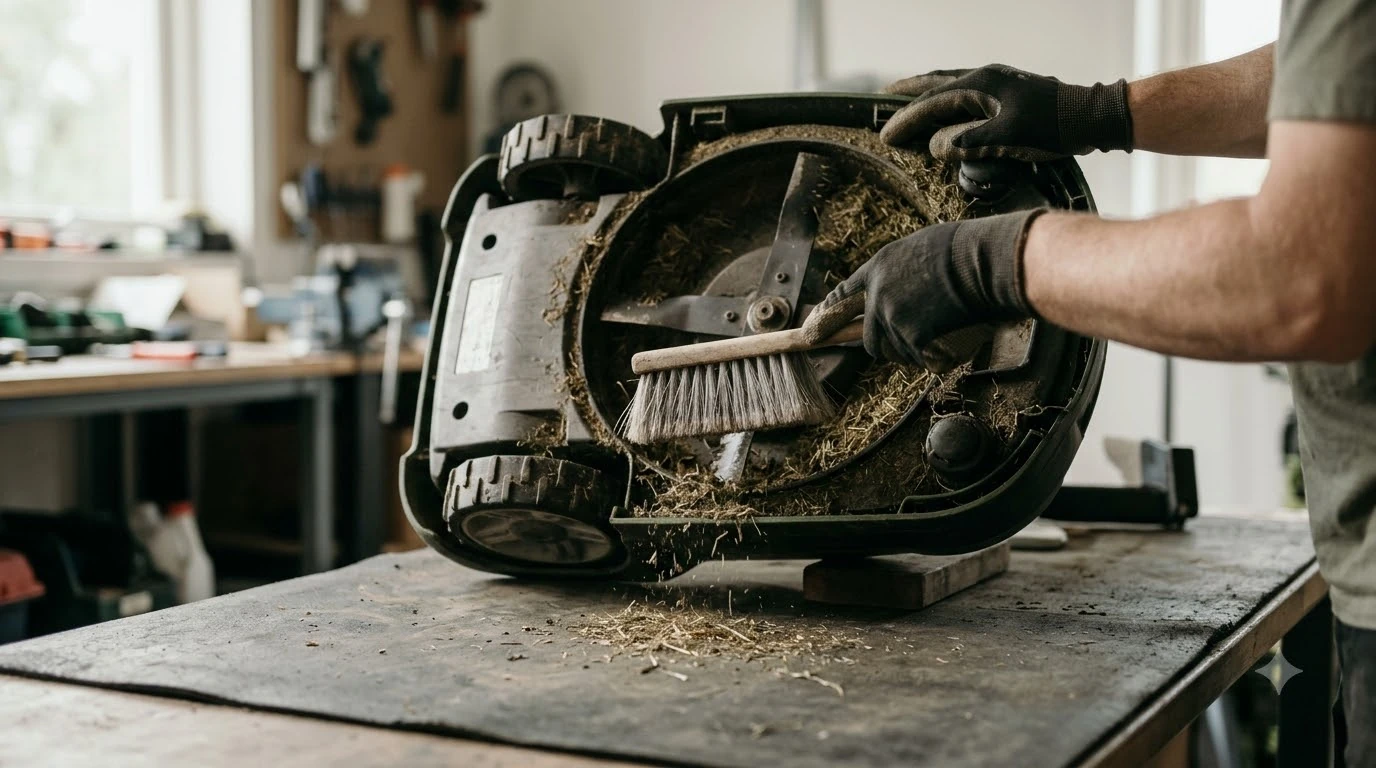

The best low maintenance robot lawn mower is the one that asks the least of you, but no robot mower needs zero care. Husqvarna and Mammotion publish the same recurring jobs for their models: replace blades every few weeks to a couple of months, clean the deck and sensors through the growing season, and replace the battery after several years. As of November 2026, our reading is that the features that reduce that work most are wire-free navigation and quick access to the blades and deck. This guide explains each task and how to compare models on it.
The short answer
- Blades are the main recurring task: Husqvarna lists 3 to 6 weeks for main disc blades and 9 to 12 weeks for EdgeCut disc blades. Mammotion says every 1 to 2 months.
- Cleaning: Mammotion advises every 1 to 2 weeks in the growing season. Husqvarna gives no fixed interval but recommends professional cleaning after each season.
- Battery: Husqvarna says battery lifespan is typically 2 to 5 years.
- Wire-free models need no boundary wire inspection or repair, according to Mammotion.
- Warranties usually exclude blades and other wear parts, so budget for them separately.
How to judge the best low maintenance robot lawn mower
Low maintenance means fewer tasks that need your attention and fewer costly parts that fail without warning. It does not mean the mower runs untouched for years. Brand support pages still list the same owner jobs: replace blades, clean the deck and sensors, keep the battery healthy, install firmware updates, and store the mower properly in winter.
Our reading is that a mower is low maintenance when those jobs are quick, predictable, and do not need special tools or a dealer visit. A blade system that swaps in a few minutes and a deck that a soft brush can reach without taking the machine apart both cut the effort. Those details matter more than the brand name on the box.
How often each upkeep task is due
Intervals depend on the brand, the blade design, lawn size, and grass type. The table gathers the figures that manufacturers publish. Use them as starting points, then adjust to what you see on your own lawn.
| Task | Brand guidance | Source |
|---|---|---|
| Main disc blades | 3 to 6 weeks under normal conditions | Husqvarna support guide |
| EdgeCut disc blades | 9 to 12 weeks | Husqvarna support guide |
| Blades, general | Every 1 to 2 months in the mowing season, depending on lawn size, grass type, and hits on hard objects | Mammotion maintenance guide |
| Cleaning | Every 1 to 2 weeks in the growing season; wet lawns or heavy clippings may need more | Mammotion maintenance guide |
| Battery, wheel, and sensor checks | Once a month | Mammotion maintenance guide |
| Professional cleaning | After each season | Husqvarna support guide |
Notice that the two brands use different units for the same job. Husqvarna sets blade life in weeks, while Mammotion uses months. Neither number is a promise. Heavy use, rocky soil, and frequent contact with hard objects all shorten the interval.
Blades: the main recurring cost
Blade life is set by wear, so inspect blades before you replace them, whichever model is the best low maintenance robot lawn mower for your yard. Husqvarna says to change blades when grass tips look frayed or whitened, or when the blades show visible damage. Sunseeker, a manufacturer’s own blog, recommends replacing a robot mower blade when more than a quarter of its cutting edge is damaged or worn smooth, and says replacement is the better option for most robot mower blades. Our notes on the signs of dull robot mower blades cover what to look for.
The same wear logic applies to any mower. Purdue Extension shows leaf blades injured by a dull mower blade and describes a lawn with a whitish cast from mowing with a dull blade, which is the damage you see when a blade is past its best.

Husqvarna gives two practical rules that save trouble later. Fit a new screw with every new blade, because reused screws can loosen. Also avoid mixing old and new blades. Mammotion advises replacing all the blades together so the cutting stays balanced, and using new screws each time.
Cleaning and sensor care
Cleaning is hand work, and it is the task owners skip most often. Mammotion says cleaning every one to two weeks during the growing season is enough to keep a mower running well, with more frequent cleaning on wet lawns or after heavy clippings. Husqvarna does not give a fixed interval, so follow the schedule in your mower’s manual if it has one.
The order matters, and Mammotion’s guide gives a clear sequence for owners to follow:
- Power off the mower. Never clean it while it is running.
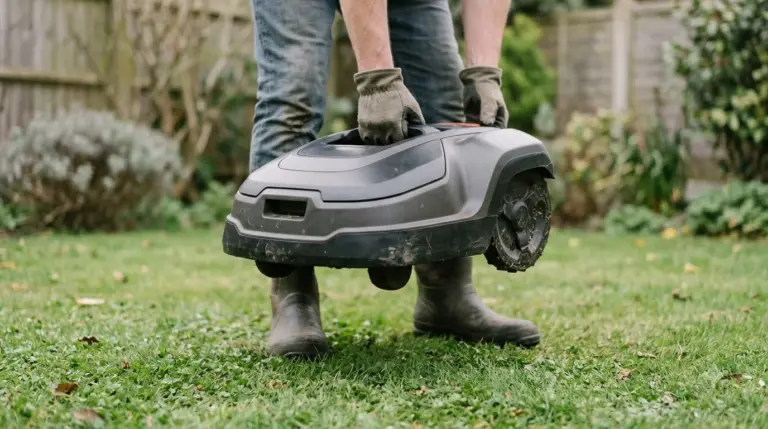
- Clear the underside. Use a soft brush or plastic scraper to remove clippings from the deck.
- Clean the wheels. Remove grass and soil that build up around the tread.
- Wipe the sensors. Mammotion’s order includes the sensors and housing.
- Clean the charging contacts. This is the last step in Mammotion’s sequence.
- Dry it fully before charging. Mammotion says to let the mower dry completely before it returns to the charging station.
Both brands caution against pressure washers. Husqvarna says never to use a high-pressure washer on the charging station, and Mammotion says to avoid one unless the manufacturer states it is safe. Our reading: a soft brush and a damp cloth cover most of the work.
Battery life and winter storage
Husqvarna says battery lifespan is typically 2 to 5 years. Ecovacs, in a robot mower cost guide, gives 3 to 5 years and advises replacing it when battery life deteriorates. Husqvarna lists frequent returns to the charging station and stopping on the lawn with no error message as warning signs. Our tips for making a robot mower last longer add more battery habits.
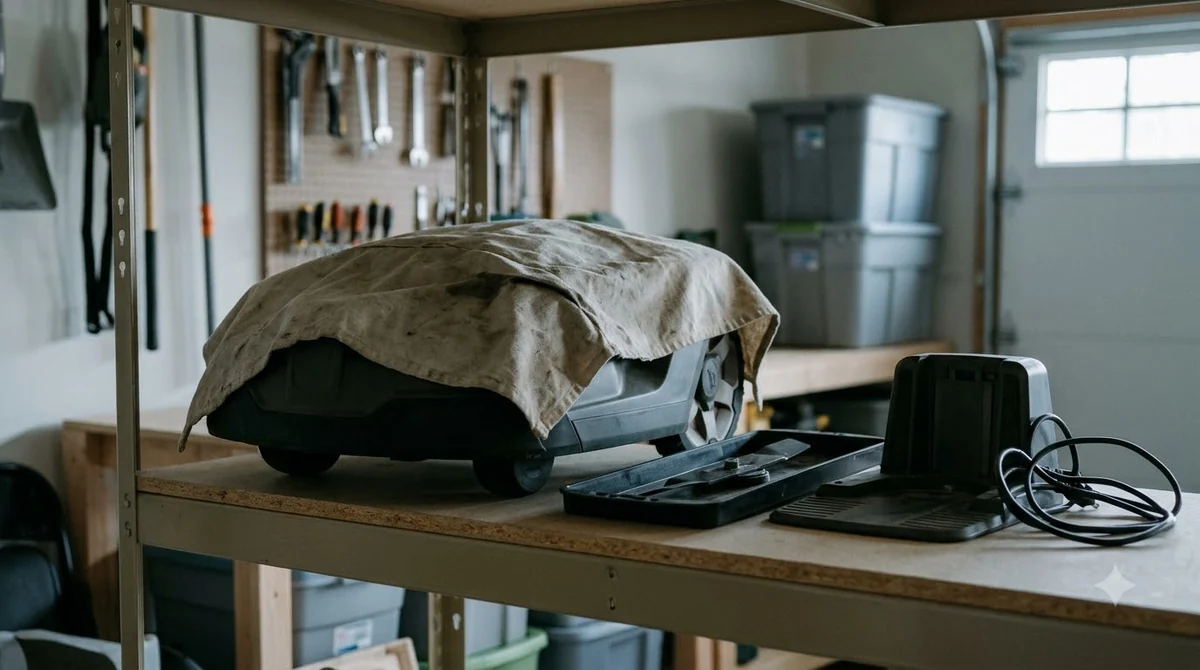
Winter storage is where many owners lose battery health. Husqvarna advises fully charging the battery before the mower is switched off, then storing it indoors in a dry, frost-free place with temperatures above 0 C (32 F). Its Frost Guard routine parks the mower when the forecast predicts temperatures below 5 C (41 F). Mammotion’s checklist says to prepare for winter before the first frost. If you wonder whether it can stay out, see whether robot mowers can be left outside.
Wire-free and boundary wire setup
Boundary wire is one of the less visible upkeep jobs on wired systems. The wire can be cut by garden tools, shift in the soil, or need repairs after a season of mowing. Mammotion states that its wire-free models need no boundary wire inspection or repair. That removes one task from the list.
Our reading is that wire-free is a real upkeep saving for owners who would otherwise check and repair wire every season, and it counts when you pick the best low maintenance robot lawn mower. For how it works, see how robot lawn mowers work without a wire. It does not remove blade, cleaning, or sensor care. Check whether a model depends on a separate base station or a satellite signal, because those parts also need to be kept clean and powered.
Warranty and excluded wear parts
Warranties usually cover the mower body and motor but leave out consumables. Ecovacs’ UK support page treats wearing parts such as blades as exceptions to its battery term and excludes normal wear and tear. Worx’s EU warranty statement excludes blades, wheels, natural wear parts, and damage from high-pressure, steam, or running-water cleaning. As of November 2026, these terms are set by each brand and change over time, so read the current statement for the exact model you plan to buy. Our comparison of the best robot mower with longest warranty lays out several policies side by side.
In the United States, the Federal Trade Commission says a written warranty on a consumer product costing more than $10 must be labeled “full” or “limited.” A full warranty carries specific obligations for the seller. A limited warranty can require the buyer to pay labor and postage. Check which type you are getting, and whether registration is required to keep the coverage.
What to check before you buy
Use these questions to find the best low maintenance robot lawn mower for your yard before you compare prices. Prices change often, while upkeep costs keep running for the life of the mower.
- Blade type and replacement cost. Find the blade interval and the price of a full set in the model’s own support pages.
- Cleaning access. Check whether the deck and sensors can be reached with a brush without special tools.
- Battery terms. Look for the stated battery lifespan, the replacement price, and the warranty term for the battery.
- Boundary wire or wire-free. Decide which upkeep you prefer to take on.
- Firmware and app. Confirm that updates are published and that key features do not depend on a subscription.
- Winter storage. Confirm the storage temperature and whether the mower has a frost-protection mode.
Frequently asked questions
How often do robot mower blades need changing?
Husqvarna gives 3 to 6 weeks for main disc blades and 9 to 12 weeks for EdgeCut disc blades under normal conditions. Mammotion says every 1 to 2 months. Wear, not the calendar, should decide when to replace them.
Do robot mowers need cleaning?
Yes. Mammotion advises cleaning every one to two weeks in the growing season. Husqvarna says regular cleaning extends the mower’s lifespan and recommends professional cleaning after each season.
How long does a robot mower battery last?
Husqvarna says battery lifespan is typically 2 to 5 years, and Ecovacs gives 3 to 5 years. Use, climate, and storage habits all affect the result.
Is a wire-free robot mower lower maintenance?
It is, in one respect. Mammotion says wire-free models need no boundary wire inspection or repair. Blades, cleaning, sensors, and the battery still need regular attention.
Sources
- Automower support guide by season (Husqvarna): blade intervals, cleaning, battery lifespan, winter storage, Frost Guard.
- Robot lawn mower maintenance (Mammotion): cleaning and blade intervals, owner tasks, wire-free note.
- How much does a robot lawn mower cost (Ecovacs): blade and battery replacement intervals.
- When to replace lawn mower blades (Sunseeker): wear threshold and replace-versus-sharpen guidance.
- Purdue Extension AY-8 (Purdue University): dull blade damage to grass.
- Warranty (Ecovacs UK support): blades as wearing parts, normal wear excluded.
- Warranty statement (Worx): excluded wear parts and cleaning damage.
- Warranty guidance (Federal Trade Commission): full and limited warranty labeling.
 Up next8 min readBest Robot MowersRobot Mower Maintenance Checklist: Cleaning, Blades, and StorageUpdated Nov 11, 2026
 9 min readBest Robot MowersWhich Ecovacs GOAT Robot Mower Model to Buy: A Sourced GuideUpdated Nov 11, 2026
 8 min readBest Robot MowersHow to Choose an RTK GPS Robot Lawn Mower in 2026Updated Nov 11, 2026
 9 min readBest Robot MowersBest Robot Lawn Mower for Seniors and Retirees: What to CheckUpdated Nov 11, 2026
 10 min readBest Robot MowersBest Robot Lawn Mower for Elderly Parents: What to Check Before You BuyUpdated Nov 11, 2026
 9 min readBest Robot MowersBest Husqvarna Automower Robot Mower Model to BuyUpdated Nov 11, 2026