
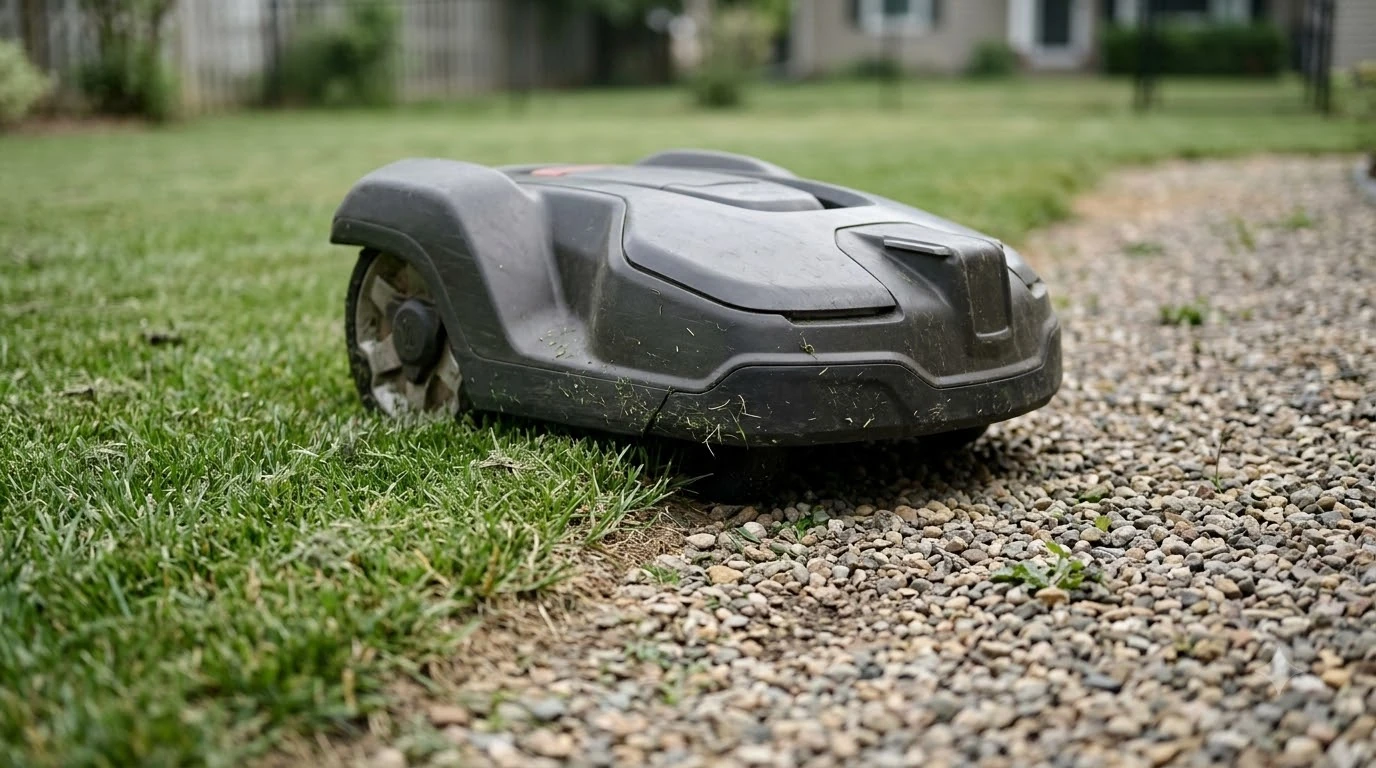

How do robot lawn mowers work without a wire? They rely on satellite positioning, sensors and a map of the lawn drawn in an app. The satellite method is usually RTK (see what RTK stands for on a robot mower), which vendors say can reach centimeter-level accuracy when the sky is clear.
The main difference from a boundary wire is that wire-free mowers depend on a clear view of the sky. Your yard layout decides which setup fits, so check the trees and buildings before you buy.
The short answer
- Edge: an app map or virtual boundary replaces the buried wire.
- Position: RTK satellite signals place the mower inside that map.
- Safety: lift and tilt sensors shut off the blades immediately.
- Limits: the mower needs a clear sky, and trees or tall buildings reduce accuracy.
How do robot lawn mowers work without a wire? Satellites and app maps
Most wire-free models store the lawn boundary in a companion app and use satellite positioning to keep the mower inside it. On Husqvarna’s EPOS system, the boundary is a virtual one built from high-precision RTK-GNSS signals through the Automower Connect app, according to Husqvarna’s US how-it-works page.
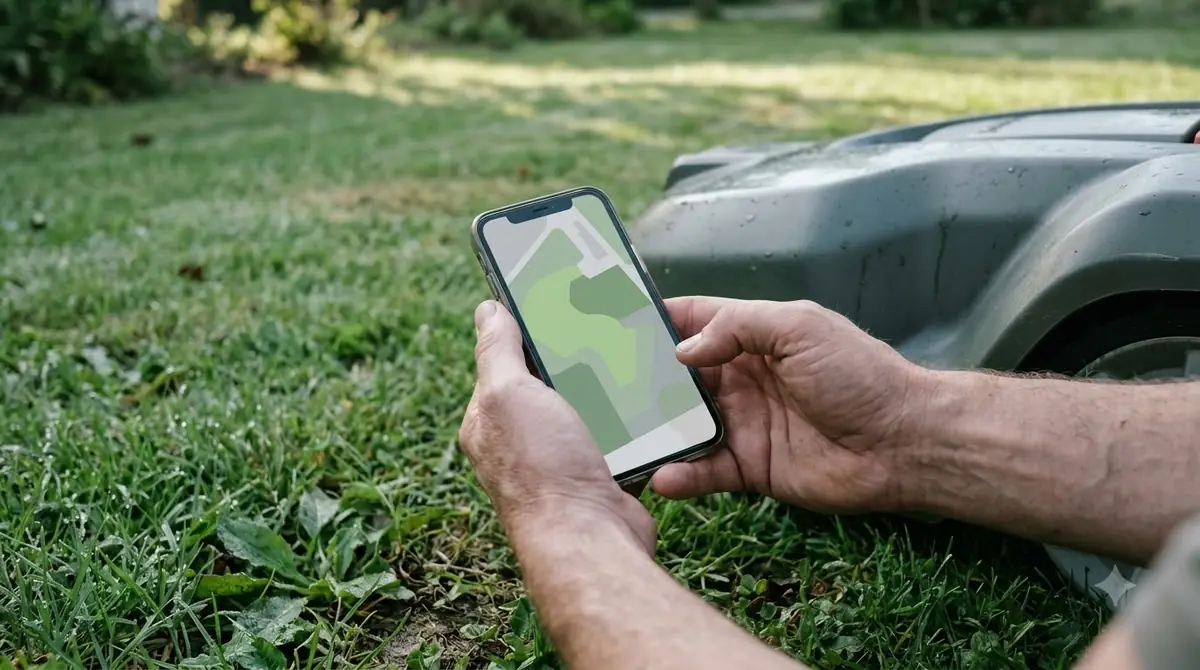
The process has three parts:
- Mapping. The boundary is set in the app rather than laid on the ground.
- Positioning. The mower reads satellite signals to know where it sits on that map.
- Returning. It heads back to the charging station by signal or guide wire, depending on the model.
Once the map is set, the mower covers the lawn in a random pattern. Husqvarna says this reaches every corner over time without leaving track marks, and that the blades cut just a few millimeters at a time.
Husqvarna says only select Automower models use GPS for navigation, and the page does not name them. Where satellite coverage is poor, the company says a physical wire can be buried instead. A “wire-free” model may still need a wire in some places.
What RTK needs, and where wire-free mowers struggle
RTK needs a clear view of the sky, and accuracy drops under heavy tree cover or close to tall buildings. Four conditions decide whether a wire-free setup works in a given yard, so check them when you ask how robot lawn mowers work without a wire in your own yard.
- Open sky: RTK needs clear sky above roughly 15 degrees from the horizon, according to RTKdata’s accuracy guide.
- Metal and water: the same guide says base sites should avoid vehicles, metal objects and water, citing NGS advice.
- Trees and buildings: Mammotion says accuracy “drops under heavy canopy or close to tall buildings.” Our guide to robot mowers that work under trees without RTK covers the alternatives.
- Coverage: Network RTK is not available everywhere, so Navimow provides a coverage checker for your area.
Without correction, consumer GPS is accurate to about 4.9 meters in open sky, which is too coarse to mark a lawn edge. RTK corrections bring that error down. Navimow says that with Network RTK, “there’s no need to install any local antenna,” but its page gives no accuracy figure in centimeters.
Sensors that stop the blades and avoid obstacles
How do robot lawn mowers work without a wire when something is in the way? Lift and tilt sensors shut the blades off immediately, and collision handling makes the mower stop, reverse and turn, according to Husqvarna’s US page. Our reading is that satellite positioning alone does not spot a toy or a garden hose, so wire-free models add sensors (see how robot mowers avoid obstacles).
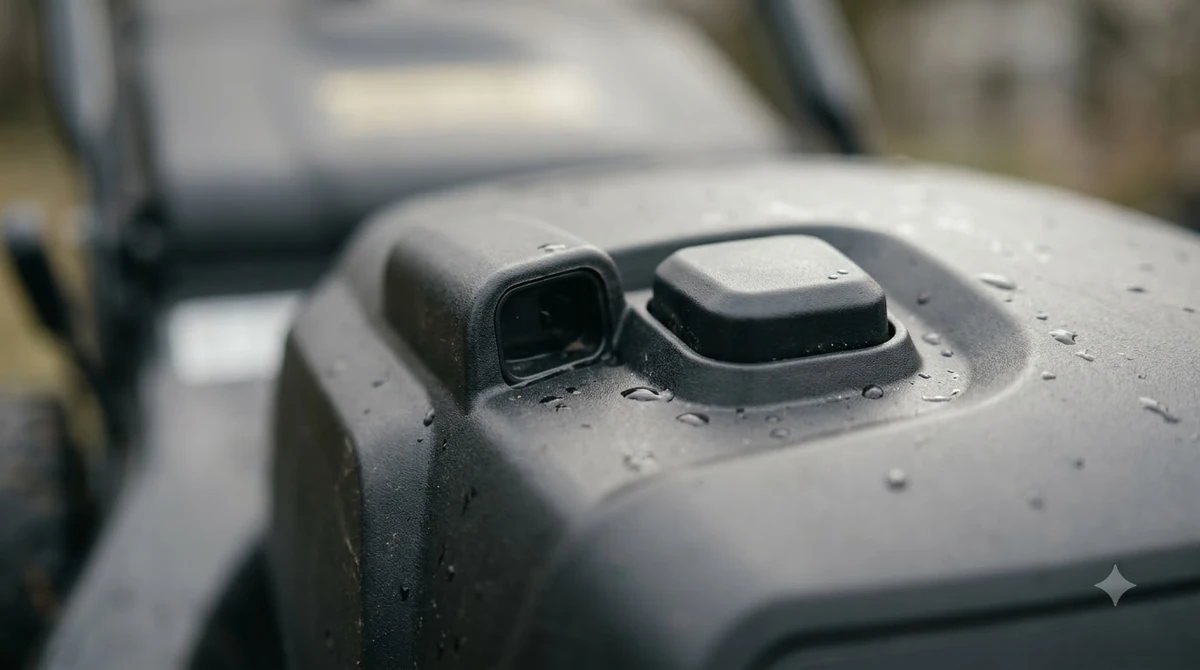
- Lift or tip: the blades stop at once when the mower is picked up or turned over.
- Collision: the mower stops, reverses and changes direction after it meets an object.
- Vision and LiDAR: some models use cameras or LiDAR to spot obstacles before contact, as explained in how lidar robot mowers work.
Husqvarna’s page describes collision handling in two different ways, once as a bump and once as steering away before contact. Ask the seller how the model behaves before you buy. Navimow says its models detect and avoid pets, children or garden decorations.
Heads up
Mowers have spinning blades and move without supervision. Keep children and pets clear when you lift, move or service the mower.
Where a wire still helps: guide wires and hybrid setups
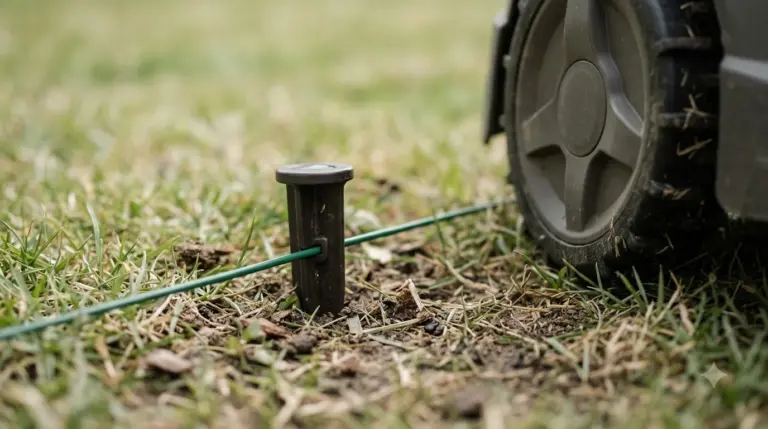
So how do robot lawn mowers work without a wire in tricky spots? Many wire-free systems still use a short guide wire to bring the mower home, and some owners add wired sections. Husqvarna describes its guide wire as patented and as the fastest route back to the dock.
That guide wire can lead the mower through passages “as narrow as 24 inches (60 cm),” according to Husqvarna. The same page is not consistent about return methods: one section mentions signals or wires, while the FAQ lists guide wire, boundary wire or GPS. Check the manual for the exact model you plan to buy.
Mammotion describes a hybrid setup that adds short wired sections around flower beds, ponds or pools, and on steep slopes. It also says wired boundaries are “very stable” in shaded areas.
How wire-free compares with a boundary wire
A boundary wire holds its edge under trees but needs installation work, while a wire-free mower skips the wire and depends on sky view. The table compares the two on the factors that matter most.
| Factor | Boundary wire | Wire-free (RTK or sensing) |
|---|---|---|
| Setup | Wire placed or buried around the edge | No wire to bury; the boundary is set in an app |
| Under trees | Described as “very stable” in shade by Mammotion | Accuracy drops under heavy canopy, per Mammotion |
| Open sky needed | No | Yes, RTK needs sky above roughly 15 degrees |
| Obstacles | Sensors plus the wire loop | Sensors and, on some models, cameras or LiDAR |
| Returning to the charger | Follows the boundary or guide wire | Guide wire or GPS, depending on the model |
| Cost | Typically lower, according to Mammotion | Typically higher, according to Mammotion |
Mammotion also notes that wire-free systems may require software updates or occasional recalibration, which is one more maintenance task that a wire model avoids. If you want the shortlist of models, see the best robot mowers without a boundary wire.
Our reading is that the choice depends on where you plan to run the mower. A boundary wire suits yards with trees and shaded corners, while wire-free suits open lawns with a clear sky. The pages cited here give no installation hours for either method, so compare dealer quotes rather than assuming one is faster.
What to check before you buy a wire-free mower
Before you buy, confirm the navigation method, measure the sky view and check the trees and buildings around the lawn. Those three checks settle most wire-free problems before they start.
- Navigation method. Confirm whether the model uses RTK, GPS, vision or a wire, since Husqvarna says only select models use GPS.
- Sky view. Look for open sky above roughly 15 degrees over the lawn.
- Coverage. For Network RTK, check service for your area, because it is not available everywhere.
- Slope and blades. Husqvarna lists 20 to 40 percent slopes for standard models and recommends replacing blades every one to two months.
So, how do robot lawn mowers work without a wire? An app map sets the edge, RTK satellite signals place the mower inside it, and sensors handle lifting, tipping and obstacles.
Frequently asked questions
Do robot lawn mowers need a boundary wire?
Not always. Many newer models use satellite positioning or sensors instead of a buried wire. Some still need a wire in places, so check the navigation method on the spec sheet before you buy.
Does RTK work under trees?
Usually less well. Mammotion says accuracy drops under heavy canopy, so a wired boundary is often the steadier choice for shaded lawns.
Is a wire-free mower more accurate than plain GPS?
Yes, when RTK corrections are used. Consumer GPS without correction is accurate to about 4.9 meters in open sky, which is too coarse for a boundary, according to RTKdata’s guide.
What happens when the satellite signal drops?
The result depends on the model. Husqvarna says a physical wire can be buried where satellite coverage is poor. Ask the seller how the model behaves during signal loss.
Sources
- Husqvarna, How do Automower robotic lawn mowers work? (manufacturer): EPOS RTK-GNSS virtual boundary, sensors, guide wire, blade replacement.
- Navimow, wire-free robot lawn mower explainer (manufacturer blog): Network RTK without a local antenna, coverage checker, obstacle avoidance.
- Mammotion, do robot lawn mowers need a boundary wire? (manufacturer blog): accuracy under canopy and buildings, hybrid setups, wired and wire-free cost comparison.
- RTKdata, wire-free robot mower RTK accuracy guide (RTK vendor guide): sky view above roughly 15 degrees, base station placement away from metal and water, uncorrected GPS accuracy of about 4.9 m.
 Up next7 min readLearnWhat Is a Boundary Wire on a Robot Mower? How It WorksUpdated Nov 11, 2026
 9 min readLearnHow to Install a Robot Mower Boundary WireUpdated Nov 11, 2026
 9 min readLearnWorx Landroid No Wire Signal: Causes and FixesUpdated Nov 11, 2026
 7 min readLearnDoes a Robot Mower Work With a Dog in the Yard?Updated Nov 11, 2026
 8 min readLearnWhat Temperature Can a Robot Mower Work In?Updated Nov 11, 2026
 7 min readLearnDo Robot Mowers Work in Hot Weather? Temperature Limits ExplainedUpdated Nov 11, 2026