
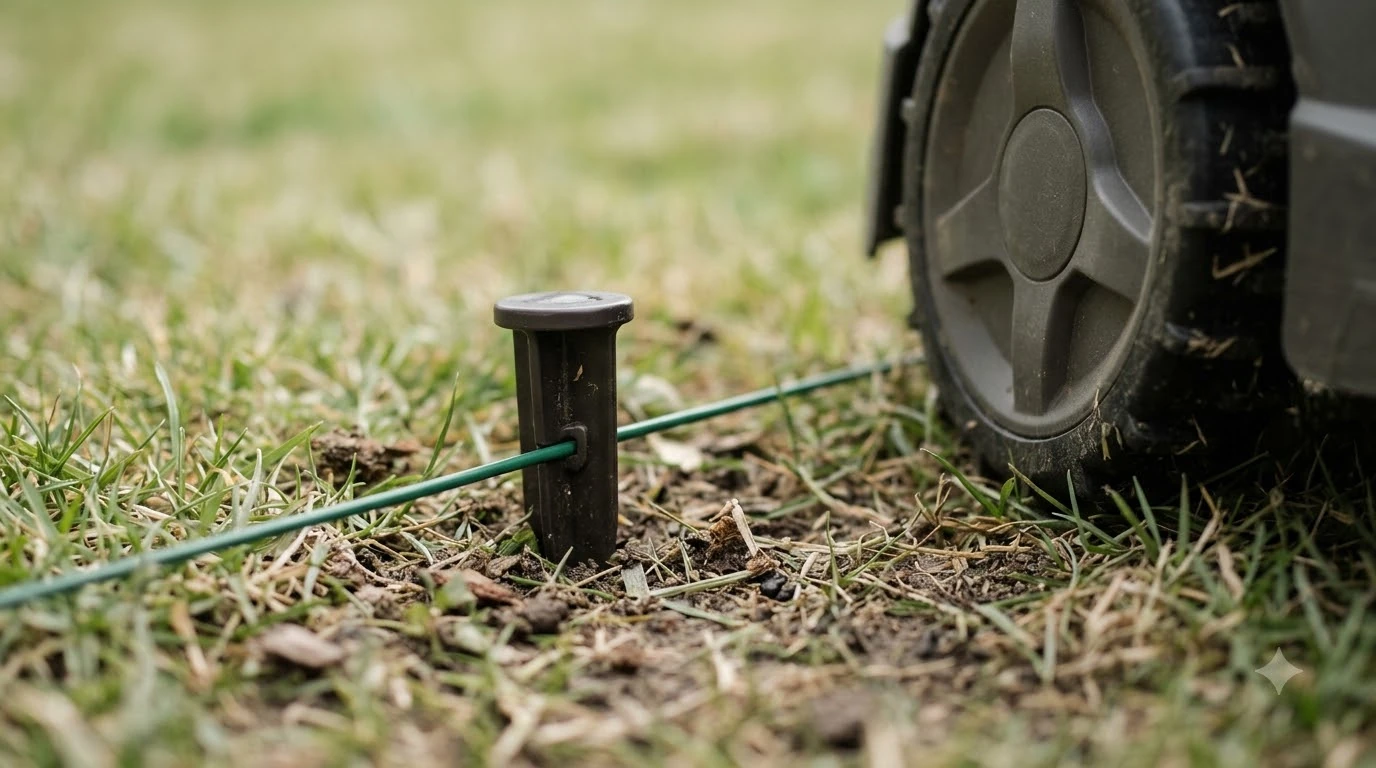

What is a boundary wire on a robot mower? It is a low-voltage, insulated cable that marks where the mower may cut. The cable is laid around the edge of the lawn and around any obstacles you want the mower to avoid, such as flower beds, ponds and patios. The charging station powers the wire, and the mower’s sensors pick up the signal it sends, so the mower knows where its cutting area ends.
The short answer
- What is a boundary wire on a robot mower? An insulated cable buried or pegged around the lawn perimeter and obstacles.
- How it works: the charging station energizes the loop, and the mower detects a very low magnetic field.
- What the mower does: it slows, turns and stops before crossing the wire.
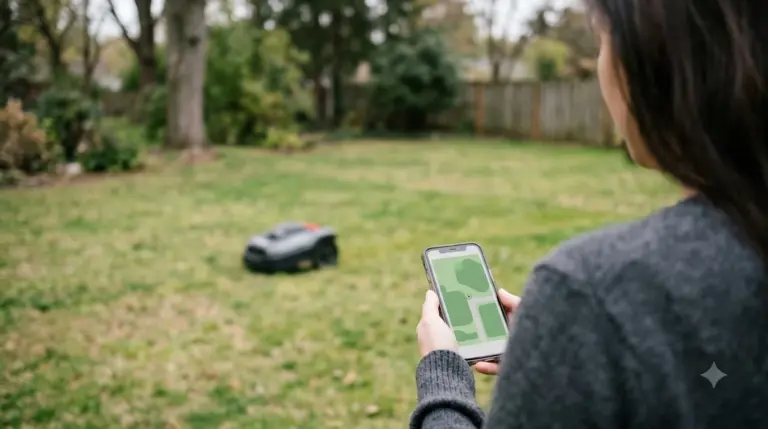
- Wire-free option: some models use satellite positioning and app-drawn virtual boundaries instead.
What is a boundary wire on a robot mower?
A boundary wire is connected to the charging station, and the station energizes it. According to Robomow’s guide to laying the wire, this creates a very low magnetic field that the robot can detect. The mower does not need to touch the wire to notice it. It reacts as it approaches the loop.
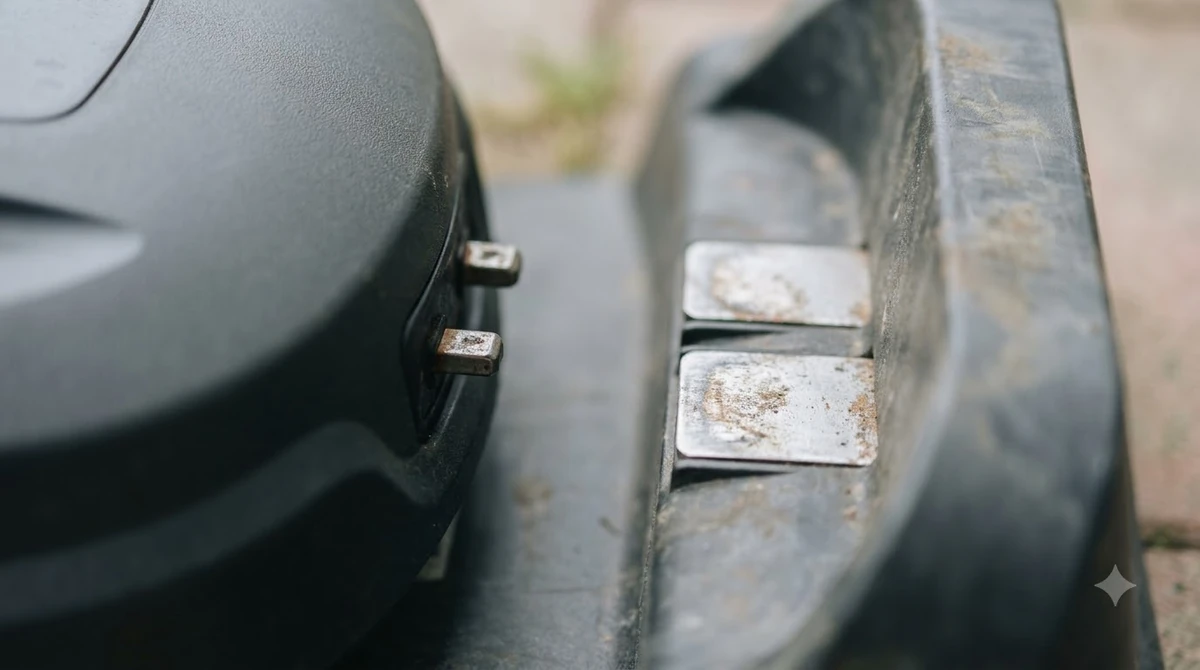
The loop starts and ends at the charging station. Its main job is to define the area to cut. Mammotion describes the signal as a continuous one that the sensors detect, and Robomow notes that the signal works like a stop sign that keeps the mower from driving over the cable.
What the wire does for navigation
What is a boundary wire on a robot mower doing as the machine moves around the lawn? Near the wire, a robot mower slows down, changes direction and stops, according to Mammotion’s explanation of boundary wire behavior. The aim is to keep the mower inside the loop without it crossing into flower beds, the driveway or a neighbor’s yard.
Husqvarna’s documentation describes a related part called a guide wire. A guide wire helps the mower return to the charging station when it is in a remote corner of the lawn. Husqvarna says its patented guide wires can help the mower pass through spaces as narrow as 24 inches (60 cm). When the battery runs low, the mower stops cutting and heads back to the station on its own.
How the boundary wire is laid
Installation is mostly a matter of depth and tension. Robomow recommends a laying depth of 4-5 cm (about 2 inches) to protect the wire from weather, and says the mower can receive the signal from a wire buried up to about 7 cm deep. Mammotion gives a similar range, recommending that the wire be buried 1-2 inches deep to prevent cuts from aeration or edging tools.

Keep the depth consistent along the whole loop. For a step-by-step walkthrough, see how to install a robot mower boundary wire. Robomow says an even depth helps the mower achieve a clean edge cut. Above ground, the wire is fastened at regular intervals with lawn hooks or robot mower wire pegs, and it should be pulled tight so it does not stick out and get damaged. Robomow also suggests leaving the cable above ground in test mode for two to three weeks before you bury it, so you can check the route before you commit to it.
Mammotion advises waterproof connectors for robot mower wire on any splice, since moisture causes corrosion. Wire is sold in rolls, and Robomow lists ready rolls of 100 m, 200 m and up to about 650 m.
How far to keep the wire from obstacles
The distance between the wire and an obstacle depends on what the obstacle is. Robomow publishes rough guide values, and it asks you to confirm the figures against your model’s manual before you install.
| Obstacle | Suggested wire distance (Robomow guide) |
|---|---|
| Walls and tall stones | about 35 cm |
| Flower beds or hedges | about 10 cm |
| Slabs and paths (at ground level or lower) | about 10 cm |
| Pond | about 35 cm, plus extra barriers so the mower cannot fall in |
| Narrow passage | wider than 70 cm |
Our reading is that these numbers are a starting point, not a substitute for the manual. The wider gap around ponds and walls is there because the mower needs room to turn before it reaches the edge.
What happens when the boundary wire is damaged
A broken wire can stop a boundary-wire mower mid-season, according to Mammotion. Robomow says a scarifier or lawn trimmer can cut a wire laid above ground relatively easily, and that damage from something like animals gnawing the cable is harder to troubleshoot and repair when the wire is buried. That is why it suggests testing the route above ground first.
Repairs use a connector. Robomow says defects in an above-ground wire can be found and repaired quickly with cable connectors, and that two cable ends can be clamped together with them. Use a connector rated for outdoor and wet conditions, as Mammotion recommends for splices, and see how to find a break in robot mower wire if the mower stops for no clear reason.
Our reading is that the best way to avoid repairs is to keep the wire away from where you edge, aerate or scarify. Keep the route clear of the paths you drive over most often, and recheck the loop after any heavy garden work. Mammotion also suggests walking the perimeter once a season and testing continuity, so that small breaks are caught early.
Wire-free alternatives
Not every robot mower needs a buried cable. Husqvarna says its traditional models used a buried physical boundary wire, while its newer EPOS system creates virtual boundaries from high-precision RTK satellite signals and an app. Husqvarna also says a physical wire can still be installed as a fallback in areas with poor satellite coverage.
So what is a boundary wire on a robot mower in practice? One option for defining the cutting area, not the only one. Both approaches answer the same question, and our guide on how robot lawn mowers work without a wire covers the other route. The trade-off is simple. A wire-based system depends on the loop being installed and kept intact, while a satellite system depends on a clear view of the sky. Both approaches still need the charging station to act as the return point.
What to check before you install a boundary wire
Plan for wire length as well. Robomow sells ready rolls of 100 m, 200 m and up to about 650 m, so measure the whole loop, including the route back to the charging station, before you buy. Then confirm three things in the manual for your model: the recommended depth, the distances for each obstacle type, and the wire gauge and connectors it accepts. Walk the route first with the cable above ground, since changes are much easier to make before it is buried.
Frequently asked questions
Does a boundary wire carry electricity?
Yes, but at low voltage. Mammotion describes it as a low-voltage wire, and Robomow says the charging station energizes it to create a very low magnetic field. The published sources do not give a specific voltage or current figure.
How deep should a boundary wire be buried?
Robomow recommends 4-5 cm (about 2 inches) and says the signal can be received from up to about 7 cm deep. Mammotion suggests 1-2 inches. Always follow your model’s manual, since depth requirements can differ.
Can a robot mower cross a boundary wire?
No. Robomow says the signal acts like a stop sign and that the cable must not be crossed under any circumstances. The mower slows and turns before reaching the wire, according to Mammotion.
Do all robot mowers need a boundary wire?
No. Husqvarna says its traditional models used a buried wire, while its EPOS system creates virtual boundaries from RTK satellite signals and an app. Check the specifications for the exact model before you plan the installation.
Sources
- Robomow boundary wire guide (manufacturer): signal, depth, spacing values and test period.
- Mammotion boundary wire article (manufacturer): low-voltage description, mower behavior near the wire, burial depth and splices.
- Husqvarna Automower how it works (manufacturer): guide wire, return to station and EPOS wire-free option.
 Up next9 min readLearnHow to Install a Robot Mower Boundary WireUpdated Nov 11, 2026
 8 min readLearnHow Do Robot Lawn Mowers Work Without a Wire?Updated Nov 11, 2026
 8 min readLearnWhat Is Virtual Boundary Mapping on a Robot Mower?Updated Nov 11, 2026
 9 min readLearnWorx Landroid No Wire Signal: Causes and FixesUpdated Nov 11, 2026
 9 min readLearnDo Robot Mowers Really Work? Yes, on the Right LawnUpdated Nov 11, 2026
 7 min readLearnDo Robot Mowers Work in Hot Weather? Temperature Limits ExplainedUpdated Nov 11, 2026