
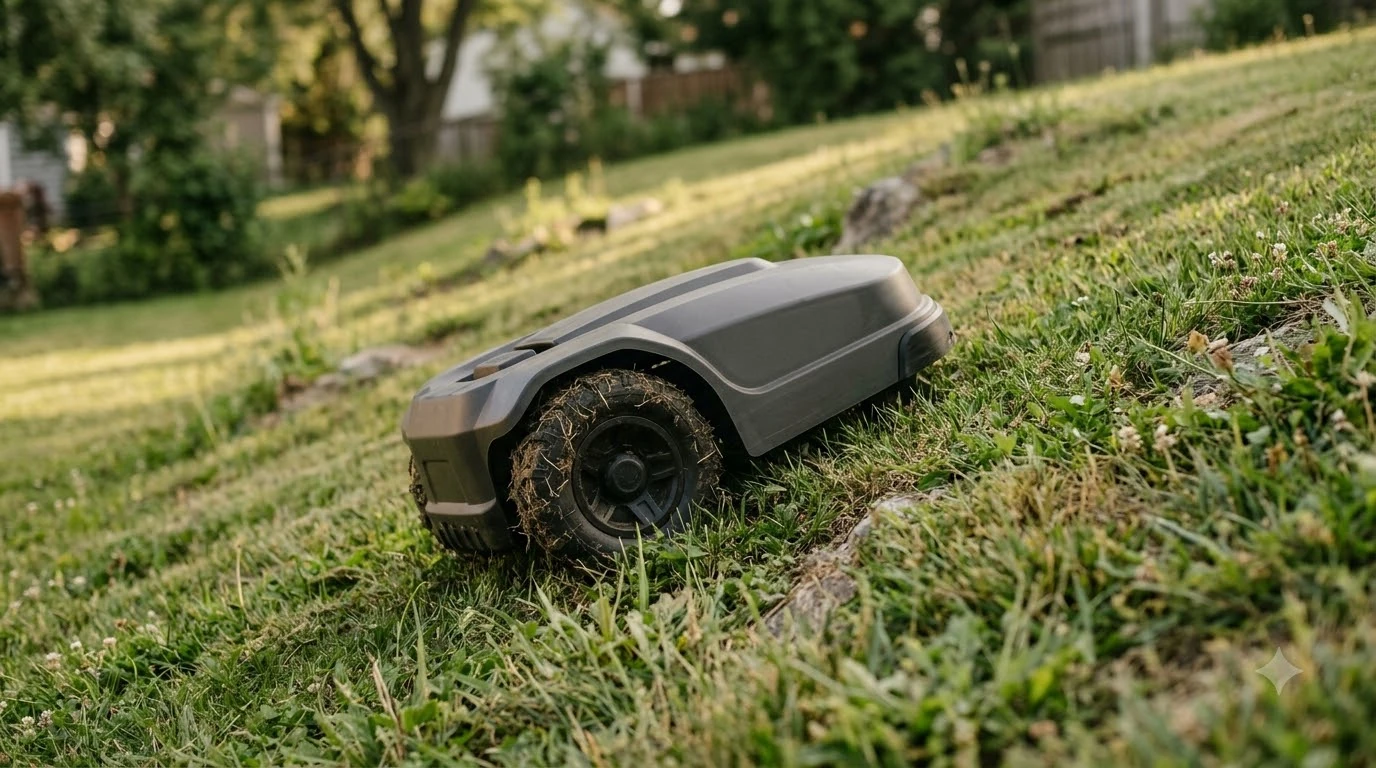

Robot mower for yard with retaining walls: it can work when the wall itself acts as the boundary, and the banks around it stay inside the model’s slope limit. Robomow’s installation guide puts the boundary wire about 35 cm (14 in) from walls, and the slope limit on any bank decides whether the mower can reach the area at all. Those are the two checks that matter most in a yard with level changes.
The short answer
- Walls: keep the boundary wire about 35 cm from a wall the mower can reach, or let a wall the mower cannot cross serve as the boundary.
- Drop-offs: treat the top or base of a wall as an edge. The sources read do not give a set distance for drop-offs, so check your model’s manual.
- Slopes: compare every bank with the model’s rated limit. Most standard residential models handle 20 to 30%.
- Passages: leave at least 70 cm for a narrow passage between wall sections, as Robomow advises.
Where a retaining wall fits in the boundary
A robot mower for yard with retaining walls can save you wire, because a retaining wall can serve as the boundary. According to Robomow’s boundary wire guide, a wall the mower cannot cross can act as the boundary, so no wire is needed along that section. Where the mower can reach the wall, the same guide suggests laying the wire about 35 cm away from walls and tall stones, and about 10 cm from beds and hedges. Our guide to routing boundary wire around obstacles shows how to apply that on a real lawn.

Obstacles in the middle of the lawn follow the same rule. Robomow says obstacles inside an area must also be demarcated with boundary wire, and the wire must never cross itself. Any planter, stone step or post inside a sloped section needs the same treatment as the outer edge.
What to do about the drop at the top or bottom of a wall
A drop is not the same as a wall, and the two need different handling. Sunseeker’s guide to slopes lists sudden drop-offs among the natural obstacles that sloped lawns often have, alongside exposed roots and rocks. Its app can mark steep embankments as no-mow areas, and it suggests a separate zone for a steep section so you can control its schedule.
Husqvarna’s steep-slope guide for the UK covers boundary placement on slopes, but it states that water and drop-offs are not covered. The guide tells you to position the boundary further in on flat ground before the slope begins. That is a reasonable starting point for the top edge of a wall, though the exact figure depends on the model.
Heads up
None of the sources read for this article gives a distance for a drop-off edge. Do not assume the mower will stop before a ledge. Read the installation section for your model and check how it handles edges and drop-offs before you buy.
Robot mower for yard with retaining walls: slope limits
A bank above or below a wall counts as a slope, and the model’s slope rating applies to it. Check the slope limit on any bank near the wall, since the bank is where traction problems start. Husqvarna’s guide uses a simple formula: slope percent equals vertical height divided by horizontal distance, times 100. A rise of 15 cm over 100 cm is a 15% slope. Standard Automower models are rated from 25 to 50%, depending on the model. See how to measure a bank’s slope for a step-by-step method.
Sunseeker groups slopes into three bands that are easy to remember. The table below uses its figures, and it is a useful way to sort a bank before you check your model’s own limit.
| Band | Slope | Angle | What it means near a wall |
|---|---|---|---|
| Gentle | Under 15% | Under 8.5 degrees | Within the range most standard models are rated for |
| Moderate | 15% to 35% | 8.5 to 19 degrees | Check the model’s limit and keep the wire further in |
| Steep | Over 35% | Over 19 degrees | Only models rated above this handle it; otherwise plan a no-mow zone |
To read a bank’s slope, remember the arithmetic: a 25% slope is a one-foot rise for every four feet of horizontal travel. Measure the rise with a level and a straight board across the bank, then divide by the board’s horizontal length. A bank that looks gentle from the house can still sit in the moderate band once you measure it, so measure each section near a wall separately.
Husqvarna’s UK guide adds that the maximum slope by the boundary varies from 10% to 50% by model. That range is wide, so the number on your model’s spec sheet is the only one that counts. Sunseeker also warns that a mower operating near or beyond its stated slope limit risks losing traction, which is a problem on a bank that sits right under a wall. The same issue shows up on side slopes and ditches, and in the question of whether robot mowers tip over on banks and hills.
Plan the wire, passages and wall sides
Passages between wall sections need enough room for both the wire and the mower. Robomow says a narrow passage should be wider than 70 cm (see also our page on robot mower narrow passage width). Husqvarna’s passage method uses at least 60 cm between boundary wires, with a guide wire through the gap.

- Mark the walls first. Walk the lawn and note each wall the mower can reach, each wall it cannot cross, and each drop.
- Set the wire 35 cm from reachable walls. Use the model’s own distance if the manual gives a different one.
- Use the wall as the boundary where it cannot be crossed. Confirm the mower cannot climb it before you skip the wire.
- Keep beds at about 10 cm. Robomow gives about 10 cm for beds and hedges.
- Keep paths and slabs at ground level. Robomow’s 10 cm rule applies only when the path sits at or below the lawn surface.
- Leave a passage over 70 cm. Check the model’s manual for the minimum.
Once the wire is laid, test the route along each wall by hand before the first full mowing run. Walk the boundary and look for spots where the wire runs closer to a drop than the manual allows.
What to check before you buy
Use this list before you commit to a model for banks and walls. Each item is something the manufacturer’s documents should answer.
- Slope limit: the rated percentage for the steepest bank in the yard, not the average.
- Wire distance: the model’s recommended spacing from walls, beds and drops.
- Passage width: the minimum width for any gap between wall sections.
- Lift and tip behavior: what the blades do when the mower is lifted or tipped. the Husqvarna safety Q&A we reviewed does not say, so ask the maker.
- Multi-zone support: whether a steep section can run as its own zone with its own schedule.
Frequently asked questions
Does a retaining wall need boundary wire?
Not always. A mower can skip wire where the wall is a barrier. Robomow says a wall the mower cannot cross can act as the boundary, so no wire is needed along that section. If the mower can reach the wall, lay the wire about 35 cm away from it.
Can a robot mower climb a bank next to a wall?
Only if the bank is within the model’s rated slope limit, so check each bank before you buy a robot mower for yard with retaining walls. Standard residential models are commonly rated for 20 to 30%, and Husqvarna lists standard Automower slope ranges of 25 to 50% depending on the model. Check the limit on your model.
How far from a wall should I lay the wire?
For a robot mower for yard with retaining walls, Robomow’s guide uses about 35 cm from walls and tall stones, and about 10 cm from beds and hedges. Use the distance in your own model’s manual if it differs, since the guide says to follow the installation instructions for each model.
Will a robot mower stop at the edge of a retaining wall?
The sources read for this article do not confirm that. Husqvarna’s UK slope guide says water and drop-offs are not covered. Treat any drop as an edge that needs wire or a fixed barrier, and read your model’s edge and drop-off instructions.
If the yard has a wall that cannot be crossed, a short gap near a steep bank, and a drop at the far end, aim for a model with some margin above your measured slope and a clear wire plan. Pick the model after you have measured every bank, not before.
Sources
- Laying the lawn boundary wire (Robomow): wire distances from walls, beds, paths and ponds, and passage width.
- Can robotic lawn mowers handle slopes? (Sunseeker): drop-offs as obstacles, no-mow zones and slope bands.
- How to optimise an Automower installation for steep slopes (Husqvarna): slope formula and standard slope range.
 Up next9 min readBy YardRobot Mower for Terraced Yard: What to Check FirstUpdated Nov 11, 2026
 8 min readBy YardBest Robot Mower for a Duplex Yard: What to Check Before You BuyUpdated Nov 11, 2026
 8 min readBy YardBest Robot Mower for a Coastal Yard With Salty Air: What to CheckUpdated Nov 11, 2026
 8 min readBy YardRobot Mower for Yard With Heavy Tree Canopy: What to CheckUpdated Nov 11, 2026
 7 min readBy YardCan a Robot Mower Cut Fine Fescue? Heights and What to CheckUpdated Nov 11, 2026
 8 min readBy YardRobot Mower for Lawn Next to a Two-Story House: What to CheckUpdated Nov 11, 2026