
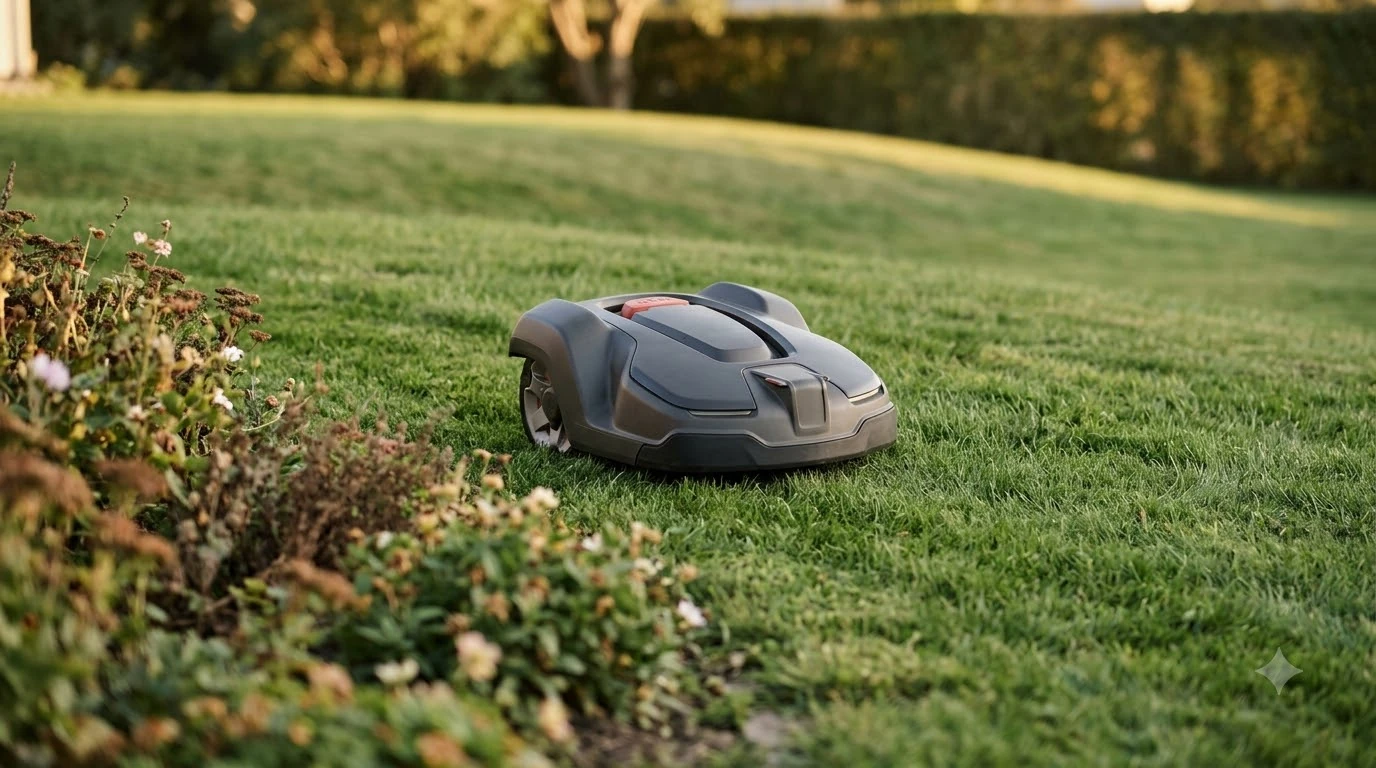

Are robot mowers tax deductible for rental property? Often yes, for the share of use that serves the rental. A mower bought for a rental can generally be treated as a rental expense. How much you deduct in the first year depends on the purchase price and whether you expense it or depreciate it, and the IRS publications we read do not name robot mowers, so confirm the classification with a tax professional.
The short answer
- Business use: the deduction follows the rental share of use. Personal use is excluded.
- Small purchases: the de minimis safe harbor lets you deduct items up to $2,500 per invoice or item if you attach the election statement.
- Larger purchases: the mower is generally depreciated, and IRS Publication 946 lists Section 179 and special depreciation options for qualifying property.
- Running costs: repairs and maintenance are generally deductible as rental expenses.
Heads up
This guide summarizes IRS publications for general information. It is not tax advice, and the limits change by year, so confirm the figures for your filing year with a tax professional.
Are robot mowers tax deductible for rental property if you also use them at home?
Only the portion of the mower that serves the rental counts. The IRS states that when property is used partly for personal purposes, you can deduct depreciation based only on the business or investment use. A mower that maintains only your rental lawn qualifies in full, while one that also mows your home lawn needs a split.
The IRS treats most rental expenses the same way. IRS Publication 527 says that in most cases the expenses of renting property, such as maintenance, insurance, taxes and interest, can be deducted from rental income. A cash-method filer generally deducts them in the year they are paid.
For expenses that cover both uses, IRS Publication 527 says you must divide the expense between rental use and personal use, and that you can use any reasonable method to do so. Expenses that belong only to the rental part of a property are not divided at all. Our reading is that a mower dedicated to one rental lawn sits in the second group, while a mower shared with your home sits in the first.
Our reading: keep a simple log or a written allocation percentage if the mower serves both properties or your home, because the split is what you would need to justify if questioned. If you are choosing a mower for a rental, see robot mowers suited to rental properties.
Expense it now or depreciate it over time
So, are robot mowers tax deductible for rental property in the first year? That depends on the treatment you choose, and a robot mower can be handled in more than one way. The table below summarizes the main options, based on the IRS pages we read.
| Treatment | When it fits | What the IRS page says |
|---|---|---|
| Repairs and maintenance | Parts and service that keep the mower working | Generally deductible unless you are required to capitalize the cost (Pub 527) |
| De minimis safe harbor | Items or invoices up to $2,500 | Deduct in the year paid if you attach the election statement to a timely return (IRS tangible property FAQ) |
| Depreciation | Larger purchase used for the rental | Spread over the recovery period, straight line with mid-month convention (Pub 527) |
| Section 179 and special depreciation | Qualifying tangible property used in business | Section 179 maximum is $2,500,000 for tax years beginning in 2025; 100% special depreciation was reinstated for certain property acquired after January 19, 2025 (Pub 946) |
The de minimis safe harbor applies per invoice or item when you have no applicable financial statement, and it is elected each year rather than adopted as a method change. The IRS tangible property FAQ also excludes inventory and land from the election. Whether a robot mower price fits under the $2,500 line depends on the model and any accessories on the same invoice. The full cost picture of a robot mower shows what else can land on that invoice, and what robot mower installation can add covers the installation line.
Section 179 and special depreciation can be large, so a bigger purchase may be deducted in the first year. There is a catch, though. IRS Publication 946 says you can elect the Section 179 deduction for partly business property only if you use it more than 50% for business in the year you place it in service. If the business-use percentage later drops to 50% or less, part of the deduction may have to be recaptured as ordinary income on Form 4797.
That 50% test is the main reason a mower that also serves your home may be a poor candidate for Section 179, even when the rental share is substantial. The IRS limits and percentages also change with new legislation, so check the figures for the year you file. The $2,500,000 Section 179 limit above is the figure on the Publication 946 page we read, which covers tax years beginning in 2025.
Classification: where a robot mower fits
Depreciation depends on which asset class the mower falls into. For residential rental property, IRS Publication 527 lists a 27.5-year recovery period for the building itself, including structural components. It places appliances, carpeting and furniture used in a residential rental in the 5-year property class.
The 27.5-year period applies to the residential rental building and its structural components, such as furnaces, water pipes and venting. A mower sits outside that structure, so the building period is not a natural fit, and the 5-year appliance class is the closest category the publication lists. The difference matters: a 5-year schedule recovers the cost much faster than 27.5 years.
Are robot mowers tax deductible for rental property as appliances? The publication does not name lawn equipment or robot mowers. A mower could be argued into the 5-year class by analogy to rental equipment, or treated differently depending on how it is used and how it is installed. Status: unconfirmed. Ask your preparer which class applies before you choose a method.
Running costs: electricity, blades and repairs
Repairs and maintenance are generally deductible unless they must be capitalized as improvements. Replacement blades, a new battery, or a repair to a damaged part are usually maintenance rather than an upgrade; battery replacement for a robot mower shows what that line can look like. An improvement, by contrast, is an expense that results in a betterment, restores the property, or adapts it to a new use, and that must be capitalized and depreciated.
Our reading: the electricity used to charge the mower is a running cost of the rental activity, and it may be deductible in the share that serves the rental. Confirm how to allocate it, because a home outlet is often shared with the household.

Two mistakes are easy to make, given how the rules above fit together. The first is deducting the full price in the year of purchase without checking the de minimis threshold, the election statement, or the Section 179 business-use test. The second is treating a mower that also serves the owner’s home as fully deductible. Our reading: both are easy to avoid by writing down the classification and the allocation before filing.
Records that support the deduction
A deduction is only as strong as the records behind it. Are robot mowers tax deductible for rental property without them? Not safely, so start with the paperwork. Keep the invoice or receipt, the date the mower was placed in service, and a note of how you use it. The IRS treats property as placed in service when it is ready and available for a specific use, including rental, so the date matters for the depreciation start.
- The purchase invoice, showing price, date, and any accessories bought together
- The date the mower was first used for the rental
- A usage note or allocation percentage if it also serves other property or your home
- Receipts for blades, batteries, and repairs, with the property they served
If you convert a mower from personal to rental use, the IRS says you can begin depreciating it at the time of the change, so record the conversion date too.

When a tax professional should review it
Are robot mowers tax deductible for rental property when the cost is large? A tax professional should review the purchase if the cost is large, the mower serves more than one property, or you want to use Section 179 or special depreciation. Publication 946 notes that the business-use requirement affects the test for some property, and the full rule is in its later chapters, which the page we read did not reach.
Bring the invoice, the placed-in-service date, your estimated rental share, and your prior-year depreciation schedule. This makes the classification and method choice faster and keeps the file consistent. For the savings side, see payback math against a lawn service.
Frequently asked questions
Can I deduct a robot mower I also use at home?
Only the business share. IRS Publication 946 says depreciation for mixed-use property is based only on business or investment use, so you need a reasonable allocation.
What is the de minimis limit for a robot mower?
The IRS tangible property FAQ lists up to $2,500 per invoice or item when there is no applicable financial statement. You must attach the election statement to the return for that year.
Is a robot mower an appliance for depreciation?
IRS Publication 527 lists appliances in the 5-year class but does not name robot mowers. Treat the classification as unconfirmed and check with a tax professional.
Where do I report the expense?
Rental expenses are reported on Schedule E. Publication 527 describes the categories, and the de minimis election is attached as a separate statement.
Sources
- IRS Publication 527, Residential Rental Property (IRS): rental expenses, repairs vs improvements, recovery periods and asset classes.
- IRS Publication 946, How To Depreciate Property (IRS): Section 179 limit, mixed-use depreciation, placed-in-service rule.
- IRS Tangible Property Regulations FAQ (IRS): de minimis safe harbor threshold, election statement and exclusions.
 Up next8 min readLearnAre Robot Mowers Expensive to Repair? What to ExpectUpdated Nov 11, 2026
 8 min readLearnAre Robot Mowers Worth It for Large Yards?Updated Nov 11, 2026
 10 min readLearnAre Robot Mowers Worth It for Seniors? 5 Simple ChecksUpdated Nov 11, 2026
 7 min readLearnAre Robot Mowers Safe at Night for Wildlife?Updated Nov 11, 2026
 9 min readLearnAre Robot Mowers Dangerous?Updated Nov 11, 2026
 9 min readLearnRobot Mower Buying Guide 2026: What to Check Before You BuyUpdated Nov 11, 2026