
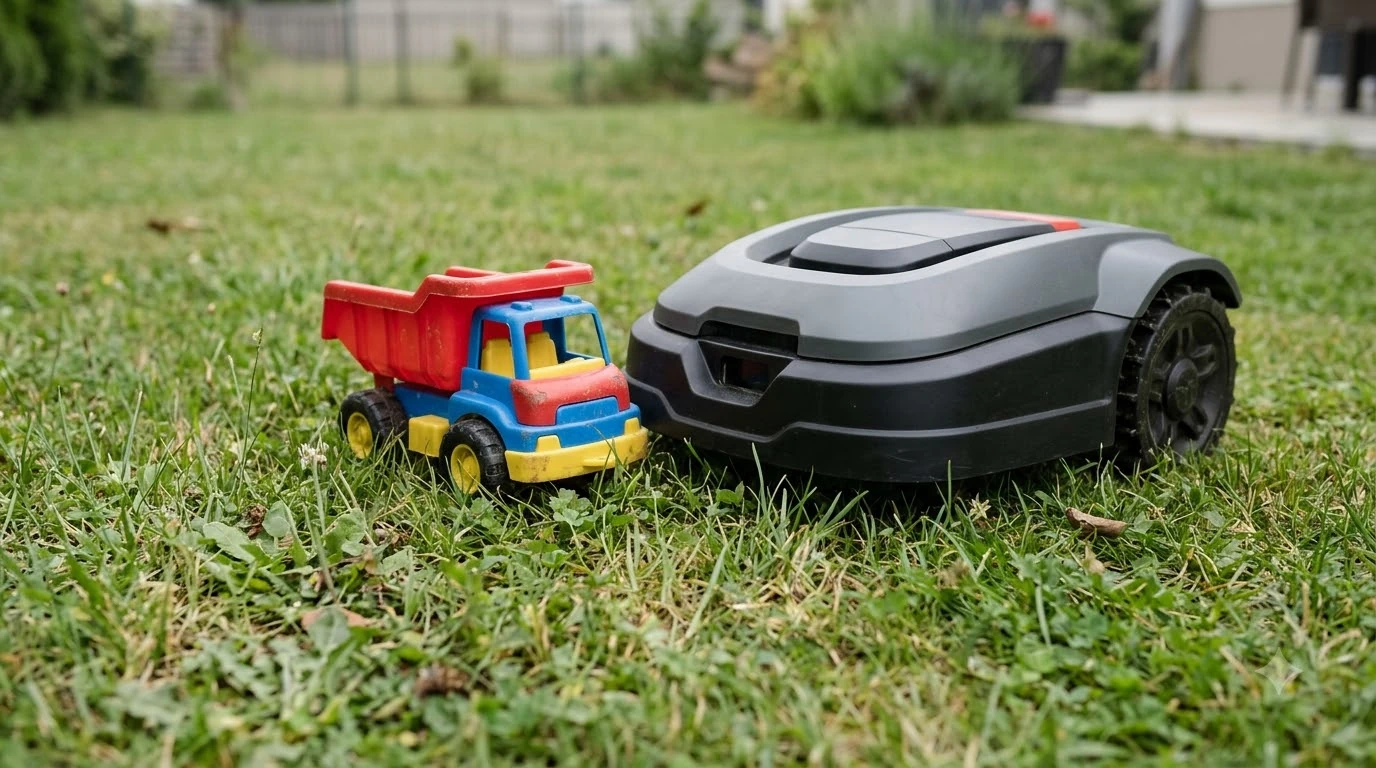

The best robot mower with ultrasonic sensors is the one your maker lists with ultrasonic object avoidance, which detects obstacles in its path before contact, and very few models offer it. On Husqvarna’s support page, the Automower 435X AWD NERA is the only model listed with ultrasonic sensors, while other models use radar. Ultrasonic detection is a useful aid, but Husqvarna says it is not a safety feature, so check the model’s own sensor list before you buy.
The short answer
- Detection comes before contact. Husqvarna says its object avoidance scans the area in front of the mower while it cuts, then changes direction when it spots something.
- Ultrasonic is rare. As of November 2026, Husqvarna lists ultrasonic sensors on the 435X AWD NERA only. Five other models use radar, and the rest have no object-detection sensors.
- Limits are real. Tall grass, small objects, flat objects and the area near the boundary are all difficult or excluded.
- Not a safety system. Husqvarna states there is no guarantee that objects will not be run over.
How ultrasonic object avoidance works on a robot mower
Object avoidance is a sensing feature layered on top of the mower’s basic collision hardware. Husqvarna describes it as sensors that continuously scan the area in front of the mower as it moves; for the wider picture, see how robot mowers avoid obstacles. When an obstacle is detected, the mower changes direction instead of pushing into it. The company says the feature works best with solid objects that have a distinct surface.
Husqvarna gives three stated aims: reducing operational stops, minimizing damage to objects, and protecting wildlife. Those aims describe what the feature is for. They do not describe a guarantee, which is why the same page warns against treating it as a safety device.
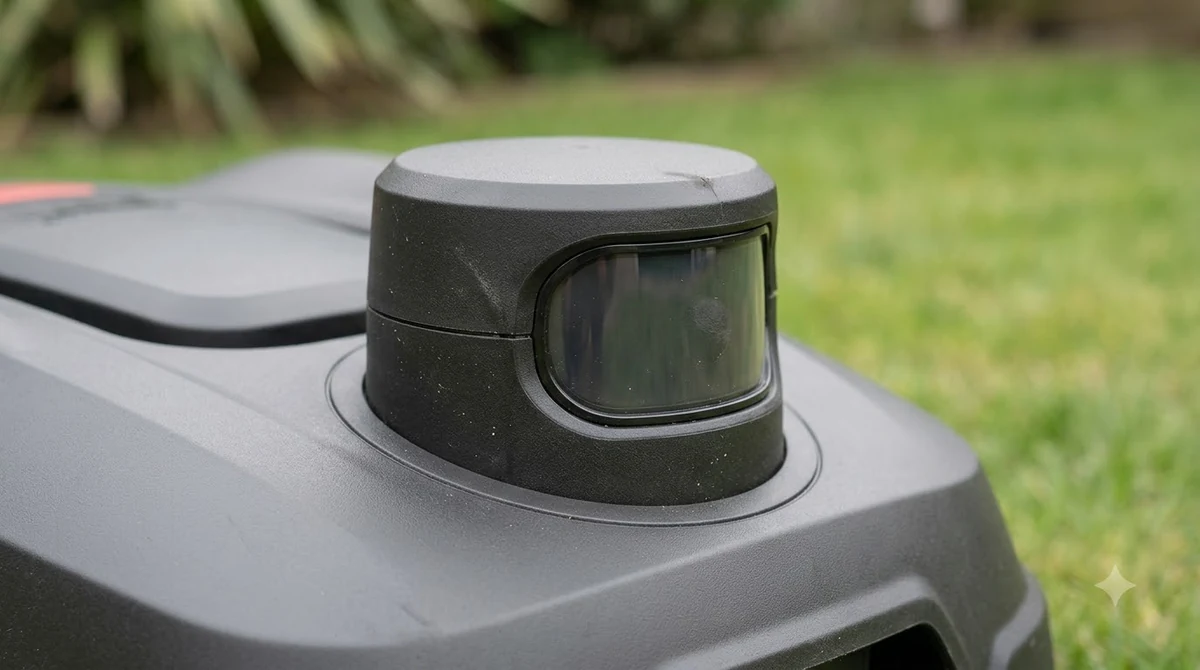
Our reading: ultrasonic avoidance is best understood as a way to reduce bumps with solid objects in the cutting path. It is not a way to make the mower responsible for everything in the yard, and it does not replace a quick walk-through before each cutting session.
Which robot mowers use ultrasonic sensors and which use radar
The sensor type depends on the exact model and sometimes on the suffix, so the model name matters more than the product line. Husqvarna’s page lists which of its Automower models carry each sensor type.
| Automower model (as listed by Husqvarna) | Object avoidance sensor | What to note |
|---|---|---|
| 405XE NERA | Radar | Radar model in the NERA line |
| 410XE NERA | Radar | Radar model in the NERA line |
| 430X NERA | Radar | Radar model in the NERA line |
| 450X NERA | Radar | Radar model in the NERA line |
| 435X AWD | Radar | Listed as radar, not ultrasonic |
| 435X AWD NERA | Ultrasonic | The only ultrasonic model on the list |
The page also says that models without these sensors do not support the feature, and that models with AI vision cameras use a different technology, which our vision robot mower explainer covers. Other brands use their own sensor combinations, so a spec sheet from each manufacturer is the only reliable check for a given model.
What ultrasonic detection can miss
Ultrasonic avoidance has documented blind spots, and most of them come from how the mower reads its surroundings. Husqvarna lists these limits on the same support page.
- Tall grass and vegetation. Sensors may read tall grass, flowers or dandelions as objects. In very high grass, Husqvarna suggests turning object avoidance off temporarily to avoid leaving uncut patches.
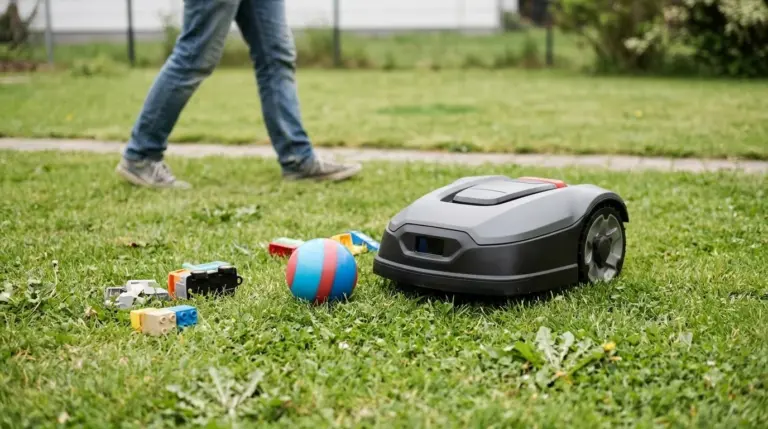
- Small objects. Husqvarna says small objects such as golf balls may be difficult to detect, especially when they sit hidden in tall grass.
- Flat or low objects. Objects lying flat or very close to the ground may not be detected at all.
- The boundary zone. Avoidance is switched off near the edge of the work area so the mower can cover the full lawn. Husqvarna gives 60 cm (2 feet) from the virtual boundary for EPOS models and 90 cm (3 feet) from the boundary wire for wire-based setups.
Those gaps matter most for objects near the edge of the lawn, such as a garden hose lying along a bed, or a toy that sits low in the grass. Check the yard before each session rather than relying on the sensor to find everything, and see how a robot mower handles kids’ toys for yards with low items.
What the 2021 hedgehog study found about sensors
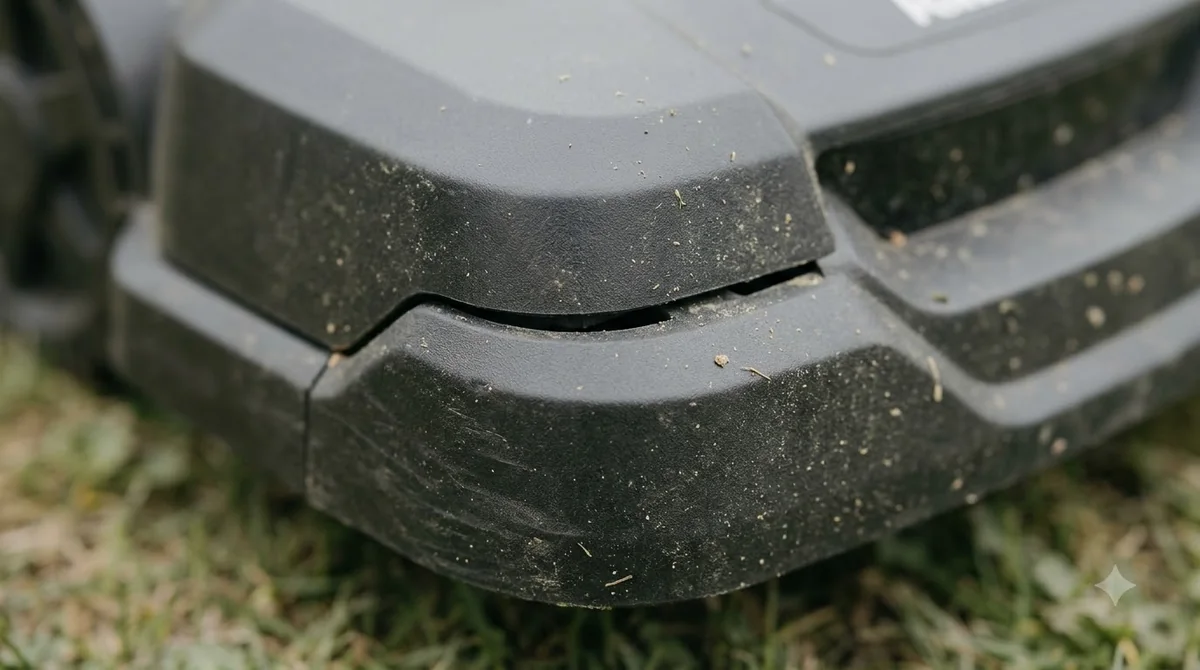
A 2021 study published in Animals (Basel) tested robot mowers against dead hedgehogs, which gives a useful outside check on sensor claims. The authors, Rasmussen and colleagues, tested 18 robotic lawn mowers, each 12 times, for 216 tests in total. Their hedgehog sample included 70 cadavers from rehabilitation centers in Denmark, grouped into four weight classes.
The headline result for this topic is that no tested model detected the hedgehog cadavers without physical contact. The authors reported no contact-free detection events at all. Damage outcomes varied across the models in the study.
Ultrasonic models needed a closer look. The authors found an association between ultrasonic sensors and a better safety index only for the combined damage categories 3 and 4 (p = 0.050), and not for category 4 alone (p = 0.076). All ultrasonic models in the study also had pivoting blades, so the authors could not separate the effect of the sensor from the effect of the blade design. Camera models showed no significant effect on safety in the same analysis.
Our reading: the study does not show that ultrasonic sensors protect small animals. For the smallest juvenile hedgehogs, under 200 g, the study records that no mower detected them, and some passed under the blades without visible injury. Anyone who wants to protect wildlife should plan for checks before mowing, not only rely on the sensor, and whether robot mowers stop for animals explains the wider picture.
Best robot mower with ultrasonic sensors: what to check before you buy
Use these checks to turn a sensor claim into a decision you can verify. Each one comes from the sources above or is a plain test you can run.
- Confirm the sensor type for the exact model. The best robot mower with ultrasonic sensors is a specific model number, not a brand. Look up the model number in the manufacturer’s support page. On Husqvarna’s list, the 435X AWD and the 435X AWD NERA are different entries.
- Check the suffix and generation. The NERA suffix changes the sensor list on Husqvarna’s page, so a similar-sounding model may not have the same feature.
- Read the detection limits. Tall grass, small objects, flat objects and boundary zones all reduce what the sensor can do. Match these limits to your own yard, especially if you have dense grass or many low toys.
- Confirm the on/off setting. On Husqvarna’s app, object avoidance is a slider under More, Settings, Accessories. If the option is missing, Husqvarna recommends installing the latest firmware and app version.
- Plan for supervision. Keep pets, children and wildlife in mind, and do not treat any sensor as a guarantee; robot mower safety for kids and pets covers the basics.
Who ultrasonic detection suits
Our reading is that a best robot mower with ultrasonic sensors suits a yard with solid, clearly shaped obstacles such as garden furniture, planters and stones, where the mower can slow or turn before a bump. It is less useful in yards with tall grass, many low items or a lot of small debris, where the listed limits apply most often. Buyers who need a stronger safety case should compare the spec sheets across brands and read the manufacturer’s own warnings before choosing.
Frequently asked questions
Do robot mowers with ultrasonic sensors always stop before touching an object?
No. Even the best robot mower with ultrasonic sensors is not guaranteed to stop: Husqvarna says there is no guarantee that objects will not be run over, because detection depends on object size, placement and grass height. The feature is not a safety function.
Which Husqvarna mower uses ultrasonic sensors?
As of November 2026, Husqvarna’s support page lists the Automower 435X AWD NERA as the only ultrasonic model. The other listed models use radar, and the page notes that models without these sensors do not support the feature.
Does ultrasonic avoidance work in tall grass?
Not reliably. Tall grass and vegetation can be read as obstacles, and Husqvarna suggests turning object avoidance off in very high grass to avoid leaving uncut patches.
Can ultrasonic sensors protect hedgehogs and other small animals?
The 2021 study in Animals (Basel) found that no tested model detected hedgehog cadavers without physical contact. Ultrasonic models showed only a limited association with better safety results, and the blade design was a confounding factor, so the sensor alone should not be relied on.
Sources
- Object avoidance with radar or ultrasonic sensors in Automower robotic lawn mowers (Husqvarna): sensor type by model, detection limits, boundary zones, app setting and the safety disclaimer.
- Rasmussen et al. (2021), Animals (Basel) (peer-reviewed study): 18 robot mowers tested against hedgehog cadavers, with results by sensor type.
 Up next8 min readBest Robot MowersBest Robot Lawn Mower for 5 Acres: What to Check Before You BuyUpdated Nov 11, 2026
 9 min readBest Robot MowersBest Robot Mower With Obstacle Avoidance: 5 Sensor TypesUpdated Nov 11, 2026
 9 min readBest Robot MowersBest Robot Lawn Mower for Townhouses: What to Check Before You BuyUpdated Nov 11, 2026
 8 min readBest Robot MowersBest Robot Mower with Mulching Blades: What to Check Before You BuyUpdated Nov 11, 2026
 10 min readBest Robot MowersBest Robot Lawn Mower for Elderly Parents: What to Check Before You BuyUpdated Nov 11, 2026
 8 min readBest Robot MowersBest Robot Mower That Works in the Rain: What to Check Before You BuyUpdated Nov 11, 2026