
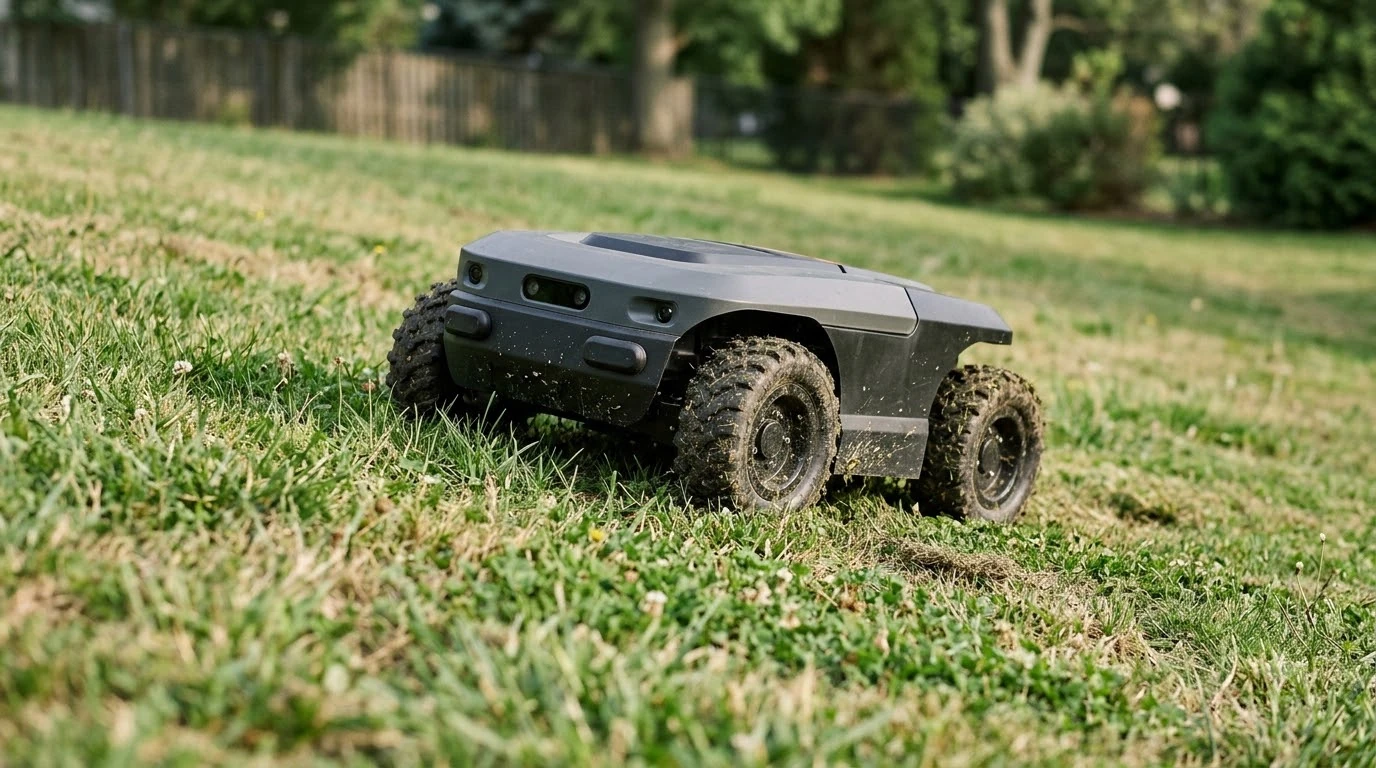

Choose a robot mower for sloped front yard use by the steepest strip it has to cross, not by the average slope. Measure that strip in percent, then check the rated limit for both the work area and the boundary, because the edge next to the street is where the limit is lowest. A front yard adds curbs, driveway edges and a public road, so those edges decide the setup as much as the headline rating does.
The short answer
- Measure the steepest path the mower must cross, in percent (rise divided by run, times 100).
- Compare that number with the rated limit for the work area and the lower limit listed for the boundary.
- Add a barrier of at least 15 cm (6 in), such as a wall or fence, along any slope edge that borders a public road, as Husqvarna asks.
- Pick AWD only when the steepest ground is above the 50 percent range that standard models cover.
Start with your steepest strip
For a robot mower for sloped front yard use, the rated limit applies to the steepest ground the mower crosses, so an average slope tells you little. Slope is calculated as vertical height divided by horizontal distance, times 100. Husqvarna gives the example that 15 cm of rise over 100 cm of run is a 15 percent slope. Iowa State University Extension describes the same idea as rise over run and gives 1:12, a rise of one foot for every 12 feet, as 8.33 percent.
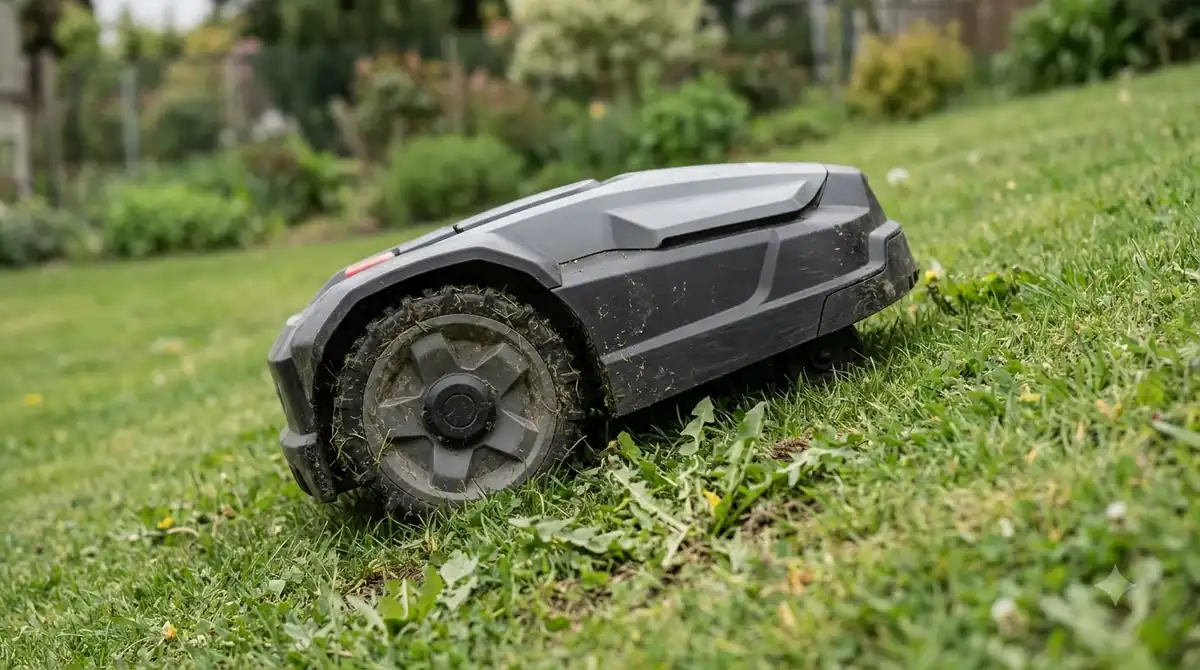
Walk the front yard with a level app on your phone or a string and a short board. Measure the steepest line from the curb toward the house, since the mower will run up and down that line as well as across it. Write down the highest percent you find, not the typical one. A front lawn that looks gentle from the sidewalk can hide a short bank near the driveway that is steeper than everything else. Our guide on how to measure yard slope walks through the measuring step by step.
Degrees are useful too, but convert carefully. Husqvarna lists 25 percent as roughly 14 degrees, 50 percent as roughly 26 degrees, and 70 percent as 35 degrees. Keep the comparison in percent when you read spec sheets, because most robot mower ratings are published that way.
Read the rating by work area and by boundary
A single rated percent is not the whole picture, because the limit near the boundary is often lower than the limit in the middle of the lawn. Husqvarna publishes two numbers per model. For example, the 305 and 315 are listed at 40 percent for the work area but 15 percent by the boundary, while the 435X AWD is listed at 70 percent for the work area and 50 percent by the boundary. Our explainer on how robot mower slope ratings work covers the same idea for other brands.
| Husqvarna model (as listed) | Work area limit | Limit by boundary |
|---|---|---|
| 305, 310, 315 | 40% | 15% |
| 405X, 430X, 450X | 40% | 15% |
| 320 NERA, 450X NERA | 50% | 25% |
| 435X AWD, 435X AWD NERA | 70% | 50% |
The practical reading is that a slope next to the curb needs the boundary number, not the headline number. Husqvarna also says that areas steeper than the mower’s limit must be excluded from the installation. If the outer edge of a slope is steeper than the limit, the boundary should move inward onto flat ground before the slope begins. Our reading is that this is the step most front-yard owners miss.
Eufy adds that a mower’s maximum rated slope is an absolute limit rather than a target for daily mowing, and that running at the top of the rating strains the motor and increases tyre slip. Choose a mower rated above your steepest strip, not at it.
The street edge: barrier and boundary rules
Where a slope borders a public road, Husqvarna’s installation guidance calls for a protective barrier, for example a wall or fence, of at least 15 cm (6 in) along the outer edge. It is a safety rule for the edge where a wheel could drop off a curb or slide down a bank toward the road. Check the local rules on mowers near sidewalks as well, since they vary by town. A front yard with no fence is a harder case, which our page on a robot mower in an unfenced front yard covers.
Heads up
Do not assume a robot mower will stop at a curb. The boundary wire, or the wire-free zone, is what keeps it off the steep edge. Test the stop point with the mower before you rely on it.
Keep the guide wire in mind too. Husqvarna advises laying the wire diagonally across a slope or straight from the bottom to the top. On AWD models it also asks for 1.5 m (5 ft) of clearance between the boundary wire and obstacles on slopes up to 50 percent, and at least 50 cm (1.6 ft) of level ground between flat areas and steep ones. Front yards often have a mailbox, a light post or a hydrant near the edge. Husqvarna notes that obstacles on a slope force the mower to turn, which increases slipping risk, especially in wet conditions, so those spots need extra room or an exclusion zone.
AWD or 2WD for a front-yard slope
AWD models are the choice when the steepest strip is above the range that standard models cover. Husqvarna lists standard models at 25 to 50 percent, depending on the model, and the 435X AWD and 435X AWD NERA at up to 70 percent. Our comparison of AWD versus 2WD robot mowers for hills goes into the trade-offs.
Four-wheel drive helps with traction, but it does not change the boundary rules. A 70 percent rating on the work area can still come with a 50 percent limit by the boundary, so the front edge is still the number to check. If your steepest strip is 30 percent or less and sits well away from the road, a standard model with a suitable rating may be enough. Our reading is that AWD is worth the extra cost mainly when the steep ground is long, wide and close to the work area, not when it is a small bank at the edge.
Wet grass and the base of the slope
The bottom of a slope is usually the wettest ground on the lawn, and that is where the mower is most likely to slip. Iowa State University Extension notes that soil at the base of a slope is often wetter than soil higher up, and that steep slopes are highly prone to erosion. For a robot mower, wet soil at the foot of a bank is where wheels slip, especially near a driveway where runoff collects.
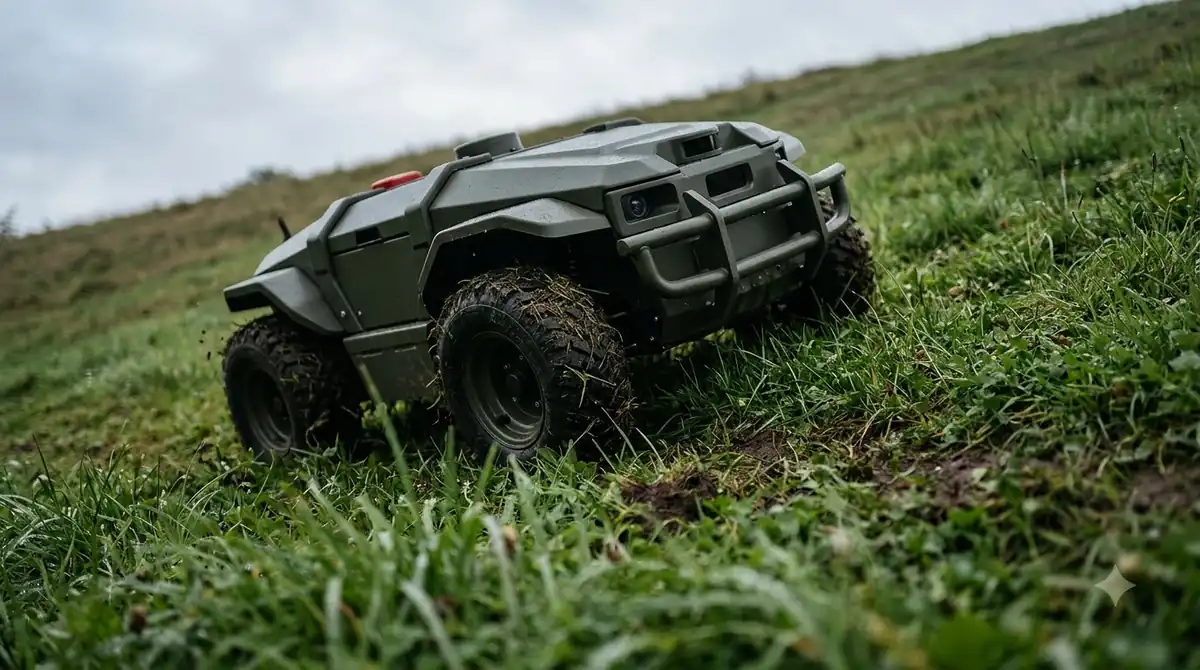
Eufy’s published guidance says wet grass reduces tyre grip even when the slope is inside the rated limit. The safer habit is to set the schedule so the mower does not run on the front bank right after rain or heavy watering. Our page on robot mowers sliding on wet slopes covers that case. Keep the wheels clean of clippings, since a clogged wheel loses grip faster than a clean one. Husqvarna recommends a soft brush or a water hose for this, and offers an optional Terrain Kit with heavy rear wheels on most models.
Setup checklist for a robot mower for sloped front yard
- Measure the steepest strip. Record the highest percent on the path the mower will cross.
- Find both limits. Read the work area rating and the lower by-boundary rating for the model you are considering.
- Protect the road edge. Plan a barrier of at least 15 cm along any slope edge that borders a public road.
- Plan the wire line. Run the guide wire diagonally or straight up the slope, and keep 1.5 m of clearance from obstacles on AWD models.
- Keep the wheels clean. Check the tyres after mowing and schedule the front bank away from wet days.
Iowa State University Extension also states that slopes around 30 percent or steeper are too steep to mow, which is a useful sanity check for any front bank you are unsure about. It is aimed at mowing by hand, so treat it as a caution, not a robot rating. If a section is steeper than the mower’s rating, the usual answer is to exclude it with a stay-out zone and mow it by hand, not to push the limit. In short, the right robot mower for sloped front yard use is the one whose boundary rating covers your steepest edge, not the one with the biggest headline number.
Frequently asked questions
Can a robot mower for sloped front yard use handle a steep bank?
It can, if the steepest strip is inside the mower’s rated limit. Husqvarna lists standard models at 25 to 50 percent and AWD models up to 70 percent. Areas above the limit must be excluded from the installation, so check the steepest path, not the average.
Why is the boundary limit lower than the work area limit?
Husqvarna publishes separate work area and by-boundary numbers for each model, and the boundary number is lower. Use the lower number for any slope that sits next to the curb, driveway or road.
What should I do about a slope that borders the road?
Husqvarna’s installation guidance asks for a protective barrier, such as a wall or fence, of at least 15 cm (6 in) along the outer edge where a slope borders a public road. Local rules on mowers near sidewalks can add requirements, so check your town before you set the boundary.
Does a wet front yard change the choice of robot mower for sloped front yard?
Yes. Wet grass reduces tyre grip even inside the rated limit, and the base of a slope is often the wettest ground. Plan the schedule around rain, keep the wheels clean, and consider a model with a traction kit if the bank stays damp.
Sources
- Optimising an Automower installation for steep slopes (Husqvarna): slope formula, per-model limits, road barrier, guide wire, AWD clearance rules, wheel cleaning and Terrain Kit.
- Gardening on slopes and hillsides (Iowa State University Extension): rise-over-run conversion, the 30 percent mowing threshold, and wet soil at the base of slopes.
- Robot lawn mower slope limits (Eufy): rated maximum as an absolute limit, wet grass and tyre grip.
 Up next8 min readBy YardRobot Mower for Front and Back Yard: What WorksUpdated Nov 11, 2026
 8 min readBy YardWill a Robot Mower Get Stuck on a Lawn With Gravel Edges?Updated Nov 11, 2026
 9 min readBy YardRobot Mower for Zoysia Grass: Height, Frequency and SetupUpdated Nov 11, 2026
 8 min readBy YardCan a Robot Mower Cut Centipede Grass? Heights and LimitsUpdated Nov 11, 2026
 9 min readBy YardCan a Robot Mower Cut Zoysia? Height and LimitsUpdated Nov 11, 2026
 9 min readBy YardRobot Mower for Hillside Lawn: Ratings and LimitsUpdated Nov 11, 2026