
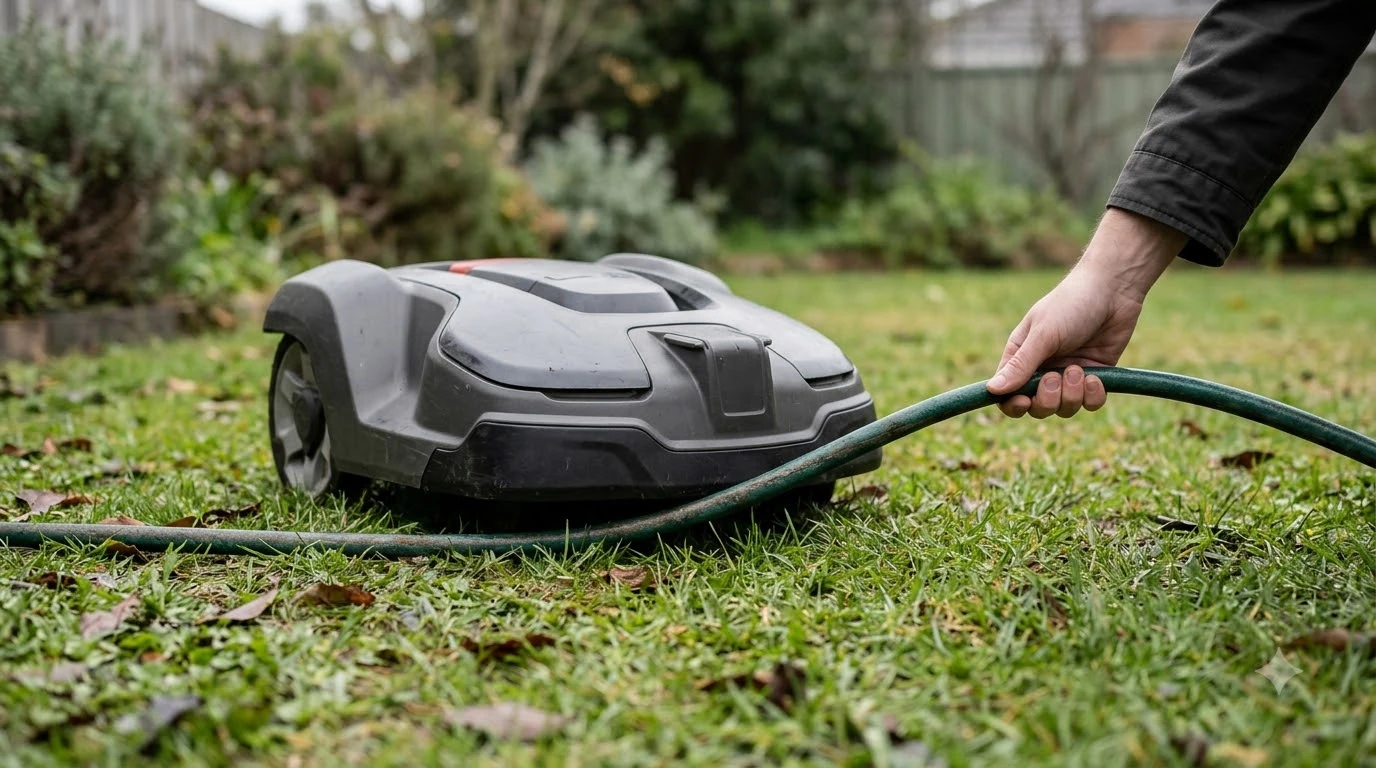

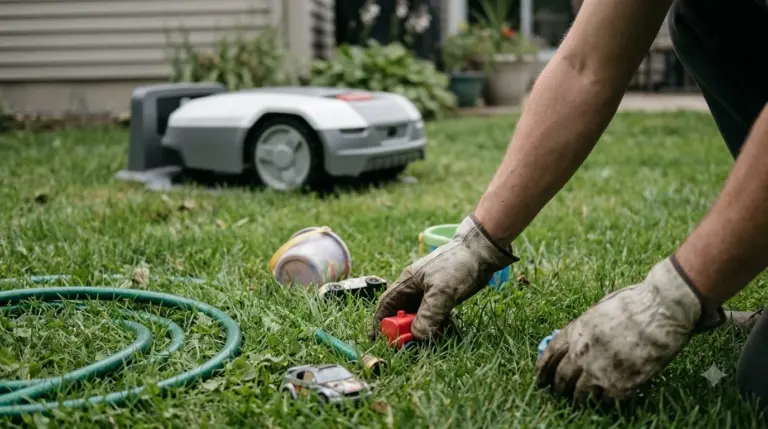
What happens if a robot mower runs over a hose? It usually stops or turns away once a sensor detects it, but a hose lying flat in the grass can still be pinched, pulled or cut. What happens depends on the sensors on the model and on how low and thin the hose is. Husqvarna treats water hoses as a priority hazard for its obstacle detection, which tells you the mower is not meant to run into one.
The short answer
- Detection: Bump and lift sensors only react after contact. Camera-based models can see a hose earlier, but one vendor says low objects are harder for radar.
- Damage: PCWorld notes that robot mowers can do real damage to hoses left on the grass. We found no test data that says how often it happens.
- Stuck: A hose across a narrow path could trap the mower. Husqvarna’s trapped-error guide lists obstacles in general and does not name hoses.
- Prevention: Keep hoses coiled and off the mowing area after each use, and check the hose and the mower after a run.
Why a hose is harder for a robot mower to read than a box
People who ask what happens if a robot mower runs over a hose are usually picturing the worst case. A hose is long, thin and often low to the ground, and it can lie in a curve across the grass. That shape is different from a box or a ball, which a sensor sees as a solid block. Our reading of the sources is that the detection problem comes from the shape, not only from the mower’s brand.
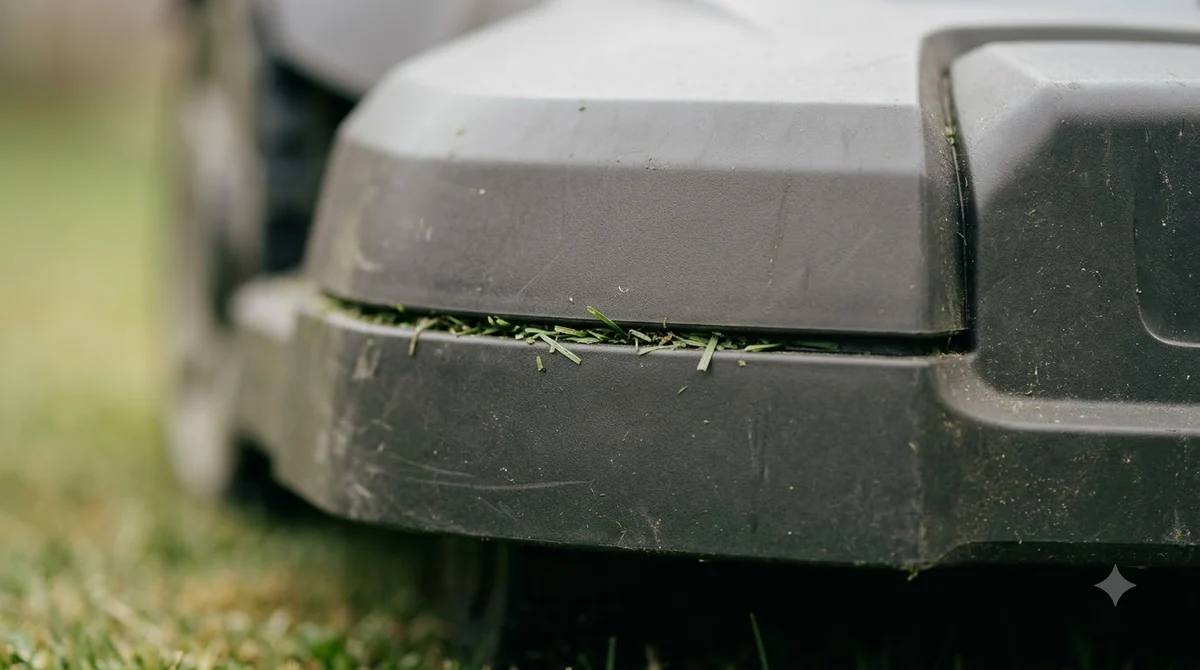
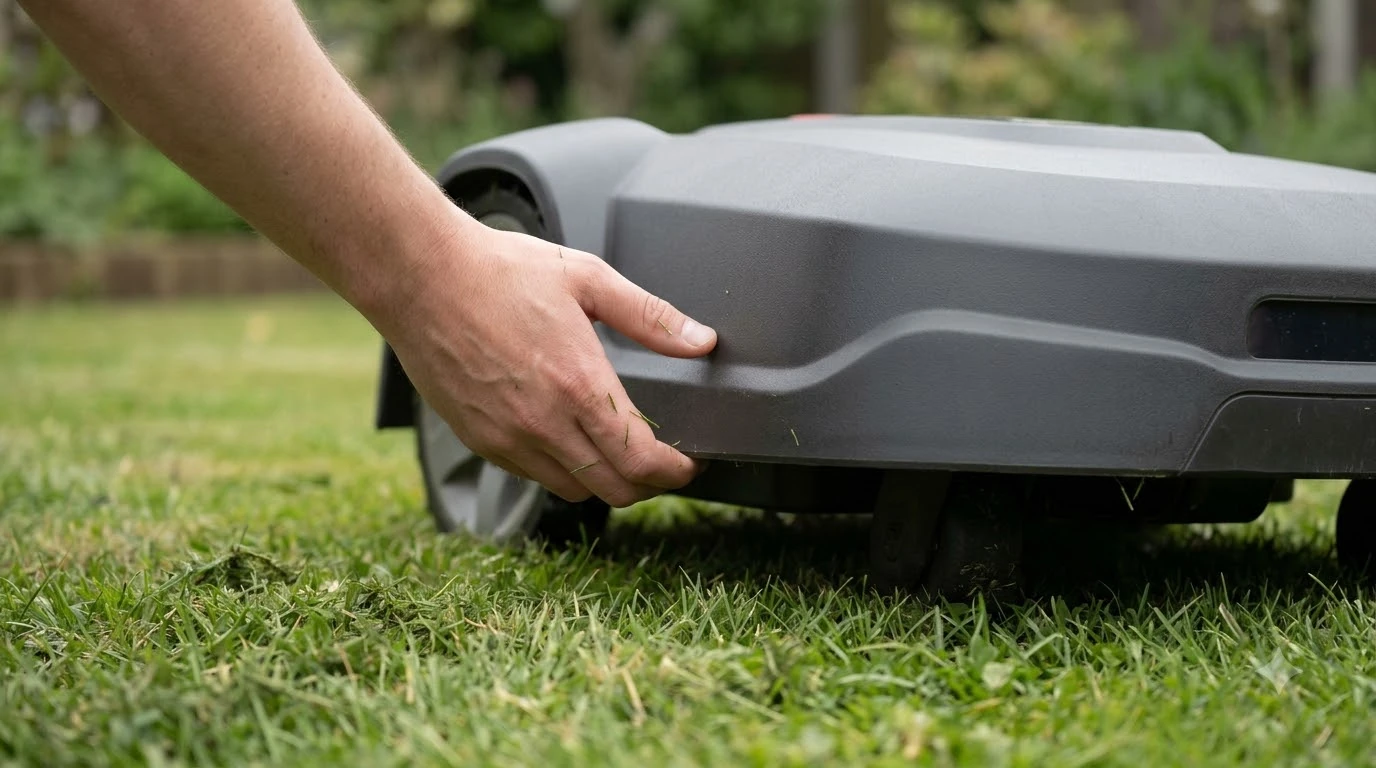
Robot mowers use several kinds of obstacle sensing. A bump sensor reacts when the body touches something and then turns the mower. A lift sensor signals that the mower has been picked up or caught on something. Camera-based models use vision to detect objects before contact. For a broader look, see how robot mowers avoid obstacles. PCWorld describes bump sensors as the simplest option and notes that camera-based systems are the most common on wire-free mowers.
Vendor material is less consistent. Lymow, a robot mower maker, says that radar systems struggle with low objects such as hoses, sprinkler heads and picnic blankets. That is a vendor claim, not an independent test, and we did not find an independent test of hose run-over in the sources we read. For a buyer, the honest takeaway is that a hose is a case where sensor type matters more than the price tag.
What manufacturers say about hoses
Husqvarna’s support article on AI vision describes a system that does not only detect objects but also classifies them by risk level, with two groups: high risk and low risk. Humans, animals and water hoses are priority hazards, and the mower keeps a larger safety distance from them “to prevent any contact.” Low-risk items such as toys, garden furniture and flowerpots are approached more closely before the mower turns. The article describes this for its NERA models, the 405VE, 410VE, 430V and 450V.
The same article is clear about older vision models. On the Aspire R6V, 308V and 312V, the mower keeps a consistent safety distance by day and changes direction regardless of the object type, and at night there is no vision support, so the mower may collide with objects it would normally detect. Our reading is that a hose left out overnight is therefore a bigger risk on a daytime-only vision model than on a day-and-night one. Object avoidance can also be switched on or off in the app, so check that the setting is on.
That approach has a practical meaning. A hose is not treated like a flowerpot, and toys are a different case, covered in how a robot mower handles kids’ toys. A mower with this kind of detection should slow and steer away earlier, but the article does not give a distance in centimeters or a success rate for hoses, so the exact behavior depends on the model and its firmware.
Husqvarna’s trapped-error guide says the Trapped message appears after multiple loop or collision events within a short time. It lists obstacles such as outdoor furniture, narrow passages, long grass and grass chunks that stop the blade disc as causes. It does not name hoses, so a hose across a path should be treated as a possible trap, not a confirmed one. To clear the error, the guide says to move the mower to an area free of obstacles, remove the obstacles and restart it, and to create a stay-out zone or island if it keeps getting trapped in the same spot.
What happens if a robot mower runs over a hose in practice
No source we read describes a hose run-over test, so we cannot say what happens in every case. PCWorld says only that robot mowers can do real damage to obstacles such as hoses, sprinklers and toys left on the grass. Our reading is that the possible results are a cut or nick in the hose wall, a kink that stops the water flow, or a hose pulled out of its fitting, and that none of these is a measured outcome. In short, what happens if a robot mower runs over a hose depends on the model, the hose and the lighting, and the safest answer is to keep the hose off the lawn.
The same logic applies to other lawn cables. Husqvarna’s wire tips warn that sharp bends and sharp debris can damage the boundary wire, and they recommend inspecting the wire before a restart after winter. The guidance is written for boundary wire, not garden hoses, but the habit of checking the lawn surface works for both.
How to protect the hose and the mower
Most of the risk comes from forgetting the hose after watering. A few simple habits remove most of it.
- Coil and store the hose. Put it back on a hose reel placed away from the mowing area or on a hook after each use, so it does not lie across the mowing zone overnight.
- Keep the path clear. If a hose has to stay out, route it along a bed edge or fence rather than across open grass the mower will cross.
- Use a boundary or no-go zone for hard-to-read areas. Husqvarna’s support says that obstacles that cannot take a bump, such as flower beds and rockeries, should be islanded in the boundary wire. Husqvarna’s AI vision article also advises stay-out zones for permanent objects, and our reading is that the same idea applies to a permanent hose path on a model that supports them. For the app steps, see how to set up no-go zones on a robot mower.
- Check after a run. Look at the hose for cuts, check the mower’s blades and wheels, and clear any grass or debris that may have wrapped around the mower. On a camera model, Husqvarna also advises keeping the lens clean by rinsing it with water and wiping it gently with a soft cloth.
Heads up
We have not tested this on any mower. The points above come from manufacturer support pages, a 2024 PCWorld article and a vendor blog. Check your model’s manual for its exact obstacle behavior before you rely on it.
What to check before you buy or set up
If hoses are common in your yard, ask about the sensor setup. Bump-only designs react after contact. Camera or AI-vision designs can react earlier. Ask whether the mower can use no-go zones in the app, and whether you can mark a fixed hose route. Our reading is that these questions matter more than a single spec number when you ask what happens if a robot mower runs over a hose on your own lawn.
Frequently asked questions
Will a robot mower cut through a garden hose?
So what happens if a robot mower runs over a hose? It can cut or damage it, if the hose is in the mowing path and the mower does not detect it in time. Sources we read describe possible damage to hoses left on the grass, but none gave a failure rate.
Do robot mowers see garden hoses?
Husqvarna’s AI vision treats water hoses as priority hazards on its NERA models, while one vendor says low objects are harder for radar. Detection varies by model, and daytime-only vision models have no vision support at night.
Can a hose cause a robot mower to get stuck?
It can, if the hose blocks a narrow passage. Husqvarna’s trapped-error guide lists obstacles in general, so remove the hose and restart, and add a stay-out zone if it keeps happening.
What is the simplest way to protect a hose from a robot mower?
Coil and store the hose after each use and keep it out of the mowing area. This removes most of the risk without changing the mower.
Sources
- Husqvarna support: object detection and avoidance with AI vision (manufacturer): high-risk and low-risk classification, hoses as priority hazards, daytime-only models, stay-out zones and lens care.
- PCWorld: how robot lawn mowers cut grass (publication, 2024): possible damage to hoses and sensor types.
- Husqvarna support: trapped Automower error (manufacturer): what triggers the Trapped message, how to clear it, and wire placement around obstacles.
- Husqvarna support: tips to prevent wire break (manufacturer): sharp bends and debris damage wire.
- Husqvarna support: how to create islands in a boundary wire (manufacturer): obstacles that cannot take a bump should be islanded.
- Lymow: obstacle avoidance (vendor blog): radar and low objects, labeled as vendor view.
 Up next8 min readLearnCan You Sell a Used Robot Mower? What to Hand OverUpdated Nov 11, 2026
 8 min readLearnCan a Robot Mower Mow Over Sticks? What the Sources SayUpdated Nov 11, 2026
 7 min readLearnHow to Set a Robot Mower Schedule (and Why It Might Not Run)Updated Nov 11, 2026
 8 min readLearnIs It OK to Run a Robot Mower Every Day?Updated Nov 11, 2026
 8 min readLearnIs It Legal to Run a Robot Mower at Night?Updated Nov 11, 2026
 9 min readLearnCan You Control a Robot Mower From Your Phone?Updated Nov 11, 2026