
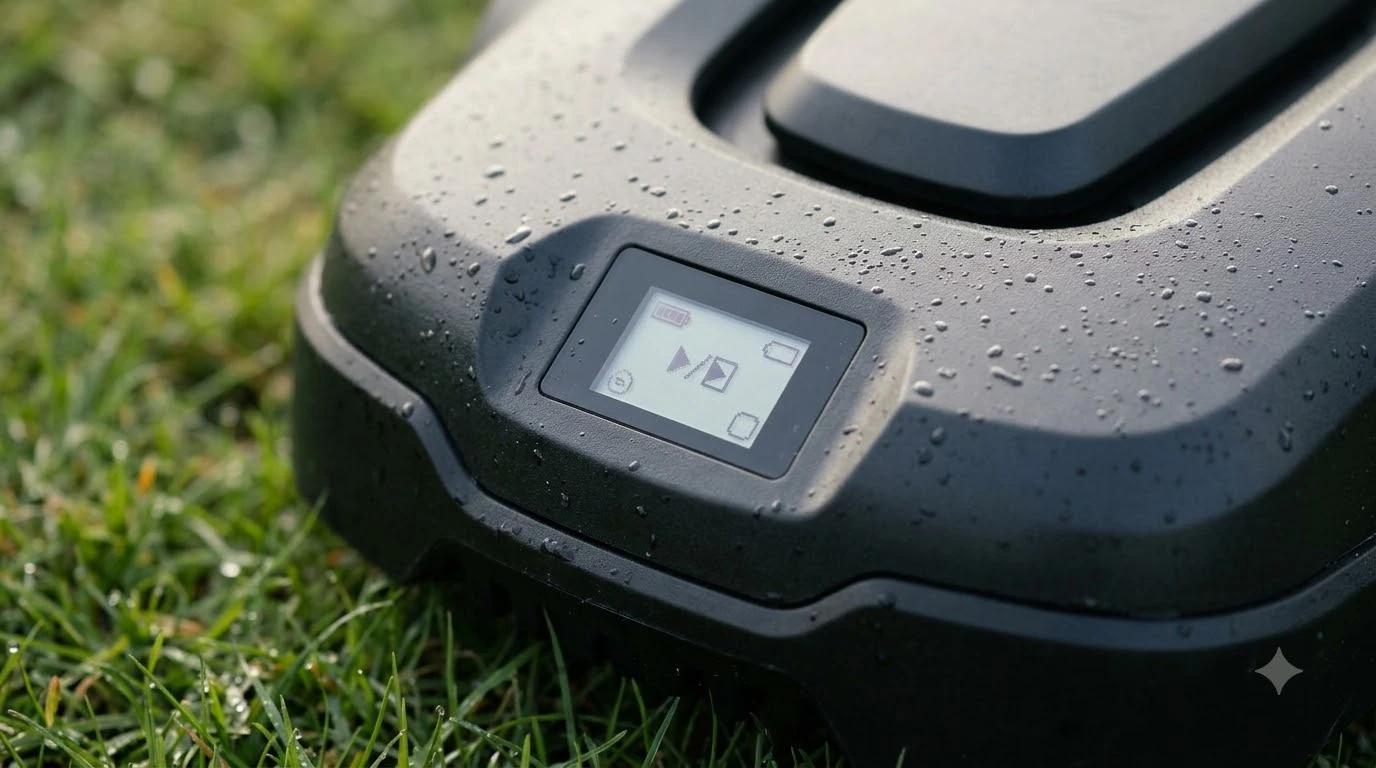

When to start and stop robot mowing each year depends on growth: start when the grass is growing again in spring, and stop when it slows and daytime highs stay near 50°F in fall. The exact dates change with your climate, so the lawn itself is a better guide than the calendar. This guide explains the signals extension and state sources use, the regional windows, and how a robot mower should follow the same rules.
The short answer
- Spring start: begin when the grass greens up and resumes growth, with firm, dry ground. Iowa State Extension says there is no set date.
- Fall stop: stop when daytime highs consistently stay near or below 50°F and growth has nearly stopped.
- Frost is not the finish line: a first frost does not automatically end the season.
- Frozen grass: do not mow while the grass is frozen or covered in frost.
- Regional windows: roughly October to early November in the north, and November to December in much of the Southeast.
When to start robot mowing in spring
For when to start and stop robot mowing each year, spring is the start. Begin once the grass is growing and the ground has firmed up after winter. Iowa State University Extension states that there is “no set date to start mowing.” Timing depends on growing conditions and the type of grass in your area, so a date on the calendar is only a rough starting window.
Extension guidance also gives a height trigger for the first cut. Iowa State says to start mowing once the grass reaches 4½ or 5¼ inches tall, then set the mower to a standard cut height of 3 to 3½ inches.
The opposite mistake is starting too early. The University of Wisconsin-Madison Extension calendar advises that you “avoid the temptation to start lawn work too early,” and that the first mowing should not be excessively short. Wait until the lawn is growing steadily, then mow regularly.
Heads up
Wait until the surface is firm and dry, even if the grass has started to grow. Farmers Almanac gives the same advice after frost: let the frost melt and the lawn dry before mowing.
When to stop mowing in fall
For when to start and stop robot mowing each year, the end comes when growth has nearly stopped. Farmers Almanac reports that mowing may be ending when daytime highs “consistently remain near or below 50°F.” Our reading is that this is a practical signal because it tracks the grass itself rather than a date on the calendar.

The article also offers a simple test you can run yourself. Mow normally, then wait. If 10 to 14 days pass with little growth, the season is probably over. If the lawn has grown another inch or two, it is not finished. The calendar date alone does not settle the question.
For many northern cool-season lawns, the last cut should be a little higher than summer height. Farmers Almanac gives a final height of roughly 2½ to 3 inches for many northern lawns, with Kentucky bluegrass and perennial ryegrass at 2 to 3 inches and tall fescue at 2½ to 3½ inches. Our reading is that a taller final cut gives the crowns more leaf to store energy through winter. Fallen leaves also affect the last weeks of the season, which is covered in our guide to running a robot mower when leaves fall.
Frost, dormancy and frozen grass
A frost is a warning sign, not a switch that turns mowing off, so it should not set when to start and stop robot mowing each year on its own. Farmers Almanac says not to assume “the first frost automatically ends mowing season,” and that frost does not necessarily mean the season is over.
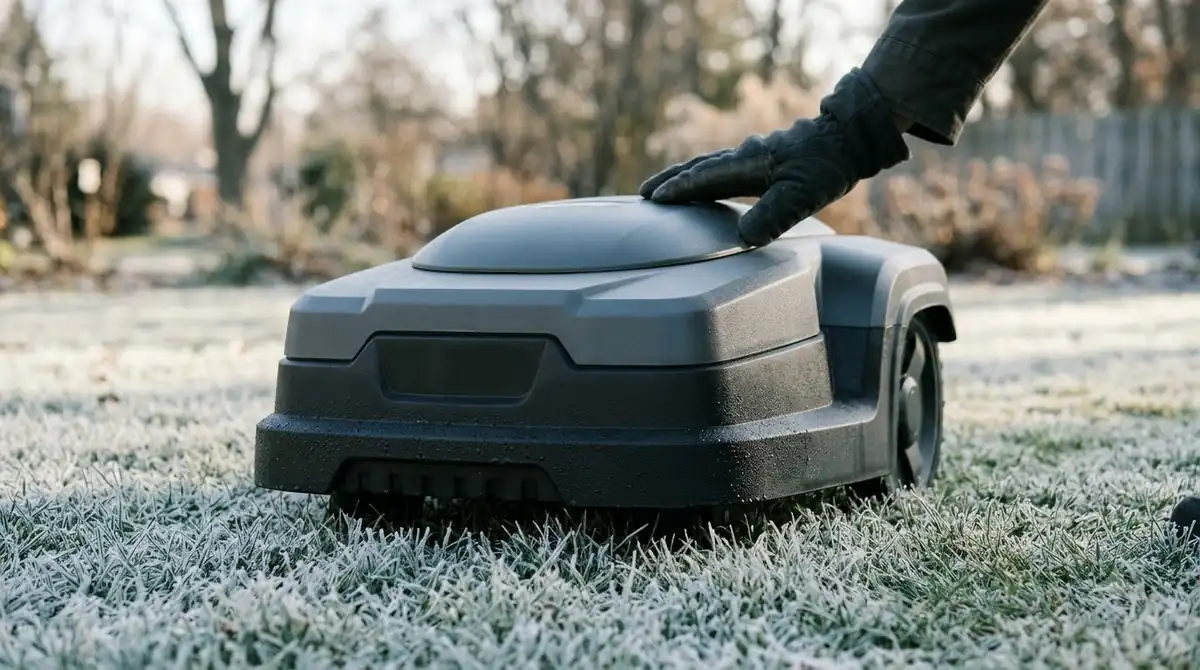
Frost timing varies a great deal, and the limits for freezing weather differ by brand, as explained in our guide to a robot mower in cold climates. Farmers Almanac notes that parts of Alaska, Montana, Idaho, Wyoming, Minnesota, northern New England and the high-elevation West can see frost in September. October is the prime first-frost month across much of the Midwest and Northeast, while the first frost often comes in November or December farther south.
Frozen grass is a separate rule. Farmers Almanac advises against mowing while the grass is frozen or covered in frost, and says to wait until the frost melts and the lawn dries.
Heads up
A robot mower can run on a schedule even when the ground is frozen. Turn off timers or the app schedule during hard freezes and cold, wet spells.
When to start and stop robot mowing each year by region
Farmers Almanac groups states by typical wind-down periods. These windows are approximate and are not deadlines, so use them only as a starting point and confirm with your state extension office.
| Region or state | Grass type (our reading) | Typical window for the last mow |
|---|---|---|
| Minnesota, Wisconsin | Mostly cool-season | October to early November |
| Illinois, Ohio, Pennsylvania, Virginia, Washington | Mostly cool-season | October to November |
| Georgia, South Carolina, Alabama, Mississippi | Mostly warm-season | November to December |
| Hawaii | Warm-season | Generally year-round |
Warm-season grasses such as bermudagrass, zoysia, centipedegrass and St. Augustinegrass slow as temperatures fall and then go dormant. Farmers Almanac does not give a temperature for them, so watch for slowing growth rather than a fixed number. In coastal California, many lawns can be mowed year-round.
Our reading is that the grass type matters as much as the state when you plan when to start and stop robot mowing each year. A warm-season lawn in the Southeast may still need mowing in November, while a cool-season lawn farther north may be dormant by then.
How often a robot mower should run
Once you know when to start and stop robot mowing each year, set the frequency to match: run the robot less often as growth slows, and never let it take off more than about one-third of the blade in a single pass. Farmers Almanac cites that one-third rule as the standard for a single mowing, and it applies to any mower, robotic or not. The one-third rule for mowing grass explains how to apply it.
In spring, the general mowing guidance from Iowa State is that most gardeners mow every 5 to 7 days. That is a human schedule, not a robot setting, but it gives a useful baseline. Our reading is that a robot should run more often in the fast growth of spring and less often as the lawn slows in fall.
Avoid calendar-only schedules when you decide when to start and stop robot mowing each year. A robot set to run daily through November will keep cutting a lawn that has stopped growing, and it can also cut a lawn that is frozen or wet. Review the schedule every few weeks during the shoulder seasons, and pause it when growth stops. The right daily hours are covered in the best time of day to run a robot mower.
Frequently asked questions
When is the right time to stop robot mowing each year in fall?
The last mow is usually when daytime highs stay near or below 50°F and the lawn grows only a little over 10 to 14 days. Farmers Almanac uses that test, and the first frost is only a rough marker for the end of the season.
Should a robot mower run in winter?
Only when the grass is still growing and not frozen or covered in frost. Our reading is that in colder regions the robot should stay parked through winter, ideally following a proper robot mower winter storage routine. In warm-season areas, occasional winter mowing may still be needed.
What height should the last cut be?
For many northern cool-season lawns, Farmers Almanac gives a final height of roughly 2½ to 3 inches. Tall fescue can go up to 3½ inches. A taller final cut leaves more leaf for the grass to use through the cold months.
Does a first frost mean I can stop mowing?
Not by itself. Farmers Almanac says the first frost does not automatically end mowing season. Keep mowing while the grass is still growing, and stop when growth slows or the grass is frozen.
Sources
- When Should You Stop Mowing Your Lawn for the Year? A State-by-State Guide (Farmers Almanac): the 50°F signal, the 10 to 14 day growth test, frost timing, state windows, final heights and the one-third rule.
- Mowing Tips for Spring (Iowa State University Extension): no set spring start date, first-cut height trigger, standard cut height and mowing frequency.
- Wisconsin Lawn Care Calendar (University of Wisconsin-Madison Extension): avoid starting too early, keep mowing until dormant, and avoid entering winter with a tall lawn.
 Up next10 min readBy YardWhen to Mow New Sod: First Cut Height and Root TestUpdated Nov 11, 2026
 9 min readBy YardWhen to First Mow New Grass Seed (Height, Not Calendar)Updated Nov 11, 2026
 7 min readBy YardRobot Mower Wet Grass: Can You Cut It and When to WaitUpdated Nov 11, 2026
 8 min readBy YardOne Third Rule for Mowing Grass: How It Works and Why It MattersUpdated Nov 11, 2026
 8 min readBy YardMowing Lawn in Summer Heat and Drought: What to ChangeUpdated Nov 11, 2026
 8 min readBy YardBest Mowing Height for Zoysia Grass: Summer, Spring and FallUpdated Nov 11, 2026