
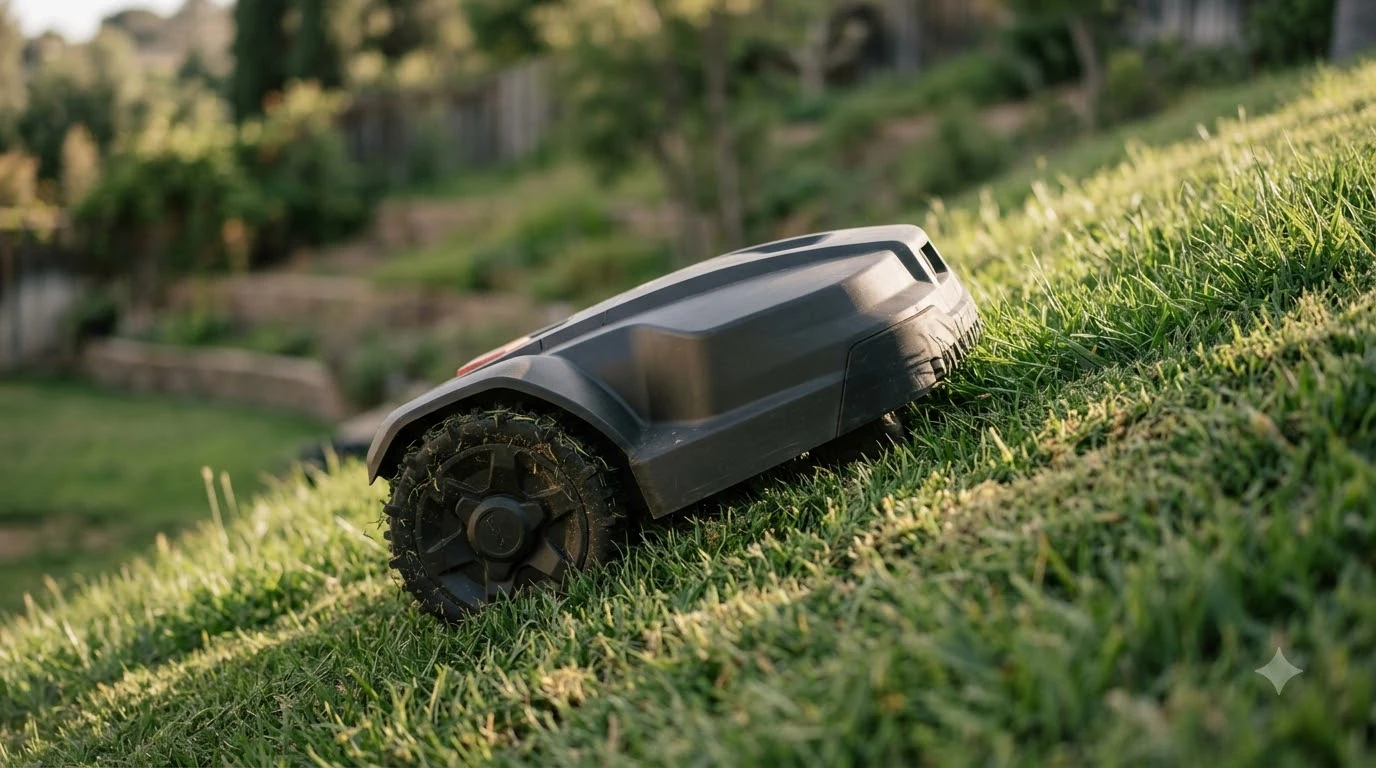

To learn how to measure yard slope, divide the vertical rise by the horizontal run and multiply by 100. A 15 cm rise over 100 cm is a 15% slope, and a tape measure with a long level is enough for most lawns. The number matters because robot mowers publish a maximum slope, so you should measure before you buy or install one. Our guide to robot mower slope ratings explained covers the spec-sheet side.
The short answer
- Formula: slope percent equals rise divided by run, multiplied by 100.
- Method: hold a long level flat with one end on the ground, then measure the vertical gap under its far end.
- Convert: for degrees, divide the percent by 100 and take the arctangent.
- Compare: check the mower’s rated work-area and boundary limits before you install.
What slope percent means
Slope percent is the vertical height divided by the horizontal distance, multiplied by 100. Husqvarna’s installation guide for steep lawns uses a 15 cm rise over 100 cm as its example, which gives a 15% slope. The rise is how far the ground climbs, and the run is the flat distance you cover along the ground.
Both measurements must use the same unit. Use centimeters for both or inches for both, and the percentage comes out the same. Our reading is that a 15% grade is gentle enough that most people walk it without noticing, so the number only starts to matter for a mower when the slope gets steeper.
How to measure yard slope with a level, string, and tape
A tape measure and a long, straight level are enough for most yards, and you do not need special equipment. Run the level straight up or down the slope, then measure the gap under its free end and the length of the level itself.
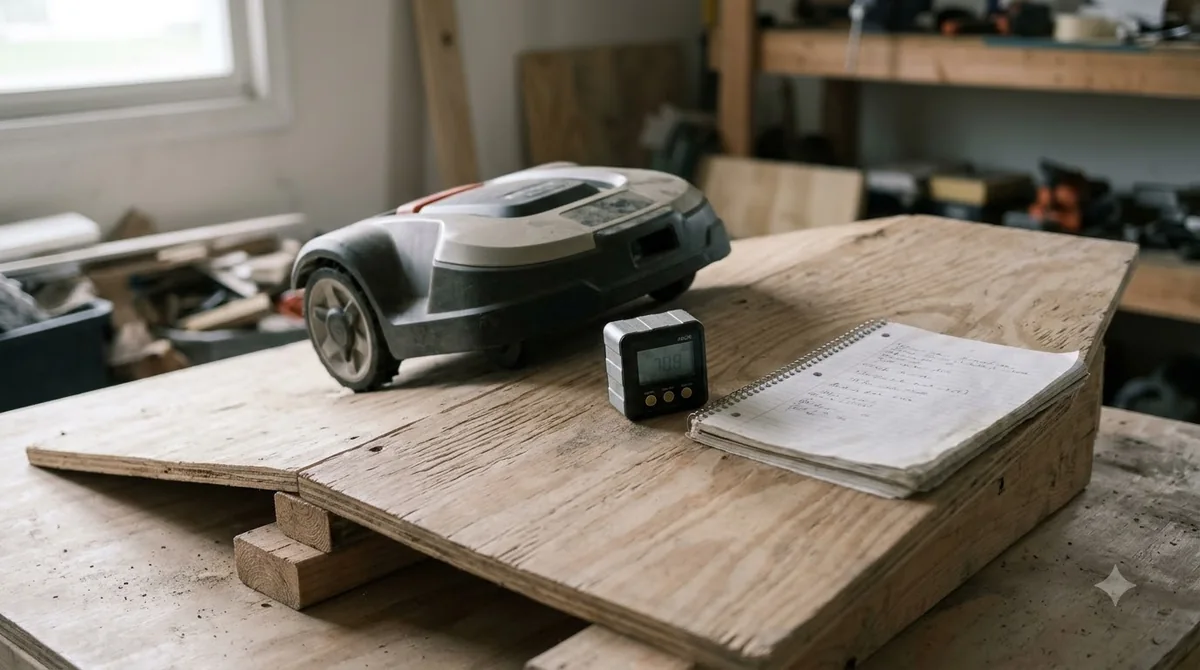
- Pick a straight line. Choose a line that runs up or down the slope, from the flat ground to the steepest part you want to check.
- Set the level flat. Rest the uphill end of the level on the grass, then raise the other end until the bubble is centered.
- Measure the run. The length of the level is the horizontal run. Use the same level each time you repeat the check.
- Measure the rise. Measure the vertical gap between the grass and the underside of the level at the free end.
- Calculate the percent. Divide the rise by the run and multiply by 100.
Repeat the check on three to five lines across the yard when you practice how to measure yard slope, and write each reading down with a rough sketch. An accurate reading depends on sampling more than one line, because slope often changes within a few steps and one reading can miss a steep patch next to a flat one. Measure both uphill and downhill, because the grade can differ on each side of a ridge.
Convert percent to degrees
To convert a percent slope to degrees, divide the percent by 100 and take the arctangent, so 8.33% equals about 4.8 degrees, according to Kapro’s slope conversion guide. Degrees and percent describe the same slope in two different units, so once you know how to measure yard slope in percent, the conversion lets you compare it with a spec sheet that uses degrees.
Husqvarna’s own table lists both units for its standard models, giving 25 to 50% as 14 to 26 degrees. Use the table below as a quick check against your own measurement.
| Slope in percent | Slope in degrees |
|---|---|
| 2.08% | about 1.2 degrees |
| 8.33% | about 4.8 degrees |
| 25% | about 14 degrees (Husqvarna range start) |
| 100% | 45 degrees |
Do not read 45 degrees as 45%, a mix-up that also comes up when you read a robot mower spec sheet. A 45 degree angle is a 100% slope, because the rise equals the run at that angle, which is far steeper than most lawns. The gap is large in the other direction too: a 45% slope works out to about 24 degrees (our calculation, arctangent of 0.45), which is far less steep than a 45 degree slope.
Why the number matters for a robot mower
Standard Automower models manage slopes of 25 to 50%, and the 435X AWD handles up to 70%, according to Husqvarna’s installation guide. Those are the outer limits, and each model has its own figures for the work area and the boundary, so match your reading to the row for your exact model.
| Model (examples from Husqvarna’s table) | Work-area limit | Boundary limit |
|---|---|---|
| 305E, 310E, 405XE NERA | 30% | 20% |
| 305, 310, 315, 405X, 415X, 420, 430X, 440, 450X | 40% | 15% |
| 320 NERA, 430X NERA, 450X NERA | 50% | 25% |
| 435X AWD | 70% | 50% |
As of 2026-11-09, the boundary limit is the lower figure for every row. This means a lawn that looks mowable inside the wire can still be too steep at the edge. Husqvarna’s table is the place to confirm the figures for your model, and the model’s manual should be checked before you buy. Once you have measured your lawn, that edge figure is the number to compare.
Where to measure and place the boundary
When you know how to measure yard slope at the edge, the rule is simple: if the outer edge of your lawn is steeper than the mower’s limit, place the boundary wire further inland, on flat ground before the slope starts, according to Husqvarna.
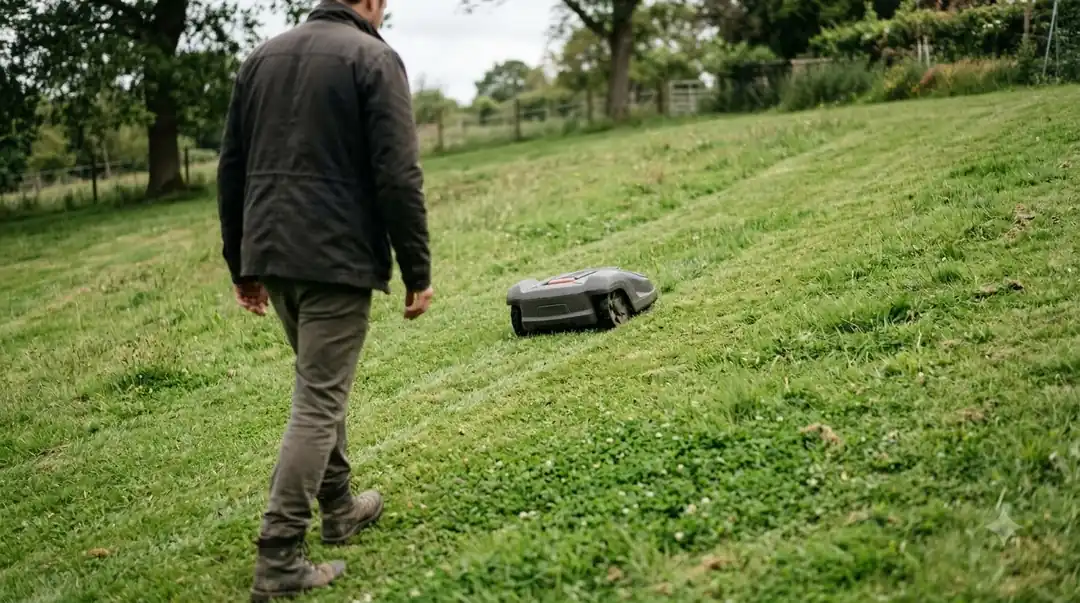
- Keep a transition zone. Leave at least 50 cm (1.6 ft) of level ground between flat areas and steep slopes, based on Husqvarna’s AWD guidance.
- Clear obstacles on slopes. Keep 1.5 m (5 ft) between the boundary wire and obstacles, or between obstacles, on slopes up to 50%.
- Protect road edges. Where a slope borders a public road, install a barrier at least 15 cm (6 in) along the outer edge.
- Lay the guide wire across the slope. Husqvarna recommends a diagonal path for better traction and less grass wear. For wiring around trees and other obstacles, see how to lay boundary wire around obstacles.
- Isolate steep patches. Use boundary wire islands or stay-out zones where the model supports them.
Traction matters as much as the rating, so note the ground condition too. Husqvarna advises keeping the wheels clear of grass with a soft brush or a hose, and some models offer an optional Terrain Kit with heavier rear wheels and wheel brushes. Our reading is that wet or worn grass can make a slope harder to climb, even when it sits under the rated limit.
Common mistakes when measuring slope
The most common mistake in how to measure yard slope is measuring one spot and treating it as the whole lawn, because slope often changes within a few steps across a yard.
- Measuring a single spot. Sample three to five lines across the yard before you decide, because a whole lawn needs more than one reading.
- Mixing units. Keep rise and run in the same unit before you divide.
- Confusing degrees with percent. A 45 degree slope is 100%, not 45%.
- Checking only the work-area limit. The boundary limit is lower for the models in Husqvarna’s table, so use that figure for the edge.
- Measuring one side only. Check the downhill side as well, since the grade can differ on each side of a ridge. If the number is high, the next question is how a robot mower copes with an uneven lawn.
Frequently asked questions
Is 45 degrees the same as 45 percent slope?
No. A 45 degree angle is a 100 percent slope, because the rise equals the run at that angle. The two units are not interchangeable, so check which unit a mower’s manual uses before you compare numbers with your yard.
What slope is too steep for a robot mower?
It depends on the model. Standard Automower models manage slopes of 25 to 50%, and the 435X AWD handles up to 70%. Compare your measured result with the work-area and boundary limits in the manual for your exact model before you install.
Do I need special tools to learn how to measure yard slope?
No. A tape measure and a long, straight level are enough for most yards. Measure several lines across the lawn, because slope often changes within a few steps, and write each reading down.
Where should the boundary wire go on a steep slope?
Place the boundary further inland, on flat ground before the slope starts, if the outer edge is steeper than the mower’s limit. Husqvarna also advises at least 50 cm of level ground between flat areas and steep slopes.
Sources
- Husqvarna support: optimising an Automower installation for steep slopes (Husqvarna): slope formula, model limits, boundary and transition guidance.
- Kapro: slope conversion guide (Kapro): percent to degrees formula and worked examples.
 Up next7 min readBy YardRobot Lawn Mower for 45 Percent Slope: What to Check Before You BuyUpdated Nov 11, 2026
 9 min readBy YardRobot Mower for Side Slopes and DitchesUpdated Nov 11, 2026
 8 min readBy YardRobot Mower for Front and Back Yard: What WorksUpdated Nov 11, 2026
 8 min readBy YardHow Small Can a Yard Be for a Robot Mower?Updated Nov 11, 2026
 7 min readBy YardCan a Robot Mower Work in a Long Narrow Yard?Updated Nov 11, 2026
 8 min readBy YardIs My Yard Suitable for a Robot Mower?Updated Nov 11, 2026