
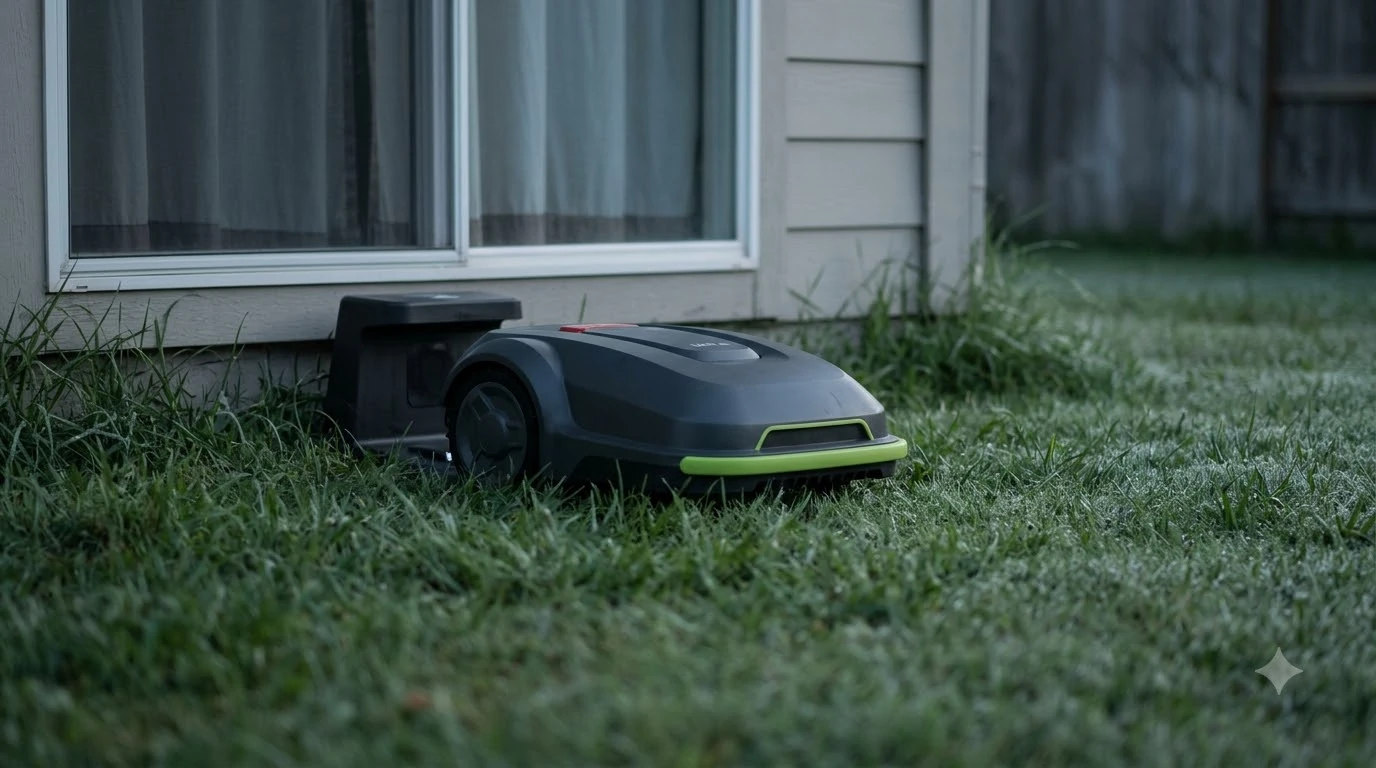

The best robot mower for a townhouse yard is the one whose dock, passages and fence-line margin fit the space you actually have. Most townhouse yards are small, walled in and shared at the edges, so the layout matters more than the feature list. Husqvarna’s US boundary-wire guide asks for 3 m of clear space in front of the dock, 150 cm on each side and 60 cm behind it.
The short answer
- Measure the dock footprint first. Boundary-wire docks need 3 m in front, 150 cm to each side and 60 cm behind, according to Husqvarna.
- Check passage widths next. Husqvarna recommends 2 m between boundary wires without a guide wire, and 60 cm with one.
- Measure the usable mowing area, not the lot. Subtract the dock, planters and no-go zones from the total before you compare size bands.
- Confirm the slope rating. Robomow says budget models handle 20 to 25 percent slopes, while higher-end models reach 45 percent.
Best robot mower for a townhouse yard: plan the dock footprint first
The dock is the largest fixed object a townhouse owner has to place, and it needs open space to work. Husqvarna’s US charging station guide gives the clearances for its boundary-wire charging station, and the numbers are easy to mark out with string or a tape before you buy.
| Installation type | Free space in front | Each side of center | Behind |
|---|---|---|---|
| Boundary wire | 3 m / 10 ft minimum | 150 cm / 60 in minimum | 60 cm / 2 ft minimum |
| EPOS wire-free | 6 m / 20 ft minimum | Not stated in the source | Not stated in the source |
The guide also asks for a level surface near a power outlet, a central spot in the mowing area where possible, and shade or a house-style cover in hot climates. Our reading is that a townhouse rear yard rarely has 3 m of open ground in front of a wall, so the dock is often the first thing that decides which model fits. The same guide does not publish distances from walls, fences or corners, so measure those yourself and ask the seller for the installation drawing before you buy.
Check passage widths between the fence and the planters
A passage is any gap the mower must drive through to reach a second zone, such as the side path between the unit and the fence (for a very tight one, see a yard with a 3-foot side passage). Husqvarna’s passage guide recommends at least 2 m between the boundary wires of a passage when there is no guide wire, and at least 60 cm when a guide wire runs through it.
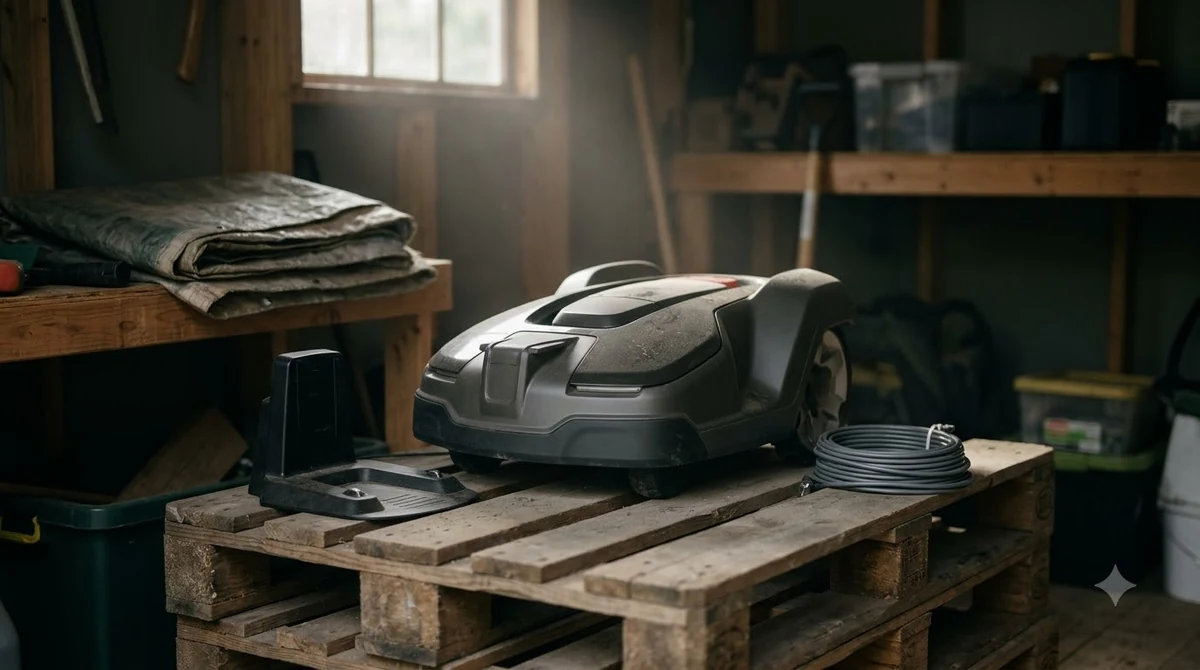
- Husqvarna: 2 m without a guide wire, 60 cm with one, and the guide wire must sit at least 30 cm from the boundary wire.
- Gardena: lists a 60 cm minimum for narrow passages on its SILENO models, measured wall to wall.
- Ecovacs: lists 0.7 m of clearance for its GOAT passages.
Robomow’s blog adds a warning about spacing. It says a passage should be wider than 70 cm, or the signals from two boundary wires can interfere with each other. Husqvarna also notes that a dead-end passage is handled by turning the mower around and mowing back through it, which takes more time in a small yard.
Measure the usable mowing area, not the lot
Size bands are a rough guide, and brands do not use the same ones. Mammotion places townhouses and small courtyards under about 500 square meters, while Ecovacs puts small lawns between 1,000 and 10,000 square feet. Neither figure is a fixed rule for a townhouse yard.
For the best robot mower for a townhouse yard, our reading is that the number you need is the mowable area after the dock footprint, planters, patio and the fence-line margin are removed. A yard that looks like 800 square feet on paper can leave only a few hundred square feet of grass the mower can reach. Measure the grass you can actually mow, then choose a band.
Slopes, patio edges and raised beds
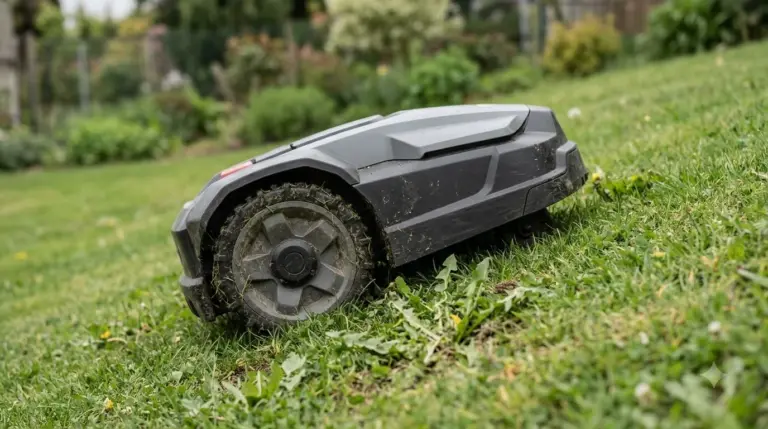
Many townhouse yards step down from a patio or a raised bed, and that step can be the hardest part for a robot mower. Robomow’s lawn-size guide states that cheap models often handle only slopes of 20 to 25 percent, while high-quality models can cope with slopes of up to 45 percent.
Check the slope rating against the steepest part of your yard, not the average. A small step may be fine on a model with off-road wheels, but a steep bank can keep the mower out of its normal zone. Our reading is that slope is a better filter for a townhouse than a long feature list, so check it before you compare the best robot mower for a townhouse yard on features.
Obstacles cut real coverage
Planters, hoses, grills, bikes and sprinkler heads take up space that the mower would otherwise use. Robomow says that obstacles and slope together can reduce a mower’s real-world coverage by up to 30 percent compared with the manufacturer’s maximum, so a rated area is a ceiling, not a promise.
Tight yards with many obstacles benefit from a 360-degree obstacle sensor. Robomow recommends this for small, winding gardens, and it lists a cutting width from 18 cm for those spaces. Keep the obstacles you cannot move, such as furniture and planters, out of the mowing plan from the start, and see what a no-go zone is on a robot mower for how to mark them. Beds along the fence add the same problem, as covered in robot mowers for a yard with flower beds.
Noise near the neighbors: what the sources do not say
No published decibel figure for a robot mower was found in the sources read for this guide, so noise cannot be compared between models using numbers from those sources. Husqvarna’s US page describes its mowers as working “quietly,” but it does not give a decibel value.
- Ask the seller for the manufacturer’s written noise specification.
- Check the mowing schedule. Mowing hours matter more in a shared yard than a single figure.
- Ask whether the mower can be set to skip hours when neighbors are home.
HOA and shared-fence rules
An association can restrict a robot mower through its covenants, and the rules differ from state to state. In Florida, Statute 720.305 requires at least 14 days of written notice, describing the violation, before a homeowners association can impose a fine or suspension.
Heads up
The Florida statute applies only in Florida and covers HOA fines in general. It does not mention robot mowers. Check your own covenants and any architectural guidelines before installing a dock or a boundary wire. For a fully enclosed lot, see robot mowers for a fenced backyard.
What to check before you buy a robot mower for a townhouse yard
Before you choose the best robot mower for a townhouse yard, confirm these five checks against your own yard, not against a brochure.
- Dock space. Mark 3 m in front, 150 cm to each side and 60 cm behind the planned dock.
- Narrowest passage. Compare it with 2 m without a guide wire and 60 cm with one.
- Mowable area. Subtract the dock, planters and no-go zones from the total lawn area.
- Slope. Compare the steepest step with the 20 to 25 percent and 45 percent ratings.
- Association rules. Read the covenants before the dock goes in.

Frequently asked questions
How much space does a robot mower dock need in a townhouse yard?
For Husqvarna’s boundary-wire installations, the US guide asks for 3 m of free space in front of the station, 150 cm on each side of its center and 60 cm behind it. Wire-free EPOS docks need 6 m in front. Measure these before you choose a model, because the dock is the main fixed space in a small yard.
How wide should a passage be for a robot mower?
Husqvarna recommends at least 2 m between boundary wires for a passage without a guide wire, and at least 60 cm with one. Gardena lists 60 cm for narrow passages on its SILENO models. A passage that is too narrow can stop the mower, so measure the narrowest gap first.
Is a robot mower quiet enough for a townhouse with shared walls?
No published decibel figure for a robot mower was found in the sources read for this guide. Ask the seller for the manufacturer’s written noise specification, and plan the mowing hours around when neighbors are home.
Can a homeowners association stop me from using a robot mower?
It depends on your covenants and your state. In Florida, Statute 720.305 requires at least 14 days of written notice before an association can impose a fine or suspension, but the statute does not name robot mowers. Read your association documents before you buy.
Sources
- Husqvarna Automower charging station placement guide (manufacturer): dock clearances, power outlet and level-surface rules.
- Husqvarna guide on creating a passage in a boundary wire installation (manufacturer): 2 m and 60 cm passage widths, guide wire spacing.
- Robomow, which robotic lawnmower suits which lawn size (manufacturer blog, dated 2021): slope ratings, obstacle sensor and output reduction.
- Gardena robotic mower FAQ (manufacturer): 60 cm narrow passage minimum.
- Ecovacs GOAT help article (manufacturer): 0.7 m narrow passage clearance.
- Robomow, laying the lawn boundary wire (manufacturer blog): 70 cm passage width and signal interference.
- Mammotion, how to choose a robot lawn mower (manufacturer blog): size band up to 500 m2 for townhouses and small courtyards.
- Ecovacs, robot lawn mower for small lawn (manufacturer blog): 1,000 to 10,000 sq ft small-lawn range.
- Florida Statutes, section 720.305 (state government): 14-day written notice before an HOA fine.
 Up next9 min readBy YardBest Robot Mower for a Duplex Yard: What to Check Before You BuyUpdated Nov 12, 2026
 8 min readBy YardRobot Mower for Soggy Lawn: What to Check Before You BuyUpdated Nov 11, 2026
 9 min readBy YardBest AWD Robot Mower for Hilly Backyard: 6 Things to Check Before You BuyUpdated Nov 13, 2026
 7 min readBy YardBest Robot Mower for Perennial Ryegrass: What to Check Before You BuyUpdated Nov 11, 2026
 9 min readBy YardRobot Lawn Mower for a 30 Percent Slope: What to Check Before You BuyUpdated Nov 11, 2026
 7 min readBy YardRobot Lawn Mower for a 25 Percent Slope: What to Check Before You BuyUpdated Nov 11, 2026