
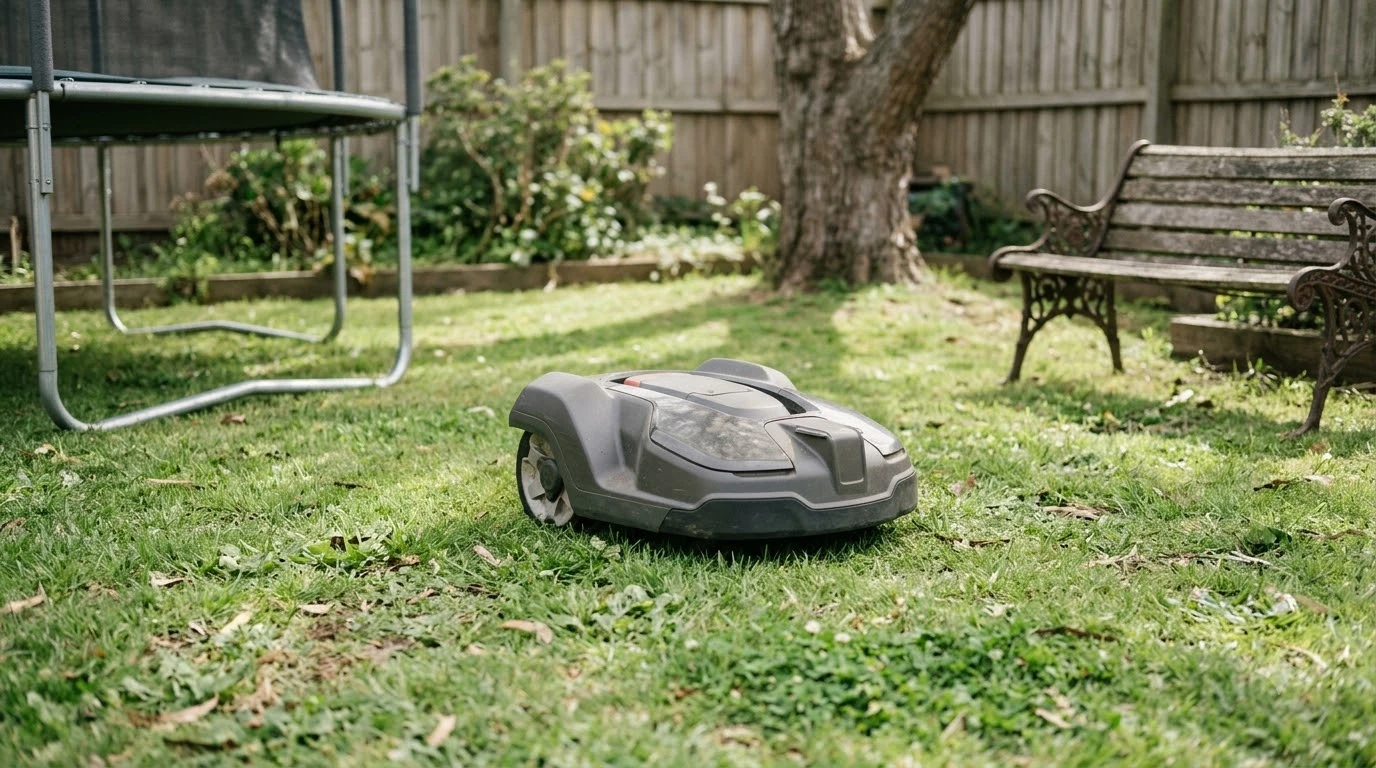

The best robot mower for a fenced backyard is the one whose navigation, clearances and slope rating fit your fence line, because no single model wins for every yard. A fence marks the edge, but a boundary wire, a virtual zone or a map sets where the mower works, so the setup matters as much as the model.
The short answer
- Navigation: wired mowers follow a buried boundary wire, while wire-free mowers depend on satellite signal that tall fences and walls can weaken.
- Guide wires: keep them at least 30 cm (12 in) from the boundary wire, and never let them cross it, according to Husqvarna.
- Virtual zones: FlexiFence needs 35 cm (14 in) of clearance from objects and 60 cm (24 in) from the work-area wire.
- Slope: FlexiFence areas are capped at a 10 percent gradient, which is roughly 5.7 degrees.
Most fenced yards come down to three checks when you look for the best robot mower for a fenced backyard: how the mower finds its way, how much room the fence line leaves for wire or zone margins, and how steep the strip along the fence runs. Work through those before you compare features, because a feature list cannot fix a layout that the mower cannot handle.
What a fence changes for a robot mower
A fence is a reference point, not a boundary signal. Husqvarna’s support pages describe a boundary wire that defines the work area, with clearance rules measured from that wire and from objects near it. Navimow’s Belgian layout guide asks buyers to account for trees, flowerbeds and fences when planning the garden, which is the same job a fence does in your yard.
When you shop for the best robot mower for a fenced backyard, our reading is that the fence itself matters less than the strip of grass between it and the nearest bed or path. That strip decides whether the mower has room to turn, and whether the wire or zone margins fit.
Wire-free or boundary wire: how the fence affects each
A boundary wire sets the work area with a physical cable, so the fence only changes where the wire runs (see wire-free vs boundary wire robot mowers for the full trade-off). Wire-free mowers map the yard with satellite positioning, and the fence affects how well they receive signal. Eufy’s Australian guide says a wired install typically takes an entire weekend, while wire-free mapping usually takes 30 to 60 minutes.
| Navigation | Setup time (per Eufy) | Near a fence or wall | Watch for |
|---|---|---|---|
| Boundary wire | Typically an entire weekend of pegging and burying cable | The wire runs along the fence at set clearances | Changing the layout means unearthing, splicing and re-burying the cable |
| Wire-free (satellite) | Usually 30 to 60 minutes of mapping | High boundary walls and neighboring buildings can degrade GPS and RTK signal | Signal quality in shaded zones can drop 30 to 70 percent |
| Virtual zone (Husqvarna FlexiFence) | Needs its own zone wire, which must stand independently | Objects inside the zone need 35 cm (14 in) of clearance from the zone wire | Cannot be attached to an existing boundary wire |
For the best robot mower for a fenced backyard in a treed courtyard, Eufy’s own guidance says heavily treed blocks or narrow urban courtyards may suit a boundary wire or a LiDAR unit better than wire-free navigation. That is a manufacturer view, so check it against how much open sky your fence line actually gets, and read how an RTK robot mower near tall buildings behaves if walls crowd the lawn.
Clearances to plan around the fence line
If the best robot mower for a fenced backyard you are considering runs on a boundary wire, keep guide wires at least 30 cm (12 in) from it, and keep them from crossing it, according to Husqvarna’s installation support. A guide wire is useful along a fence because it can steer the mower through a gap, down a slope or through a narrow passage, but each margin eats into the strip you measured. Our guide to how to lay boundary wire around obstacles shows the same margins on a plan.
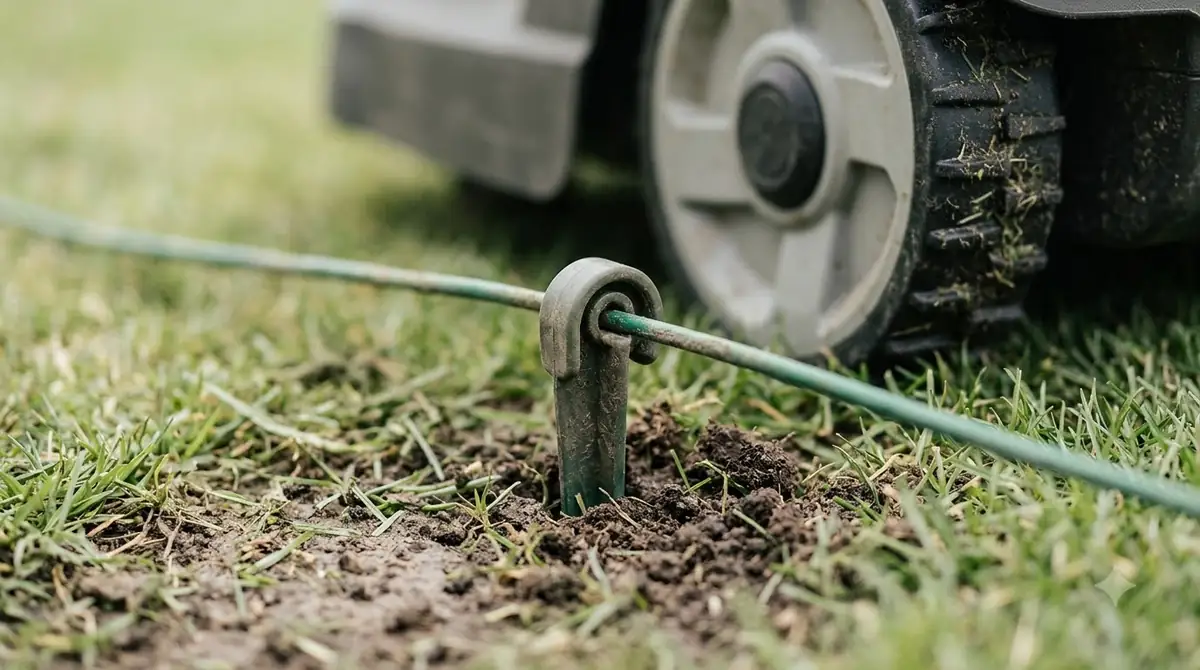
- Guide wires: at least 30 cm (12 in) from the boundary wire.
- FlexiFence objects: at least 35 cm (14 in) from the zone boundary wire.
- Zone to work area: at least 60 cm (24 in) between the zone wire and the work-area boundary wire.
- Existing wire: FlexiFence cannot be attached to an existing boundary wire and must stand independently.
Our reading is that a fence with a narrow strip against a flowerbed leaves little room for these margins. In that case, a wire-free mower or a layout with a wider strip may be easier to install than a tight zone.
Slope along the fence line
Husqvarna caps the slope inside a FlexiFence area at a 10 percent gradient, which is roughly 5.7 degrees. A 10 percent gradient means a rise of 10 cm for every 100 cm of run, so a fence line that climbs a bank can rule out a zone on that side of the yard.
Slope ratings vary by model, so each best robot mower for a fenced backyard on a bank needs its own check. Navimow’s Belgian page lists 45 percent (24 degrees) for its AWD model, 55 percent (29 degrees) for a LiDAR Pro model and 84 percent (40 degrees) for its steepest model. Those figures are model specific, so read the current spec sheet for the exact model you are considering, and check whether the slope runs along the fence or across it. The robot mower slope rating explained guide covers how to read those figures.
Beds, trees and gaps along the fence
For the best robot mower for a fenced backyard, trees, flowerbeds and fences are the obstacles Navimow’s layout guide asks buyers to plan for before any wire or map is set. Husqvarna’s guide wire example shows the same problem in practice, with a wire leading the mower through a fence and a narrow passage.
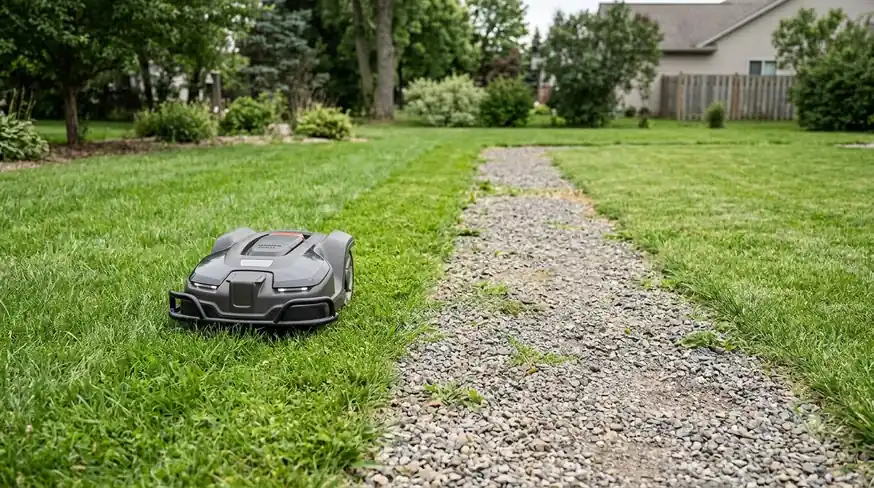
Our reading is that a bed that sits close to the fence line works best with a clear margin between the cutting path and the plants. Measure the gap at the narrowest point, not the average, because the mower will meet the narrowest point first. See robot mower flower beds for how beds change the layout.
Who each option suits
An open fenced lawn with a clear sky view and a gentle slope suits the best robot mower for a fenced backyard with most navigation types, while a shaded, treed or steep fence line points toward a boundary wire or a model with a higher slope rating. The table below sets out the common cases, as our reading of the sources above.
| Yard situation | Navigation to consider | Why |
|---|---|---|
| Open lawn, clear sky, slope under 10 percent | Wire-free or boundary wire | Fewest constraints from the fence line |
| Tall fence or wall close to the lawn | Boundary wire | Walls and tall buildings can degrade GPS and RTK signal |
| Heavily treed or narrow courtyard | Boundary wire or LiDAR | Eufy says these layouts may suit wire or LiDAR better |
| Fence line steeper than 10 percent | Check the model rating, and avoid a FlexiFence zone on that side | FlexiFence areas are capped at a 10 percent gradient |
What to check before you buy the best robot mower for a fenced backyard
Before you buy, measure the strip between the fence and each bed, check the slope along the fence and confirm that the navigation type suits your sky view. These five checks take an afternoon and show whether a model fits your yard.
- Measure the strip. Find the narrowest gap between the fence and each bed or path, then compare it with the 30 cm, 35 cm and 60 cm margins above.
- Walk the slope. Check the gradient along the fence line, because a FlexiFence area is limited to 10 percent.
- Check the sky view. Wire-free mowers need a clear view of the sky, and tall fences and walls can weaken the signal.
- Read the manual. Clearances and slope limits differ by brand and model, so use the manual for the model you plan to buy.
- Plan the boundary. Decide where the wire or zone runs along the fence, and where any guide wire must pass through a gap.
Frequently asked questions
Which navigation suits a fenced backyard best?
The best robot mower for a fenced backyard depends on the fence height and your sky view. Wire-free mowers can be quicker to set up, but tall fences and walls can weaken satellite signal. A boundary wire is the safer fit where signal is poor, although Eufy notes that wired installs typically take an entire weekend.
How far should a guide wire be from the boundary wire?
Husqvarna’s support page sets at least 30 cm (12 in) between a guide wire and the boundary wire, and says the two should not cross. The gap between the wire and the fence itself depends on the model, so follow the manual for your mower.
Does a steep fence line rule out a robot mower?
Not automatically. A FlexiFence area is capped at a 10 percent gradient, but some models list much higher slope ratings, such as 45 to 84 percent for certain Navimow models. Check the rating for the exact model and whether the slope runs along the fence or across it.
Can a FlexiFence zone be attached to an existing boundary wire?
No. Husqvarna says FlexiFence cannot be attached to an existing boundary wire and must stand independently, so plan for a separate zone wire with its own clearances.
Sources
- Install and use Automower FlexiFence in boundary wire installations (Husqvarna): zone clearances, 10 percent slope cap and the rule against attaching to an existing wire.
- How to lay a guide wire in a boundary wire installation (Husqvarna): 30 cm guide wire spacing and the no-crossing rule.
- Wired vs wire-free robot lawn mower (Eufy): setup times, signal near walls and shaded zones, and suited layouts.
- Lawnmower wire layout (Navimow): layout obstacles and model-specific slope ratings, on a Dutch-language page.
 Up next8 min readBy YardCan a Robot Mower Work in a Fenced Backyard?Updated Nov 11, 2026
 9 min readBy YardBest AWD Robot Mower for Hilly Backyard: 6 Things to Check Before You BuyUpdated Nov 13, 2026
 9 min readBy YardBest Robot Mower for a Small Backyard in the City: What to Check FirstUpdated Nov 12, 2026
 8 min readBy YardCan a Robot Mower Work in a Yard With Backyard Chickens?Updated Nov 12, 2026
 7 min readBy YardRobot Mower for a Sloped Front Yard and Flat BackyardUpdated Nov 14, 2026
 6 min readBy YardRobot Mower for a High Altitude Yard: What Changes and What to CheckUpdated Nov 11, 2026