
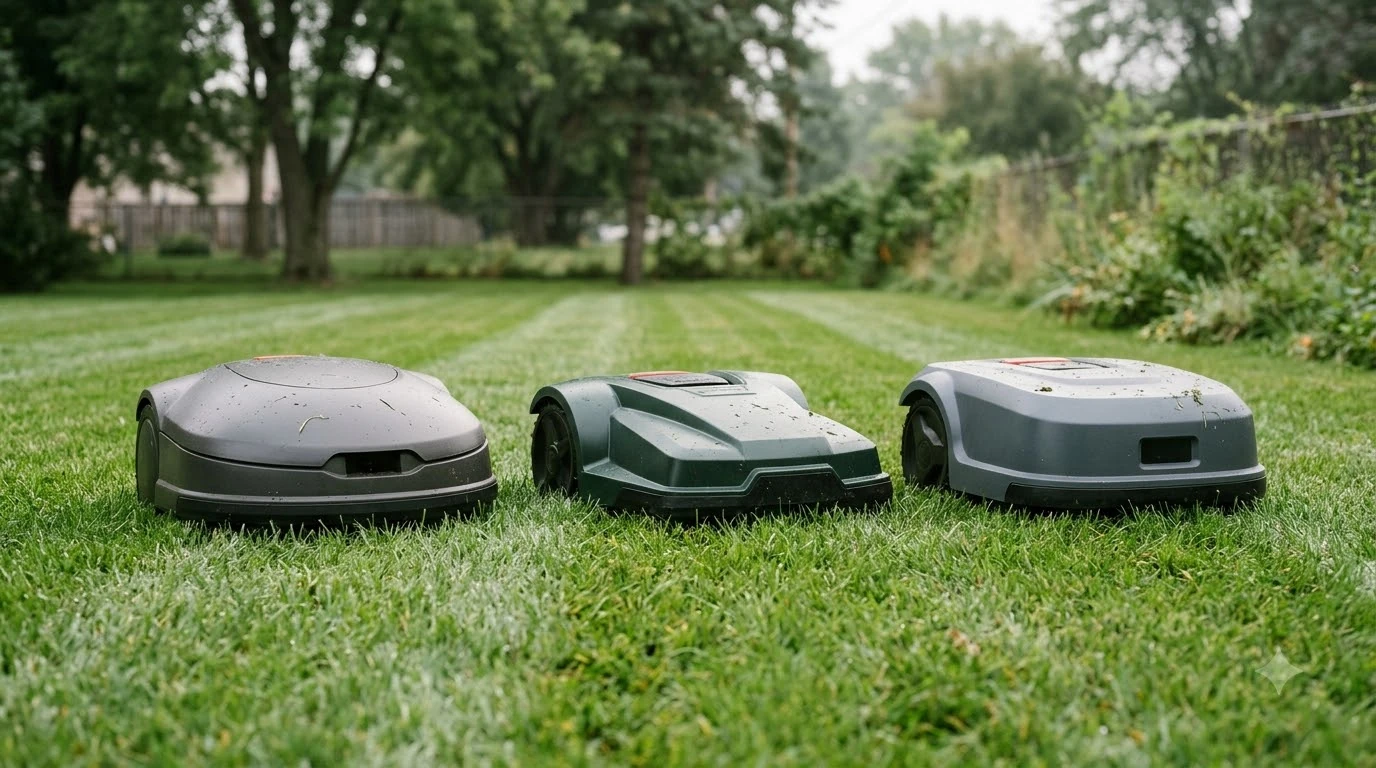

In a robot mower vs electric lawn mower comparison, the main difference is who does the work each session. A robot mows on its own schedule once it is set up, while a corded or battery electric lawn mower still needs you to walk behind it. The sources we read compare robot mowers mostly against gas mowers, so the noise and effort figures below are against gas, not against electric push models.
The short answer
- Effort: in a robot mower vs electric lawn mower choice, the robot runs on a schedule. Husqvarna rates its effort as “Low” and traditional mowers as “High.”
- Noise: Husqvarna cites about 60 decibels for its Automower and about 90 for a gas mower. The sources we read give no decibel figure for corded or battery push mowers.
- Limits: lawn size and slope depend on the model. The figures we found range from up to 2,700 square feet and 35 percent slope to 800 square meters and 18 degrees.
- Setup: a robot needs additional hardware, while a push mower does not.
- Our reading: a robot suits hands-off mowing on a lawn inside its rated limits. An electric push mower suits a lawn the robot cannot cover, or a budget that rules out a robot.
Robot mower vs electric lawn mower: effort and upkeep
The main difference is labor. Husqvarna’s comparison page describes its Automower as mowing automatically, including when you are not home, and controllable from a smartphone, and rates the effort and time involved as “Low.” The same page rates traditional mowers as “High,” because you operate them yourself (Husqvarna automower comparison).
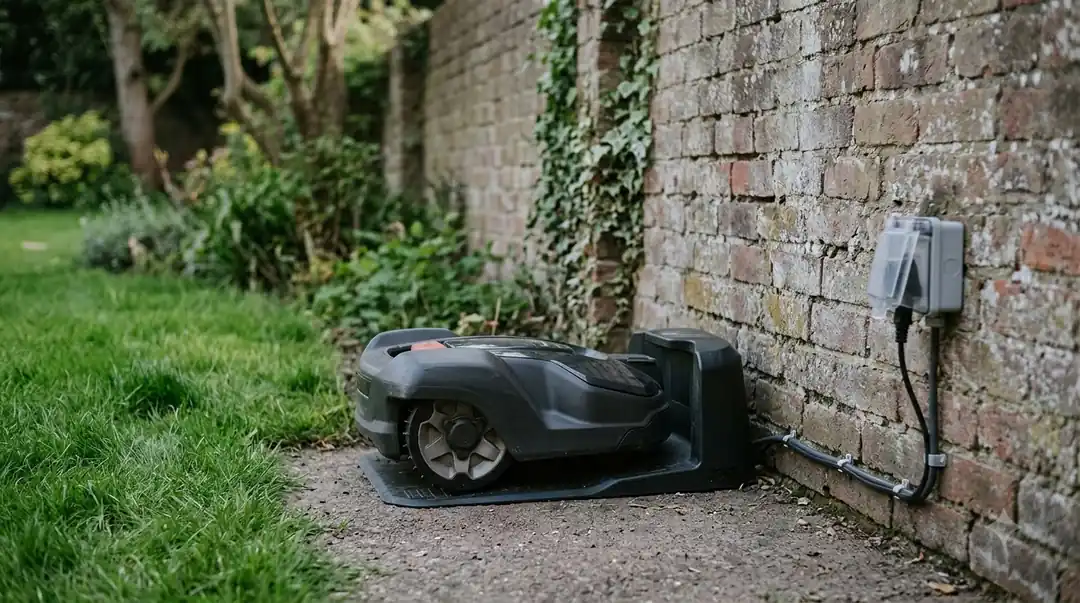
Upkeep is different too. Husqvarna describes robot maintenance as “Minimal” and traditional maintenance as “Average,” and advises replacing blades regularly whichever mower you use. Eufy’s blog, written by a manufacturer, says robot owners should “check the blades, clean the underside when required and remove objects that could interrupt mowing” (eufy robot vs electric lawn mower).
An electric push mower has no schedule. You decide when to mow and you do the mowing. The sources we read give no weekly time figure for electric push mowers, so this guide does not put a number on the difference.
Noise: robot mower vs electric lawn mower
On noise, a robot mower vs electric lawn mower comparison is hard to settle from the sources we read. Robot mowers come out well ahead of gas mowers on the figures in our sources. Husqvarna gives “around 60 decibels” for its Automower and “around 90 decibels” for a typical gas mower, and says the Automower is “33% quieter than gas” (Husqvarna). TopTenReviews lists 60 dB for the Gardena SILENO Minimo, a robot model (TopTenReviews).
For scale only, OSHA sets a workplace permissible exposure limit of 90 dBA for an 8-hour day, and a hearing conservation trigger of 85 dBA as an 8-hour time-weighted average (OSHA noise). These are workplace rules, not ratings for home mowers, so they do not tell you whether a given mower is safe for a given lawn.
The gap that matters for an electric push mower is missing. None of the sources we read gives a decibel rating for a corded or battery push mower, so compare the spec sheets of the models you are considering before assuming either type is quieter. If noise is your main worry, see how to reduce robot mower noise.
Robot mower vs electric lawn mower: side-by-side
The table lists only what the sources state. Where a source is silent, the cell says so rather than filling in an estimate.
| Factor | Robot mower | Corded or battery push mower | Gas push mower |
|---|---|---|---|
| Who runs it | The robot, on a schedule (Husqvarna: effort “Low”) | You (Husqvarna: effort “High”) | You (Husqvarna: effort “High”) |
| Noise | About 60 dB (Husqvarna Automower; TopTenReviews on Gardena model) | No figure in the sources read | About 90 dB (Husqvarna, typical) |
| Power | Battery (Husqvarna: “fundamentally battery-powered”) | Corded or battery; no runtime figure in the sources read | Gas |
| Slope limit | Model-specific: 35% (Gardena); up to 18 degrees (eufy E15) | Not covered | Not covered |
| Lawn size limit | Model-specific: up to 2,700 sq ft (Gardena); up to 800 sq m (eufy E15) | Not covered | Not covered |
| Extra hardware | Yes (Husqvarna; hardware not named) | No (Husqvarna) | No (Husqvarna) |
| Maintenance | Minimal (Husqvarna); check blades and underside (eufy) | Average (Husqvarna) | Average (Husqvarna) |
Lawn size and slope limits
Robot limits are set per model, so the figure for one machine does not apply to another. TopTenReviews lists the Gardena SILENO Minimo at up to 2,700 square feet and slopes up to 35 percent. Eufy’s blog, written by the manufacturer, says its E15 is suitable for lawns up to 800 square meters, slopes up to 18 degrees and grass below 9 centimeters, citing its Australian product page for that model.
Husqvarna’s comparison page does not give a maximum lawn size or slope for its Automower. Neither source covers slope or lawn size for electric push mowers.
Our reading: a robot’s rated area and slope are firm limits, and robot mower slope ratings are defined differently by each maker. If your lawn is larger or steeper than the rated figures for the model you are considering, the robot is the wrong pick for that lawn, and a push mower deserves a closer look.
Power and running cost
Husqvarna notes that robotic mowers are “fundamentally battery-powered” and that battery or electric mowers produce far fewer carbon emissions in use than gas products. The page does not give a kWh, runtime or cost figure for either type.
Eufy’s blog uses the phrase “enough runtime to finish the job in one session” but gives no duration. The sources we read therefore do not support a running-cost comparison between robot and electric push mowers, and this guide does not offer one. For a closer look at one cost line, see robot mower electricity cost.
Heads up
Running-cost claims in vendor blogs are often tied to one model and one region. Treat any single figure as a starting point and check the spec sheet and current local rates before deciding.
Setup and boundary hardware
Husqvarna lists “Yes” under additional hardware for its Automower and “No” for traditional mowers. The page does not name the hardware. It does mention wire-free EPOS robotic mowers, which implies that other Husqvarna models use a physical boundary wire. For how the wire-free approach works, see how robot lawn mowers work without a wire. Setup steps are not covered in the sources we read, so check the manual for the model you are considering.
Husqvarna’s table gives “No” for additional hardware on traditional mowers, so the electric push option carries no boundary-hardware step.
Who a robot mower vs electric lawn mower choice suits
Our reading of the sources above, not a test result:
- A robot mower fits a lawn that sits inside the rated area and slope of a specific model, for someone who wants mowing to happen without a weekly session.
- An electric push mower fits a lawn that is larger, steeper or more irregular than the robot limits you find, or someone who wants no installation and no boundary hardware.
The sources do not show one type winning on every measure, and this guide does not rank them.
Frequently asked questions
Is a robot mower quieter than an electric lawn mower?
The sources we read compare robots with gas: Husqvarna gives about 60 dB for its Automower and about 90 dB for a typical gas mower. None of them gives a decibel rating for corded or battery push mowers, so compare spec sheets for the models you are weighing.
Does a robot mower need a boundary wire?
Husqvarna lists additional hardware for its Automower without naming it, and mentions wire-free EPOS models, which suggests other models use a physical wire. Check the manual for the exact model before buying.
Can a robot mower handle a slope?
It depends on the model. TopTenReviews lists up to 35 percent for the Gardena SILENO Minimo, and eufy lists up to 18 degrees for its E15. Use the rated slope of the exact model, not a figure from another brand.
Which costs less to run, a robot or an electric push mower?
The sources we read do not give comparable running-cost figures for electric push mowers, so we cannot give a verdict. Compare current electricity rates and battery replacement costs for the models on your list.
Sources
- Automower comparison (Husqvarna, manufacturer): effort, noise, power, setup and maintenance ratings.
- Robot vs electric lawn mower (eufy, manufacturer blog): E15 lawn size, slope, grass height limits and maintenance tasks.
- Robot vs push lawn mower (TopTenReviews): Gardena SILENO Minimo noise, slope and lawn size.
- Noise and hearing conservation (OSHA, US government): workplace exposure limits, used for scale only.
 Up next7 min readReviews & CompareCorded Electric Mower vs Robot Mower: Which Suits Your LawnUpdated Nov 12, 2026
 9 min readReviews & CompareMammotion Luba 3 AWD Pros and Cons: What the Sources ShowUpdated Nov 13, 2026
 8 min readReviews & CompareLymow One Problems and Complaints: What the Sources ShowUpdated Nov 14, 2026
 9 min readReviews & CompareRandom Pattern vs Systematic Robot Mower: What the Sources ShowUpdated Nov 14, 2026
 8 min readReviews & CompareRobot Mower Annual Maintenance Cost: What the Sources ShowUpdated Nov 12, 2026
 7 min readReviews & CompareSunseeker Elite X5 Problems and Complaints: What the Sources ShowUpdated Nov 15, 2026