


Should you bury or peg robot mower boundary wire? Peg it first, and bury it later only if you want a cleaner lawn. Robomow describes burial as optional, and Anker’s Eufy guide advises a surface test even when you plan to bury the wire.
The short answer
- Peg first: pin the wire to the surface for a test run of 2 to 3 weeks before you bury anything.
- Burial is optional: Robomow says it is by no means necessary to lay the boundary wire underground.
- Depth if you bury it: about 4 to 5 cm (1.5 to 2 in), with 7 cm (about 3 in) as the outer limit in the sources we read.
- Peg spacing: Anker advises pegs or lawn hooks about every 1 meter (about 3 ft).
- Our reading: bury only after the layout is final, because a buried wire is harder to find, repair and move.
Deciding whether you should bury or peg robot mower boundary wire comes down to a trade between protection and flexibility. A buried cable is shielded from weather and garden tools, while a pegged cable can be lifted and rerouted in minutes. Both options work with a robot mower, so the choice depends on how settled your yard layout is and how much you want to change it later.
Should you bury or peg robot mower boundary wire? A quick comparison
Pegging the wire is the quicker setup and the easier one to change. Burying it takes more time, but Anker calls it the best choice if you scarify your lawn regularly, and the wire is protected from the elements and garden tools.
| Factor | Pegged on the surface | Buried in a trench |
|---|---|---|
| Setup | Push pegs into the ground and insert the wire into the slots, as Worx describes | Dig a channel first; Robomow says an initial channel of about 4 cm (1.5 in) is needed |
| Weather exposure | Corrosion and weathering risk is “incomparably higher” than underground, per Robomow | Protected from the elements and garden tools, per Anker |
| Appearance | Visible at first; the lawn covers it in about 2 to 4 weeks, per Robomow | Invisible once the soil is back in place |
| Repairs | Breaks are easier to spot | Breaks are not visible, so a tool is needed to locate the signal fault |
| Layout changes | Simpler to adjust | Changing the garden design is comparatively complicated |
| Labor and cost | Less time to lay | More time to lay; hiring a professional costs more |
The table summarizes manufacturer guidance, not a side-by-side test. The main practical point is that a surface-laid wire is easier to fix, while a buried one holds up better against scarifiers, trimmers and digging.
Why start by pegging the wire
The short answer to should you bury or peg robot mower boundary wire is to start by pinning it to the surface for 2 to 3 weeks, because Anker advises that test run even if you plan to bury the wire later, to confirm the mower navigates correctly. Robomow makes a similar point for rolled turf, recommending that the wire go above ground first.
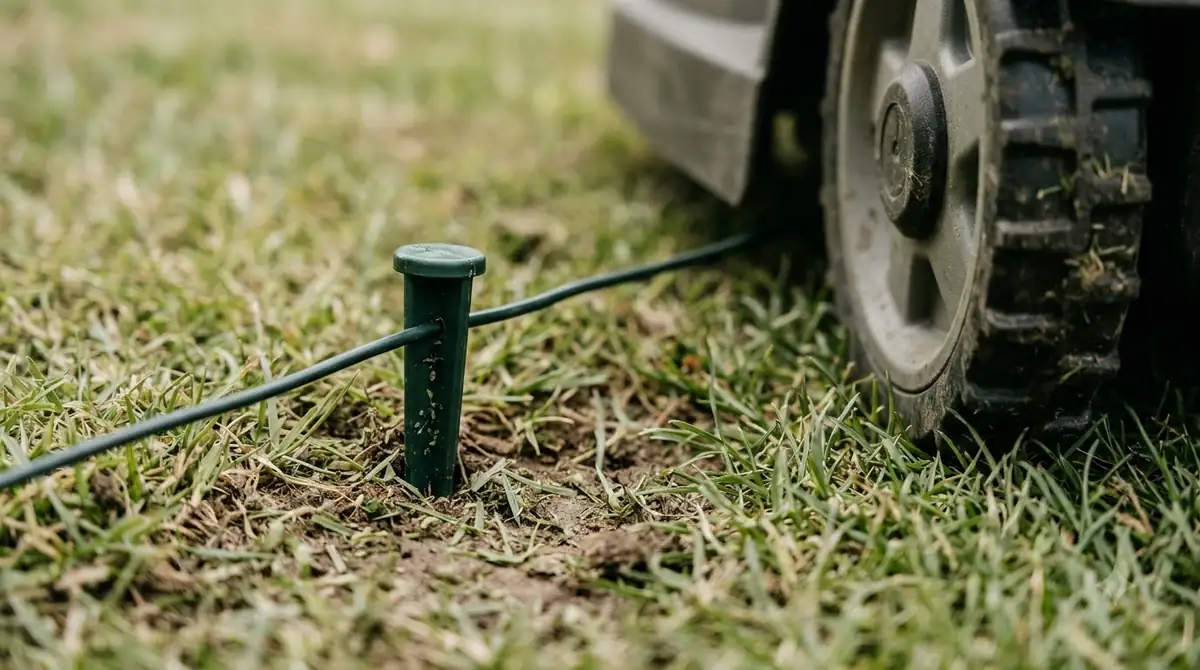
During the test, watch how the mower returns to its charging station and whether it follows the route you expected. Anker notes that adjustments are easier to make before the wire goes underground, which is the main reason to peg it first.
- Check the return path to the charging station on several runs.
- Move pegs and wire where the route looks wrong, before anything is buried.
- For rolled turf, Robomow gives a window of about 3 weeks to place the wire underneath.
Burial depth and signal reach
Most manufacturer figures put a buried wire at about 3 to 7 cm (1 to 3 in), with 4 to 5 cm (1.5 to 2 in) described as the optimal depth. Robomow gives a general range of 3 to 7 cm, while Anker’s installation steps say 3 to 5 cm with a maximum of 7 cm. Its FAQ gives 4 to 5 cm as the optimal depth, so the sources agree on the target and differ only at the edges.
Depth matters in both directions. Robomow warns that a wire buried too deep can cause signal interference, which means the mower may not receive the signal reliably. A wire buried only 1 to 2 cm (under 1 in) deep can work its way back to the surface during scarifying.
Heads up
Robomow says most cables transmit with minimal problems to a depth of about 7 cm. Burying deeper than necessary adds risk without adding protection, so the goal is about 4 to 5 cm (1.5 to 2 in), not the deepest the wire can go.
Peg spacing and how to secure the wire
Anker advises securing the wire with pegs or lawn hooks about every 1 meter (about 3 ft) when it sits above ground. Worx’s product page gives a simpler instruction: push the pegs into the ground at regular intervals along the perimeter, then insert the wire into the slots.
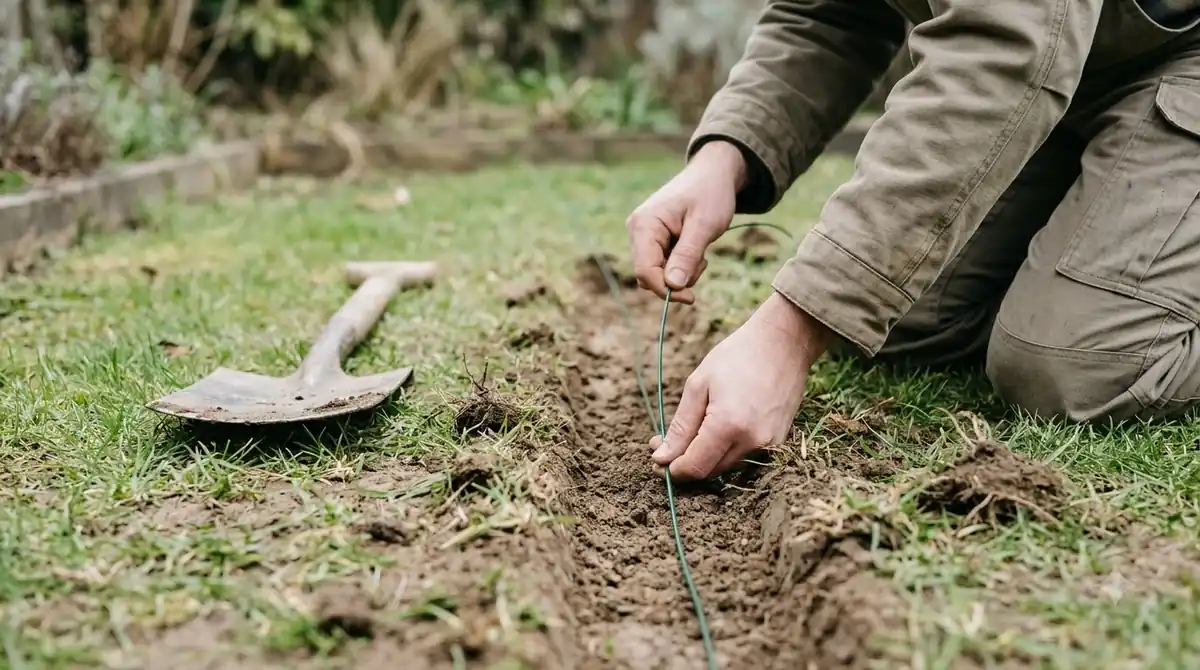
Robomow recommends mowing the lawn as short as possible before you lay the wire and securing it firmly with lawn nails. It also says that after a few weeks the grass grows in and the wire is no longer visible. Our reading is that extra pegs on curves and corners help stop the wire from lifting, although none of the sources we read gives a figure for that.
Repairs, changes and extensions
A buried wire is harder to locate, repair and reroute, so finish the layout before you bury any of it. Robomow notes that breaks in a buried cable are not easy to detect visually and need a tool to find the signal fault; our guide to finding a break in robot mower wire covers the process. Changing a buried layout later is also more work than moving pegs, and Robomow notes that a professional installation costs more; see robot mower installation cost for what that can involve.
Lawns change over time. Anker says the perimeter wire needs adjusting when lawn areas change, and that it can be extended easily, although the total wire length is finite, so check how much boundary wire you need before you plan a bigger loop. Our reading is that a new section deserves the same surface test before you bury it, and that waterproof wire connectors are the usual way to join it to the old run.
A practical sequence for owners
Peg the wire, test it for 2 to 3 weeks, adjust the layout, and bury it at about 4 to 5 cm only if the route holds. This order is our reading of the manufacturer guidance rather than a single source’s instructions. It answers the practical question, should you bury or peg robot mower boundary wire in most yards: peg first, then bury.
- Lay and peg the wire on the surface. Use pegs or lawn hooks, placed about every meter, and press the wire into the slots. For the full perimeter layout, see our boundary wire installation guide.
- Run the mower for 2 to 3 weeks. Anker recommends this test with the wire pinned, even when you plan to bury it.
- Fix the layout first. Move pegs and wire where the route looks wrong, because changes are easier before burial.
- Bury at about 4 to 5 cm (1.5 to 2 in) if you still want to. Cut a straight trench and keep the depth even along the run.
- Check the wire after scarifying. A wire buried too shallow can resurface, so inspect it after heavy raking.
Common mistakes
The most common errors are burying the wire too shallow, burying it too deep, and burying it before the route has been tested. Each one is easy to avoid if you start with a pegging test.
- Burying at 1 to 2 cm (under 1 in). Robomow warns that the wire may resurface during scarifying.
- Going deeper than needed. Robomow links excessive depth to signal interference.
- Burying before the test. Changes that take minutes with pegs become a digging job underground.
- Skipping the surface step on rolled turf. Robomow recommends placing the wire above ground first.
Frequently asked questions
Should you bury or peg robot mower boundary wire at first?
Peg it at first. Robomow says it is by no means necessary to lay the boundary wire underground. A surface-laid wire works, but it is exposed to weather and garden tools, and it stays visible until the grass grows over it.
Can I bury the wire after pegging it?
Yes. Anker advises a 2 to 3 week test with the wire pinned to the surface before burial, and Robomow mentions a 3 week window for placing the wire under turf. Adjust the layout during the test, because changes are harder once the wire is in the ground.
How deep should buried boundary wire be?
About 4 to 5 cm (1.5 to 2 in) is the depth most often described as optimal. Robomow gives a general range of 3 to 7 cm (1 to 3 in) and warns that a wire buried too deep can cause signal interference, while a wire at 1 to 2 cm can resurface during scarifying.
How far apart should the pegs be?
Anker advises pegs or lawn hooks about every 1 meter (about 3 ft) above ground. Worx says to push pegs in at regular intervals along the perimeter. Check your mower’s manual for its own spacing, because the sources we read do not give one exact figure.
Sources
- Do I have to lay the boundary wire underground? (Robomow): burial is optional, surface test first, trench depth, trade-offs of surface and buried wire.
- How deep must the boundary wire be laid for robotic mowers? (Robomow): general depth range, optimal depth, risks of too deep and too shallow.
- Robot lawn mower boundary wire installation (Anker, Eufy UK guide): two to three week test, peg spacing, burial depth, changes and extensions.
- Landroid 100 pegs (Worx): pushing pegs at regular intervals and inserting the wire into the slots.
 Up next9 min readBy YardHow to Lay Boundary Wire Around Trees and ObstaclesUpdated Nov 11, 2026
 8 min readBy YardHow Much Boundary Wire Do You Need for a Robot Mower?Updated Nov 11, 2026
 9 min readBy YardRobot Mower and Dog Poop: Should You Let It Mow Over Waste?Updated Nov 11, 2026
 9 min readBy YardWhere to Put a Robot Mower Charging Station (Placement Rules)Updated Nov 11, 2026
 8 min readBy YardRobot Mower and Moles or Gophers: What Actually WorksUpdated Nov 11, 2026
 8 min readBy YardRobot Mower for Clover Lawn: What the Extension Sources SayUpdated Nov 11, 2026