
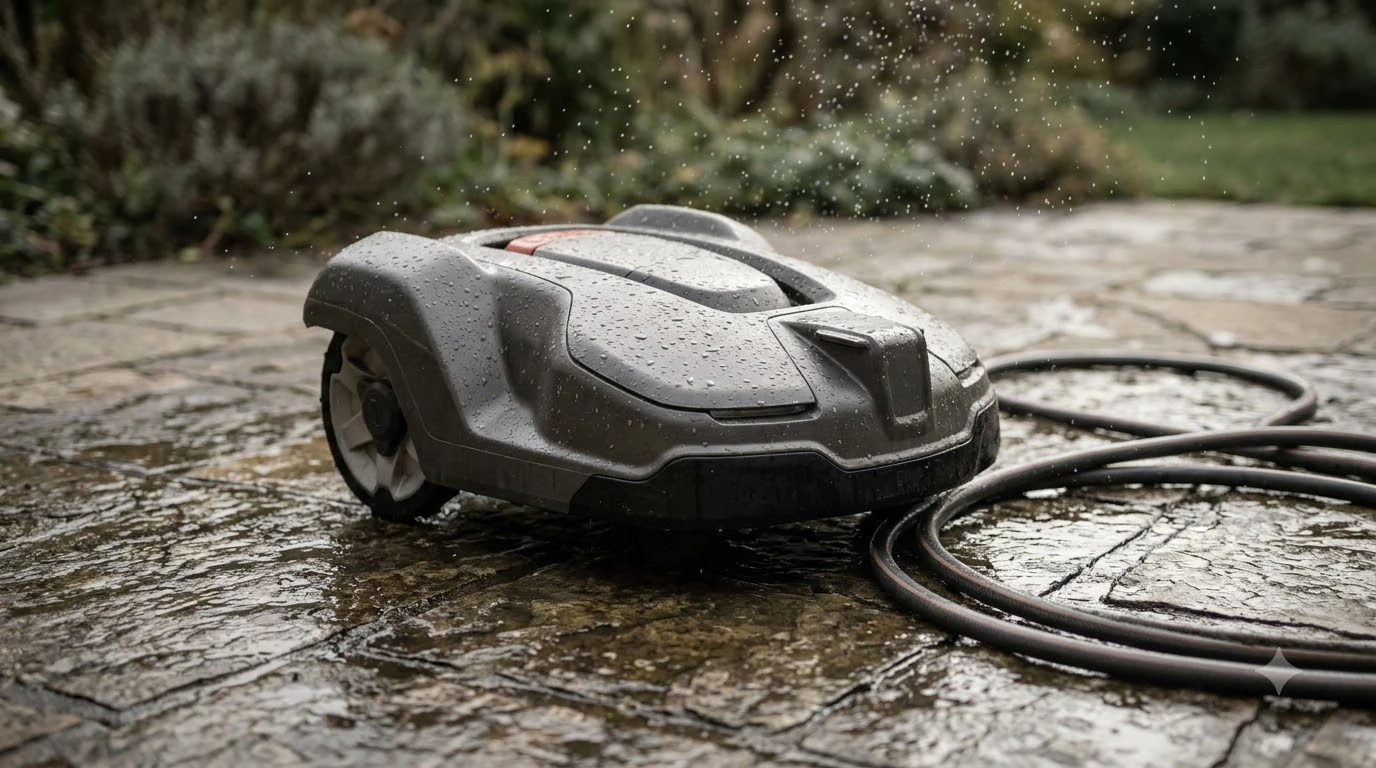

The best robot mower for a yard with a swimming pool is the one you can keep physically away from the water. Look for a setup that uses a boundary wire or a fence-style barrier rather than an app zone alone, a published wire margin of about 30 to 50 cm from the pool edge, lift and collision sensors, and a charger placed at least 1 m from the pool. No single model has independent pool test data behind it, so the setup and the specs you can verify matter more than any brand name.
The short answer
- Barrier first: Husqvarna’s support says not to use an app stay-out zone to keep a mower out of a pool, and to fence the area with a boundary wire plus a barrier at least 15 cm high.
- Margin: one retailer guide puts the wire 30 to 50 cm from the pool edge, adjustable by model.
- Sensors: lift and collision sensors are the backup, not the pool detector.
- Water: an IP rating describes an enclosure test, not pool or chlorine resistance. We did not find a published chlorine rating.
- Charger: keep the base at least 1 m from the pool and out of splash and rain runoff.
Why a physical barrier beats a software zone around a pool
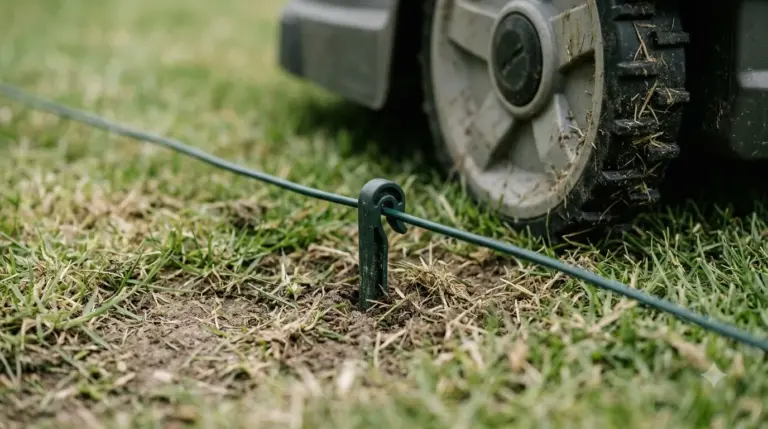
A pool is a hazard that a mower can enter in one wrong turn, so the first question is how the mower is kept off the water. Wire-free models draw a no-go zone in an app, and that is useful for lawn beds and paths. For a pool, the manufacturer guidance we read is more cautious. Husqvarna’s support page for its AIM stay-out zones says plainly: “Never use a stay-out zone created with AIM Technology to stop your mower from running into a swimming pool or the street.” It then tells owners to fence the area with the boundary wire and a barrier at least 15 cm (6 in) high.
Our reading: a software zone is a convenience feature, and a barrier you can see and touch is the safeguard. When you shop for the best robot mower for a yard with a swimming pool, ask whether the maker supports a wire or fence arrangement at the pool, and whether the manual gives a distance for it. If the only answer is an app zone, treat the pool as a place that needs a physical stop. A separate guide explains whether a robot mower can mow around a pool safely and what setback to use.
Heads up
Some vendors say their AI cameras can spot pool coping and treat it as a hard wall. Mammotion’s safety blog makes that claim without describing a test method or a figure, so treat it as a claim until you can check it in the manual.

How much margin to leave between the wire and the pool edge
The distance from the boundary wire to the water is the number that matters most, and the published figures differ by source. The table below lists what we could verify and what each figure actually applies to.
| Source | Figure | What it applies to |
|---|---|---|
| Unicorn Floats (retailer) | 30 to 50 cm from the pool edge | Pool setup; adjustable by model; not a manufacturer figure |
| Robomow (manufacturer blog) | About 35 cm from a garden pond | Garden pond, not a pool; use as a sense of scale |
| Husqvarna (manufacturer support) | Barrier at least 15 cm high at the pool | Fence-style barrier used with the boundary wire |
The ranges are not interchangeable. A pond figure from one brand is not a pool rule, and a retailer’s 30 to 50 cm is a starting point that the manual for your model may change. Our reading is to set the wire at the upper end of the published range when the coping is hard, the water is close, or the lawn slopes toward the pool.
Sensors: what lift and collision sensors do and do not cover
For a swimming pool yard, sensors are a backup to the setup. Most robot mowers carry collision sensors that register a bump and lift sensors that register the body being raised. Those sensors can stop the blades when the mower hits an obstacle or is picked up, and a retailer guide we read says most models have both. For more on how the blade-stop side works, see whether robot mowers have blade stop sensors. That is useful around a pool, but it is a backup. A lift sensor reacts after the mower has already moved, and a collision sensor reacts after contact, so neither is a reliable way to recognize water before the mower reaches it.
Slope adds a second limit. Navimow lists maximum slopes of 45% (about 24 degrees) for the i2 AWD, 55% (about 29 degrees) for the i2 LiDAR Pro, and 84% (about 40 degrees) for the X4. If the pool sits at the bottom of a grade, check the slope rating against the real ground, not the lawn’s average, because a steep edge near water deserves extra margin. Our reading is that a wider wire margin is the simplest hedge.
Water ratings and chlorine: what IP numbers do and do not say
Buyers often look for an IP rating and assume it covers pool water. It does not. IP codes come from IEC 60529, which tests an enclosure against dust and water spray or immersion under defined conditions. IPX7 means the enclosure survives immersion to 1 m for 30 minutes, and IPX8 covers deeper or longer immersion as the maker defines it. Those tests say nothing about chemical exposure from pool water, and nothing about how the mower behaves in a pool. Our guide to robot mower IP ratings explained covers the codes in more detail.
We did not find a manufacturer or independent source that rates robot mower parts for chlorine or pool-water exposure. Our reading: treat a mower that goes into a pool as a failed setup, not a waterproof one. Unicorn Floats advises not to let the mower be submerged, and to switch off the power at once if it falls in.
Where to put the charger, away from the water
The charging base is where a pool and a mower often meet, because the base is usually on the same side of the lawn as the water. A retailer guide we read advises keeping the charging station at least 1 m from the pool and protected from rain. That keeps splash and runoff off the contacts and keeps the mower’s route to the dock short and predictable. For general placement rules, see where to put a robot mower charging station.

Route the boundary wire around the pool coping, the pump, and any technical room, so the mower never has to cross a pump pad or a gravel edge to reach the dock. If your layout forces the dock close to the pool, a physical barrier and a clear run to the base matter more than the exact wire distance.
Clippings, swim times and the stone strip
Clippings are a practical problem. A retailer guide we read notes that grass can wash into the pool and the skimmer, which is why it suggests mowing outside swim times. A stone or deck strip between the lawn and the pool does most of the work of keeping grass out of the water, and it also gives the wire a clear edge to follow. For the best robot mower for a yard with a swimming pool, that strip matters as much as any feature on the spec sheet. If you also want to fence off a flower bed or a play area, how to set up no-go zones on a robot mower shows the steps.
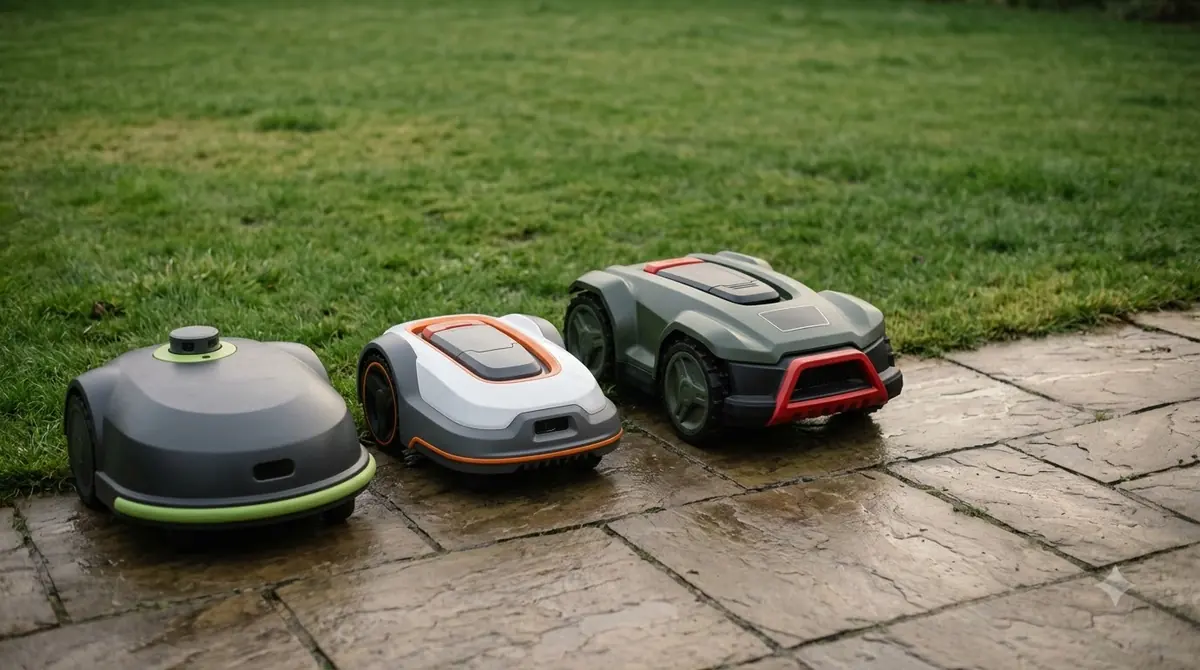
Checklist: the best robot mower for a yard with a swimming pool
Use this list when you compare mowers for a yard with a pool. None of these items is a ranking, and each needs a source you can check.
- Barrier support. Does the maker document a wire plus fence or barrier at the pool, with a height?
- Wire margin. Is there a published distance for water or a pool, and does it match the manual?
- Sensors. Does the model list collision and lift sensors, and what does the manual say they stop?
- Slope. Is the slope rating above the steepest ground near the pool?
- Water rating. Note the IP code, and do not read it as a pool or chlorine rating.
- Charger distance. Can the base sit at least 1 m from the pool and under cover?
Frequently asked questions
Can I rely on an app no-go zone when choosing the best robot mower for a yard with a swimming pool?
Husqvarna’s support says not to, and to fence the pool area with the boundary wire and a barrier at least 15 cm high. Use the app zone as an extra layer, not as the only protection.
How far should the boundary wire be from a swimming pool?
A retailer guide we read gives 30 to 50 cm from the pool edge, adjustable by model. Check the manual for your mower, because the figure varies.
Do lift and collision sensors stop a mower from entering a pool?
They react after the mower moves or touches something, so they are a backup. They are not a reliable way to detect water before the mower reaches it.
Should I still trim by hand near the pool?
Our reading: plan on some edge work near coping, and use a stone or deck strip to keep grass out of the water. The sources we read do not describe a fully hands-off setup.
Sources
- Husqvarna support: creating stay-out zones with AIM Technology (manufacturer): stay-out zone warning and 15 cm barrier.
- Robomow: laying the lawn boundary wire (manufacturer): wire as stop signal, 35 cm pond distance.
- Unicorn Floats: top robot lawn mowers guide (retailer): 30 to 50 cm wire, 1 m charger, stone strip, submersion advice.
- Navimow: are smart lawn mowers safe for pets and children (manufacturer): slope ratings for i2 AWD, i2 LiDAR Pro and X4.
- IP Code (IEC 60529 summary) (reference): IPX7 and IPX8 definitions.
 Up next7 min readBy YardHow Does a Robot Mower Handle a Swimming Pool?Updated Nov 10, 2026
 9 min readBy YardChoosing and Setting Up a Robot Mower for a Yard With an Above-Ground Pool LadderUpdated Nov 19, 2026
 8 min readBy YardChoosing and Setting Up a Robot Mower for a Yard With a Pool Deck Coping LipUpdated Nov 19, 2026
 9 min readBy YardCan a Robot Mower Mow Around a Pool Safely?Updated Nov 11, 2026
 6 min readBy YardRobot Mower for a Lawn with a Kiddie Pool: Barrier FirstUpdated Nov 13, 2026
 8 min readBy YardBest Robot Mower for a Townhouse Yard: Layout Checks Before You BuyUpdated Nov 13, 2026