

In short, how does a robot mower handle a swimming pool? It depends on setup, not on sensing water on its own. A buried boundary wire or an app no-go zone marks the pool edge, and the mower’s onboard sensors act as a backup. Vendor claims about AI that recognises pool coping are not backed by independent test data, so the wire or zone is what you should rely on.
The short answer
- Wired mowers: the boundary wire is a stop signal, and Robomow gives approx. 35 cm as the distance to a pond.
- Wire-free mowers: you draw a no-go zone around the pool in the app.
- Setback: Unicorn Floats advises a wire 30 to 50 cm from the pool edge, adjustable by model.
- Charger: keep the charging station at least 1 m from the pool.
- Water: the mower must not be submerged, so switch off the power at once if it falls in.
How a boundary wire keeps the mower off the pool edge
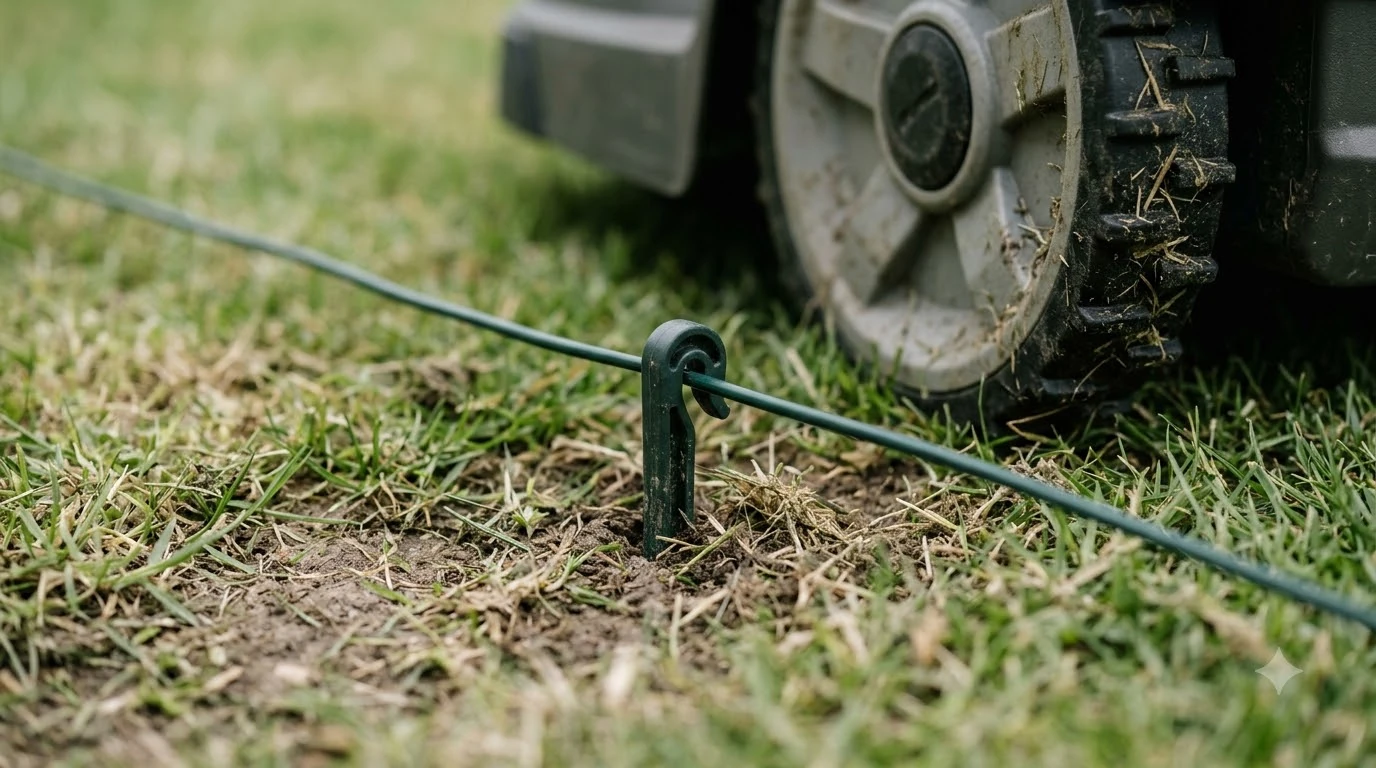
A wired robot mower follows a loop of buried or pegged cable. The mower reads the signal from that cable and turns back before it crosses the line, so the wire is effectively a stop signal for the whole lawn.
Robomow describes the wire as a way to stop the mower from driving over the cable and from landing in a garden pond. Its guidance gives an approximate distance of 35 cm to a pond, with extra obstacles placed so the mower cannot fall in. The same page puts the laying depth for the signal receiver at up to 7 cm, which is why the wire needs to be installed close to the surface and kept out of deep soil.
Keep in mind that these are the manufacturer’s figures for a garden pond, not a swimming pool. A pool edge is usually a hard, raised coping, so the wire is normally routed further out from it.
No-go zones and sensors: what the mower can and cannot see
A no-go zone is an area you mark on the map where the mower is not allowed to go. Wire-free mowers depend on this method entirely, while many wired models use it as a second layer. Unicorn Floats describes the wire-free setup as drawing a no-go zone around the pool in the app, and the wired setup as routing the cable away from the coping, following the setback the manufacturer specifies.
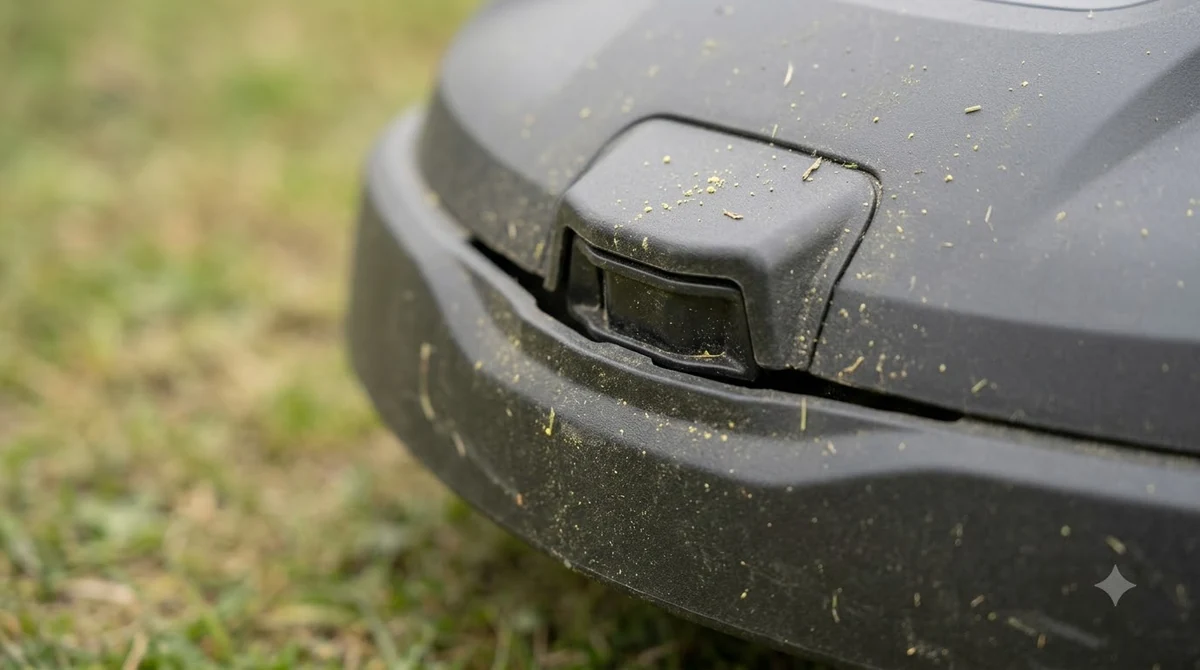
Most mowers also carry collision and lift sensors. These react after contact or when the mower is picked up, so they catch a bump or a lift but do not map the edge in advance. A drop sensor is meant to detect a sudden change in ground level, but its ability to work over water depends on the model and is not something the sources we read confirm.
| Setup | How it keeps the mower off the pool | What to check |
|---|---|---|
| Boundary wire | Stop signal at the cable, set 30 to 50 cm from the edge | Laying depth and the setback in your model’s manual |
| No-go zone in the app | Mapped exclusion area, no cable needed | Zone is drawn accurately on the map |
| Collision and lift sensors | React after contact or a lift | Not a substitute for a wire or zone |
Mammotion, a robot mower maker, says its AI can identify pool coping, curbs, and gravel edges and treat them as hard walls. The same article gives no exact distance for its safety buffer, only “several inches,” and it says nothing about independent testing. Treat these as the vendor’s claims, and do not rely on them in place of a wire or zone.
Setting up the area around the pool
Unicorn Floats recommends planning the surroundings of the pool before installing the mower, since the layout decides how a robot mower handles a swimming pool in practice. Its guidance is to place the boundary wire 30 to 50 cm from the pool edge, following the manufacturer’s recommendations, and to route the wire around the coping, the pump, and the technical room.
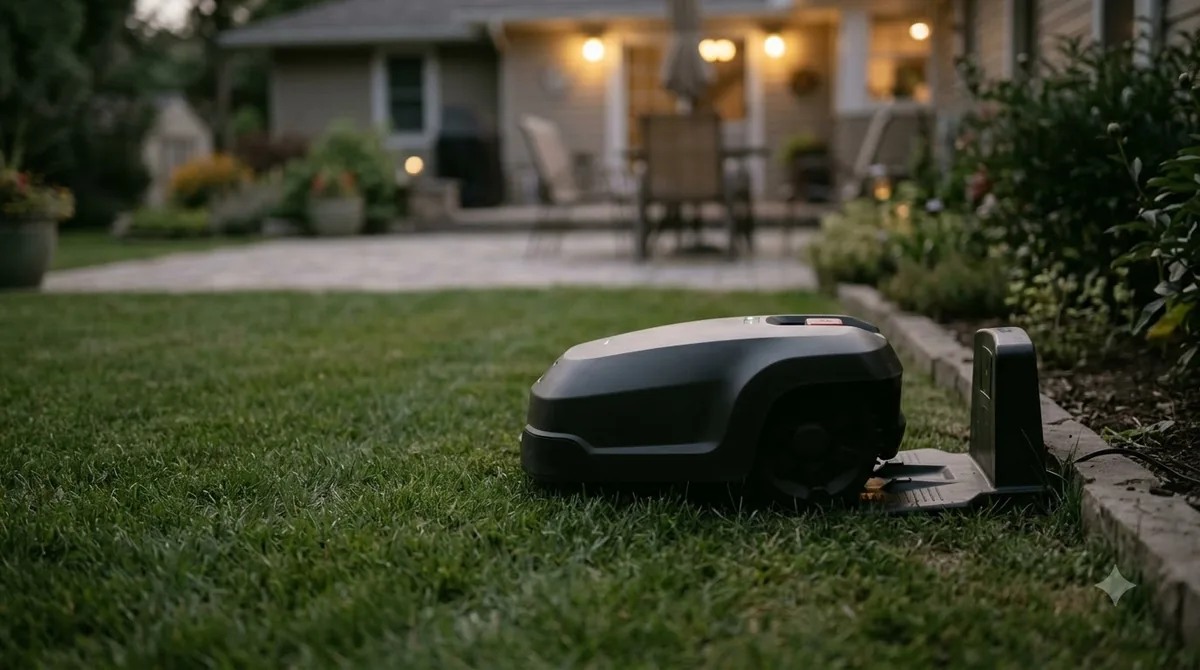
- Charging station: place it in an accessible, rain-protected spot at least 1 m from the pool.
- Stone or deck strip: a strip of stone or decking between the lawn and the pool stops most grass from landing in the water, according to the same source.
- Edge work: expect some hand trimming near the coping. In our reading, a robot mower will not reach the very edge of a pool deck, so that strip stays a manual job.
How does a robot mower handle a swimming pool day to day?
Beyond the wire and the zone, daily running raises three practical issues: clippings, swim times and water hazards.
Clippings are the everyday hazard when a robot mower works near a pool that robot owners overlook. Unicorn Floats warns that clippings thrown from the lawn end up in the water and then in the skimmer, where they add to the cleaning work.
The same source advises scheduling mowing outside swim times. A mower that runs in the middle of the afternoon is likely to be near swimmers, and a schedule set for early or late in the day keeps both the water and the people clear.
Heads up
Mowing the grass near the pool does not replace the setback. Even with a wire or zone in place, the grass near the coping still needs trimming by hand, so plan that work on a separate schedule.
What happens if a robot mower falls into the pool
A robot mower must not be submerged, according to the Unicorn Floats guidance. If one falls into the pool, the source says to switch off the power immediately, before any electrical diagnosis, and then retrieve the unit.
Mammotion’s vendor blog makes a stronger statement, saying that submerging a robot mower usually results in permanent electronic failure. It gives no test method, so treat it as the manufacturer’s risk warning rather than measured data. Whatever the cause, keeping the mower on its wire or zone is the way to avoid the situation in the first place.
Frequently asked questions
Can a robot mower detect that there is a pool?
In most setups it does not sense water. It stays out because of a boundary wire or an app no-go zone. Mammotion says its AI can recognise pool coping, but that is a vendor claim, and the sources we read do not confirm how reliably it works.
How far should the boundary wire be from a pool?
Unicorn Floats gives 30 to 50 cm from the pool edge, adjustable by model. Check your manufacturer’s manual for the exact setback, because the figure depends on the model.
Should I still trim the grass by hand near the pool?
Yes, in our reading. A robot mower cannot reach the very edge of a pool deck, so some hand trimming is usually needed. A stone or deck strip between lawn and pool reduces the grass that ends up in the water.
What should I do if the mower falls into the pool?
Switch off the power immediately and do not run the mower. The Unicorn Floats guidance says the mower must not be submerged, and Mammotion warns that submersion usually causes permanent electronic damage.
Sources
- Laying the lawn boundary wire: how the robotic lawnmower works (Robomow): stop signal, 35 cm pond distance, 7 cm signal depth.
- Top 5 robot lawn mowers for pools (Unicorn Floats, a pool retailer): 30 to 50 cm wire setback, 1 m charger distance, no-go zones, clippings, submersion advice.
- AI lawn mower safety protection guide (Mammotion, vendor blog): vendor claims about pool coping recognition and submersion, used only as claims.
 Up next9 min readBy YardBest Robot Mower for a Yard With a Swimming PoolUpdated Nov 13, 2026
 8 min readBy YardHow Does a Robot Mower Handle Tree Roots?Updated Nov 10, 2026
 8 min readBy YardHow Does a Robot Mower Handle Kids Toys?Updated Nov 11, 2026
 8 min readBy YardHow Does a Robot Mower Handle a Fire Pit?Updated Nov 11, 2026
 9 min readBy YardHow Does a Robot Mower Handle Solar Lights?Updated Nov 11, 2026
 8 min readBy YardHow Does a Robot Mower Handle Raised Garden Beds?Updated Nov 11, 2026