
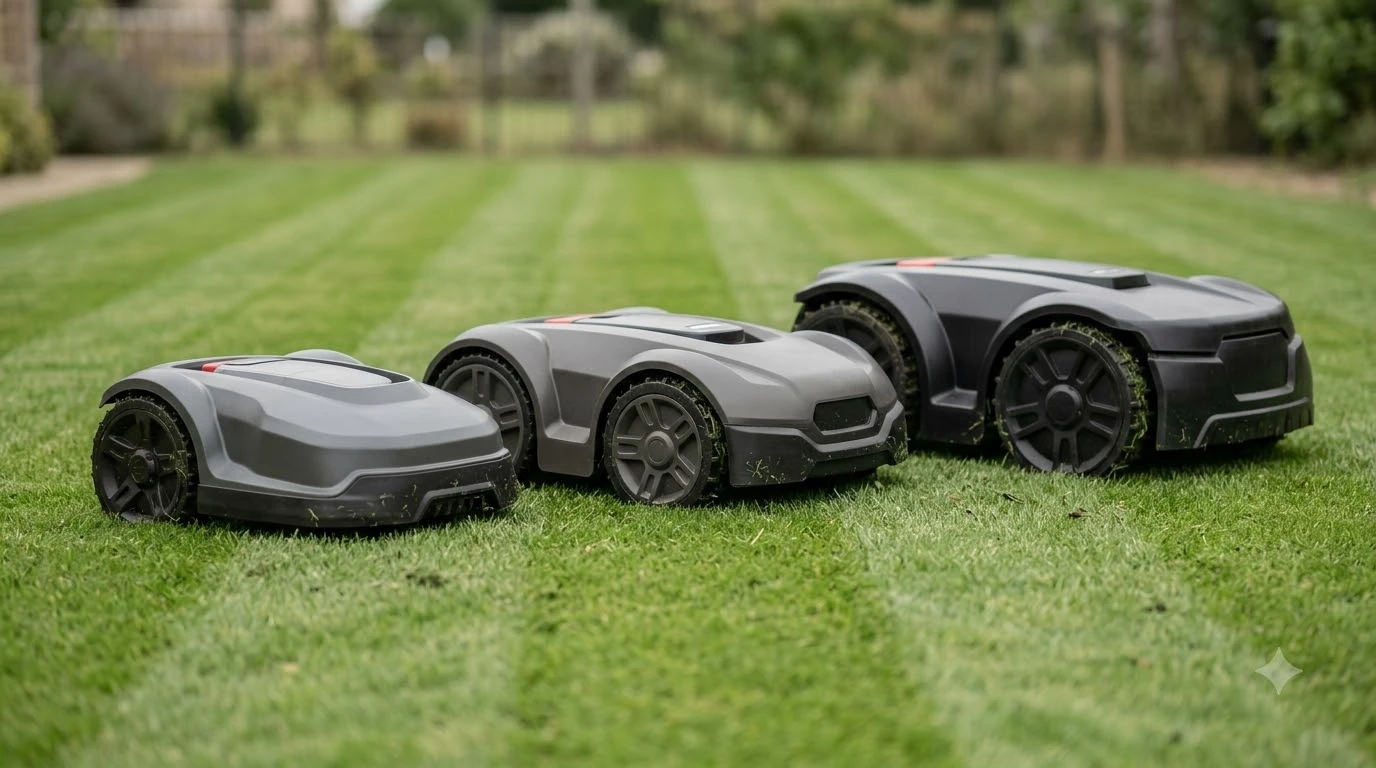

The ecovacs goat o1000 rtk vs ecovacs goat a1600 rtk comparison comes down to lawn size, slope and recharge time, according to the official Ecovacs spec pages. The O1000 RTK lists a 45% slope rating and coverage up to 1/4 acre, while the A1600 RTK lists 50% and up to 500 m² per charge. The two pages come from different markets, so the figures are not always in the same units.
The short answer
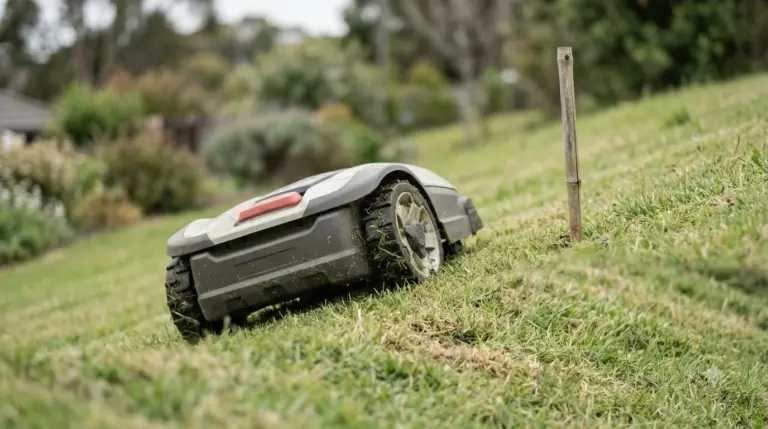
- Slope: the O1000 RTK is rated at 45% (about 24 degrees) in its work area, and the A1600 RTK at 50% (about 27 degrees).
- Coverage: the O1000 RTK page says up to 1/4 acre, and the A1600 RTK page says up to 500 m² per charge.
- Charging: the A1600 RTK page lists a 45-minute recharge with 180 W fast charging, and the O1000 RTK page lists about 100 minutes to charge.
- Navigation: both use RTK positioning. The O1000 RTK adds a camera and 3D ToF sensing, and the A1600 RTK is listed with LiDAR-enhanced RTK navigation at 2 cm precision.
Ecovacs GOAT O1000 RTK vs Ecovacs GOAT A1600 RTK at a glance
In the ecovacs goat o1000 rtk vs ecovacs goat a1600 rtk pairing, both are wire-free robot mowers that Ecovacs sells with RTK satellite positioning. The O1000 RTK page and the A1600 RTK page list them with overlapping but not identical fields, and the A1600 page leaves out several figures that the O1000 page gives. The table below shows only what each page states.
| Spec | GOAT O1000 RTK | GOAT A1600 RTK |
|---|---|---|
| Max slope | 45% work area (24°) | 50% (27°) |
| Coverage | Up to 1/4 acre | Up to 500 m² per charge |
| Mowing rate | About 1,507 to 1,938 ft²/h | 500 m² in 2 hours (page footnote says 400 m² per hour) |
| Navigation | RTK with camera and 3D ToF | LELS LiDAR-enhanced RTK, 2 cm precision |
| Recharge or charge time | About 100 minutes | 45 minutes at 180 W |
| Noise | 57 dBA | Not stated |
| Battery | 18 V, 4,000 mAh | Not stated |
| Warranty | Not stated on the page | Not stated on the page |
Cutting height and width
On cutting height, the O1000 RTK cuts from 1.2 to 3.2 inches in its spec table, which the feature text gives as 3 to 8 cm in 0.5 cm steps. The A1600 RTK page lists 3 to 9 cm in 1 cm increments, so its range reaches a little higher while its steps are coarser.
The O1000 RTK lists an 8.66-inch cutting width. The A1600 RTK page we read does not state a cutting width, so this comparison cannot say which deck is wider. Our reading: before you weigh the two models, check the width on the current product page for the market you live in before you judge how many passes the mower will need.
Slope rating: 45% against 50%
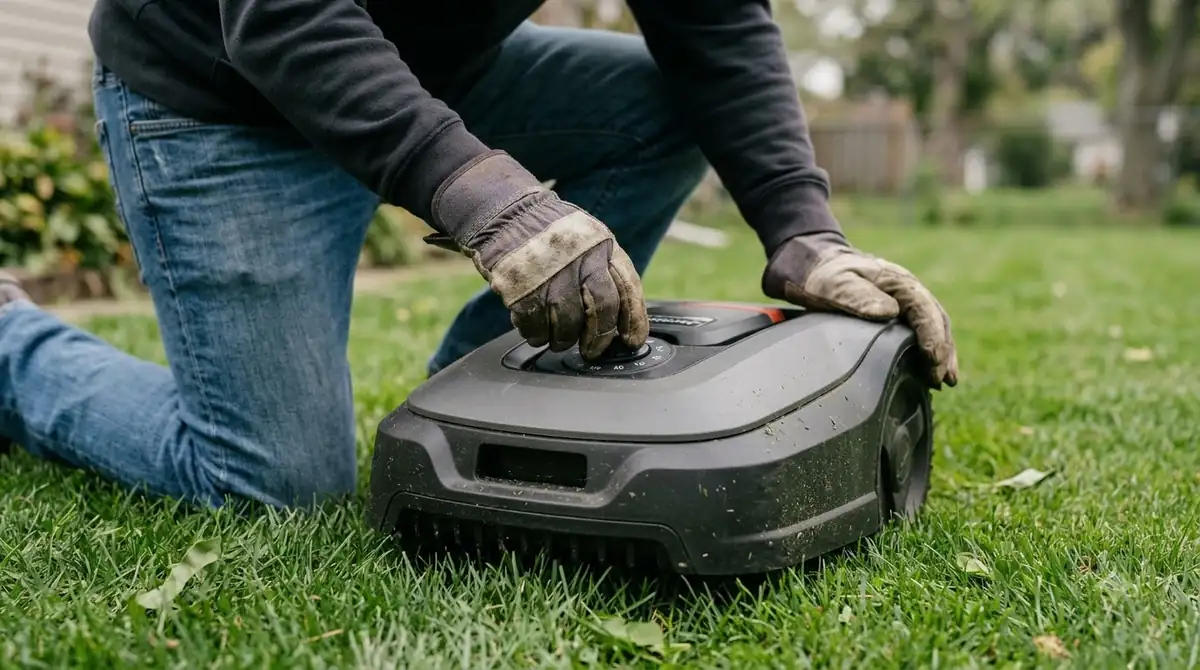
The O1000 RTK is rated for 45% slope in its work area, which Ecovacs converts to 24 degrees. Its virtual boundary limit is 17%, and the page gives no degree figure for that limit. The A1600 RTK is rated at 50%, which the page gives as 27 degrees.
A percent rating and a degree rating describe the same angle, but they are easy to confuse. For the ecovacs goat o1000 rtk vs ecovacs goat a1600 rtk slope gap, our reading: a 45% slope is about 24 degrees, and a 50% slope is about 27 degrees, so the gap between the two models is roughly 3 degrees on paper. Measure your steepest section with a level app in degrees, then compare that number with the rating for the model you are considering. Treat both figures as maximums, not as guarantees for every lawn. Our explainer on how robot mower slope ratings work covers the percent-to-degrees conversion.
Lawn size and mowing rate
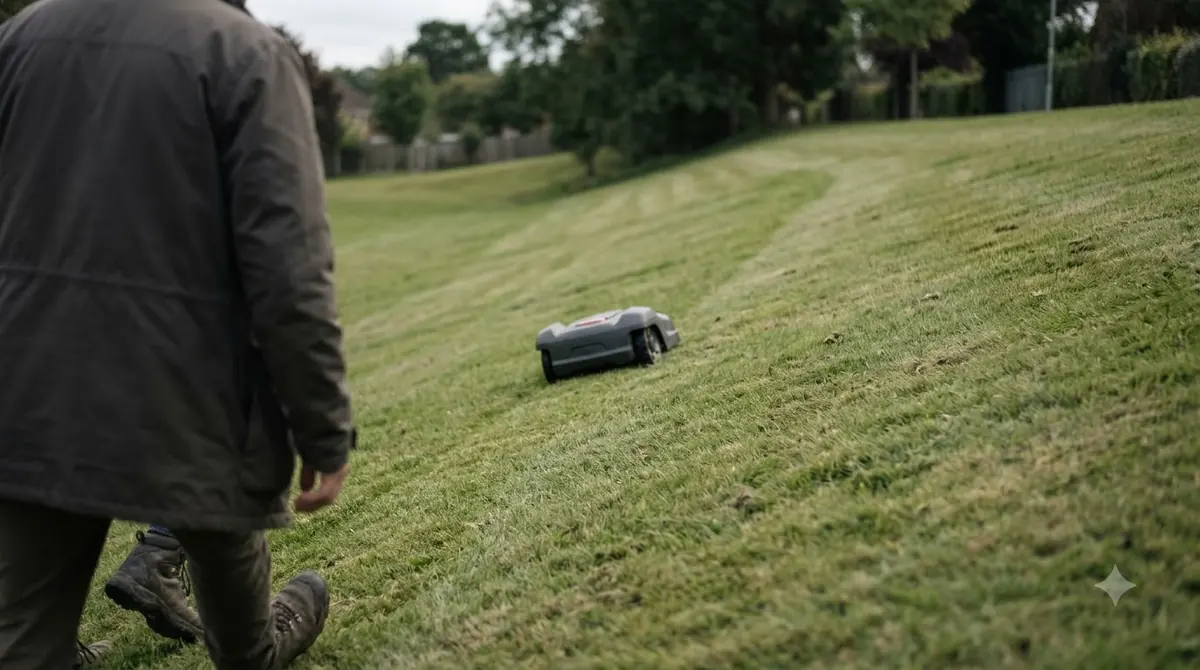
On coverage, the O1000 RTK page says it mows up to 1/4 acre, which is about 10,890 square feet. Its efficiency figures are about 1,507 ft² per hour in delicate mode and about 1,938 ft² per hour in efficient mode.
The A1600 RTK page says it covers up to 500 m² per charge, which is about 5,380 square feet. The same page lists 500 m² in 2 hours, but a footnote says the mower can mow 400 m² per hour, so the page gives two different rates. Because the two pages use different units and may describe different market versions, the coverage figures do not translate into a clean winner. Our reading: for a lawn near the 1/4 acre mark, the O1000 RTK figure is the one to check first, and you should confirm the A1600 figure with Ecovacs before deciding.
Navigation and boundary setup
On navigation, the ecovacs goat o1000 rtk vs ecovacs goat a1600 rtk difference is the sensor set. The O1000 RTK combines RTK satellite positioning with a camera and 3D time-of-flight (ToF) sensing. The page says the 3D ToF and AI camera handle obstacle avoidance, and it lists a 17% limit for its virtual boundary. The A1600 RTK page describes LELS LiDAR-enhanced RTK navigation with 2 cm positioning precision.
RTK positioning relies on a clear view of the sky, so yard layout matters for both models. Our guide to the RTK base station explains the role of the base. Our reading: a yard with tall trees, a house wall close to the lawn, or a shaded corner may give the mower less satellite signal in those areas, whichever model you pick. The 2 cm figure is a manufacturer figure, and we did not find an independent accuracy test for either model. If signal drops are a concern, see our notes on Ecovacs GOAT RTK signal lost.
Battery, noise and charging
On charging, the O1000 RTK lists an 18 V, 4,000 mAh battery, about 65 minutes of continuous mowing, a 57 dBA noise rating and about 100 minutes to charge. Those four figures are on the same spec table, which makes them easy to compare.
The A1600 RTK page lists a recharge time of 45 minutes with 180 W fast charging. It does not state battery capacity, runtime, or noise, so the O1000 RTK has the more complete set of published figures. Our reading: a faster recharge helps only if the mower’s runtime per charge is long enough for your lawn, and the A1600 page does not say how long a single run lasts.
Who each option suits
Based on the published specs, the ecovacs goat o1000 rtk vs ecovacs goat a1600 rtk decision favors the O1000 RTK for a reader who wants a complete set of figures, including runtime, noise and a 1/4 acre coverage claim. The A1600 RTK fits a reader who needs the steeper 50% rating or the shorter recharge time, and who can confirm the missing figures with Ecovacs.
- Choose the O1000 RTK if your lawn is near 1/4 acre and you want runtime and noise on the spec sheet before you buy.
- Choose the A1600 RTK if your steepest section is close to 50% and a 45-minute recharge matters for a long mowing day.
- Neither is the right pick if your yard has poor sky view, because both depend on RTK signal for positioning.
What to check before you buy
Neither official page we read states a warranty length, so check the warranty on the page for your region before you buy. The A1600 page also leaves out cutting width, noise, battery capacity, runtime and weight, which means the comparison has gaps on that side.
- Market version: the O1000 figures come from Ecovacs’ US page, and the A1600 figures come from its global page.
- Slope: convert your measured slope to degrees and compare it with 24 or 27 degrees.
- Lawn size: measure the lawn from a yard map, then compare it with the 1/4 acre and 500 m² figures.
- Prices: check the current price on the retailer or Ecovacs page, because prices change often and this article does not list one.
Frequently asked questions
Which suits a larger lawn, the GOAT O1000 RTK or the GOAT A1600 RTK?
On the pages we read, the O1000 RTK lists coverage up to 1/4 acre, while the A1600 RTK lists up to 500 m² per charge. The two figures use different units and come from different market pages, so confirm both before you decide.
Does the A1600 RTK have a steeper slope rating than the O1000 RTK?
Yes, on the pages we read. The A1600 RTK is rated at 50% (about 27 degrees), and the O1000 RTK is rated at 45% (about 24 degrees) in its work area. Both are maximum ratings, so measure your steepest section before you rely on them.
Which model charges faster?
The A1600 RTK page lists a 45-minute recharge with 180 W fast charging, while the O1000 RTK page lists about 100 minutes to charge. Check whether each figure refers to the same battery state before you compare them.
Do either of these mowers need a boundary wire?
Neither official page we read says a boundary wire is required. The O1000 RTK uses RTK with a camera and 3D ToF sensing, and the A1600 RTK uses LELS LiDAR-enhanced RTK navigation. Check the setup guide for your model before installation.
Start with lawn size and slope when you weigh the ecovacs goat o1000 rtk vs ecovacs goat a1600 rtk, because those are the two specs both pages state most clearly. Check the figures that are missing from the A1600 page before you compare prices, and confirm the market version of each spec sheet. For the wider range, see our guide to which Ecovacs GOAT model to buy and our Ecovacs GOAT A1600 RTK pros and cons.
Sources
- Ecovacs GOAT O1000 RTK product page (Ecovacs, manufacturer): slope, coverage, mowing rate, cutting height and width, noise, battery and charging.
- Ecovacs GOAT A1600 RTK product page, global site (Ecovacs, manufacturer): slope, coverage per charge, mowing rate, navigation precision and recharge time.
 Up next7 min readReviews & CompareEcovacs GOAT A1600 RTK vs Dreame A1 Pro: Sourced Spec ComparisonUpdated Nov 11, 2026
 12 min readReviews & CompareIs the Ecovacs GOAT A1600 RTK Worth It? Specs, Limits and Trade-offsUpdated Nov 11, 2026
 7 min readReviews & CompareEcovacs GOAT A1600 RTK Review: Published Specs and GapsUpdated Nov 17, 2026
 8 min readReviews & CompareSegway Navimow i110n vs Ecovacs GOAT O1000 RTK: What the Specs SayUpdated Nov 13, 2026
 9 min readReviews & CompareEcovacs GOAT O1000 RTK Review: What the Published Specs SayUpdated Nov 11, 2026
 9 min readReviews & CompareMammotion Luba 3 AWD vs Ecovacs GOAT A1600 RTK: Which Fits Your Lawn?Updated Nov 11, 2026