
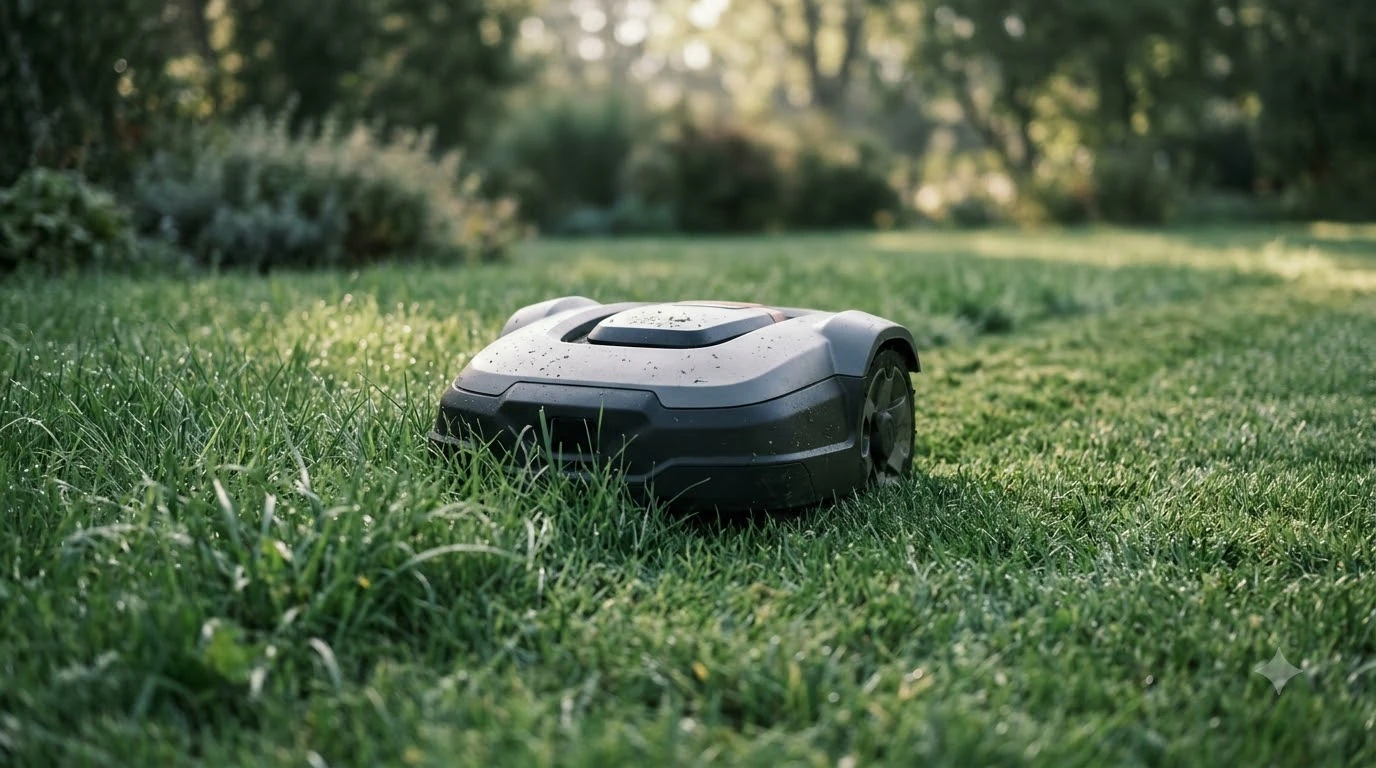

Do robot mowers cause thatch buildup? No, not on their own. Penn State Extension and Oregon State University Extension both say grass clippings do not add to thatch. Thatch forms mainly from the grass species, how much nitrogen and water the lawn gets, and how high it is cut. Here is what the extension sources say and where a robot mower fits.
The short answer
- Direct answer: no. A robot mower is not the main cause of thatch.
- Clippings: Penn State and Oregon State both say clippings do not contribute to thatch.
- Main causes: grass species, excess nitrogen, frequent shallow watering, and a high cutting height.
- Thin layer: UC IPM says a layer under 1/2 inch can be beneficial. Colorado State says to try to slow buildup once it exceeds 1/2 inch.
- Removal: thatch is removed by raking or dethatching, which a robot mower does not do (our reading).
What thatch is and when it matters
Thatch is a layer of stems and roots between the green blades and the soil, and a thin layer is normal. Penn State describes it as a “tightly intermingled layer of partially decomposed stems and roots” that sits between living turf and the soil surface. The UC IPM Healthy Lawns guide adds stolons and rhizomes to that list and says a thin layer “(less than 1/2 inch thick) can be beneficial to the lawn.”
The trouble starts when the layer grows faster than it breaks down. UF/IFAS Gardening Solutions says that some thatch is healthy, but excess thatch is spongy and “causes the mower to sink and cut grass too short, leading to stressed turf.”
Do grass clippings cause thatch?
No. Clippings are mostly leaf tissue and break down quickly, so they do not add to thatch, which means robot mowers do not cause thatch buildup through their clippings. How robot mowers handle the cut grass is explained in whether robot mowers mulch grass. Penn State Extension says clippings are “composed mostly of leaf tissue that decomposes rapidly, they do not contribute to thatch.” Oregon State Extension is just as direct: “Despite what you may have heard, grass clippings do not cause thatch buildup.”
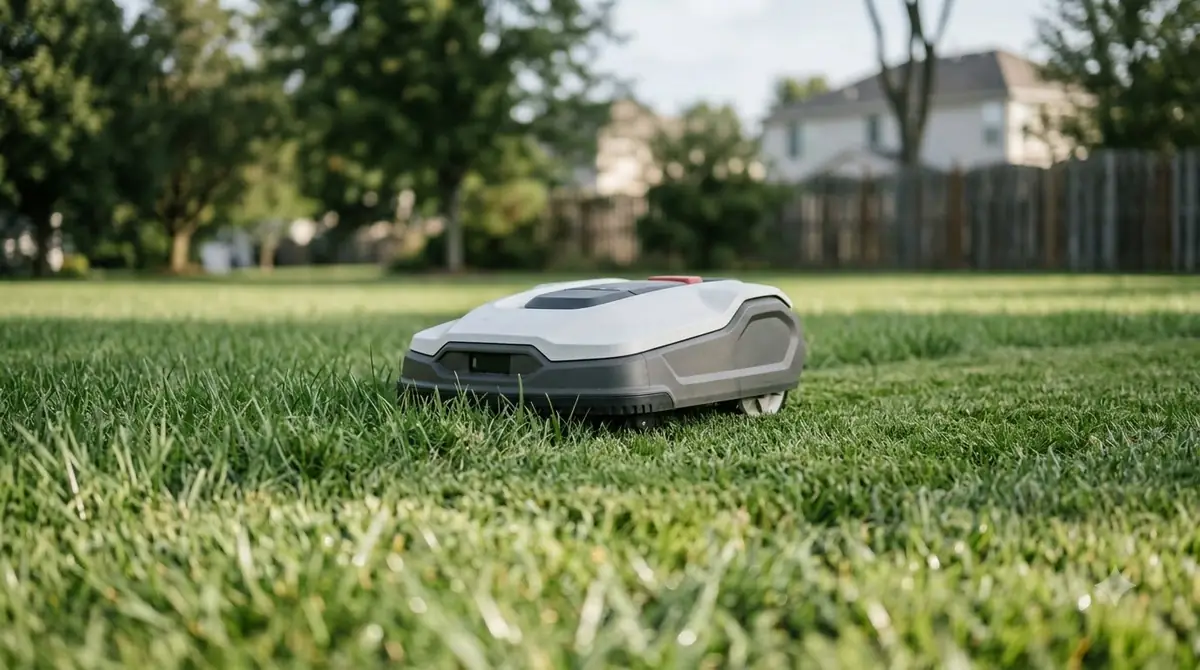
Oregon State quotes turf specialist Kowalewski: “Virtually all research conducted with turf has shown that grass clippings do not increase thatch.” Colorado State Extension lists clippings the same way and says they should be returned to the lawn during mowing to recycle the nutrients they contain.
Clippings also feed the lawn. Penn State reports that leaf clippings from Kentucky bluegrass returned 46 to 59 percent of the nitrogen applied as fertilizer over a three-year study. Oregon State puts clippings at up to 3 to 4 percent nitrogen by weight.
What actually causes thatch
Thatch builds up when grass produces more material than the lawn can break down. UC IPM names the main drivers: the grass species, excess nitrogen, and frequent, shallow irrigation. When you ask do robot mowers cause thatch buildup in your own yard, the table below lines up each factor with what the sources say.
| Factor | What the sources say | Source |
|---|---|---|
| Grass species | Tall fescue and perennial ryegrass produce little thatch. Kentucky bluegrass, bentgrass and fine fescue are more prone to it (see a robot mower on Kentucky bluegrass). | UC IPM; Colorado State |
| Nitrogen | “Avoid excessive amounts of nitrogen.” UF/IFAS says too much nitrogen or water causes excessive spongy thatch. | UC IPM; UF/IFAS |
| Irrigation | “Avoid frequent and shallow irrigation on established lawns.” | UC IPM |
| Cutting height | “In most cases, thatch increases as mowing height increases.” | Oregon State, quoting Kowalewski |
| Heavy cuts | Remove clippings if too much grass comes off at one time. Oregon State’s one-third rule limits each cut. | UC IPM; Oregon State |
Do robot mowers cause thatch buildup on their own?
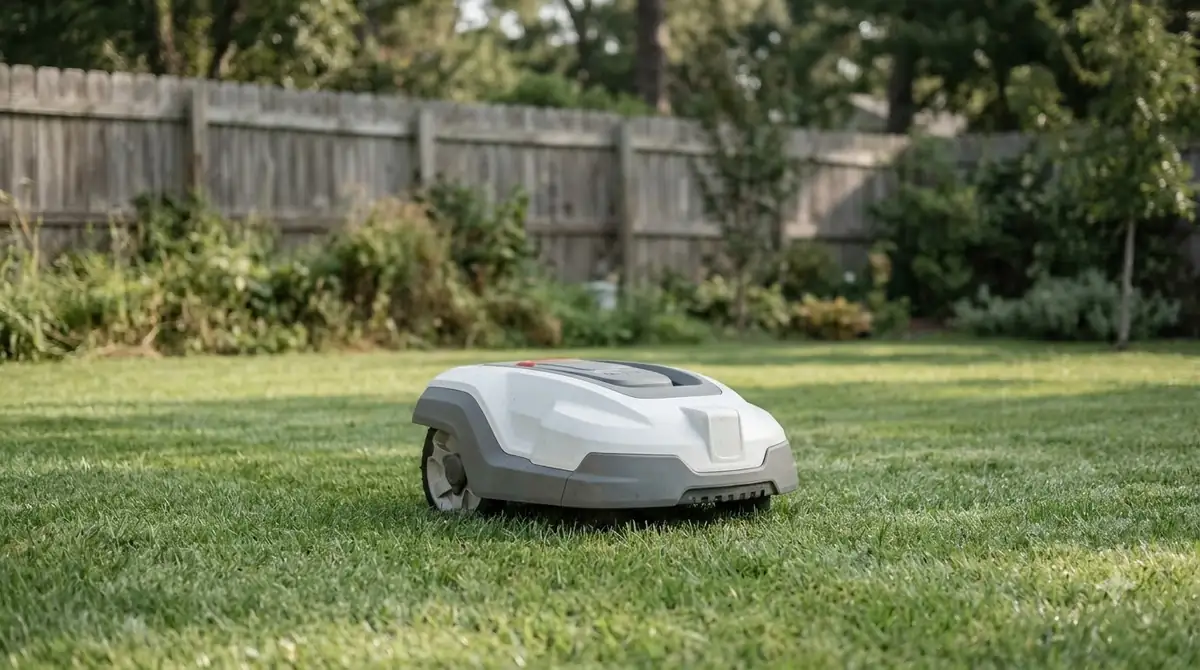
A robot mower does not add thatch by itself, so the short answer to do robot mowers cause thatch buildup stays no. It removes only a little grass on each run, so its clippings are small and fall into the turf, which is the kind of clipping the sources say does not build thatch. Oregon State’s one-third rule is also easier to follow with frequent short runs than with occasional heavy cuts. Our reading is that this is the main way a robot mower helps keep thatch down.
The height setting is the part to watch. Oregon State’s quote that thatch tends to rise as mowing height increases means a robot mower left at a high setting for years may build more thatch than one kept at a moderate height. Colorado State recommends 2.5 to 3 inches for the Colorado species it covers and says to mow at the same height all year. That is regional advice, so check the range for your own grass, or see the best mowing height for a robot mowed lawn.
When to dethatch and what to do
Dethatch only when the layer is clearly too thick. Do robot mowers cause thatch buildup on your lawn? That depends on the factors above far more than on the mower itself. Colorado State says to “try to slow buildup when the thatch layer exceeds 1/2 inch in thickness,” and warns that thickness “can increase quickly beyond this point, making it difficult to control later.” The UC IPM thatch page does not give a dethatching number and links to a separate page we did not read, so treat 1/2 inch as a checkpoint rather than a fixed rule.
The method matters. Colorado State says light power raking “may be beneficial if done often,” but deep power raking “can be damaging and often removes a substantial portion of the living turf.” UF/IFAS advises removing excess thatch and changing management so it does not come back.
Heads up
A robot mower cuts grass; it does not rake, verticut, or remove a thatch layer. Dethatching is a separate job, so a robot mower does not replace it (our reading).
Keeping thatch in check on a robot-mowed lawn
Do robot mowers cause thatch buildup when the settings are wrong? Thatch follows the same drivers either way, so control nitrogen, watering pattern, cutting height and how much each cut removes.
- Feed by the book. UF/IFAS and UC IPM both point to excess nitrogen as a driver. Penn State says nitrogen is usually applied at no more than 1.0 pound per 1,000 square feet, in two to three applications over a growing season. Our guide on fertilizing a lawn mowed by a robot mower covers timing.
- Water deeply, not often. UC IPM advises against frequent, shallow irrigation on established lawns.
- Set the height once and keep it. Colorado State says to mow at the same height all year. Our reading: pick a height that suits your grass and leave it alone.
- Follow the one-third rule. Oregon State says to remove no more than one-third of the grass blade at a time. A robot mower that runs most days makes this easier to meet.
- Check the layer. Our reading: pull a small plug and measure the brown layer between the soil and the green blades. If it is over 1/2 inch, plan for light raking rather than deep raking.
Frequently asked questions
Do robot mowers cause thatch?
No, not on their own. Penn State and Oregon State both say grass clippings do not contribute to thatch. Thatch comes mostly from grass species, excess nitrogen, frequent shallow watering, and a high cutting height.
Is a thin thatch layer bad for a lawn?
Not necessarily. UC IPM says a thin layer of less than 1/2 inch can be beneficial to the lawn. Colorado State says to try to slow buildup once the layer exceeds 1/2 inch.
Can a robot mower remove thatch?
Our reading is no. A robot mower cuts grass but does not rake or dethatch. Colorado State warns that deep power raking can damage living turf, so remove thatch with light raking if the layer is over 1/2 inch. A lawn aerator for robot mower lawns is a separate tool to check.
Should I bag clippings to prevent thatch?
Bagging is not needed to prevent thatch. Penn State and Oregon State say clippings do not contribute to it, and Colorado State recommends returning clippings to the lawn to recycle nutrients. Bagging is a choice about appearance or clumps, not thatch.
Sources
- Recycling turfgrass clippings (Penn State Extension, updated Oct 15, 2025): clippings do not contribute to thatch, nitrogen recycling and fertilizer rate.
- Thatch (UC IPM Healthy Lawns): definition, the 1/2 inch thin-layer note, and the causes of thatch.
- Leave grass clippings for a greener, healthier yard (Oregon State University Extension, Apr 2024): clippings and thatch, the mowing-height quote, the one-third rule, and clipping nitrogen content.
- Lawn diseases (UF/IFAS Gardening Solutions): excess thatch from nitrogen or water, and removal.
- Lawn care basics (Colorado State University Extension): thatch-prone grasses, the 1/2 inch threshold, power raking, and mowing height.
 Up next9 min readLearnCan a Robot Mower Cut Long Grass? What the Sources SayUpdated Nov 11, 2026
 8 min readLearnCan a Robot Mower Mow Over Sticks? What the Sources SayUpdated Nov 11, 2026
 7 min readLearnCan a Robot Mower Cut Your Foot? What the Sources SayUpdated Nov 11, 2026
 8 min readLearnHow to Prevent Grass Buildup Inside Robot Mower Wheel WellsUpdated Nov 19, 2026
 8 min readLearnHow to Reduce Static Electricity Buildup on a Robot MowerUpdated Nov 19, 2026
 8 min readLearnDo Robot Mowers Need a Ground Rod? What the Manuals SayUpdated Nov 12, 2026