
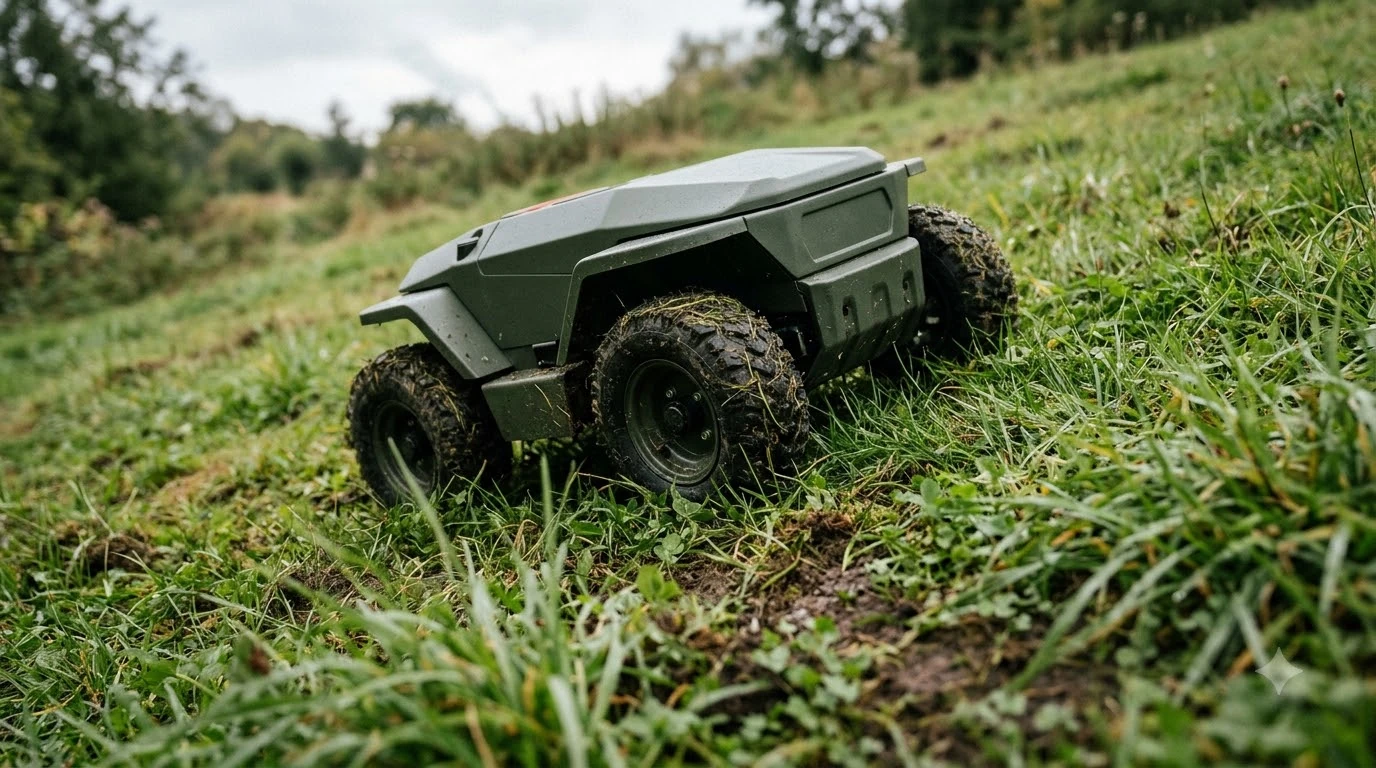

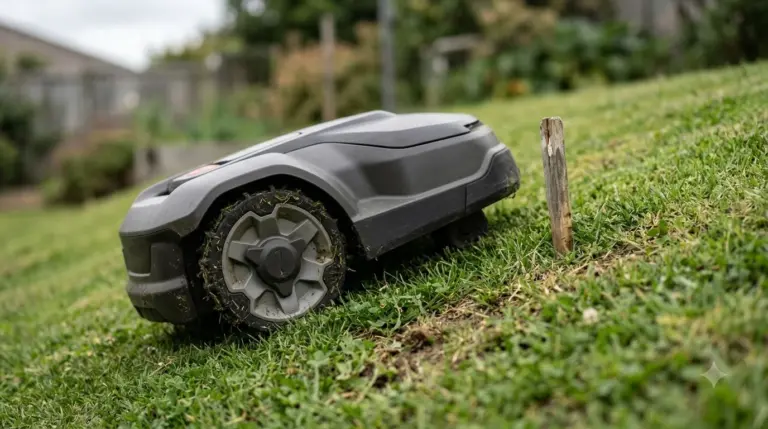
Can a robot lawn mower handle an 80 percent slope? Only a few all-wheel-drive models are advertised for it, and the manufacturer table we read does not list 80 percent for any model. 80 percent is about 38.7 degrees, and most robot mowers are rated well below that. A robot lawn mower for 80 percent slope should be checked against the manual, not the sales page.
The short answer
- 80 percent is about 38.7 degrees. Percent is rise divided by run, times 100, so it is not the same as degrees.
- The official Husqvarna table tops out at 70 percent for the work area, with a 50 percent limit at the boundary wire, on the 435X AWD.
- Some vendor pages claim 80 percent for AWD models such as the Mammotion LUBA 3 AWD. Treat those as marketing claims until the manual confirms the figure.
- A rating is a limit, not a daily target. Wet grass and the boundary wire can cut the usable slope well below the headline figure.
What 80 percent means in degrees
Slope is usually given as a percentage, but the angle is what you feel underfoot. A 100 percent slope is a 45-degree angle, so an 80 percent slope is steeper than most people expect. The conversion is arctan(percent / 100), and the figures below use that formula. Any robot lawn mower for 80 percent slope claim should state both numbers.
| Slope (percent) | Angle (degrees) | Where you see it |
|---|---|---|
| 35% | 19.3 | Low end of the 35 to 45 percent range Eufy gives for standard models |
| 50% | 26.6 | Boundary limit on the 435X AWD |
| 70% | 35.0 | Work-area limit on the 435X AWD, the top Husqvarna figure we read |
| 80% | 38.7 | Claimed by some vendor pages for AWD models |
The gap between 70 and 80 percent looks small on paper, but it is about 3.7 extra degrees. On a wet lawn, that difference matters more than the number suggests. Our reading is that the percentage and the angle should both appear on any spec you compare.
Which robot lawn mower for 80 percent slope claims are advertised
Only a few products carry an 80 percent claim in the pages we could read, and none of them is a published manufacturer spec sheet. Most appear in vendor blogs or comparison articles. The table records what each source says, not what the unit has been tested to do.
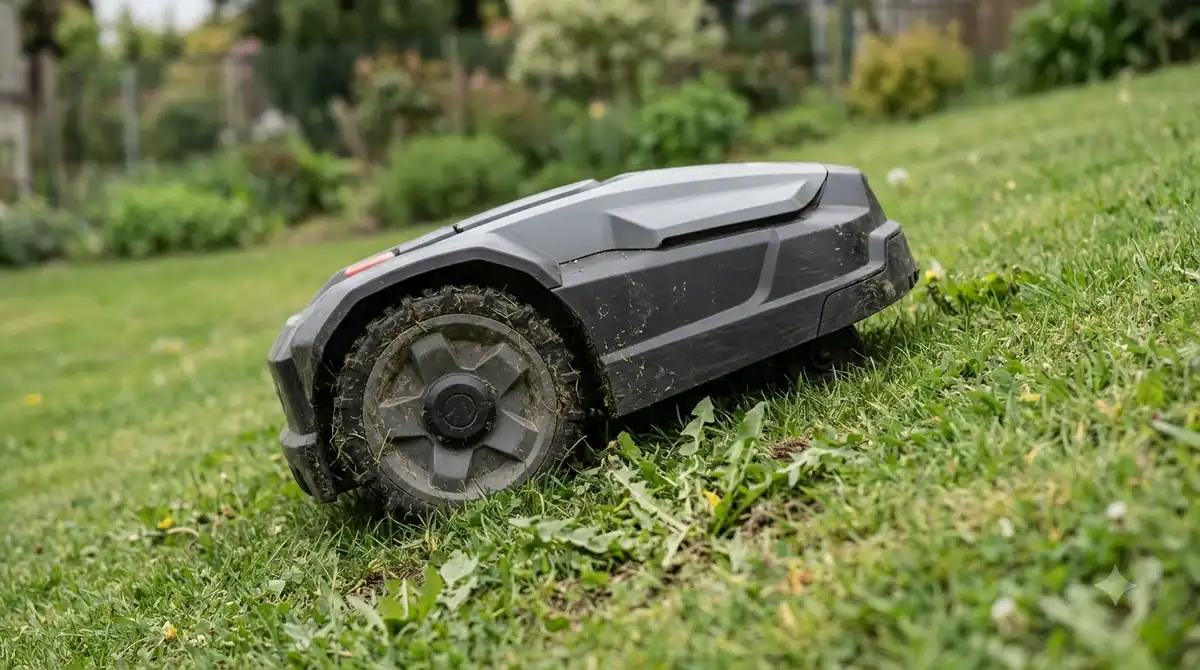
| Model | Slope claim in the source | Type of source |
|---|---|---|
| Mammotion LUBA 3 AWD | “climb slopes of up to 80% (38.6°)” | Mammotion blog (vendor) |
| Mammotion LUBA 2 AWD 5000H | “inclines up to 38° (80%)” | Eufy comparison article |
| Mowrator S1 4WD | “inclines up to 37° (75%)” | Eufy comparison article |
| Husqvarna Automower 535 AWD | “slopes up to 35° (70%)” | Eufy comparison article |
| Ambrogio 4.0 Elite RTK 4WD | “inclines up to 34° (about 66%)” | Eufy comparison article |
| Segway Navimow H3000N-VF | “inclines up to 24° (45%)” | Eufy comparison article |
The Mammotion blog gives no boundary figure and no statement about wet grass, so it cannot be used to judge how the unit behaves at the edge of a lawn. The Eufy comparison article is a secondary source. It repeats figures from the brands, and it does not mark which ones come from a manual. Before relying on any robot lawn mower for 80 percent slope claim, look for the same number in the manufacturer’s manual or support pages.
Why the official table and the claims do not match
The Husqvarna support page is the most detailed manufacturer source we read. It lists two limits for every model: the work-area limit and the boundary limit. On the 435X AWD, the work area is rated at 70 percent and the boundary at 50 percent. The page does not list any model or figure at 80 percent or above.
The gap between the table and the marketing figures usually comes from three things. First, a vendor may quote the steepest section it can climb rather than the limit it recommends. Second, a figure in a comparison article may be copied from a product page that has not been checked against the manual. Third, a “climbs up to” phrase does not say whether the figure applies to the work area, the boundary, or both (our comparison of AWD vs 2WD robot mowers for hills explains why drive type matters here). Our reading is that a claim of 80 percent without a boundary figure and a manual reference should be treated as incomplete.
Boundary wire and steep edges
A steep lawn is not only a question of what the mower can climb. The Husqvarna page says, “Areas with slopes that are too steep must be excluded from the installation.” Its guidance is to keep the boundary wire off the steepest ground, using wire islands or stay-out zones where needed. For the 435X AWD, the page gives clearances that depend on the slope band. Up to 50 percent, keep 1.5 m (5 ft) between the boundary wire and obstacles. From 50 to 70 percent, keep obstacles off the slope, and keep 1.5 m (5 ft) from the bottom of the slope to the boundary wire.
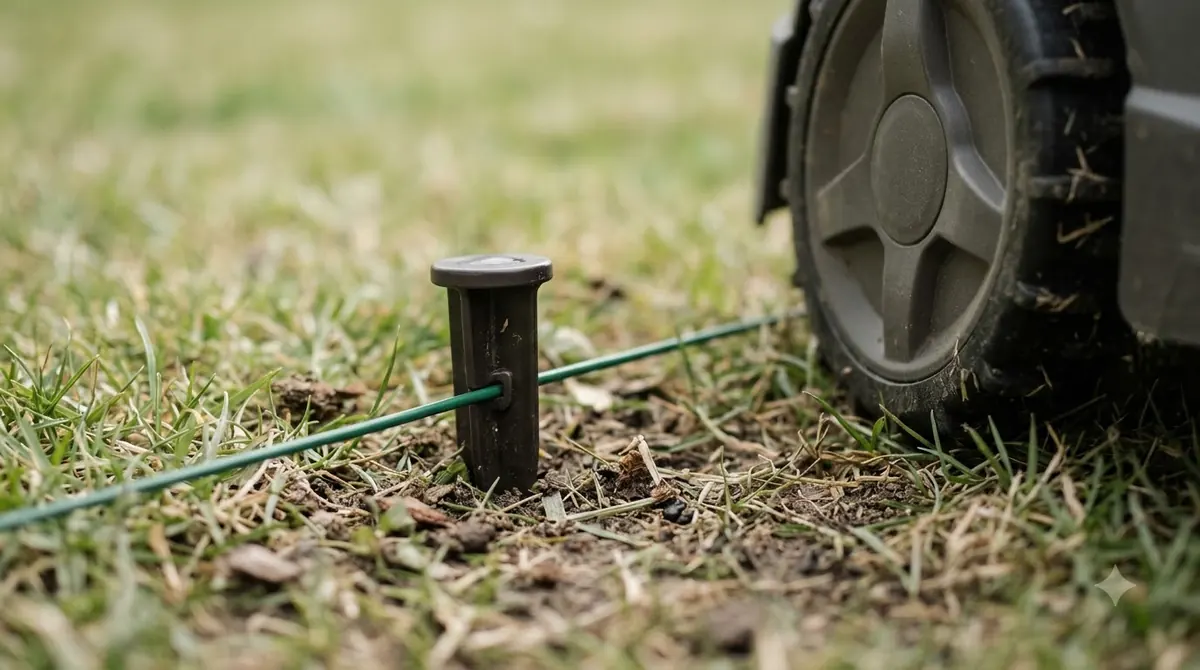
The page also asks for at least 50 cm (1.6 ft) of level ground between flat areas and steep slopes. Plan the layout so that the mower reaches a flat area before it turns back toward the steep section.
Wet grass and battery on steep ground
A slope rating describes what the mower can climb in good conditions. Eufy’s Australian guide calls a maximum slope “an absolute limit rather than a target for daily mowing.” It also says wet grass “reduces tyre grip, causing the unit to slide sideways or slip downhill.” The same guide notes that steeper inclines can noticeably reduce runtime per charge. Our piece on whether robot mowers slide on wet slopes covers the grip side in more detail.
Wet grass and battery both matter on an 80 percent lawn, so any robot lawn mower for 80 percent slope needs margin. A mower rated to 80 percent on paper may slip on a damp lawn, and it may finish a mowing cycle with less charge than it would on flat ground. We recommend treating the rated figure as the top of the range and choosing a model with a margin, especially if your lawn is often wet.
How to check your slope before buying
Measure the steepest section of the lawn, not the average. The Husqvarna page gives the formula: slope percent equals vertical height divided by horizontal distance, times 100. A rise of 15 cm over a run of 100 cm is a 15 percent slope. Eufy suggests a smartphone incline app or a spirit level with a tape measure, placed on the steepest part of the lawn, and our guide to how to measure yard slope in percent and degrees walks through it.
Take at least three readings across the slope, and note the highest. Compare that number with both the work-area limit and the boundary limit (our explainer on robot mower slope rating explained covers percent versus degrees). A lawn that reads close to 80 percent will leave little room for error, so the boundary and stay-out layout becomes more important.
When 80 percent is too steep for turf
Robot mowers are not the only consideration. Iowa State University Extension treats a slope of 20 percent (1 in 5) or more as steep, and says that ground about 30 percent (1 in 3) or steeper is too steep to mow for turf. Those thresholds are a landscape rule, not a robot mower specification, but they are a useful reality check. An 80 percent lawn is far beyond the steepness where most lawns are kept as mown turf.
The same extension guide advises securing sod on slopes steeper than 10 percent with two or three stakes or staples per strip. If you are laying new sod or seed on a steep bank, plan that work before the mower goes in. Our reading is that a robot lawn mower for 80 percent slope is a tool for the one section of a yard that is still mowable, not a reason to mow steep banks at all.
What to check before you buy a robot lawn mower for 80 percent slope
Use this checklist before you rely on any figure for a robot lawn mower for 80 percent slope, and read how to choose a robot mower for slopes for the wider picture.
- Find the work-area limit and the boundary limit. A single headline number is not enough. If the manual gives only one figure, ask the manufacturer which one it is.
- Find the source of the figure. A manufacturer manual or support page carries more weight than a comparison article.
- Measure your steepest section as rise over run, then convert it to percent.
- Keep a margin. We recommend choosing a model with a rating above your steepest measurement, not one that matches it exactly.
- Plan the boundary. Check the exclusion rule and clearances in the manual, and plan wire islands or stay-out zones for the steepest ground.
- Check wet-weather behavior. Ask whether the manual advises against mowing on wet slopes.
Frequently asked questions
Can a robot lawn mower really climb an 80 percent slope?
Some vendor pages say so for AWD models such as the Mammotion LUBA 3 AWD. The Husqvarna support table we read lists 70 percent as the highest work-area limit, so the 80 percent figure should be confirmed in the manual before you rely on it.
Is 80 percent the same as 80 degrees?
No. 80 percent is about 38.7 degrees. An 80 degree slope would be almost vertical, and no robot mower source we read describes that kind of ground.
Why is the boundary limit lower than the work-area limit?
On the Husqvarna 435X AWD, the work area is rated at 70 percent and the boundary wire at 50 percent. The manual says that areas that are too steep must be excluded from the installation, so the edge of a steep lawn is treated more cautiously.
Does wet grass change the slope rating?
Eufy’s guide says wet grass reduces tyre grip and can make the mower slide or slip downhill, even within its rated slope. Treat the rating as a limit for good conditions, not a guarantee for every day.
Sources
- Optimising an Automower installation for steep slopes (Husqvarna support): work-area and boundary limits by model, exclusion rule, clearances, slope formula.
- Gardening on slopes and hillsides (Iowa State University Extension): steep-slope thresholds, stakes for sod on slopes above 10 percent.
- Robot lawn mower slope limits (Eufy, vendor blog): tier ranges, absolute limit, wet grass, battery runtime on steep ground.
- Best robot mower for steep terrain (Eufy, comparison article): vendor-reported slope figures for several models, cited as secondary sources.
- Best robot lawn mower for steep slopes (Mammotion, vendor blog): the 80 percent claim for LUBA 3 AWD, with no boundary figure.
 Up next8 min readBy YardRobot Lawn Mower for a 35 Percent Slope: What to Check Before You BuyUpdated Nov 11, 2026
 7 min readBy YardRobot Lawn Mower for a 25 Percent Slope: What to Check Before You BuyUpdated Nov 11, 2026
 8 min readBy YardRobot Lawn Mower for 50 Percent Slope: What the Rating MeansUpdated Nov 11, 2026
 7 min readBy YardRobot Lawn Mower for 70 Percent Slope: What the Limit Really MeansUpdated Nov 11, 2026
 9 min readBy YardRobot Lawn Mower for a 30 Percent Slope: What to Check Before You BuyUpdated Nov 11, 2026
 10 min readBy YardRobot Lawn Mower for 45 Percent Slope: What to Check Before You BuyUpdated Nov 11, 2026