

How do I know if a robot mower will work in my yard? It usually does when three things line up: the lawn fits the model’s rated coverage area, the slopes stay under the model’s stated incline limit, and the grass can be cut to a suitable height before the first run. Manufacturer suitability guides start with these checks, and this guide walks through each one so you can test your own yard before you buy.
The short answer
- Size: compare your measured lawn area with the model’s rated area. Husqvarna’s select models are rated up to about 5000 m2.
- Slope: compare your measured slope with the incline limit in the spec sheet. One Husqvarna model is rated up to 35 degrees.
- Edges and obstacles: plan the boundary wire clearances if the model uses wire. Anker’s guide gives 30 to 35 cm from walls and fences.
- Grass height: cut the lawn to a suitable height before installation. Anker says below 6 cm.
- Zones: separate lawn areas need a passageway, and the mower has to reach each one.
Measure the lawn against the mower’s rated area
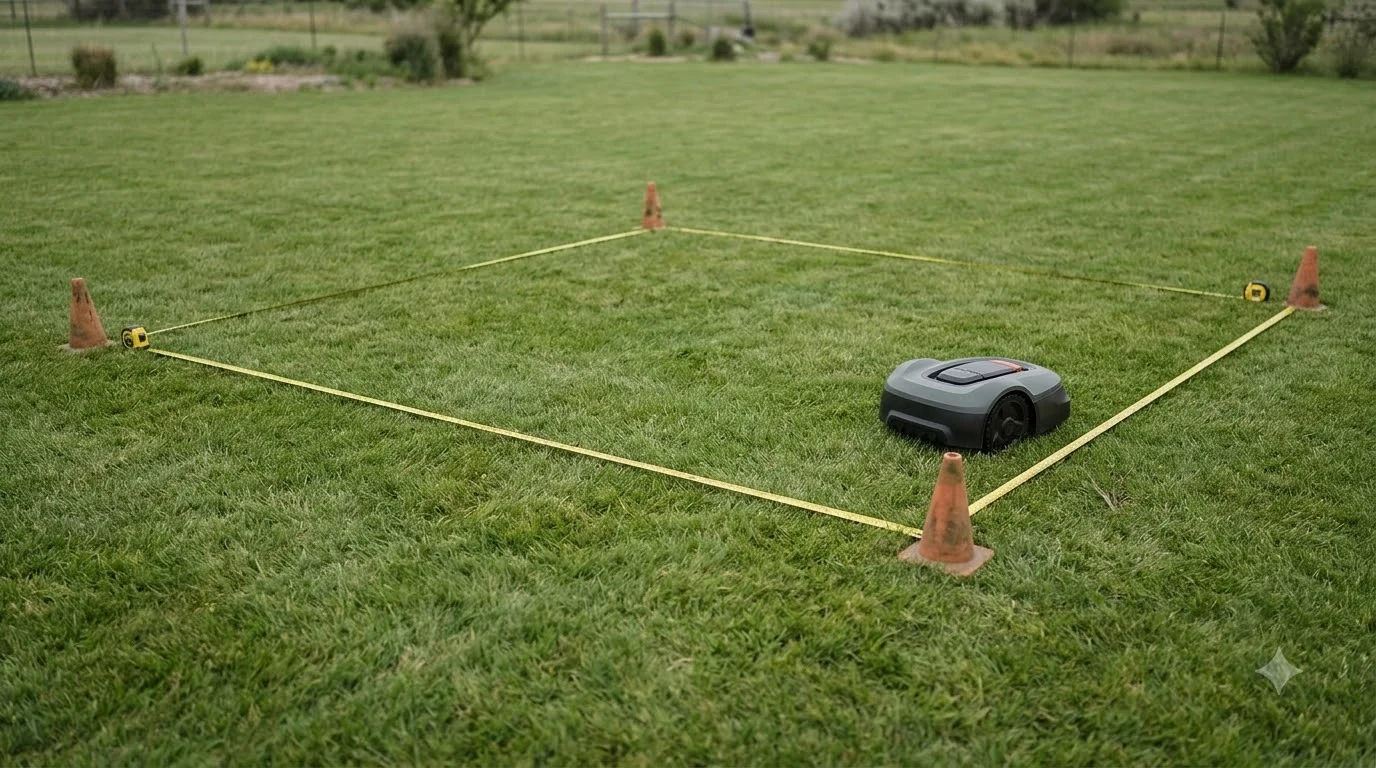
How do I know if a robot mower will work in my yard? Start with the number that matters most: the lawn area in square meters. Husqvarna’s suitability guide recommends measuring with Google Earth Pro, using its ruler tool to trace the perimeter and the obstacles. The tool reports the total perimeter and the overall area in square meters, which you can compare directly with the model’s rating. For a US reader, 5,000 square meters is about 1.2 acres and 1,600 square meters is about 0.4 acre (our conversion). For a worked sizing example, see what size robot mower you need for 1.5 acres.
Husqvarna gives the rating as a range. The Automower 450X is listed at about 5000 m2 and the 315X at about 1600 m2, each with a stated tolerance of plus or minus 20 percent. Our reading is that a yard near the top of a rating leaves little margin, so a yard well under the rating is the safer fit. Your mower’s manual or spec sheet, not a general guide, sets the final limit.
How do I know if the slope is too steep?
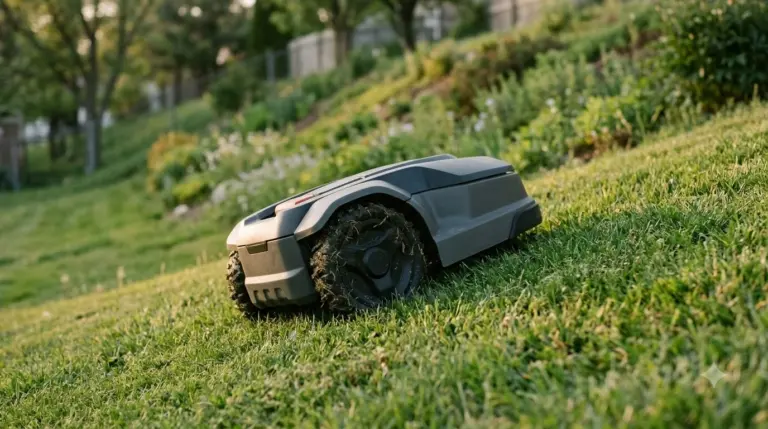
Slope is a common reason a robot mower struggles, and the number to check is the model’s incline limit. Husqvarna’s Automower 435X AWD is listed for inclines up to 35 degrees, and the page says the model’s light weight and center of gravity help it hold steep ground. Other models have lower limits, so read the rating for your specific model.
To measure your own slope, use the rise-over-run method from a University of British Columbia topography resource, which notes that slope is the vertical change divided by the horizontal distance, and that the two must use the same units. Multiply the result by 100 to get a percentage. For example, a 2-foot drop across 50 feet is 4 percent, since 2 divided by 50 is 0.04.
Degrees and percent are different scales, so convert before you compare. Our calculation puts 35 degrees at about 70 percent, which is steep for any lawn. Our guide to a robot lawn mower for a 45 percent slope covers the steep end in more detail. Check the spec sheet for the unit each manufacturer uses, because some publish a percentage and others an angle.
Look at bumps, dips and holes
Uneven ground is the second reason a yard may not suit a robot mower, mainly because the mower can scalp high spots and drop into low ones. Husqvarna says its large driving wheels handle uneven lawns and help prevent scalping. Its guidance is to fill dips, grooves and holes before the first run for a smoother finish.
Walk the lawn and look for soft spots, ruts and sunken edges. Our reading is that a lawn with many dips needs leveling before you install, because the mower’s own wheels will not fix the ground. For rough lawns in particular, see our guide to a robot lawn mower for a bumpy, uneven lawn.
Map the boundary, obstacles and wire distances
Wire-based models need a perimeter, and the wire must sit a set distance from each type of edge. The Anker and Eufy guide gives these clearances for its boundary-wire installation, and they show how many edges your yard may have. Use them to sketch your yard before you buy wire, and read how to install a robot mower boundary wire for the laying itself.
| Edge type | Wire distance (Anker and Eufy guide) |
|---|---|
| Walls, fences, raised beds | 30 to 35 cm |
| Flower beds, hedges, paths level with the grass | 10 to 15 cm |
| Ponds | 35 cm, ideally with a physical barrier |
The Husqvarna page does not mention boundary wire. It describes sensors that detect garden furniture, pets and large objects, then stops, reverses and continues. The page also warns that the mower cannot tell small toys from organic objects, so clear those off the lawn. Count the objects in your yard and note which ones sit close to the grass edge.
Heads up
The clearances above come from one brand’s guide for its wire-based models. The page does not say how these clearances apply to other navigation types, so check the manual for the model you plan to buy.
Check the grass height before the first run
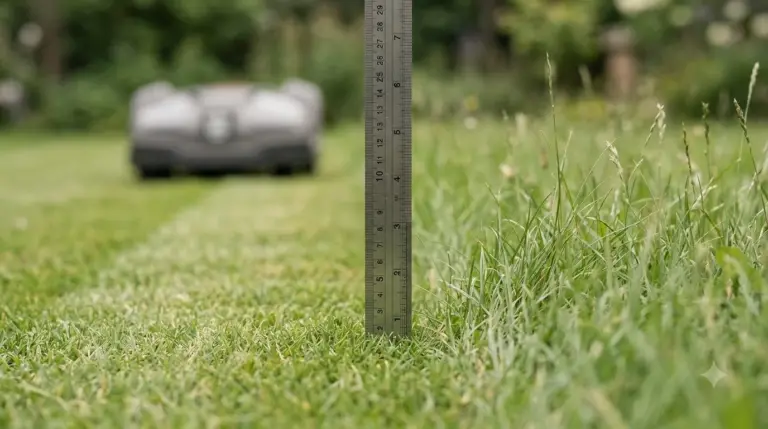
Grass height decides whether the mower can start cutting well. Anker’s guide says to cut the grass below 6 cm before installing boundary wire, and to trim the lawn edges so the wire can sit close to the soil. Husqvarna’s advice is similar in spirit: cut the lawn to the height you want first, then let the mower maintain it.
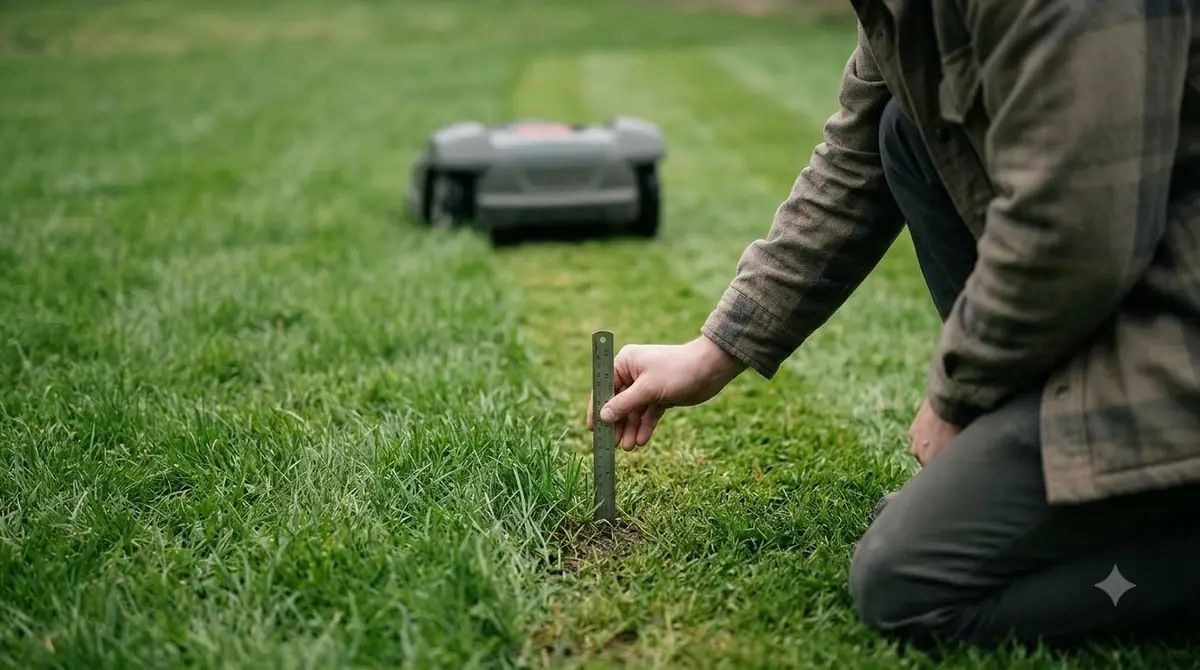
Taller or denser patches can slow the mower down. Husqvarna says dense or tall areas trigger a spiral cutting mode until they match the rest of the lawn. If your yard has long grass in parts, cut those sections down before the first run so the mower does not spend its first week catching up.
Count zones and narrow passages
A yard split by a driveway, a path or a fence is a multi-zone job. Husqvarna says separate lawn areas can be linked by a passageway that crosses paths or driveways, and that its mowers can navigate narrow passages. The page does not give a minimum passage width, so measure the narrowest gap and compare it with the width figure in the spec sheet.
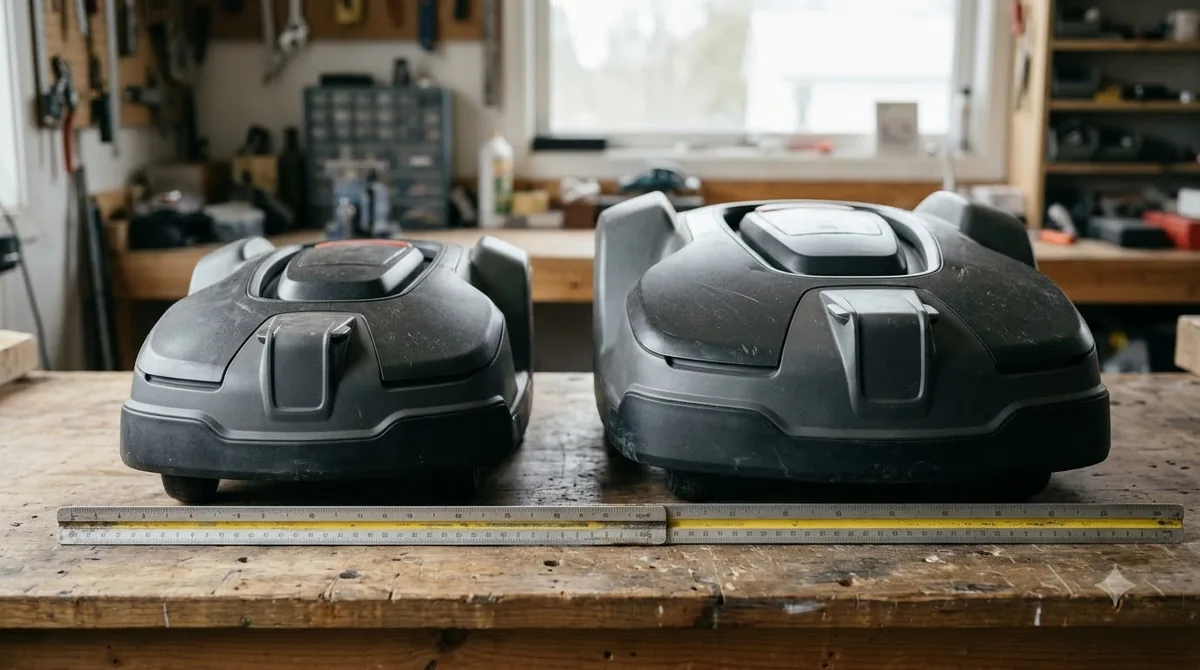
Our reading is that a yard with several zones needs more boundary wire or more careful sensor coverage, and that each passage should be wide enough for the mower body with room to turn. Sketch each zone and its passage on a simple map before you decide, and see how a robot mower can mow multiple separate lawns for the linking details.
How do I know if a robot mower will work in my yard? A six-step check
You do not need special tools to answer how do I know if a robot mower will work in my yard before you buy. Start with a sketch of the yard and a measuring tape, then work through the list in order.
- Measure the area. Trace the lawn in Google Earth Pro and note the square meters.
- Measure the slope. Run a level line across the steepest section, then divide the vertical change by the horizontal distance.
- Feel for bumps. Walk the lawn and mark dips, holes and soft spots.
- Map the edges. Mark walls, fences, beds, ponds and paths, and note the clearance each needs.
- Check the grass. Measure the height and cut long patches before the first run.
- Compare with the spec sheet. Set your area, slope, zones and passage widths next to the model’s ratings. Any figure over a limit is a reason to pick a different model or to change the yard.
What a fit, a maybe and a no look like
Use the table below to sort your results when you ask how do I know if a robot mower will work in my yard. The thresholds are our reading of the figures above, not a rule from any manufacturer, so the model’s own limits always win.
| Check | Likely fits | Needs a closer look |
|---|---|---|
| Lawn area | Well under the model’s rated area | Close to the rating, or above it |
| Slope | Well under the model’s incline limit | Near the limit, or steeper than the limit |
| Bumps and holes | Level, or easy to fill | Many deep dips or ruts |
| Grass height | Can be cut to a suitable height before installation | Long grass that needs repeated cutting |
| Zones and passages | One zone, or passages wide enough for the mower | Several zones linked by narrow gaps |
Frequently asked questions
How do I know if my lawn is too big for a robot mower?
Measure the lawn in square meters and compare it with the model’s rated area. Husqvarna lists its 450X at about 5000 m2 and its 315X at about 1600 m2, each with a plus or minus 20 percent tolerance. A lawn close to the rating leaves little margin.
How steep can a robot mower go?
It depends on the model. Husqvarna’s Automower 435X AWD is rated up to 35 degrees. Check the incline figure in the spec sheet for the exact model, since limits differ across brands and models.
Do robot mowers need boundary wire?
Wire-based models do. Anker’s guide gives wire distances of 30 to 35 cm from walls and fences, and 10 to 15 cm from beds, hedges and level paths. Other navigation types are not covered by that guide, so check the model’s manual.
How short should the grass be before a robot mower starts?
Anker says to cut the grass below 6 cm before installing boundary wire. Husqvarna says to cut the lawn to the height you want first, because dense or tall patches make the mower switch to a spiral cutting mode.
Sources
- Is my lawn suitable for an Automower? (Husqvarna): rated areas, incline limit, Google Earth Pro measuring, uneven ground, sensors, passageways.
- Robot lawn mower boundary wire installation (Anker and Eufy): wire distances from edges and ponds, grass height before install.
- Slope fundamentals (University of British Columbia, Topography): slope as rise over run and the percent formula.
 Up next8 min readBy YardIs My Yard Suitable for a Robot Mower?Updated Nov 11, 2026
 8 min readBy YardDo Robot Mowers Work on Bumpy Lawns? What to Know FirstUpdated Nov 11, 2026
 9 min readBy YardWhat Happens If You Cut Grass Too Short?Updated Nov 11, 2026
 7 min readBy YardWill a Robot Mower Get Stuck on a Rocky Yard?Updated Nov 11, 2026
 7 min readBy YardCan a Robot Mower Cut Mixed Weedy Lawn? What to KnowUpdated Nov 11, 2026
 7 min readBy YardCan a Robot Mower Work in a Long Narrow Yard?Updated Nov 11, 2026