
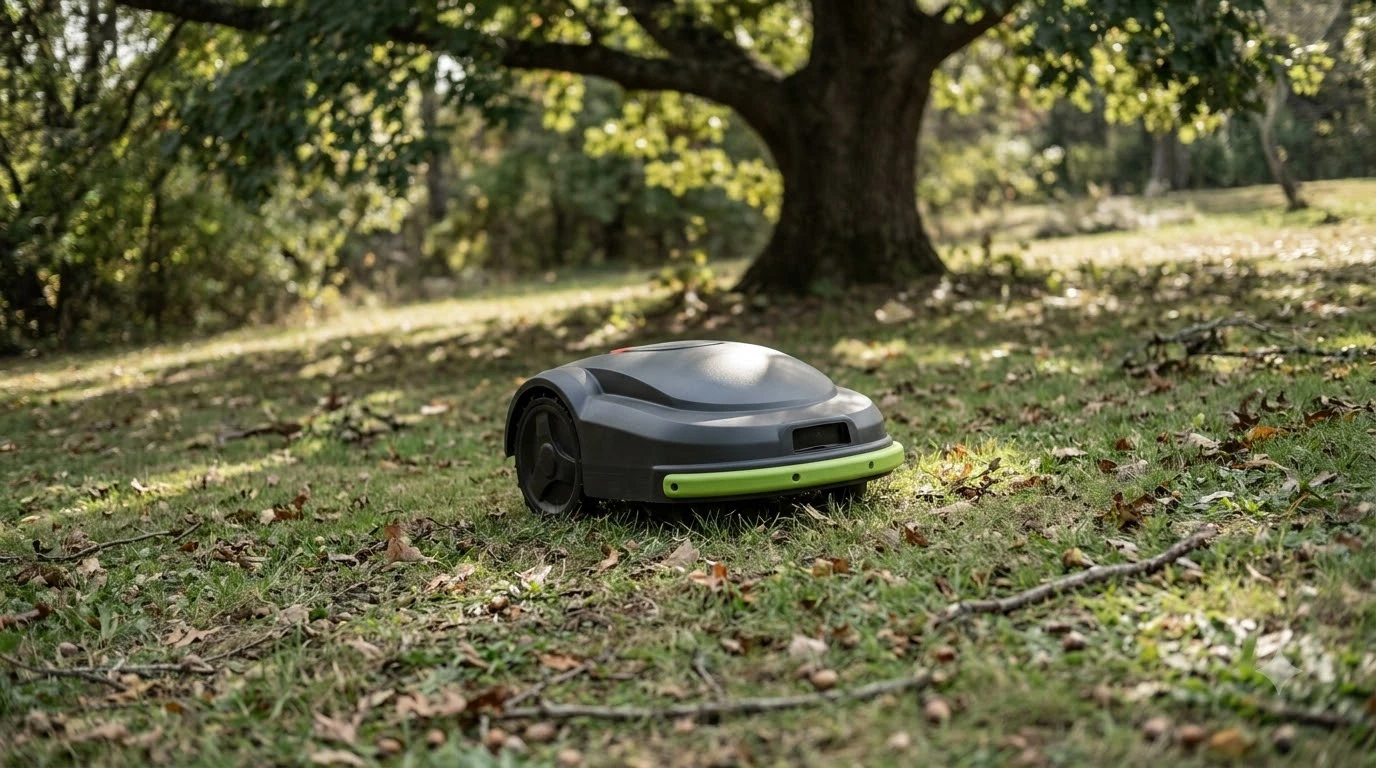

How does a robot mower handle tree stumps in the lawn? It either senses the stump and steers around it, or the boundary wire keeps it out of the stump area. A stump is a solid, fixed object, so it is not like a passing toy. Which of the two happens depends on the sensors and on how the wire is laid. We did not find an independent test of stump handling, so this guide relies on manufacturer, retailer and extension facts as of November 2026.
The short answer
- Sensors decide the first contact. Bump sensors react only after the mower touches the stump; ultrasonic and vision systems can react earlier.
- No stump height limit is published. The climb heights in vendor marketing are claims, so do not assume a stump is low enough to cross.
- Wire keeps the mower out. Sources advise 30 to 35 cm between the wire and solid obstacles.
- Remove what you can. Hard objects in the grass can damage blades and boundary wire.
How does a robot mower handle tree stumps in the lawn?
A stump is a fixed, solid obstacle that the mower has to notice or avoid, so the answer to how a robot mower handles tree stumps in the lawn starts with detection. Robot mowers are designed to identify and avoid obstacles, and the examples usually given are rocks, fallen branches and tree roots that have pushed through the ground. A stump is a similar fixed object, but it stands above the grass and can be hidden by long grass.
Owners of robot mowers complain about getting stuck on rocks, branches, or bushes, so a stump in an open lawn is a real risk to plan for. Trunks follow similar rules, which we cover in how a robot mower handles trees.
Our reading is that a tree stump in the lawn belongs in the boundary plan from the start, the same way a tree trunk does. Waiting to see whether the sensors cope is the weakest option, because you find out only after the mower has already reached the stump.
How sensors detect a stump
Sensor type decides when the mower reacts. Bumper sensors are the simplest method. Navimow calls its bumpers the “first line of defence” against solid obstacles, but says they “only respond after contact.” PCWorld explains that ultrasonic and infrared sensors detect objects before contact, while lift and tilt sensors signal a caught or unsafe angle.
Worx describes its Landroid as using automotive-grade ultrasonic sensors to detect obstacles, and says the auto-pilot steers to avoid them. The product page gives no detection range or stopping distance, so there is no number to compare against other models.
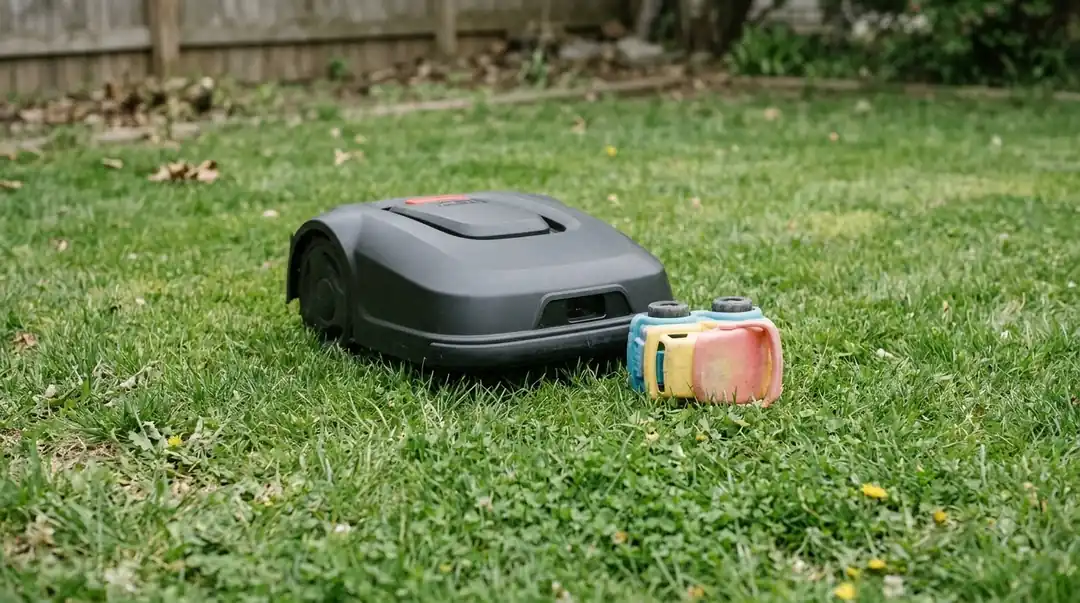
Vision systems are the other main approach. Lymow says its One Plus can tell “permanent features (like flower bed borders and tree trunks)” from temporary objects. That is a manufacturer claim, and the page cites no independent testing. The quality of the sensors matters as much as the type: SlashGear’s June 2026 review notes that “the sensors on these tools aren’t always great.”
| Sensor type | When it reacts | What the sources say |
|---|---|---|
| Bump (bumper) | After contact | Navimow: “first line of defence” against solid obstacles |
| Infrared or ultrasonic | Before contact | PCWorld: detect objects before contact |
| Vision or camera | Before contact, by recognizing the object | Lymow claim: separates tree trunks from temporary objects |
Stump height and clearance claims
Vendors publish climb heights, but none of the sources we read gives a height limit for stumps. Lymow lists a “vertical obstacle-clearing height of 7cm” for the One Plus and says it can go over small garden borders while avoiding taller beds and tree bases. Those are vendor figures, and we would not treat them as a stump test.
Eufy’s setup checklist gives the safer rule: “Small or partly hidden objects should be cleared rather than left for obstacle detection to handle.” A low stump hidden in long grass is exactly the kind of object the sensors may miss, so it is a problem to solve before the mower runs, not a case the sensors will handle.
The same checklist gives terrain limits for its E15 model: “grass below 9 centimetres” and “terrain variations below 3 centimetres.” It also advises checking exposed roots that “create sudden steps in the mowing surface.” A stump with roots around its base can create that kind of step. Our guide to how a robot mower handles tree roots covers that part in more detail.
Blades, wire and stump damage
Hard objects damage the mower and its wire, so clearing matters even when the sensors work. Robomow warns that “Stones in particular can cause serious damage to the blades.” Husqvarna’s wire guidance says to remove rocks and sharp objects from the ground that may break the wire over time.
A stump is larger than a stone, but the principle is the same. For tree stumps in the lawn, the question is whether the mower reaches them at all: anything hard near the mowing path can damage the cutting system or the wire. Husqvarna’s collision-sensor support page lists an obstacle wedged in place as one cause of a collision error. Its advice is to free the mower, check for debris, and contact the local dealer if the problem continues.
Fencing tree stumps in the lawn with boundary wire or an island
So, how does a robot mower handle tree stumps in the lawn with the least risk? The most reliable method we found in the sources is to keep the mower out of the stump area. Boundary wire does that job. Anker advises keeping the wire around 30 to 35 cm away from walls, fences, raised beds and other solid obstacles. lawnmowers.com says walls, fences and trunks need at least 30 cm of clearance from the wire, and soft edges such as beds or mulch can be 25 to 30 cm.
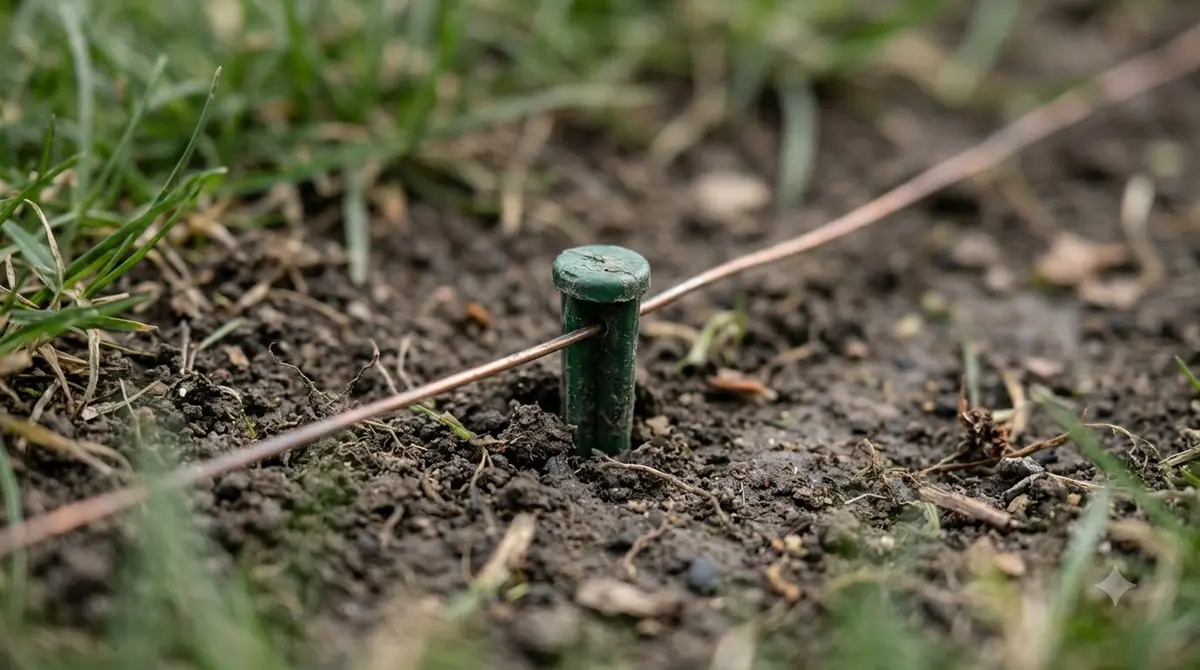
Husqvarna describes islands in the boundary wire for areas the mower should not enter, such as flower beds or rockeries, and warns that the wire must not cross itself. For a stump in the middle of a lawn, an island with a 30 to 35 cm margin is the simplest plan. For a stump at the edge, put the wire at the same margin so the mower never reaches it. Wire layout is installation work, so check your model’s manual before cutting any wire. Our guide to laying boundary wire around trees and obstacles shows the loop, and our steps to set up no-go zones on a robot mower cover the app route.
Clear the lawn before the first run
Clearing is the cheapest step for any loose object near a stump, and it costs nothing else. If you are still asking how does a robot mower handle tree stumps in the lawn once the loose items are gone, the answer is the wire plan above.
Removing loose and hidden objects is cheaper than relying on sensors. Eufy’s checklist lists “Stones and fallen branches” among the items to remove before the first run. Ecovacs’ help page says to remove items that may trap the mower, “such as piles of leaves, stones, toys, fruits, loose wires.”
A stump cannot be picked up, but the checklist suggests excluding a fixed garden feature from the mowing area. That is the same result as the wire fence described above, so you can treat it as one plan with two steps.
What to check before you buy
Use the list below when you compare models for a yard with tree stumps in the lawn or other fixed objects, and see our list of the best robot mower with obstacle avoidance for sensor types. Each point comes from a source above, or from our reading where it says so.
- Sensor type. Ask whether the model uses bump sensors only, ultrasonic or infrared, or vision. Bump-only designs react after contact, which is the case you want to avoid.
- Documented obstacle height. Use only figures from the manufacturer’s manual. Marketing climb heights are claims, not stump tests.
- Boundary options. Check that the model supports islands or no-go zones, since a stump often needs one.
- Support material. Look for a manual that explains obstacle errors and the wire clearance the mower needs.
Frequently asked questions
How does a robot mower handle tree stumps in the lawn?
It depends on the sensors and on the boundary wire. Bump-only models react after contact, while other sensor types can react before it. We did not find an independent test of stump handling, so check the model’s manual and reviews that name the obstacle type.
Can a robot mower climb over a stump?
None of the sources we read gives a height limit for stumps. Vendor figures such as Lymow’s 7 cm obstacle-clearing height are marketing claims. Assume the mower cannot climb a stump unless the manual states otherwise.
How far should boundary wire stay from a stump?
Anker advises 30 to 35 cm from solid obstacles, and lawnmowers.com gives at least 30 cm from trunks. Use the larger margin if the stump has exposed roots, since roots can create steps the mower may catch on.
Should I remove a stump before I buy a robot mower?
No source requires it. Sources do advise clearing loose stones and sharp objects and excluding fixed features from the mowing area. Our reading is that a low stump in an open lawn is simpler to remove than to fence, but the decision depends on your budget and on the stump’s size.
Sources
- Worx Anti-Collision System (manufacturer): ultrasonic sensors and auto-pilot steering.
- Lymow, Mower World (manufacturer blog): 7 cm obstacle-clearing height and vision claims.
- Eufy, robot lawn mower setup checklist (manufacturer): objects to clear, exposed roots, height and terrain limits.
- SlashGear, common problems with robotic mowers (publisher, June 2026): stuck on rocks and branches, sensor quality.
- Navimow, how robot lawn mowers avoid hazards (manufacturer): bumper sensors respond after contact.
- PCWorld, how robot lawn mowers cut grass (publisher): bump, ultrasonic and infrared detection.
- Husqvarna, tips to prevent wire break (manufacturer, KA 70226): remove rocks and sharp objects.
- Husqvarna, collision sensor problem (manufacturer, KA 01448): causes of collision errors.
- Husqvarna, how to create islands in a boundary wire (manufacturer, KA 01427): islands for flower beds and rockeries.
- Anker, robot lawn mower perimeter wire (manufacturer): 30 to 35 cm from solid obstacles.
- lawnmowers.com, robotic mower boundary wire setup guide (October 2026): clearances from trunks, walls and soft edges.
- Robomow, what a robotic lawnmower does with leaves (manufacturer): stones can damage blades.
- Ecovacs help, GOAT stuck FAQ (manufacturer): remove items that may trap the mower.
 Up next8 min readBy YardHow Does a Robot Mower Handle Tree Roots?Updated Nov 10, 2026
 8 min readBy YardHow Does a Robot Mower Handle Trees?Updated Nov 11, 2026
 8 min readBy YardCan a Robot Mower Handle a Lawn With Oak Tree Acorns in Autumn?Updated Nov 19, 2026
 7 min readBy YardHow Does a Robot Mower Handle a Boulder in the Lawn?Updated Nov 12, 2026
 8 min readBy YardHow Does a Robot Mower Handle a Lawn with Lamp Posts?Updated Nov 12, 2026
 8 min readBy YardHow Does a Robot Mower Handle a Patio? Wire and Edge RulesUpdated Nov 12, 2026