
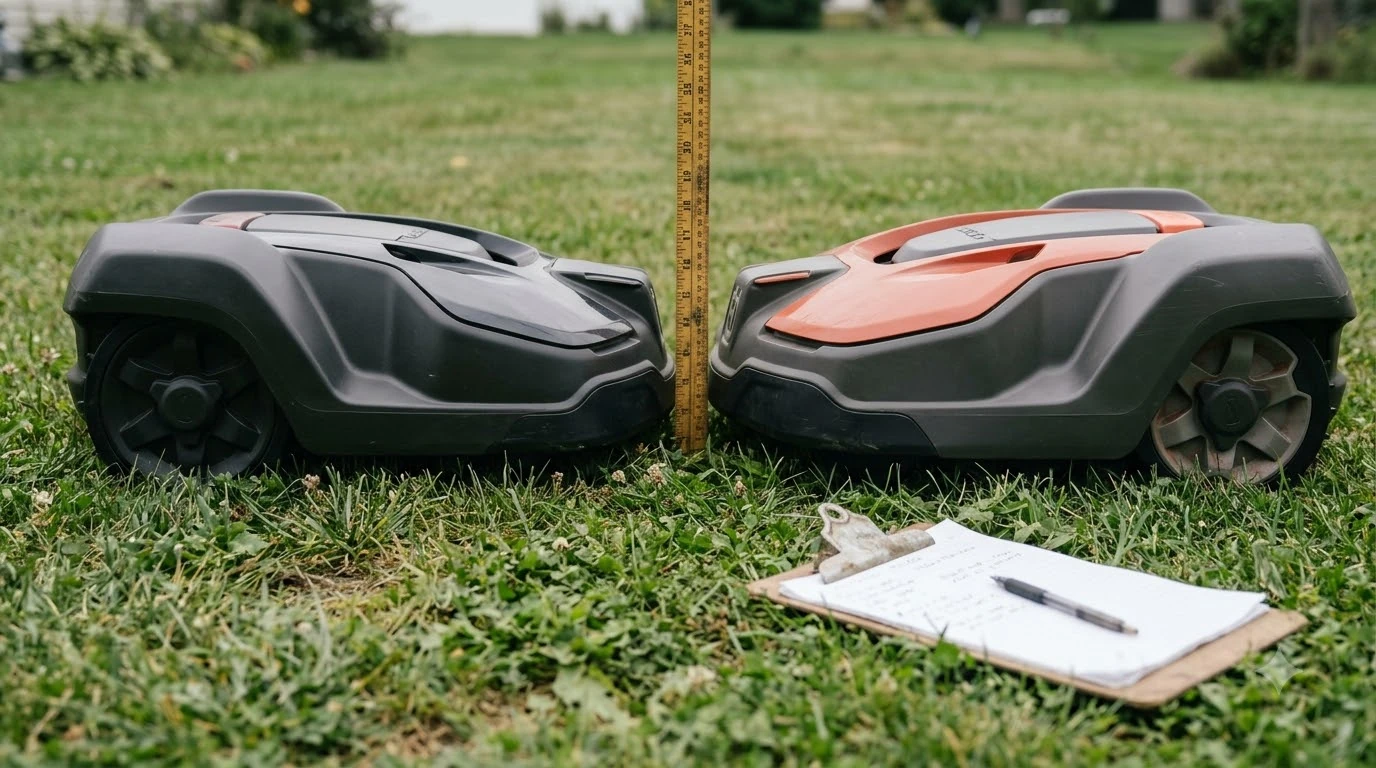

The robot mower vs gas mower long term cost gap is mostly about running costs, not the purchase price. A gas mower buys fuel and needs regular engine service, while a robot mower draws electricity and mainly replaces its battery and blades. As of the week of 2026-11-02, the U.S. Energy Information Administration puts regular gasoline at $4.153 per gallon, and residential electricity at 18.16 cents per kWh for August 2026.
The short answer
- Fuel vs power: a gas mower costs about $4.15 for every gallon it burns, while a robot mower costs about 18 cents for every kWh it draws.
- Gas upkeep: oil changes about every 25 hours or twice a season, a spark plug and air filter about once a year, and blade sharpening once or twice a season.
- Robot upkeep: the main recurring items are the battery, replaced every 3 to 5 years, and blades. A robot mower maker estimates $100 to $300 per battery.
- Our reading: total the items for your own lawn hours and local prices, because the answer depends on how much you mow.
Robot mower vs gas mower long term cost: fuel and electricity
Running cost starts with energy. The gap between a gas mower and a robot mower is wide per unit, but how many units you use decides the total. The EIA weekly gasoline update lists the U.S. average regular retail price at $4.153 per gallon for the week of 2026-11-02, and that figure includes taxes. At that price, every 10 gallons a gas mower burns costs about $41.53.
Electricity is much cheaper per unit. The EIA Electric Power Monthly, Table 5.6.A shows U.S. residential prices at 18.16 cents per kWh for August 2026, a preliminary estimate.
A robot mower’s energy use is the open question. A robot mower maker says its mowers use “0.5 to 2 kWh weekly” and gives no season length or lawn size, so we treat that as an unverified vendor estimate. Our arithmetic on that range gives 9 to 36 cents of electricity per week, or about $2.70 to $10.90 over a 30-week season. That season length is our own assumption, not a published figure.
The fuel side is harder to put in one number. Gas use depends on engine size, lawn size and how long the mower runs, and we did not find a verified gallons-per-acre figure in the pages we could open. The formula is simple, though: gallons used per season, times the price, plus the fuel line on your own mowing log.

Gas mower upkeep
A gas mower’s running cost is more than fuel, and service is a large part of the robot mower vs gas mower long term cost picture. Bob Vila’s maintenance guide gives these intervals, which set the schedule that drives the cost.
- Oil: change it about every 25 hours of use, or at least twice per mowing season, and sooner if it looks murky.
- Spark plug: replace it at least once a year, at the start of the season or every 25 hours.
- Air filter: replace it about once a year, and stop mowing if you notice misfiring, lost power or black smoke.
- Blade: sharpen it once or twice per season.
The same guide does not give dollar figures, so the cost of these parts and of a shop service has to come from your local prices. Each item is a small line, but together they repeat every season, and they are the cost a robot mower avoids.
Robot mower wear items
A robot mower has fewer scheduled jobs, but its wear items still cost money and belong in any robot mower vs gas mower long term cost estimate. The main ones are the battery and the blades. A robot mower maker’s blog, which we did not verify independently, gives these estimates:
| Item | Vendor estimate | Our arithmetic per year |
|---|---|---|
| Battery | $100 to $300, every 3 to 5 years | About $20 to $100 |
| Blades | $15 to $30 per new set, every 2 to 3 months | About $60 to $180 if you replace blades that often |
The blade line matters most. If those vendor figures hold for your model, blade replacement could cost more each year than the battery, so check your mower’s manual for the real replacement interval. If a battery is the main worry, upgrading a robot mower battery is covered in a separate guide. Our reading is that the blade interval depends on lawn wear and mower model, so it is the item to verify before you buy.
We did not find an oil or spark plug schedule for robot mowers in the manufacturer pages we could open, which fits the parts listed above. That is a gap in our research, not a claim that these mowers need no upkeep at all.

Build your own comparison
A simple way to compare the robot mower vs gas mower long term cost is to total the cost over the same number of years for each mower. Purchase prices vary by tier, as the guide to cheap versus expensive robot mower differences explains. Use the formula below and fill in your own numbers.
| Line | Gas mower | Robot mower |
|---|---|---|
| Purchase price | Your price | Your price |
| Energy per season | Gallons used times $4.153 | kWh used times $0.1816 |
| Service per season | Oil, spark plug, filter, blade sharpening at your local prices | Blades at your replacement interval |
| Replacement parts over the years | Engine wear items, as your manual lists | Battery at $100 to $300 every 3 to 5 years |
For a worked example, take a robot mower that uses 2 kWh per week for a 30-week season, which is our assumption. At 18.16 cents per kWh, that is about $10.90 a season in electricity. The same season on a gas mower burning 10 gallons, another assumption of ours, at $4.153 is $41.53 in fuel alone, before service. Those two energy lines are the core of the gap, and the service and battery lines decide the rest.

When gas may still make sense
Cost alone rarely settles the robot mower vs gas mower long term cost question. Our reading is that a gas mower can still be the simpler choice when the lawn is larger than a robot mower’s rated coverage, when the ground is steep or uneven, or when obstacles make a boundary setup hard. Check the rated coverage and slope limits in the manufacturer specification for the model you are considering, since those limits decide what is possible. For a big property, the guide to robot lawn mower versus zero-turn mower is the next comparison, and whether you should buy a robot lawn mower covers the wider decision.
A robot mower wins on time if you would otherwise mow every few days. Our reading is that gas often costs less to buy, and it suits a large yard where fuel stops are acceptable. The break-even point is your own mowing hours, not a single published number.
Frequently asked questions
Is a robot mower cheaper to run than a gas mower?
Usually, on energy alone. At EIA prices, electricity is about 18 cents per kWh and gasoline about $4.15 per gallon. A robot mower’s energy cost is small, while a gas mower adds oil, spark plug, filter and blade service each season. Total cost also depends on the purchase price and on how many hours you mow.
How often does a gas mower need an oil change?
About every 25 hours of use, or at least twice per mowing season, according to Bob Vila’s maintenance guide. Change the oil sooner if it looks murky. Your owner’s manual gives the interval for your specific model.
How much does a robot mower battery cost to replace?
A robot mower maker’s blog estimates $100 to $300 per battery, replaced every 3 to 5 years. We did not verify that figure independently. Check your model’s battery specification and replacement price before you buy.
Do robot mowers need oil changes?
We did not find an oil change interval for robot mowers in the manufacturer pages we could open. Their common upkeep items are the battery and blades. Read your model’s manual to confirm the full list of scheduled maintenance.
Sources
- Gasoline and Diesel Fuel Update (U.S. Energy Information Administration): the weekly U.S. average regular gasoline price of $4.153 per gallon for the week of 2026-11-02.
- Electric Power Monthly, Table 5.6.A (U.S. Energy Information Administration): residential electricity at 18.16 cents per kWh for August 2026, a preliminary estimate.
- Lawn Mower Maintenance Tips (Bob Vila): oil, spark plug, air filter and blade intervals for gas mowers.
- Is a Robotic Lawn Mower Worth It? (Terramow, a robot mower maker): vendor estimates for battery life and cost, blade replacement and electricity use. Used as a vendor claim, not independently verified.
 Up next9 min readReviews & CompareRobot Mower Long Term Ownership Review: 2026 FactsUpdated Nov 11, 2026
 8 min readReviews & CompareRobot Lawn Mower vs Riding Mower: Cost Over 5 YearsUpdated Nov 11, 2026
 8 min readReviews & CompareMammotion vs Segway Navimow Robot Mower: 5 Specs ComparedUpdated Nov 11, 2026
 7 min readReviews & CompareWhich Robot Mower Has the Best Edge Cut? Brand Figures ComparedUpdated Nov 11, 2026
 7 min readReviews & CompareHusqvarna Automower Alternatives: Cheaper Options ComparedUpdated Nov 11, 2026
 8 min readReviews & CompareMOVA vs Mammotion Robot Mower: Specs Compared (2026)Updated Nov 11, 2026