
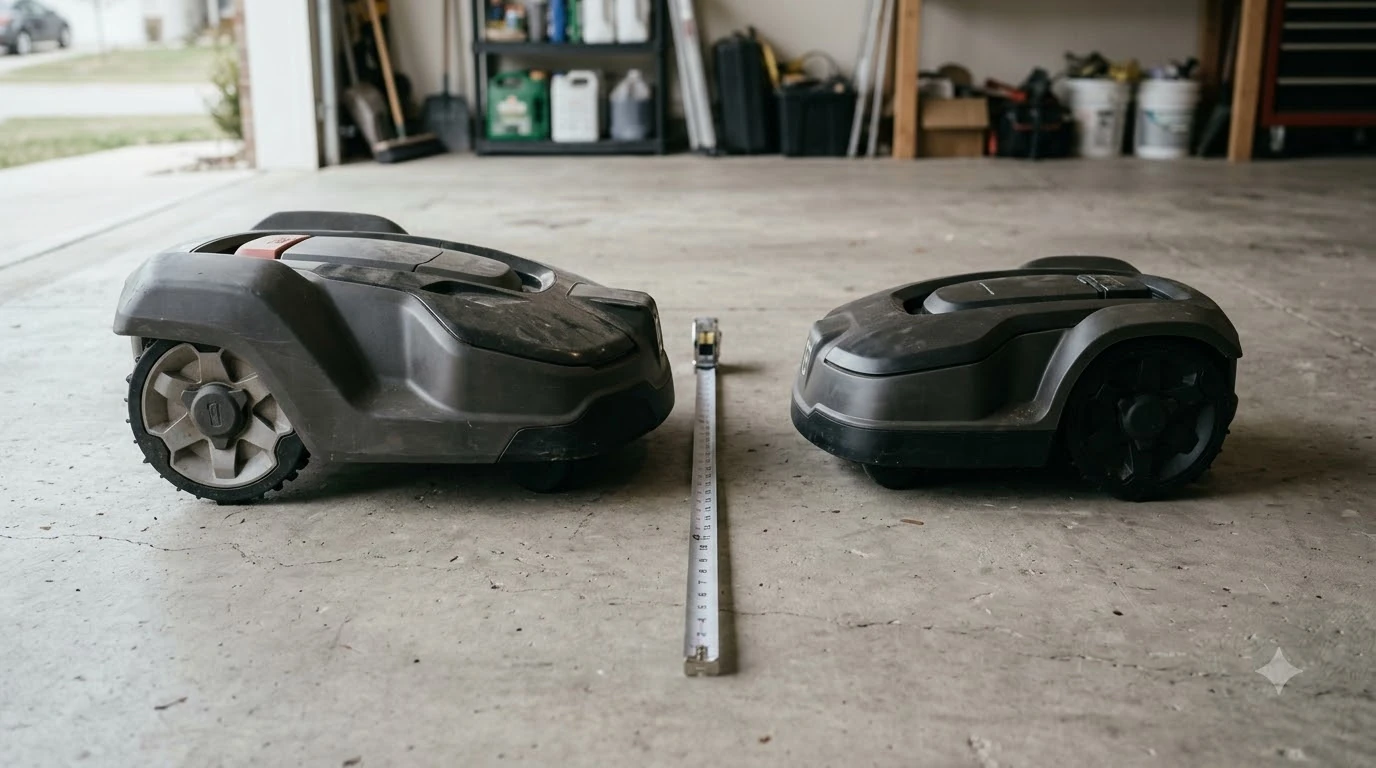

The main cheap vs expensive robot mower differences are navigation, slope rating, rated lawn size and warranty. Price alone is a weak signal, because a higher price usually buys a particular mix of features rather than a better mower in every respect. Use the spec sheet for your own yard, not the price tag alone.
The short answer
- Navigation: cheaper models more often need a boundary wire or clearly defined edges, while pricier models more often use satellite positioning such as RTK.
- Slope: budget models are commonly rated for about 17 to 19 degrees, while the top rating in the reviewed set is 38 degrees.
- Size and cutting width: rated lawn size ranges from 150 to 5,000 square meters in the reviewed set, and the listed cutting widths run from 16 to 24 centimeters.
- Warranty: terms in the reviewed set run from 2 years to 5 years, with no single rule linking warranty to price.
Cheap vs expensive robot mower differences in price
Automated robot mowers are more likely to start from around £400 in UK retail guides, while basic drop-and-mow machines start near £300, as of 2026-11-10. Gardeners’ World’s robotic mower buyer’s guide gives those starting points and notes that automated models usually cost more than a standard lawn mower.
At the top of the range, the same guide gives a rough figure of £3,000 to £4,500 for premium models built for very large lawns. That is a UK figure, so US prices may differ. Use it to understand the shape of the gap rather than as an exact budget. Our guide on how much a robot lawn mower costs covers what drives the price.
In practice, a higher price tends to buy a specific combination: a more capable way of finding position, a higher slope rating, a larger rated area, a bigger battery or a longer warranty. A cheaper mower can match a pricier one on one of these and fall short on another, so compare the attributes that matter for your lawn.
Navigation: boundary wire versus satellite positioning
Navigation is the biggest of the cheap vs expensive robot mower differences. Cheaper models more often rely on a boundary wire or on defined edges, while pricier models more often use RTK, which Gardeners’ World says can place the mower within a few centimeters. The guide’s examples show the split clearly. The camera-based OcuMow 16 “Only works on lawns with clearly defined boundaries,” while the Stihl iMOW 5 “requires a boundary wire around the perimeter of the lawn.”
Wire-free setup has its own trade-offs. Consumer NZ’s robot lawn mower guide describes wireless models as usually quicker and easier to set up, but warns that satellite interference can affect them. For properties with poor satellite reception, a wire boundary is the safer choice. The same guide notes that physical wires can be damaged and need repositioning when mowing zones change. For a fuller comparison, see wire-free versus boundary wire robot mowers.
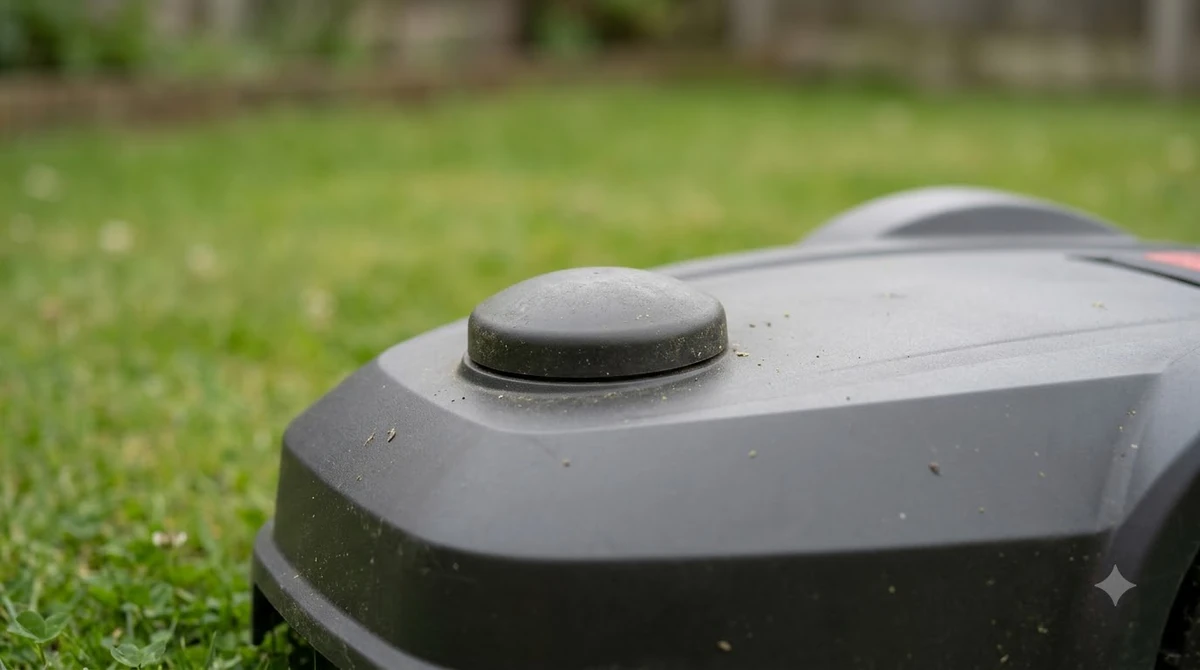
Our reading is that the navigation method matters more than the headline price. A cheaper wired model can suit a flat lawn you are happy to wire once. A wire-free model is more convenient if you plan to change zones or move the boundary, while a wired model is more dependable where satellite signal is weak.

Slope ratings and terrain
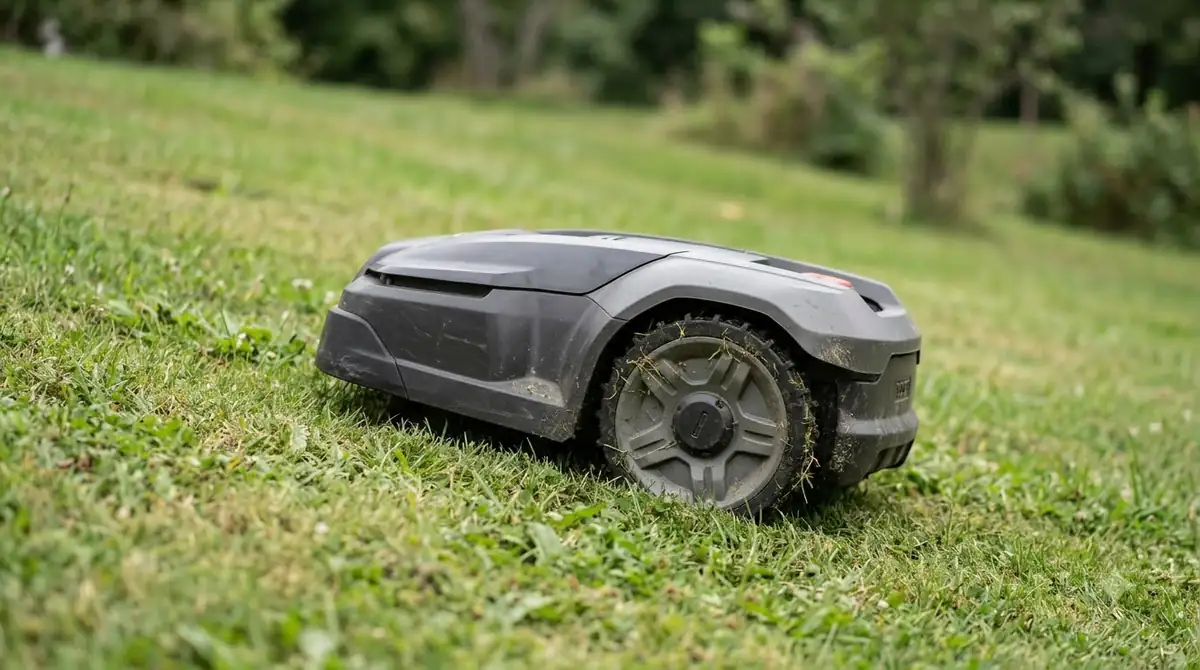
Slope is one of the cheap vs expensive robot mower differences that shows up on the hill itself. Budget robot mowers are commonly rated for about 17 to 19 degrees, while the Mammotion Luba mini 2 is rated for 38 degrees and has all-wheel drive, according to Gardeners’ World. The guide lists the Ecovacs GOAT O600 at 24 degrees and the Stihl iMOW 5 at 22 degrees, rising to 31 degrees with its upgrade wheels.
Consumer NZ tested robot mowers on slopes of 19 degrees, which it describes as 35 percent. It reports that some models are claimed to climb up to 39 degrees, or 80 percent, but adds a caution. Some manuals say the mower should run on its maximum claimed slope only for short spells, not across the whole mowing area.
A slope rating is therefore a ceiling, not a guarantee for full-time mowing on that gradient. If your lawn has a real hill, look for a rating comfortably above the steepest section you measure, and read the manual’s conditions for that rating. The guide to robot mower slope ratings explains how to read the number.
Rated lawn size and cutting width
Rated lawn size varies widely in the Gardeners’ World comparison, from 150 square meters on the OcuMow 16 to 5,000 square meters on the Navimow X350E, and tends to rise with price without following it strictly. The table below uses the manufacturer ratings listed in that guide, as of 2026-11-10. These are claims, not independent measurements of what each mower cuts.
| Model | Rated max lawn | Rated max slope | Warranty |
|---|---|---|---|
| LawnMaster OcuMow 16 | 150 sq m | 19 degrees | 2 years |
| WORX Landroid Vision Cloud WR303E | 300 sq m | 17 degrees | 2 years |
| Stihl iMOW 5 | 500 sq m | 22 degrees (31 with upgrade wheels) | 5 years |
| Ecovacs GOAT O600 | 600 sq m | 24 degrees | 3 years |
| Segway Navimow i208 LiDAR | 800 sq m | 24 degrees | 3 years |
| Mammotion Luba mini 2 AWD 1000 | 1,000 sq m | 38 degrees | 3 years |
| Segway Navimow X350E | 5,000 sq m | 24 degrees | 3 years |
Cutting width varies too. The guide lists the OcuMow 16 with a 16 centimeter deck, the Stiga A4 at 18 centimeters, and the Ecovacs GOAT O600 at 19 centimeters, which it calls narrow. Consumer NZ’s testing covered areas up to 2,000 square meters, so the 5,000 square meter rating on the Navimow X350E goes well beyond that test range.
Our reading is that a narrower deck usually means more passes over the same ground, so a small-deck model can take longer on a large yard even when its rated area fits. Check both the rated area and the cutting width before you assume a mower will finish the lawn in a day.
Battery, cutting height and build
Battery capacity is one of the clearest differences in the reviewed set. Gardeners’ World describes the WORX WR303E’s 2.5Ah battery as fine for lawns up to 300 square meters, while the OcuMow 16 uses a 24-volt, 4.0Ah pack. A bigger battery does not automatically mean a bigger lawn, so read the rated area alongside the battery specification.
Consumer NZ notes that replacing a battery yourself may save money, since taking the mower to a service agent can cost more. Cutting height is another practical difference. The guide says the best models it tested have a 40 to 45 millimeter range with nine or more cutting heights, while most cut as short as 20 millimeters and some only go down to 30 millimeters.
Build quality is the hardest difference to judge from a spec sheet. Neither guide grades materials, housing or waterproofing, so treat any build claim as unverified until you can check the model or its manual.
Warranty and long-term ownership
Warranties in the reviewed set run from 2 years to 5 years, with the longest 5-year terms listed for the Stihl iMOW 5 and the Husqvarna 308V. Gardeners’ World lists 2-year warranties for the OcuMow, WORX and Cobra Mowbot 800, and 3-year terms for the Ecovacs, Navimow i208, Luba mini 2 and STIGA A 6v.
A longer warranty does not by itself make a mower cheaper to run. Our reading is that ownership cost is shaped by parts you replace over time, such as batteries and blades, and by any boundary wire you must reposition. Check whether the battery is covered by the same term as the mower, and who carries out repairs, before you compare warranties. A separate robot mower warranty guide lists what to look for.
When a cheaper robot mower is enough
The cheap vs expensive robot mower differences matter least on a small, flat lawn. A cheaper robot mower is usually enough for a small, flat lawn with clearly defined edges, where a narrower deck and a lower slope rating do not limit it. Gardeners’ World notes that the camera-based OcuMow 16 only works on lawns with clearly defined boundaries, which describes many small front lawns.
Our reading of the trade-offs points to four simple tests:
- Size: your measured lawn sits well inside the rated area, with some headroom.
- Slope: your steepest section sits well inside the rated slope.
- Edges and signal: the edges are clear and satellite reception is either good or you are happy to install a wire.
- Layout changes: you rarely change zones, so a wire is not a recurring chore.
If your lawn fails any of those tests, a pricier model is more likely to fit, even though the upfront cost is higher. The cheapest mower to buy is not always the cheapest to live with if it must be rewired or cannot finish the lawn. For budget options, read about the best cheap robot lawn mower.
Frequently asked questions
Is an expensive robot mower always better than a cheap one?
No. A higher price tends to buy a particular mix of navigation, slope rating, rated area and warranty. A cheaper mower can suit a small, flat lawn with clear edges, while a pricier model suits a large or steep yard. Compare the specifications against your own lawn.
What is the biggest difference between cheap and expensive robot mowers?
Navigation is usually the biggest difference. Budget models often need a boundary wire or clearly defined edges, while pricier models more often use satellite positioning such as RTK. Each approach trades setup effort against satellite reception and how easily you can change zones.
Do cheap robot mowers have shorter warranties?
Not always. Gardeners’ World lists 2-year warranties on some budget models and 3-year terms on others, with 5-year terms on the Stihl iMOW 5 and Husqvarna 308V. Check what each warranty covers, including whether the battery is included, before you buy.
How do I check whether a cheaper mower can handle my slope?
Measure the steepest section of your lawn and compare it with the rated slope. Consumer NZ notes that some manuals allow maximum-slope operation only for short spells, so leave headroom and read the conditions attached to the rating.
Sources
- Robotic mowers buyer’s guide (Gardeners’ World, updated July 2026): UK price starting points, navigation examples, slope ratings, cutting widths, battery figures, warranty terms and the rated spec table.
- Robot lawn mowers guide (Consumer NZ, updated March 2026): wireless versus boundary wire setup, slope testing, battery replacement and cutting height ranges.
 Up next9 min readReviews & CompareCellular vs Wifi Robot Mower: Which Connection Fits Your YardUpdated Nov 11, 2026
 7 min readReviews & CompareBoundary Wire vs RTK Installation Time: What the Guides SayUpdated Nov 11, 2026
 9 min readReviews & CompareRobot mower with base station vs without: what changesUpdated Nov 11, 2026
 8 min readReviews & CompareMammotion vs Segway Navimow Robot Mower: 5 Specs ComparedUpdated Nov 11, 2026
 9 min readReviews & CompareAWD vs 2WD Robot Mower for Hills: Which Drive Do You Need?Updated Nov 11, 2026
 9 min readReviews & CompareRobot Mower vs Self-Propelled Mower for SeniorsUpdated Nov 11, 2026