
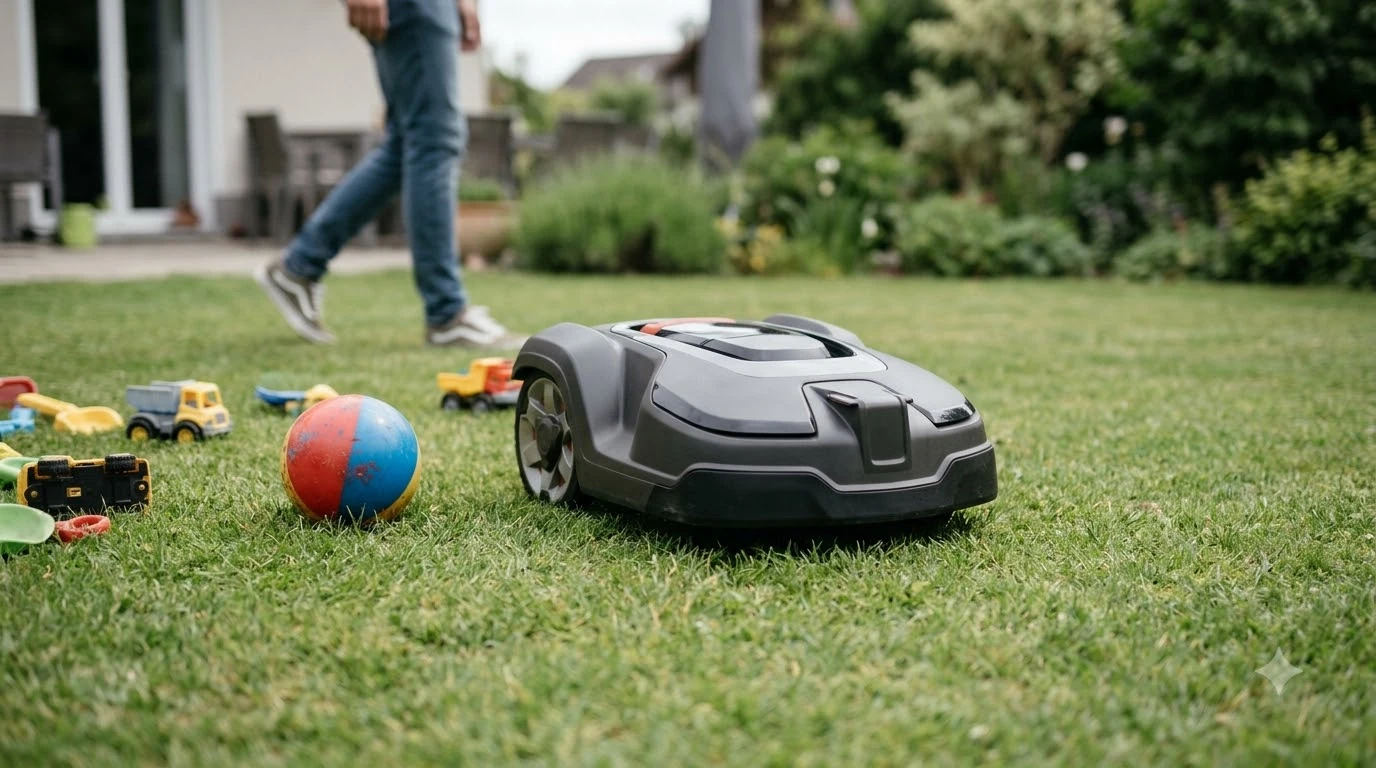

How does RTK work on a robot lawn mower: a fixed base station measures satellite error at a known spot and sends correction data to the mower, which narrows its GPS position from several meters to a few centimeters. The corrections only help when the mower can see enough open sky, so tree cover and nearby walls are the main weak points.
The short answer
- Base station: a fixed unit in the yard that knows its exact position and works out the satellite error at that spot.
- Corrections: the base sends them to the mower, typically by radio or Wi-Fi.
- Accuracy: standard phone GPS is within 5 to 10 meters, while RTK is described as within a few centimeters.
- Limit: heavy tree cover, walls, and roof overhangs weaken the signal.
What RTK adds to a robot mower’s GPS
RTK, or real-time kinematic correction (see what RTK stands for on a robot mower), is a method that improves ordinary satellite positioning. Sunseeker’s technical blog says standard phone GPS is within 5 to 10 meters, while RTK can pinpoint a location to within a few centimeters. Sunseeker Elite explains the base station and accuracy figures. Those numbers come from a brand blog, so they describe what the vendor claims rather than an independent test.
So how does RTK work on a robot lawn mower in plain terms? It swaps a rough satellite fix for a corrected one. Our reading is that the gap matters most for a mower that has to follow a boundary and keep its mowing lines straight. A position error of several meters is larger than many lawn edges, so a mower relying on standard GPS alone would struggle to track them.
How does RTK work on a robot lawn mower: base and rover
The base station sits at a fixed point and compares what the satellites report with its own known position. It works out the error at that exact spot and sends the correction to the receiver on the mower, called the rover. The mower applies that correction to its own readings, which is why the result is far tighter than standard GPS.
In the setup Sunseeker describes, the base sits a few meters from the charging station and is cabled to it, and the link between base and mower is typically radio or Wi-Fi. The blog does not give a maximum range for that link, so check the spec sheet for any model you consider. Smooth walls can also cause trouble, because satellite signals bounce off them before reaching the receiver. Sunseeker suggests covering such walls with textured material, such as unpainted wood.
Mammotion’s explainer on RTK describes the traditional base as a fixed point on the property, often a rooftop or garden pole, with a local wireless link to the mower. It also says accuracy falls as the mower moves farther from the base and that the mower needs a direct line of sight to it. Some brands offer a network option instead, where the mower receives corrections over a 4G module or home Wi-Fi from permanent reference stations that feed a central server. Mammotion’s network RTK article claims 1 to 2 centimeters for that method, a vendor claim that the article does not back with test data.

RTK accuracy compared with other positioning
RTK is described as accurate to a few centimeters, but none of the vendor pages we read give test conditions, so treat that figure as a best case for a clear sky. The table sets out what the sources say about each approach.
| Positioning method | Accuracy as described | Main weak spot |
|---|---|---|
| Standard phone GPS | Within 5 to 10 meters (Sunseeker) | No correction, so the error stays large |
| RTK with a base station | A few centimeters (Sunseeker); centimeter-level (Yarbo) | Tree cover, walls, roof overhangs, and a moved base |
| RTK with fallback sensors | Vision, IMU, and odometry take over when RTK drops (Yarbo) | The sources give no accuracy figure for fallback under trees |
Why trees and roof overhangs weaken RTK
Heavy tree cover can reduce RTK accuracy because branches and leaves block and reflect satellite signals. Sunseeker says heavy tree cover, walls, or roof overhangs can weaken accuracy, and it recommends a base spot with about a 160-degree vertical view of the sky. Mowrator’s guide on RTK signal loss under trees adds that signals can bounce off trunks, fences, and sheds, and that a base placed under overhanging branches can also be affected.
Yarbo, which sells RTK mowers, says areas with poor satellite visibility, such as those near tall trees or buildings, can see momentary loss of RTK precision. Yarbo’s RTK reliability article says its mowers switch to vision, IMU, and odometry when the RTK signal drops, and that the IMU helps with stability. The same article does not measure how accurate that fallback is under a canopy, so the sources cannot tell you how well a shaded lawn will be covered.
How does RTK work on a robot lawn mower when part of the sky is blocked? It still uses the base corrections, but our reading is that fewer satellites reach the receiver, so the fix is less steady. Our guide on why a robot mower keeps losing its RTK signal covers the common causes. Mowrator describes the usual results when the fix is lost as pausing, slowing down, or correcting the route. Those are vendor descriptions, not measured results, but they show what to watch for during the first runs. We recommend treating a heavily shaded lawn as a test case, not a given.
Setup, first fix, and what to ask before you buy
An RTK mower usually needs a few minutes to lock onto satellites after it is powered on. Sunseeker advises waiting 3 to 5 minutes for the RTK signal to acquire satellites, and says a solid blue or green light shows a strong signal. Setup can often be finished in under an hour, according to the same blog. Our walkthrough on setting up an RTK robot mower goes step by step.
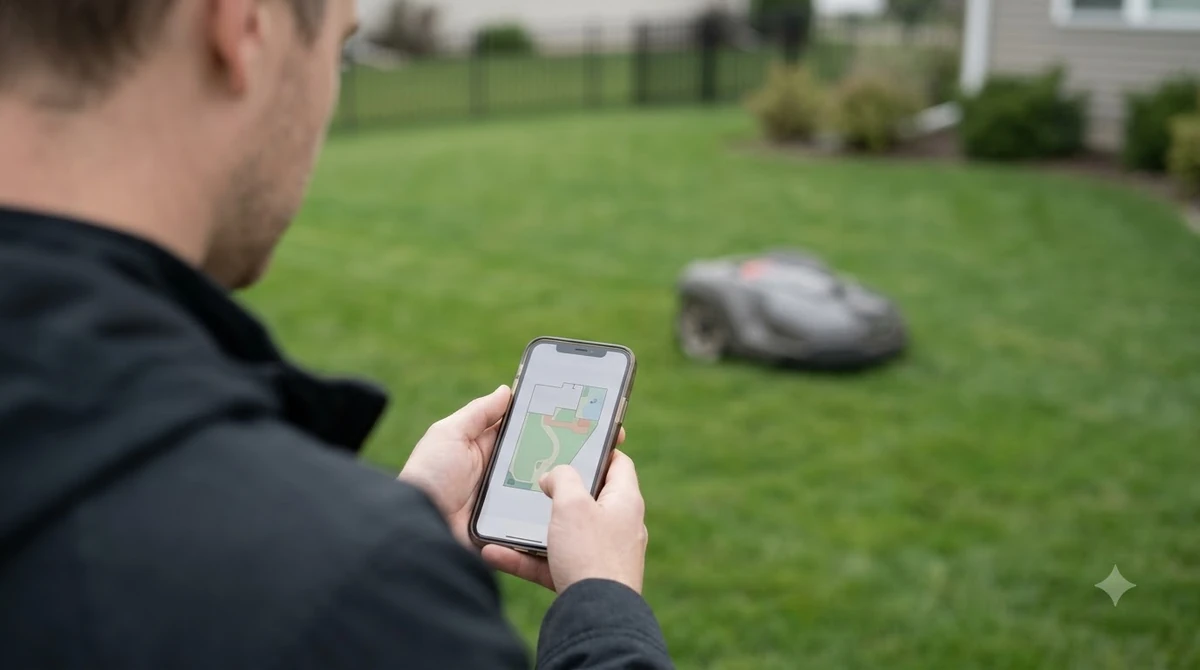
- Pick a spot with a wide sky view. Sunseeker recommends about a 160-degree vertical view for the base; see where to mount an RTK base station for placement options.
- Anchor the base firmly. Yarbo reports user comments that a base moved by even a few inches from wind or other causes can require re-mapping the whole lawn. These are user reports, not test results.
- Wait for the first fix. Allow 3 to 5 minutes before you expect accurate positioning.
- Watch the first runs closely. Yarbo tells owners to expect to rescue the mower from obstacles during the learning phase.
Before you buy, ask the seller a few direct questions. Which fallback sensors does the mower use when RTK drops? Where must the base sit, and how much open sky does it need? Does moving the base require re-mapping? Is there any published accuracy figure under tree cover? If the answers are vague, the spec sheet may not match your yard.
Frequently asked questions
Is RTK more accurate than standard GPS?
Yes, according to the vendor descriptions. Sunseeker says standard phone GPS is within 5 to 10 meters, while RTK can reach a few centimeters with a clear view of the sky. None of the sources we read tested this against an independent reference.
Does RTK work under trees?
It can work, but heavy tree cover weakens the signal. Vendors describe brief losses of precision and fallback to vision, IMU, or odometry. The sources do not quantify how accurate the fallback is, so test a shaded lawn before you rely on the mower.
How does RTK work on a robot lawn mower in practice?
A fixed base station works out the satellite error at its known spot and sends corrections to the mower. In the designs described by Sunseeker and Yarbo, the base sits a few meters from the charging station, is cabled to it, and uses radio or Wi-Fi. Check the spec sheet for the exact design of the model you are considering.
How long does a first RTK fix take?
Sunseeker advises waiting 3 to 5 minutes for the RTK signal to acquire satellites. A solid blue or green light indicates a strong signal, according to the same blog. Setup can often be completed in under an hour.
If your yard has large trees, treat RTK as one part of the decision rather than a guarantee. Ask how the mower navigates when the fix drops, and check the fallback sensors in the spec sheet. Our RTK vs LiDAR vs vision comparison shows how the other navigation types handle shade. On an open, clear lawn, RTK is a precise option, but the accuracy figures come from vendors and should be confirmed with a test run.
Sources
- What is RTK technology (Sunseeker Elite): RTK versus standard GPS, base station role, sky view, and setup timing.
- RTK robot mower reliability: can you trust it (Yarbo): base placement, fallback sensors, and stated limits.
- RTK robot mower signal loss under trees (Mowrator): how trees and reflections affect the signal.
- What is network RTK (Mammotion): traditional base versus network corrections, line of sight, and vendor accuracy claims.
 Up next8 min readBest Robot MowersRTK vs LiDAR vs Vision: Which Robot Mower Navigation Fits Your YardUpdated Nov 11, 2026
 8 min readBest Robot MowersHow to Choose an RTK GPS Robot Lawn Mower in 2026Updated Nov 11, 2026
 9 min readBest Robot MowersHow Much Does a Robot Lawn Mower Cost?Updated Nov 11, 2026
 9 min readBest Robot MowersWhat Does AWD Mean on a Robot Mower?Updated Nov 11, 2026
 9 min readBest Robot MowersHow Many Hours a Day Does a Robot Mower Run?Updated Nov 11, 2026
 8 min readBest Robot MowersHow Much Electricity Does a Robot Mower Use?Updated Nov 11, 2026