
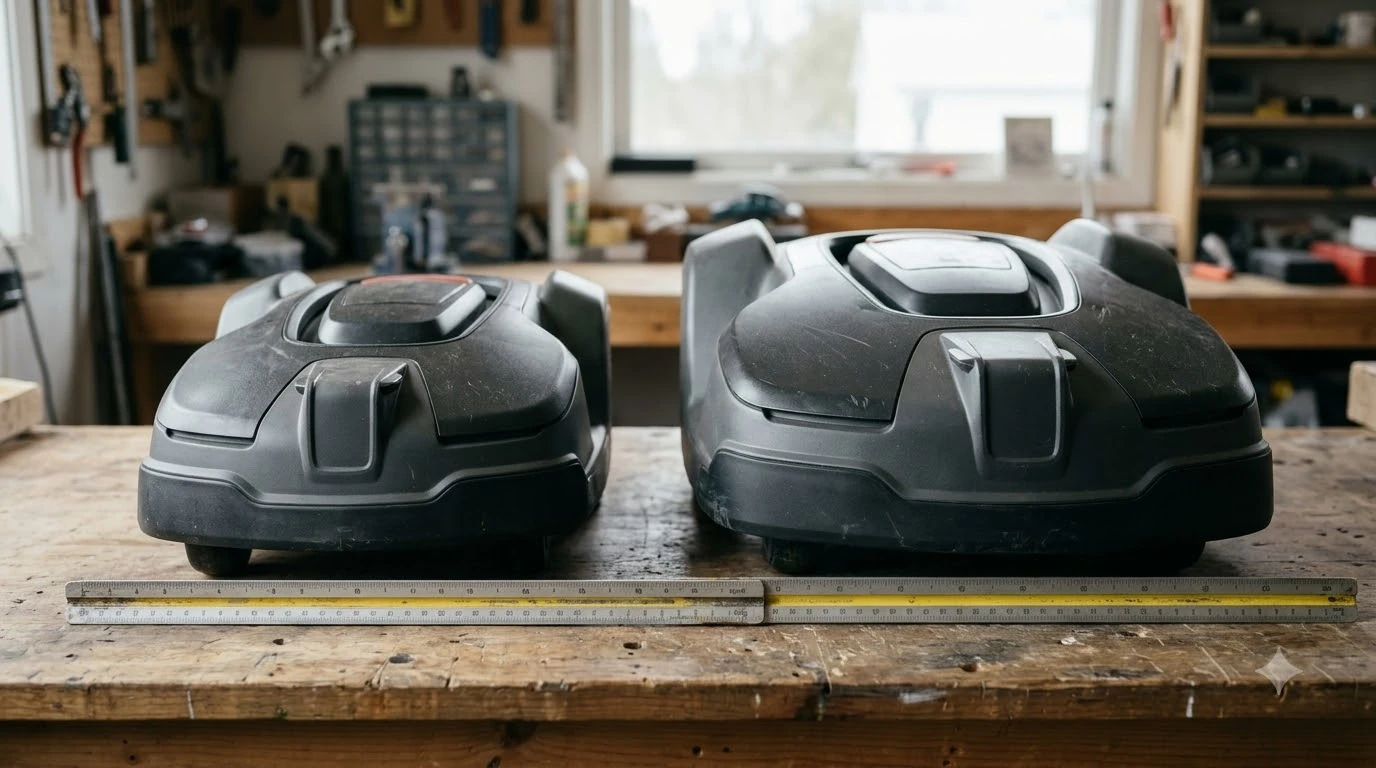

The LUBA 3 AWD 1500H vs Navimow i215 LiDAR choice comes down to drive layout, listed coverage and the 4G fee. Both mowers navigate with LiDAR and vision, and the i215 needs no boundary wire or RTK antenna. As of November 2026, the published specs favor different yards.
The short answer
- Drive and slope: the LUBA 3 AWD series is listed for slopes up to 80%, while the i215 is rated 45% and drives on its rear wheels only.
- Navigation: both use LiDAR plus vision, with no perimeter wire on the i215 and no RTK listed for the LUBA 3 1500 row.
- Listed area: the i215 is rated 0.37 acre, while Mammotion’s Canadian page gives the LUBA 3 1500 a standard size of 0.25 acre, labeled standard rather than maximum.
- Battery and fee: the i215 runs about 160 minutes, and its 4G service is free for the first year, then about $32.90 a year as one reviewer reported.
- Skip the i215 if your lawn has many low curbs, gravel or mulch borders.
LUBA 3 AWD 1500H vs Navimow i215 LiDAR: specs at a glance
The two mowers are close in navigation style but differ on drive and listed coverage. The table lists only figures found on the pages read for this comparison. Where a figure was not on the page, the table says so rather than guessing.
| Spec | LUBA 3 AWD 1500H | Navimow i215 LiDAR |
|---|---|---|
| Drive | All-wheel drive (series-level claim) | Rear-wheel drive only |
| Maximum slope | Up to 80% (38.6 degrees), series-level | 45% |
| Listed area | 1,000 m2 (0.25 acre) standard size, Canada | 0.37 acre (1,497 m2) |
| Navigation | 360 LiDAR plus vision, dual camera | LiDAR plus vision, no perimeter wire |
| RTK | Not listed for the 1500 row | No RTK antenna needed |
| Cutting height | 25 to 70 mm and 55 to 100 mm, two ranges | 2 to 4 in (5.1 to 10.2 cm), set in the app |
| Cutting width | Not listed on the page read | 8.66 in (22 cm) |
| Battery | Not listed on the page read | 7.65 Ah, about 160 minutes runtime |
| Weight and warranty | Not listed on the page read | 14.7 kg (32.4 lb), 3 years |
Navigation: no boundary wire on either, and RTK is not listed for the LUBA 3 1500
Both mowers rely on LiDAR and vision rather than a buried wire. Mammotion’s Canadian overview lists the LUBA 3 1500 and 1500H row with 360 LiDAR plus vision, dual camera. The same row shows no RTK, while the 3000 and 5000 rows are marked plus RTK.
The Navimow i215 is described as wire-free with no RTK antenna, according to the spec summary on Smart Home Compared. Our reading is that buyers who want to skip base stations and antennas should look at both specs before assuming either one needs them. For how the sensors work, see how LiDAR robot mowers navigate, and for more options see the best LiDAR robot lawn mower with no RTK antenna.
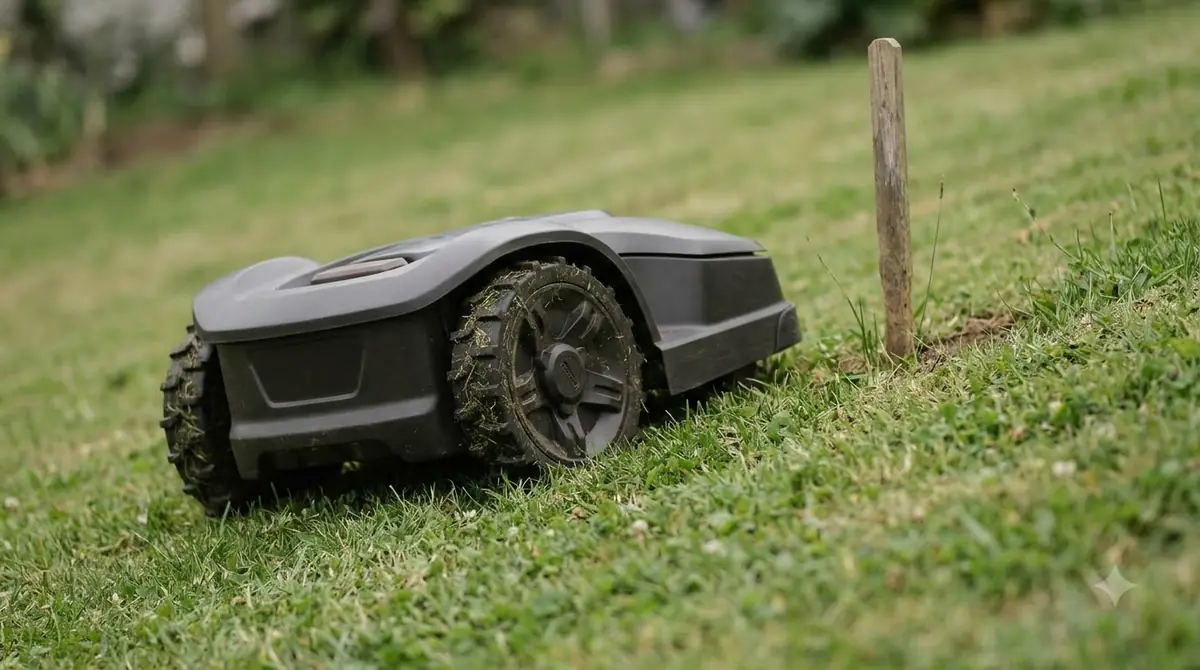
The i215 has limits in the same area. A hands-on PCWorld review said Navimow confirmed the i215 has no dedicated cliff sensor. Its connectivity is 2.4 GHz Wi-Fi only, with no Apple Home, SmartThings or Matter support.
Drive and slopes: all-wheel drive against rear-wheel drive
The LUBA 3 AWD series is described as all-wheel drive for slopes up to 80%, or 38.6 degrees. That figure is a series claim on Mammotion’s page, not a rating for the 1500 model alone, so it is a starting point rather than a guarantee for one yard.
When you compare the LUBA 3 AWD 1500H vs Navimow i215 LiDAR on drive, the question is how much grip your yard needs. A 45% rating and an 80% series claim are not measured on the same basis, so compare them only as published figures. See robot mower slope rating explained and AWD vs 2WD robot mowers for hills for the difference between percent and degrees and between drive types.
The i215 is rated for slopes up to 45% and has rear-wheel drive only. Smart Home Compared lists rear-wheel drive as a weak point and recommends an all-wheel model for large open areas or yards with many low edges. Our reading is that a steep bank is the place where the drive layout matters most.
Coverage: check the listed area for your country
The LUBA 3 1500 is listed at 1,000 m2, or 0.25 acre, as its standard mowing size on Mammotion’s Canadian page. The page labels this as standard, not as a maximum. Other regional listings may state a different area for the same model, and this article could not check them.
For the LUBA 3 AWD 1500H vs Navimow i215 LiDAR coverage question, the i215 is rated for up to 0.37 acre, or 1,497 m2. The PCWorld hands-on lawn was about 7,645 square feet, roughly 0.18 acre, which is about half the listed maximum. Check the spec sheet for your country before you compare coverage numbers, and see our guide to what AWD means on a robot mower if drive type is still unclear.
Cutting height and deck width
The i215 cuts from 2 to 4 inches, or 5.1 to 10.2 cm, with the height set in the app. Its deck is 8.66 inches wide, which the spec summary calls narrow. Our reading is that a narrow deck means more passes on a large lawn.
The LUBA 3 1500 page lists two cutting ranges, 25 to 70 mm and 55 to 100 mm. It does not clearly tie each range to the standard or H version, so check the manual for the exact model before comparing heights.
Battery, weight and the 4G fee
The i215 carries a 7.65 Ah battery rated for about 160 minutes of runtime, with about 130 minutes to recharge. The spec summary says the battery is not owner-swappable, which matters for a mower you plan to keep for years.
Its anti-theft package includes GPS tracking, a PIN lock, an alarm and a built-in 4G module. The 4G service is included for the first year. PCWorld’s reviewer reported a renewal fee of $32.90 per year, and Smart Home Compared gives about $33 a year in the US and Canada. The fee may change, so check the current Navimow fee as of November 2026. The battery and fee for the LUBA 3 1500 were not on the page read, so this LUBA 3 AWD 1500H vs Navimow i215 LiDAR comparison makes no claim on those points.
Who should pick which: LUBA 3 AWD 1500H or Navimow i215 LiDAR
Pick the LUBA 3 AWD series when drive grip on slopes matters most. Pick the i215 when a wire-free setup on a medium lawn with trees and shade suits you, and you can accept its edge limits.
- Steep banks or many low edges: the all-wheel drive layout of the LUBA 3 AWD series fits that case better, as long as your slope stays within the rated figure.
- Medium lawn with trees and shade: the i215 matches the maker’s suited-for note on that kind of yard.
- Fence lines with a raised grass edge: the PCWorld hands-on test saw the i215 slip off a narrow strip there, so map that edge with a wider margin.
- Before you buy: confirm the listed area for your country and the current 4G renewal fee.
Our reading is that the LUBA 3 AWD 1500H vs Navimow i215 LiDAR choice turns on your slope and edges more than on navigation, since both rely on LiDAR and vision. Measure your steepest slope and count your low edges before you pick. Then confirm the listed area for your country and the current 4G fee on the official site.
Frequently asked questions
Does the Navimow i215 LiDAR need a boundary wire or an RTK antenna?
No. The i215 navigates with LiDAR and vision, and the spec summary lists no perimeter wire and no RTK antenna. Setup still needs the dock on level ground and a battery above 50% before mapping, according to PCWorld.
Is the LUBA 3 AWD 1500H all-wheel drive?
Mammotion describes the LUBA 3 AWD series as all-wheel drive for slopes up to 80%, and the 1500 row belongs to that series. The 80% figure is a series claim, so check the manual for the exact model before relying on it for a steep bank.
How big a lawn is the LUBA 3 AWD 1500H listed for?
Mammotion’s Canadian overview lists 1,000 m2, or 0.25 acre, as the standard mowing size for the 1500 row and labels it standard, not maximum. Other regional listings may state a different area, so check the spec for your country.
What does the Navimow i215 4G service cost after the first year?
PCWorld’s reviewer reported a renewal fee of $32.90 per year, and Smart Home Compared gives about $33 a year in the US and Canada. Fees and terms can change, so confirm the current price on Navimow’s official site before you buy.
Sources
- Mammotion Canada LUBA 3 AWD overview (manufacturer): used for the 1500 row’s navigation, standard size, series slope claim, cutting height ranges and RTK row.
- Smart Home Compared, Segway Navimow i215 LiDAR (review site): used for the i215 specs, drive layout, anti-theft features, pros and cons.
- PCWorld, Navimow i215 review (publisher): used for the hands-on lawn size, fence-edge test, missing cliff sensor and the reported 4G renewal fee.
 Up next8 min readReviews & CompareEcovacs GOAT A2000 vs Mammotion LUBA 3 AWD 1500H: Specs ComparedUpdated Nov 12, 2026
 10 min readReviews & CompareSegway Navimow X3 vs Mammotion Luba 3 AWD: Published Specs ComparedUpdated Nov 11, 2026
 8 min readReviews & CompareMammotion LUBA 3 vs Segway Navimow: Specs ComparedUpdated Nov 11, 2026
 8 min readReviews & CompareSegway Navimow i215 LiDAR Review: Specs, Pros and ConsUpdated Nov 16, 2026
 7 min readReviews & CompareLUBA 3 AWD 3000H vs Navimow X430: High-Cut Specs ComparedUpdated Nov 12, 2026
 8 min readReviews & CompareWorx Landroid Vision vs Mammotion Luba 3 AWD: Published Specs ComparedUpdated Nov 14, 2026