
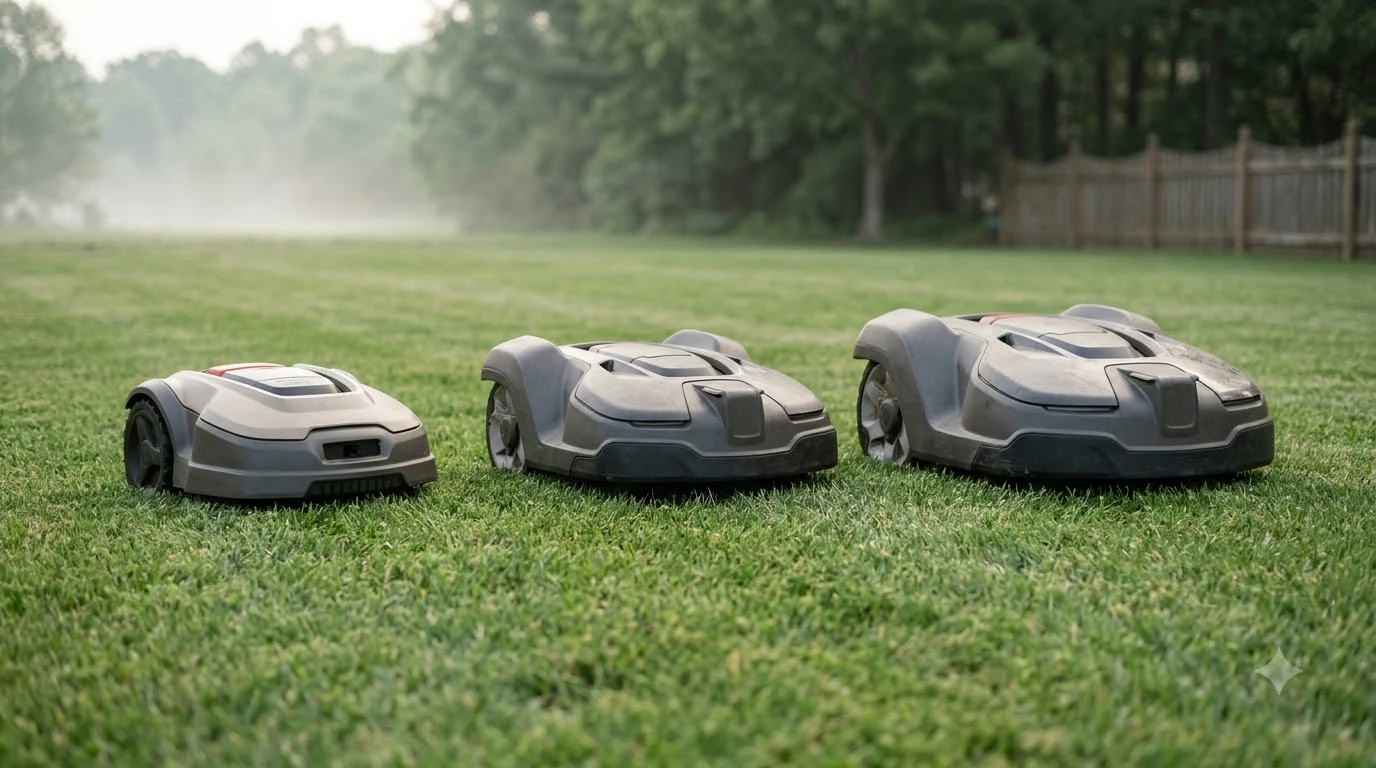

Chinese robot mower brands vs Husqvarna come down to three spec areas: how the mower finds the boundary, how steep a slope it rates for, and how it is sized. Neither side wins on every spec. This guide compares the published numbers from each brand so you can judge which trade-offs fit your yard.
The short answer
- Boundary: Husqvarna’s Automower 435X AWD uses a physical wire. Mammotion’s Luba 3 AWD and Segway Navimow’s Network RTK models use satellite positioning and need no local antenna, according to their pages.
- Slopes: Husqvarna rates the 435X AWD at 50% at the wire and 70% inside the installation area. Navimow rates its X4 at 84% (40 degrees).
- Lawn size: Husqvarna lists 0.9 acre (plus or minus 20%) for the 435X AWD. Mammotion’s product menu lists 1,500 to 10,000 square meters for the Luba 3 AWD.
- Our reading: in a Chinese robot mower brands vs Husqvarna comparison, judge the rating at your steepest spot and the size range at your real lawn, not the brand name.
How the two sides find the boundary
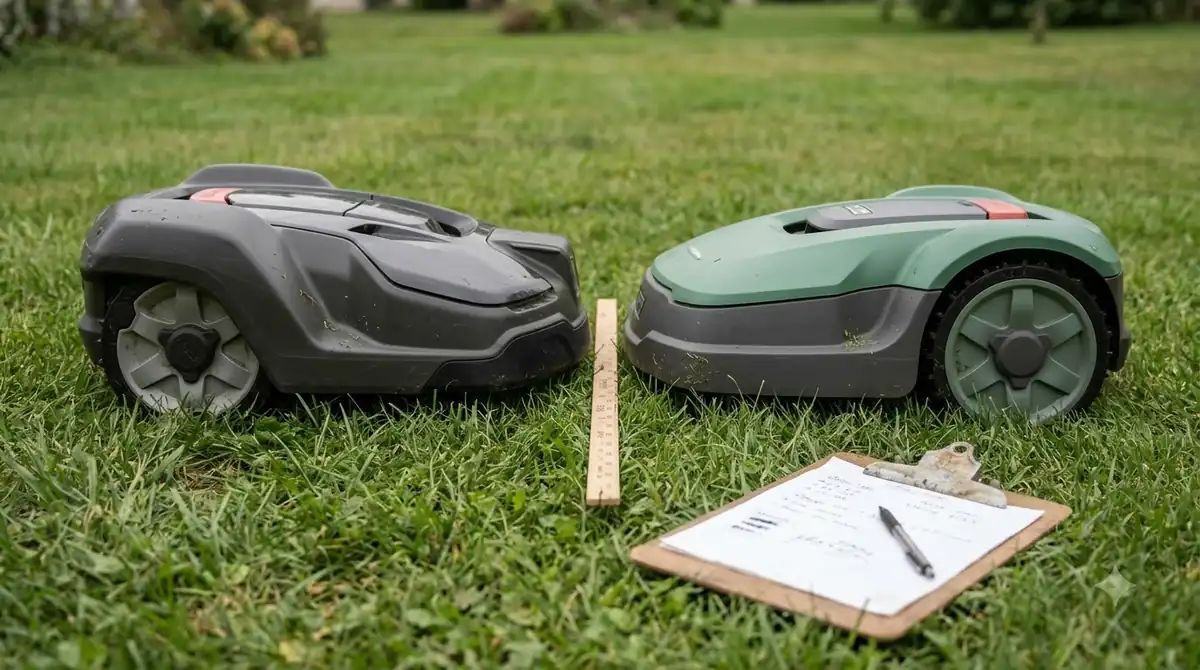
In a Chinese robot lawn mower vs Husqvarna comparison, the boundary method decides how much work the install takes and how the mower behaves near trees and walls. Our guide to wire-free versus boundary-wire mowers covers the trade-off in more detail. Husqvarna’s US lineup lists boundary types per model, either physical wire or virtual wire. The 435X AWD page describes a physical wire, and it says the loop wire and stakes are not included in the price.
Husqvarna’s EPOS system, shown on its regional site, works without physical wires. It uses RTK and GNSS positioning and states accuracy of about 1 to 6 cm for its Cloud option and 1 to 2 cm for its reference-station options.
Mammotion’s Luba 3 AWD page describes a 360-degree LiDAR, vision and NetRTK system. The page says NetRTK connects automatically through the iNavi service, so no RTK base or antenna is required. Segway Navimow’s explainer on wire-free mowers makes the same point for its Network RTK support.
Heads up
Husqvarna’s US page uses the term “virtual wire” as a boundary type but does not define it in the text we read. Check the manual for the exact model before you assume a wire-free install.
Our reading is that a wire-free mower from any brand depends on a clear view of the sky for its satellite signal. The pages we read do not give a sky-view figure, so ask the seller or read the manual before you buy a satellite-only model for a yard with tall trees or a large building close to the lawn. The guide on RTK mowers near tall buildings explains where the signal can struggle.
Chinese robot mower brands vs Husqvarna on slope ratings
Slope ratings are the most useful number for hilly yards, but the brands do not publish them on one shared basis. Segway Navimow lists degrees and percent, while Husqvarna gives one figure at the wire and another inside the installation area.
| Model | Published slope rating | Where the brand says it applies |
|---|---|---|
| Husqvarna Automower 435X AWD | 50% at the wire; 70% inside the installation area | Boundary and installation area, per Husqvarna |
| Husqvarna Automower 420 iQ | 45% inside the installation area; 15% at the boundary | Per Husqvarna US spec sheet |
| Segway Navimow i2 AWD | 45% (24 degrees) | Gentle inclines, small rocks or short gravel paths, per Segway |
| Segway Navimow i2 LiDAR Pro | 55% (29 degrees) | Gentle inclines, small rocks or short gravel paths, per Segway |
| Segway Navimow X4 | 84% (40 degrees) | Serious hills, uneven ground, exposed roots |
| Mammotion Luba 3 AWD | Not stated on the page we read | Check the manual |
The numbers are not directly comparable. Husqvarna’s 70% refers to the area inside the installation, and Navimow’s ratings are listed as the mower’s own slope capability. Our reading is that the safest comparison is the rating at the spot where the mower will actually work, such as near the boundary or on the steepest section of your lawn. Our guide to how robot mower slope ratings work explains what each figure means.
A high rating does not mean every hill is easy. The Navimow page pairs its top rating with rough ground and exposed roots, which suggests that surface and obstacles matter as much as the angle. Walk the slope and note any bare or loose patches before you choose a model.
Lawn size, cutting height and coverage
Husqvarna lists a recommended lawn size for each model on its US page, with a plus or minus 20 percent tolerance. The 420 iQ is listed at 1 acre, the 440 iQ at 2 acres, the 560 EPOS at 1.5 acres, the 580 EPOS at 2 acres, and the CEORA at 6 acres. The 435X AWD is listed at 0.9 acre.
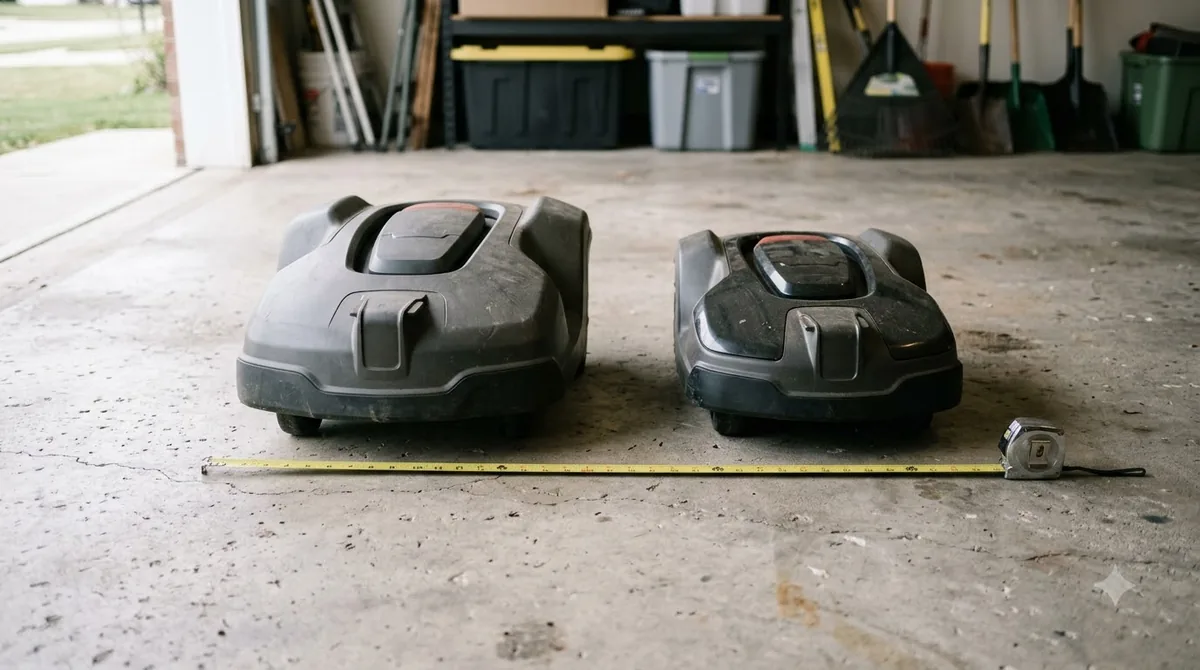
Mammotion’s product menu lists coverage of 1,500 to 10,000 square meters for the Luba 3 AWD. Its product page says the 1500 (H) model is positioned for lawns up to 1,500 square meters, about 0.37 acre. The same page says the mower fits through gaps as narrow as 70 cm and lets you set virtual walls and no-go zones for tricky boundaries. Those figures come from the brand’s own pages, so the model that fits your lawn matters more than the top of the range. For background on the term, see how coverage ratings are defined.
On cutting height, the 435X AWD page lists an electrically adjustable range from 1.2 to 2.8 inches, set through the app. The 420 iQ spec sheet lists 1 to 4 inches, and the same page lists a 1-acre lawn size with a 0.5-acre figure for irregular shapes. The Luba 3 AWD page mentions flexible cutting height without numbers, and we did not find a published cutting range for the Navimow models on the pages we read.
For Chinese robot mower brands vs Husqvarna on lawn size, our reading is that a lawn near the top of a model’s size range will run the mower for longer each day, so pick a model with a margin above your measured lawn area rather than one sized exactly to it.
What to check before you buy
The headline specs are only part of the decision when you compare Chinese robot mower brands vs Husqvarna. For a closer look at one pair, read the Mammotion and Husqvarna head-to-head. The brands publish different levels of detail, so the manual, the app and the service options matter as much as the rating table above.
- Boundary method. Decide between a physical wire and satellite positioning, then read the install section of the manual for that exact model.
- Slope. Measure your steepest section and compare it with the rating that applies to that spot.
- Lawn size. Compare the recommended area with your measured lawn, and leave room for the plus or minus margin.
- Cutting height. Confirm the range you need on the spec sheet for the model, not on a general brand page.
- Service. Ask the seller about local repair, warranty terms and parts before you buy.
When you weigh Chinese robot mower brands vs Husqvarna on price, the pages we read did not state warranty terms or service-network coverage, so those answers come from the seller or the brand’s support team, not from this guide.

Frequently asked questions
Do Chinese robot mowers need a boundary wire?
Not always. Mammotion’s Luba 3 AWD page describes sensor-based positioning with NetRTK and does not mention a boundary wire. Segway Navimow’s Network RTK support needs no local antenna. Install needs vary by model, so read the manual for the exact model you plan to buy.
Does the Husqvarna 435X AWD need a boundary wire?
Yes. Husqvarna lists the 435X AWD’s boundary type as physical wire, and its page says the loop wire and stakes are not included in the price. Budget for both when you compare the total cost.
Which brand handles steep slopes better?
In a Chinese robot mower brands vs Husqvarna slope comparison, the published ratings do not compare on one basis. Navimow lists its X4 at 84% (40 degrees), while Husqvarna lists the 435X AWD at 50% at the wire and 70% inside the installation area. Check the rating that applies to your steepest spot.
Is a Chinese robot mower cheaper than Husqvarna?
This guide does not quote prices, because the pages we read did not give current figures. Compare the price of each model at the seller and check what is included, such as wire, stakes or a charging station, before you decide.
Sources
- Husqvarna Automower lineup, US (Husqvarna): boundary types and recommended lawn sizes per model.
- Automower 435X AWD, US (Husqvarna): boundary type, slope ratings, cutting height and lawn size.
- Husqvarna EPOS, regional page (Husqvarna): RTK and GNSS positioning and accuracy figures. The page is in a regional language and the figures are as listed there.
- Automower 420 iQ, US (Husqvarna): boundary type, slope ratings, cutting height and lawn size.
- Luba 3 AWD (Mammotion): navigation system, NetRTK setup and coverage range.
- How robotic lawn mowers work without boundary wires (Segway Navimow): Network RTK and the slope ratings for its i2 and X4 models.
 Up next9 min readReviews & CompareGardena vs Husqvarna Robot Mower: What the Spec Sheets ShowUpdated Nov 11, 2026
 8 min readReviews & CompareWorx Landroid vs Husqvarna Robot Mower: What the Specs ShowUpdated Nov 11, 2026
 7 min readReviews & CompareMammotion vs Husqvarna Robot Mower: What the Specs ShowUpdated Nov 11, 2026
 9 min readReviews & CompareSegway Navimow vs Husqvarna Robot Mower: What the Specs ShowUpdated Nov 11, 2026
 7 min readReviews & CompareWhich Robot Mower Brand Lasts the Longest? What the Evidence ShowsUpdated Nov 11, 2026
 9 min readReviews & CompareHusqvarna Automower 115H vs Worx Landroid Vision: SpecsUpdated Nov 11, 2026