
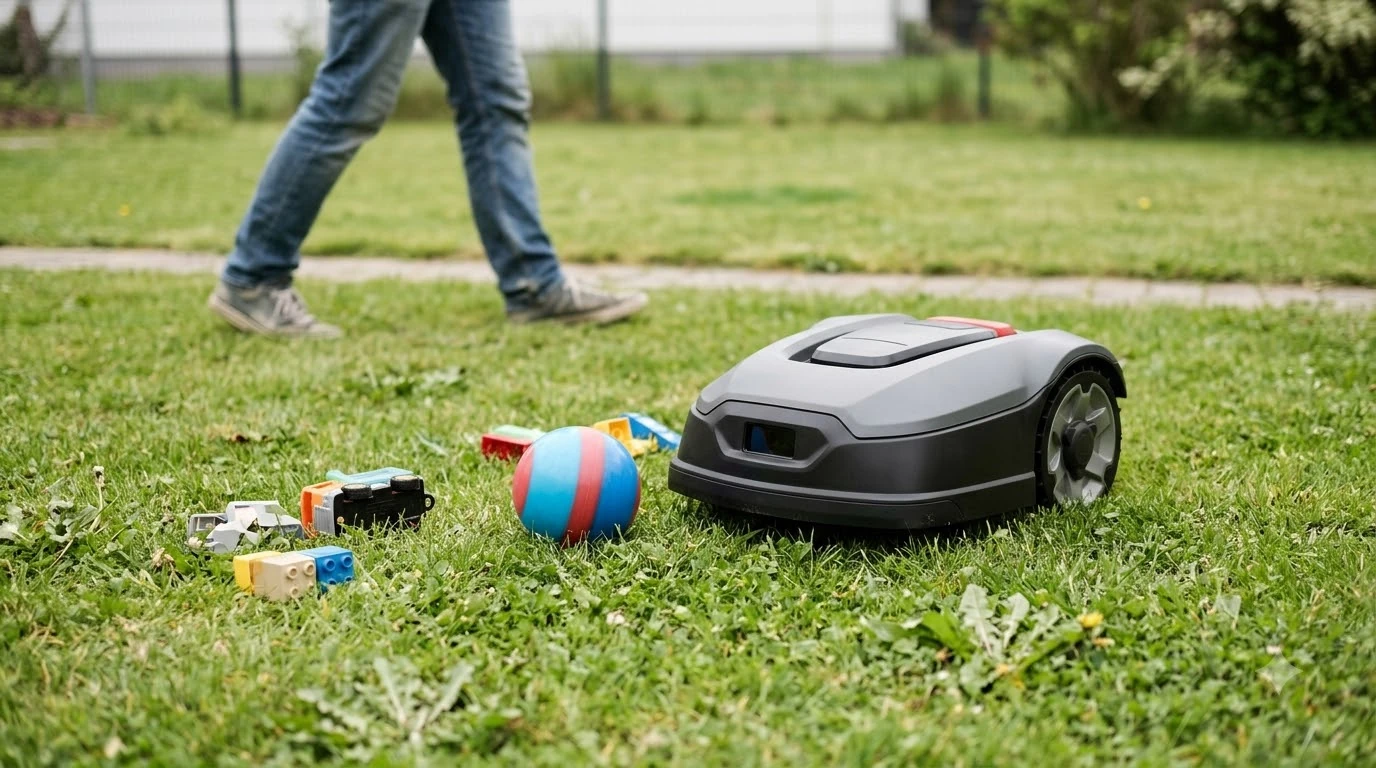

There is no single best robot mower for complex yards. The right machine depends on how your lawn is laid out: how many separate zones it has, how narrow the passages between them are, how steep the slopes get, and how many obstacles and tree-shaded areas the mower has to work around. Match those features to the specifications below before you compare brands.
The short answer
- Zones: a complex yard usually needs a mower that can store several zones and move between them, with a safe route between each pair.
- Passages: check the narrowest gap the manufacturer lists, often around 0.8 m (about 31 in) for some brands, or 60 cm (24 in) for a boundary-wire passage.
- Slopes: compare the slope rating in percent and degrees, because the two do not line up. A 45% rating is about 24 degrees.
- Navigation: wire-free models avoid laying wire around beds, but their satellite or sensor performance depends on the yard, so check the conditions the brand lists.
What makes a yard complex for a robot mower
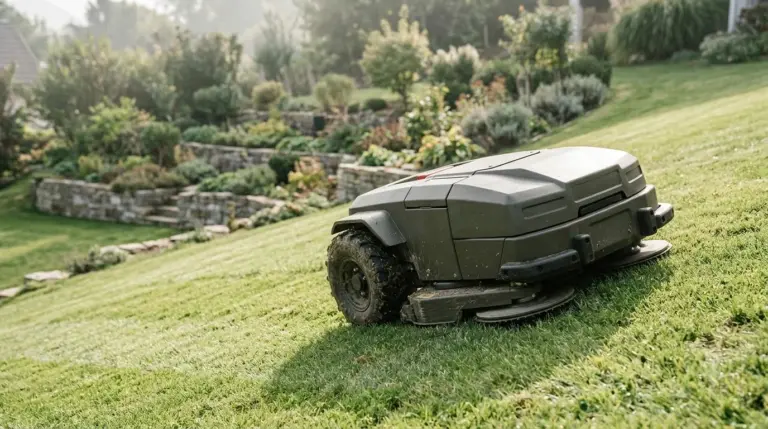
A yard counts as complex when a single open rectangle does not describe it. Common examples include a front lawn and a back lawn joined by a side path, a garden with raised beds in the middle of the grass, a slope that runs along one edge, or a large oak that shades part of the turf. Each of these creates a different problem for a robot mower, and most robot mowers are sold with a single area rating that says little about any of them.
Think of your yard as a list of features to check, not as one total square footage. Choosing the best robot mower for complex yards starts with that list, and the sections below cover the features that most often decide whether a robot mower fits.
Multi-zone lawns and how the zones connect
A multi-zone setup splits the lawn into areas the mower works one at a time, often with different cutting schedules for each. Worx describes its Landroid Vision set-up as letting you select up to four zones of a garden and set rules for each of them. The zones are linked by a passage, and that passage is where most problems start. In Worx’s Landroid Vision guide, each zone must be wider than 2 m, the path between zones should be shorter than 6 m, and any obstacle on the straight line the mower travels during a transition can cause that transition to fail.
Robomow describes a layout where a main zone is the largest and usually holds the charging station, while a smaller secondary zone is joined to it by a pathway.
A zone that is cut off from both cannot be reached by the mower on its own. Our reading is that before you buy, you should sketch your yard, mark each zone and each connection, and check the connection lengths against the brand’s own guide. If a zone can only be reached by carrying the mower over grass or gravel, it is a separate lawn, and it needs its own plan (see mowing multiple separate lawns). Zone rules like these are a core part of picking the best robot mower for complex yards, so read them in the brand’s own guide.
Narrow passages between lawn sections
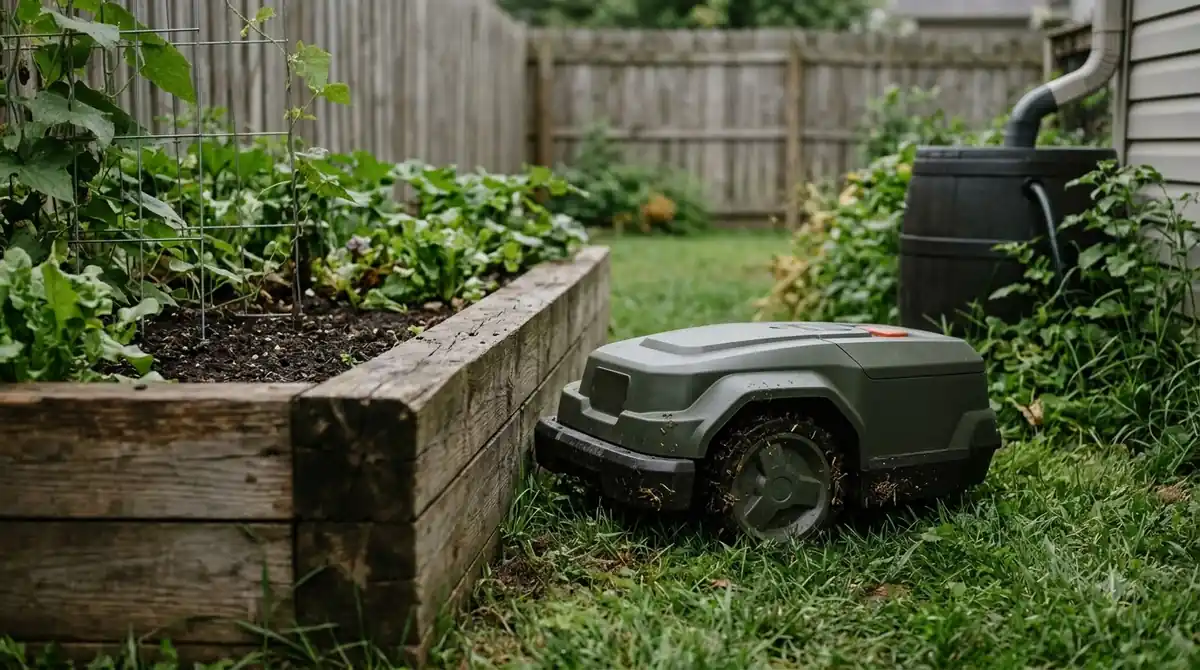
A passage is a gap the mower must drive through to reach another part of the lawn, often between a fence and a tree or along a side of the house. Narrow gaps are a common reason a robot mower gets stuck or never reaches a section at all.
Husqvarna’s boundary-wire guide describes a passage made with two boundary wires set 60 cm (24 in) apart, with a guide wire kept at least 30 cm (12 in) from the boundary wire. Lymow lists a passage clearance of at least 0.8 m (about 31 in), measured at the narrowest point of the gap. These are different systems, so the numbers are not directly interchangeable. Our reading is that a gap under about 60 cm is a risk to plan around, and our guide to narrow side yard passages looks at widths in more detail.
| Passage type | Published figure | Source |
|---|---|---|
| Husqvarna boundary-wire passage | 60 cm (24 in) between wires; guide wire at least 30 cm (12 in) from boundary wire | Husqvarna support |
| Lymow passage clearance | at least 0.8 m (about 31 in) at the narrowest point | Lymow blog |
| Husqvarna virtual transport path (EPOS) | starts at least 1 m (3.3 ft) inside the work area | Husqvarna support |
Slopes and uneven ground
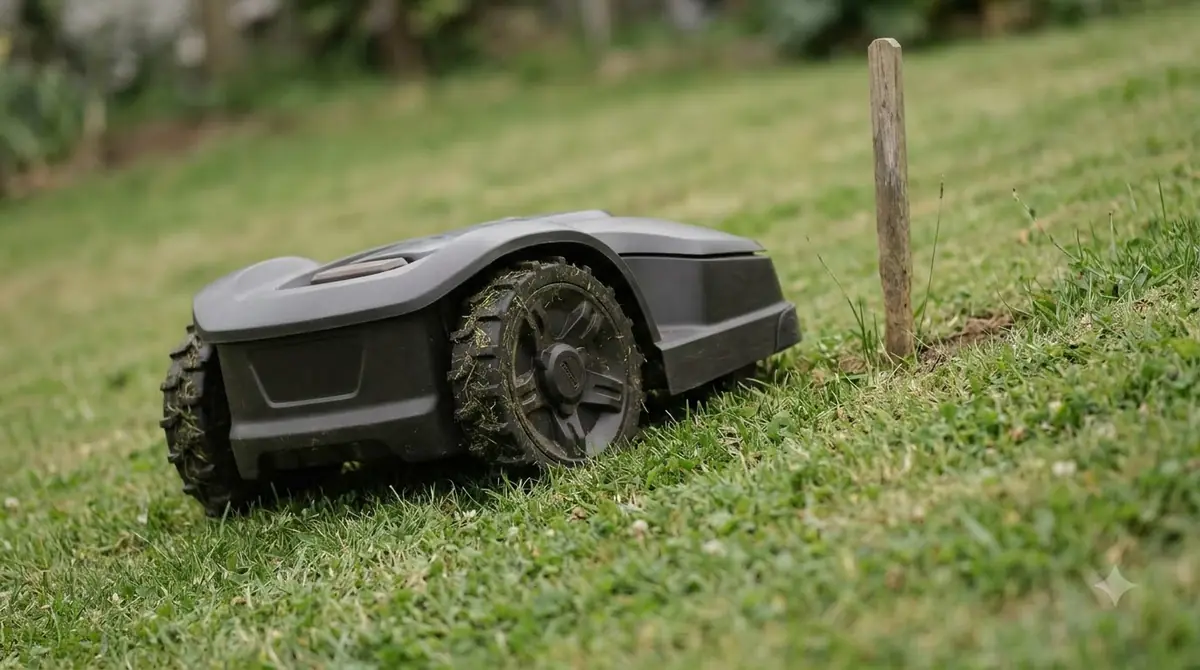
Slope is the feature most people underestimate. Husqvarna says that standard models handle slopes of 25% to 50% (about 14 to 26 degrees), depending on the model. Its 435 iQ AWD is listed as navigating slopes up to 70%. Navimow lists its i205 AWD at 45% (24 degrees) and its i210 LiDAR Pro at 55% (29 degrees). Those numbers come from the manufacturers, not from independent testing, so treat them as a starting point. When you shortlist the best robot mower for complex yards, use them as a first filter against your own measured slope, which measuring yard slope in percent and degrees explains step by step.
Percent and degrees measure the same thing in different ways. A 45% slope is about 24 degrees, and 100% is 45 degrees, so the two scales look very different at the steep end. Bob Vila’s review lists degree ratings for several robot mowers, including 38.6 degrees for the Mammotion Luba 3 AWD and 40 degrees for the Navimow X430, as of November 2026. Worx advises measuring your steepest section first, using a one-metre straight stud and a bubble-level app, rather than trusting a single slope figure on a box.
| Slope rating as published | Equivalent angle (approx.) |
|---|---|
| 25% to 50% (Husqvarna standard models) | 14 to 26 degrees |
| 45% (Navimow i205 AWD) | 24 degrees |
| 55% (Navimow i210 LiDAR Pro) | 29 degrees |
| 70% (Husqvarna 435 iQ AWD) | 35 degrees |
Obstacles, garden beds and no-go zones
Complex yards are full of things a robot mower should avoid: garden beds, a hose, a play set, a tree root that rises out of the grass.
The usual way to keep the mower away from them is a no-go zone (here is how to set up no-go zones), and the method differs between systems. Husqvarna’s EPOS wire-free system sets a stay-out zone at a minimum of 30 x 30 cm (1 x 1 ft), while its AIM system cannot schedule a stay-out zone and should not be placed over the charging station, a guide wire, or a passage you want the mower to use. Husqvarna also asks for 6 m (20 ft) of free space in front of the charging station in EPOS set-ups.
The best robot mower for complex yards is usually the one whose no-go method fits your beds. Worx says its ACS module steers around obstacles instead of bumping into them, and that its Off-Limits module draws a virtual boundary for no-go areas. That is the manufacturer’s description; the guide does not give a minimum distance from the obstacle.
Sunseeker notes that LiDAR can help in gardens with many obstacles, shaded areas, or complex layouts where satellite signals may be weaker. Our reading is that you should map every bed and obstacle you can see on the day you set up the mower, because a stay-out zone you forget to draw is a zone the mower will drive into.
Navigation options for complex layouts
How the mower knows where it is matters most in a complex yard, so it shapes any shortlist of the best robot mower for complex yards. Boundary-wire systems follow a buried wire and handle tight, defined edges well, but they need wire laid around every zone and bed. Wire-free systems use satellite positioning, LiDAR, cameras, or a mix, and they are easier to change, but their accuracy can drop under dense tree cover. The table below summarises the options that appear in the sources used for this article, and our wire-free vs boundary wire comparison goes deeper.
| Navigation | Where it helps in a complex yard | Where it can struggle |
|---|---|---|
| Boundary wire | Defined edges and a fixed, known layout | Many zones and beds mean many metres of wire to install and maintain |
| RTK satellite positioning | Open lawns with zones mapped in an app | Heavy tree cover can weaken the signal, which is why some brands add LiDAR or vision |
| LiDAR | Shade and obstacles where satellite signal is less reliable (Sunseeker’s description) | Performance figures come from manufacturers; no independent test is used in this article |
| Vision (camera) | Recognising obstacles and steering around them | Operating conditions vary by brand; check what the manual lists |
Mammotion’s LUBA 3 AWD page describes a mix of LiDAR, NetRTK and dual-camera AI vision, and says the NetRTK connection needs no RTK antenna. It is a manufacturer description, not an independent test, so check how it performs under your own tree cover.
Acre ratings are only a starting point
Most robot mowers are sold with an acre rating, but a complex yard rarely matches the rating neatly. Husqvarna’s product list carries a “lawn size ±20%” label on its 435 iQ AWD, which means a rating is an estimate rather than a hard limit. Bob Vila’s list gives ratings from 0.15 acre for the Navimow i206 to 1 acre for the Navimow X430, and the same review shows a Mammotion Luba 3 AWD rated at 0.75 acre. Mammotion’s own blog says 2WD mowers suit yards under roughly 0.25 to 0.5 acre, and AWD mowers power all four wheels, which can help on slopes, though the blog’s slope figures for 2WD conflict with each other.
In a complex yard, the effective area is smaller than the total lawn because the mower cannot cut under beds, around tree trunks or inside stay-out zones. Our reading is to size the best robot mower for complex yards by the cuttable area, leave a margin, and check whether the rating assumes a single zone.
Choosing the best robot mower for complex yards: a checklist
- Draw the yard. Mark each zone, each passage, each slope, and each bed or obstacle on a simple sketch.
- Measure the narrowest passage. Compare it with the manufacturer’s minimum for that system.
- Measure the steepest section. Use a straight stud and a level app, then compare the result with both the percent and degree ratings.
- Confirm zone rules. Ask how many zones the model supports, how it moves between them, and what happens when an obstacle sits on that route.
- Check the stay-out method. Make sure the system can draw no-go zones around every bed, and confirm whether those zones can be scheduled.
- Check support for your area. Confirm the warranty and service in your state before you commit.

Frequently asked questions
What is the most important feature for a complex yard?
There is no single feature that fits every yard when you look for the best robot mower for complex yards. Our reading is that the passage width between zones and the steepest slope are the two checks that most often decide whether a robot mower can reach the whole lawn.
Do I need zones for a complex yard?
Not always. A yard with one connected area and a few beds may need only no-go zones. Zones matter when parts of the lawn are separate, joined by a path, or cut on a different schedule.
Is a 45% slope the same as a 45-degree slope?
No. A 45% slope is about 24 degrees. Percent measures rise over run, and degrees measure the angle, so the two numbers look very different on steep ground.
Can a robot mower handle trees in the lawn?
Some models can work around trunks and roots, but tree cover can weaken satellite signals. Sunseeker suggests LiDAR can help in shaded or obstacle-heavy gardens, and Husqvarna and Worx both describe stay-out or no-go zones for trees and beds. Confirm the behaviour in the brand’s manual before you buy.
Sources
- Husqvarna support: passage in boundary-wire installation (manufacturer): passage width and guide wire spacing.
- Husqvarna support: EPOS stay-out zones and transport paths (manufacturer): minimum zone size and charging-station clearance.
- Husqvarna support: stay-out zones with AIM technology (manufacturer): scheduling and placement limits.
- Husqvarna support: installation for steep slopes (manufacturer): standard slope range.
- Husqvarna robotic lawn mowers (manufacturer): listed area and slope figures for AWD models.
- Worx wiki: Landroid Vision multi-zone set-up (manufacturer): zone width and transition rules.
- Worx: robot mowers and complex lawns (manufacturer): zone count, obstacle handling and slope check.
- Robomow: can the robotic lawnmower mow multiple areas or zones (manufacturer): main and secondary zone layout.
- Lymow: robot mowers for separate front and back yards (manufacturer): passage clearance.
- Segway Navimow i-series specifications (manufacturer): slope ratings by model.
- Sunseeker glossary: robot lawn mower multi-zone (manufacturer): LiDAR in complex gardens.
- Mammotion blog: 2WD vs 4WD robot mowers (manufacturer): drive layout and yard size guidance.
- Mammotion LUBA 3 AWD (manufacturer): LiDAR, NetRTK and AI vision description, no RTK antenna.
- Bob Vila: best robot lawn mowers (publisher): listed area and degree ratings.
 Up next9 min readBy YardHow to Map a Complex Yard for a Robot MowerUpdated Nov 10, 2026
 9 min readBy YardBest Robot Mower for Centipede Grass: 6 Checks Before BuyingUpdated Nov 13, 2026
 9 min readBy YardBest AWD Robot Mower for Hilly Backyard: 6 Things to Check Before You BuyUpdated Nov 13, 2026
 6 min readBy YardBest Robot Mower for a Yard with Maple Trees: What to CheckUpdated Nov 14, 2026
 10 min readBy YardBest Robot Mower for a Yard with Lawn Ornaments: What to CheckUpdated Nov 12, 2026
 8 min readBy YardBest Robot Mower for a Yard With a Dry Creek Bed: What to CheckUpdated Nov 12, 2026