
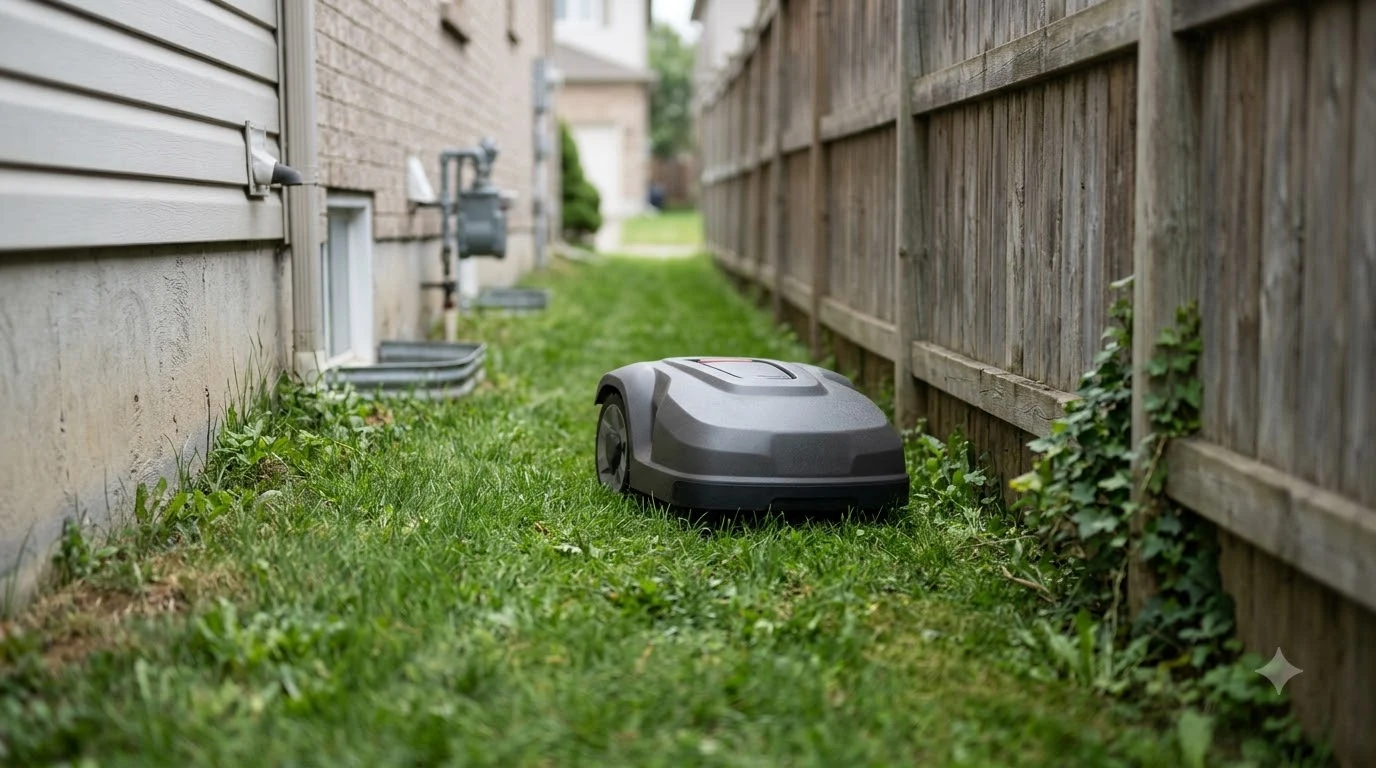

The best robot mower for a corner lot is one with a strong boundary-wire system, a guide-wire option, and enough passage handling to get around two street frontages without missing edges. A corner lot has more perimeter, more turns, and often a narrow strip along the side street, so the mower you pick and the way you lay the wire matter more than they do on a simple rectangular yard. This guide explains what changes on a corner lot, how to lay the wire around the bends, and what to check before you buy.
The short answer
- Choose by perimeter first: a corner lot usually has a longer boundary than the square footage suggests, so check the model’s wire length limit.
- Keep bends gentle: Husqvarna advises avoiding guide-wire bends sharper than 45 degrees.
- Plan the side-street strip: a narrow passage under 2 m (6.5 ft) is best handled with a guide wire.
- Place the charging station with a straight run of wire in front of it, away from the tightest corner.
What makes a corner lot different
A corner lot is harder for a robot mower for two reasons. First, the lawn is usually bounded by two streets, two driveways or sidewalks, and sometimes a neighbour on each side, so there are more places where the boundary wire has to turn. Second, the lawn often narrows into a side strip that is awkward to mow with a machine built for an open rectangle. A corner lot is one site type among several, and the guide to mowers for different property types covers the rest. Narrow side yards are covered in narrow townhouse yards and mowers alongside the guidance above. Newly built lots are covered in mowers for new construction homes to round out the picture for this topic.
Our reading of the manufacturer guidance is that the corner itself is rarely the problem. The problem is the combination of a tight turn and a passage the mower has to pass through to reach the rest of the lawn. Treat the corner as a design question before you buy, not something to fix after the wire is in the ground.
Laying boundary wire around the corners
Corners are where most wire layouts go wrong. Husqvarna’s guide-wire instructions warn against laying a guide wire at sharp angles, and advise avoiding bends sharper than 45 degrees, because the mower can struggle to follow a wire that turns too hard. The same logic applies to the outer boundary, so use gentle, rounded turns where the wire changes direction.
- Mark the perimeter first. Walk both street edges and the side strip, and mark where each turn falls before you lay any wire.
- Keep the wire off the curb line. Leave room between the wire and the sidewalk or curb so the mower does not run its wheels along the edge of the street.
- Use gentle bends. Round the corners rather than cutting them square, and avoid sharp corners in any guide wire.
- Test the whole edge. Run the mower once and watch every corner, not only the open lawn.
Heads up
Husqvarna notes that a guide wire loop over about 400 m (1,300 ft) can make navigation difficult, and the lower 150 m (490 ft) limit applies to the Aspire R4. A large corner lot with a long perimeter can reach these limits faster than you expect, so add up the wire length before you buy.
Where to put the charging station
The charging station is the anchor for the whole layout, and on a corner lot its location affects how easily the mower reaches both street-facing sections. Husqvarna recommends laying the wire straight for at least 2 m (6.5 ft) from the charging station, or 1 m (3.3 ft) for its Aspire R4 model. That straight run gives the mower a clean path to follow when it leaves and returns. A dock that sits outside between visits matters even more at a second property, as this note on robot mowers for weekend homes explains. A dock that sits outside between visits needs thought, and a robot mower for vacation homes faces different charging station questions from a corner lot.
Keep the station out of the tightest corner if you can. A station tucked into a sharp bend leaves little room for the mower to line up, and it makes the guide-wire connection harder to hide. Put it where the lawn opens up, even if that means a longer run of wire.
Passages between the front and side yard
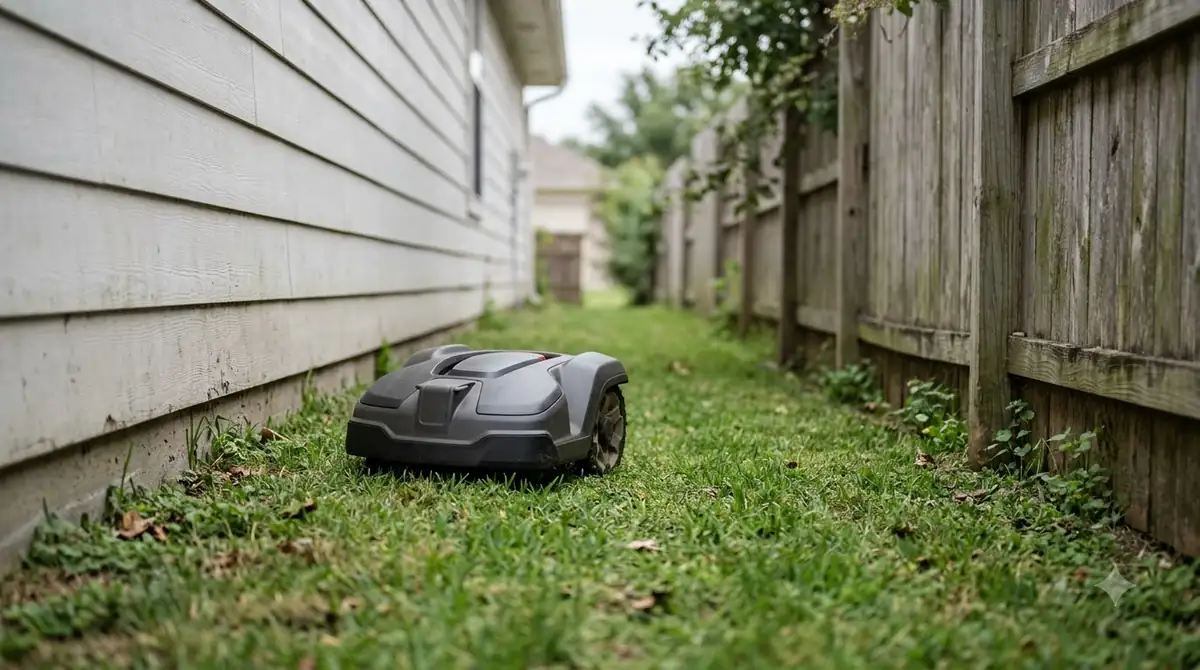
Most corner lots have at least one narrow connection between the main lawn and the side strip, such as a gap beside a fence, a gate, or a walkway. Husqvarna’s passage guidance recommends a passage of at least 2 m (6.5 ft) for good cutting results on some models, and says that passages narrower than 2 m are best served by a guide wire. Passages between areas matter at larger sites, as mowers for a church lawn shows. Rules often apply to side yards, as mowers for HOA neighborhoods describes.
A guide wire keeps the mower on a defined path through the gap. Keep it at least 30 cm (12 in) from the boundary wire, and avoid crossing the boundary wire. The mower runs to the left of the guide wire when facing the charging station, so leave clear space on that side.

Best robot mower for a corner lot: what to check before you buy
Use this table to compare models against the features a corner lot needs. The right answer depends on your specific layout, so measure both street frontages and the side strip before you start. A short explanation of the same topic is in the right mower for a corner lot.
| Feature | Why it matters on a corner lot | What to look for |
|---|---|---|
| Wire length limit | Long perimeters use up wire fast | A stated maximum loop length that covers your full edge |
| Guide wire support | Narrow side strips and gaps need a defined path | Optional guide wire for passages |
| Passage width | Side strips are often narrower than the open lawn | Manufacturer’s stated minimum passage width |
| Charging station placement | Corners limit where the station fits | Enough room for a straight wire run in front |
Our recommendation is to read the manual’s passage and wire-length figures before you commit to a model. A mower that handles one corner well may still struggle with a long side strip, so match the model to the hardest part of your lawn rather than the easiest.
Frequently asked questions
Can a robot mower handle a corner lot with two street sides?
Yes, if the boundary wire is laid with gentle bends and the wire length stays within the model’s limit. The street-facing edges need the most care, because the mower will run close to the curb or sidewalk.
How sharp can a corner be in the wire?
Husqvarna advises avoiding guide-wire bends sharper than 45 degrees, since the mower can struggle to follow a sharp turn. Round the corners where you can.
Do I need a guide wire for a corner lot?
Not always. A guide wire becomes useful when the lawn has a passage narrower than about 2 m (6.5 ft), such as a gap beside a fence or a side strip that connects to the main lawn.
Where should the charging station go on a corner lot?
Place it where the lawn opens up rather than in the tightest corner, and leave a straight run of wire in front of it. Husqvarna recommends at least 2 m (6.5 ft) of straight wire from the station on most models.
Sources
- How to lay a guide wire in a boundary wire Automower installation (Husqvarna): used for the 45-degree bend limit, the 400 m loop limit, the 2 m straight run from the charging station, and the 30 cm guide-wire spacing.
- How to create a passage in an Automower boundary wire installation (Husqvarna): used for the 2 m passage recommendation and the note that narrower passages are best served by a guide wire.
 Up next8 min readBest Robot MowersWhat Is the Best Robot Mower for a Corner Lot?Updated Nov 11, 2026
 9 min readBest Robot MowersHow to Spot a Real Robot Mower Deal Before You BuyUpdated Nov 11, 2026
 7 min readBest Robot MowersBest Robot Mower for a Lot with No Outlet Nearby: Power PlanUpdated Nov 14, 2026
 7 min readBest Robot MowersSelf Charging Robot Lawn Mower: How Auto Return WorksUpdated Nov 13, 2026
 7 min readBest Robot MowersBest Robot Mower with Fastest Charging: What the Figures ShowUpdated Nov 10, 2026
 8 min readBest Robot MowersHow Robot Mowers Return to the Charging StationUpdated Nov 11, 2026