
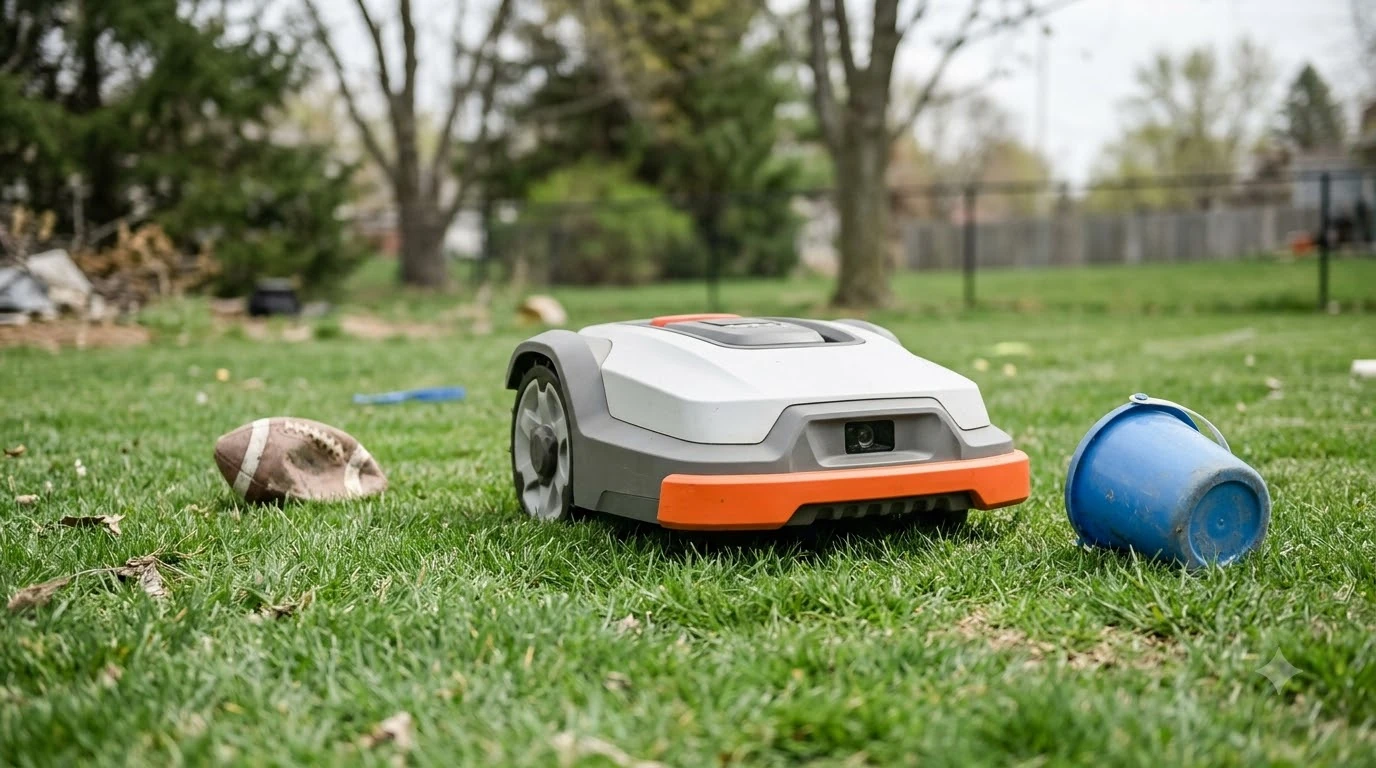

A robot mower for a lawn with a cistern lid can work, but the lid’s height decides the setup. A lid sitting flush with the turf is the hardest case, because many sensors can miss objects that lie flat or sit very close to the ground. A raised lid is easier to see and avoid, though it is still not guaranteed. In both cases the safer choice is to fence the lid with a boundary wire island or a stay-out zone.
The short answer
- Raised lid: sensors have a better chance of detecting it and steering around it.
- Flush lid: the highest risk, because Husqvarna notes that flat or very close objects may not be detected.
- Safest setup: a wire island around the lid, with the wire kept at least 26 cm from the edge of the fixture on the Worx island guidance.
- Not a safety feature: no sensor system guarantees that a mower will never run over an object.
Flush lids and raised lids behave differently
A cistern lid is a fixed cover, usually metal or plastic, set into the lawn to protect an underground tank. Its height above the grass is what matters most. A lid that sits level with the turf offers almost no profile for a sensor to read. A lid that stands a few centimeters proud is a clearer target, but it can still be missed if the grass around it is tall or wet. A cistern lid is one of several water-related features, and water features in a robot-mowed yard covers the general rules. Raised water containers need a clear stay-out zone, as rain barrel placement on a lawn describes.
Husqvarna’s object avoidance guidance says that objects lying flat or very close to the ground may not be detected, and it adds that the system “is not a safety feature. There is no guarantee that objects will not be run over.” Our reading is that a flush cistern lid belongs in the same risk group as those flat objects, so it should never be left to sensors alone.
What the sensors can and cannot see
Most robot mowers use some mix of bump sensors, ultrasonic or radar sensors, and in some models cameras. Bump sensors only react after contact. Ultrasonic and radar sensors can detect a tall object before the blade reaches it, but they struggle with thin or low items. Camera systems add risk sorting, yet Husqvarna’s AI vision page names raised or legged objects as hard to judge, and says the mower may try to pass under a raised section. Its advice is to create a stay-out zone wherever there is a risk of the mower getting stuck. Open water is a bigger hazard than a lid, which koi pond edges and robot mowers explains.
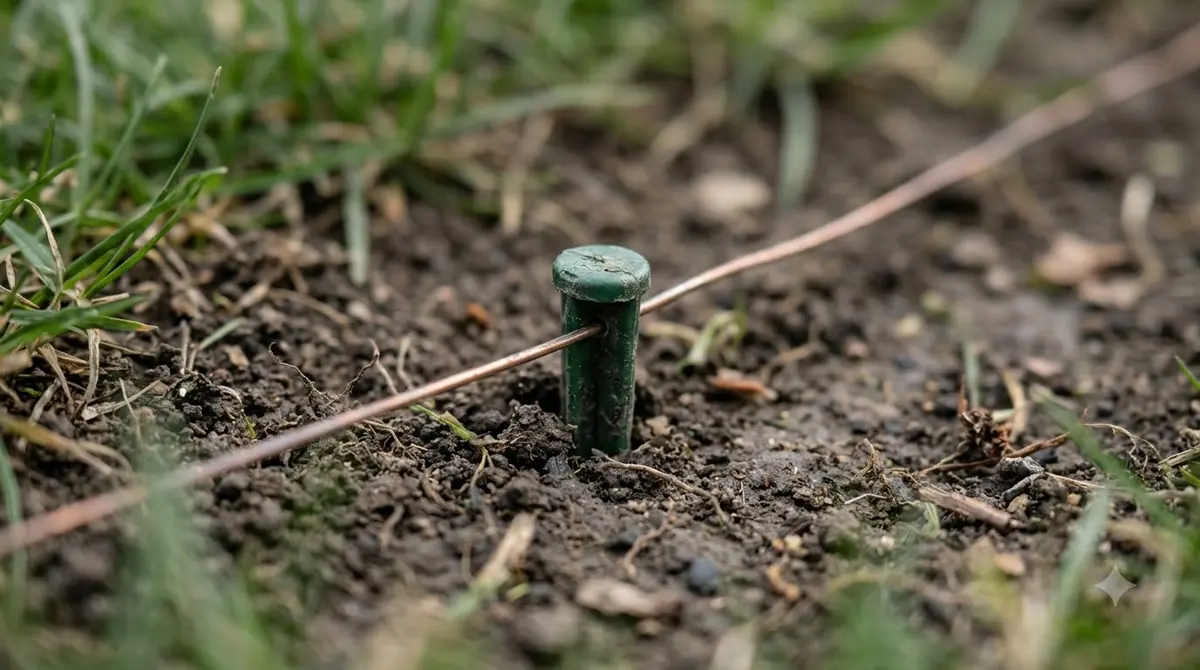
Husqvarna also gives a clearance rule for avoidance. On its radar and ultrasonic sensor page, avoidance is switched off within 60 cm of a virtual boundary and within 90 cm of a boundary wire. That means the sensors cannot be relied on to protect a lid that sits right beside the wire, so the fence has to be set up with that gap in mind.
Heads up
Grass height changes the picture. Husqvarna warns that objects hidden in high grass can be missed or can trap the mower, so a cistern lid surrounded by long grass needs trimming around it before the mower runs.
Robot mower for a lawn with a cistern lid: when to fence it
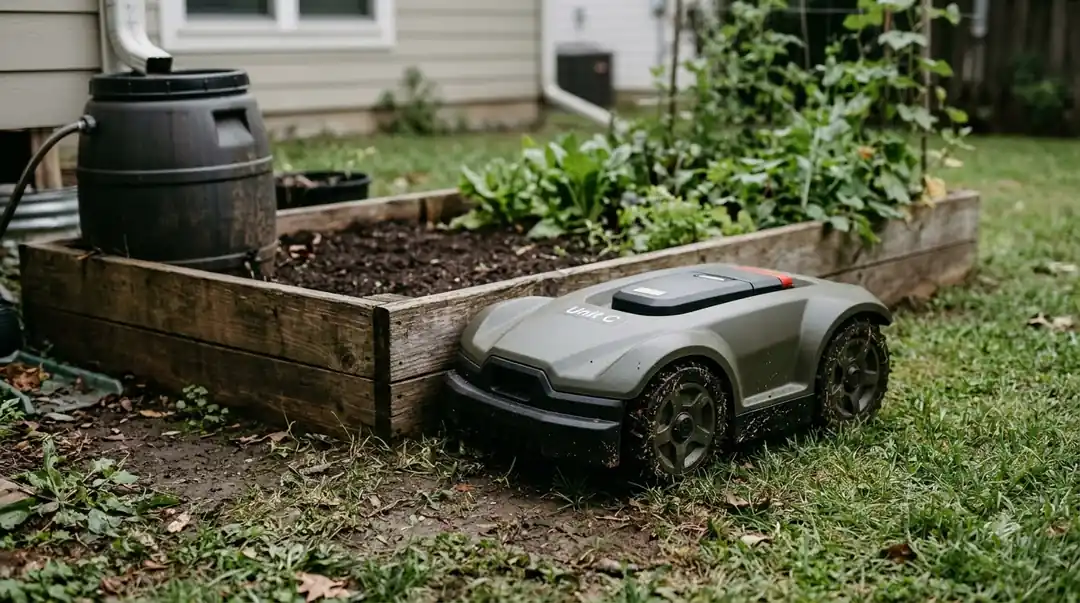
A wire island is a closed loop of boundary wire around an object that the mower should not touch. Husqvarna’s island guidance recommends islands for obstacles that cannot take a bump, such as flower beds and rockeries. A cistern lid is a good fit for the same logic, since hitting a metal lid can damage the blades or the mower body. Another hard-edged feature that needs a marked stay-out zone appears in hot tub clearance on a lawn.
- Measure the lid. Note its diameter and whether it sits flush, slightly raised, or tall.
- Plan the loop. Keep the island wire clear of the lid’s edge. Worx’s island guidance uses 26 cm as the wire clearance.
- Keep the wires apart. Husqvarna says the island wires must not cross. The mower will not recognize the island and will stop if they do.
- Close the loop. Lay the two return wires close together so their signals cancel out.
- Test the path. Run one slow pass and check that the mower turns before the island instead of rolling over the lid.
Islands cost time to install, but they are the only option that does not depend on sensors. If the lid is in the middle of an open lawn, a wire island is usually cleaner than a long cut-out boundary around it.
Stay-out zones and physical markers
Many apps let you draw a stay-out zone around a fixed object. Husqvarna’s EPOS page recommends zones around trees, roots and stones, with a minimum size of 30 x 30 cm, and says the mower will not pass through a stay-out zone. A virtual zone is useful for a lid that is already well marked, but it does not replace a physical barrier. Husqvarna’s AIM guidance says a virtual zone does not replace the physical fence and recommends a barrier of at least 15 cm, or 6 inches, where a lid sits near a pool or street. Low planted areas also need marked boundaries, as rain garden boundaries for robot mowers explains.
A stay-out zone is the simpler option when the lid is off to one side and the mower never needs to run close to it. Our reading is to combine both methods: a zone for the app, and a wire island as the fallback if the zone is not enough.
What to check before you buy
If the lawn already has a cistern lid, check these points before you choose a model: Fixed water features change the shortlist, as fountain yard mower shortlist explains.
- Sensor type: ask whether the model uses bump, ultrasonic, radar or camera sensing, and how it handles flat objects.
- Island support: confirm that the app or installation guide supports wire islands and how many you can set.
- Stay-out zones: check the minimum zone size and whether zones can be drawn without a wire.
- Grass height: plan how long grass will be trimmed around the lid, since tall grass can hide it.
The right model is the one whose installation method fits your lid. Read the manual’s section on fixed objects before you assume the mower will handle the lid on its own.
Related reads: Flush drainage features that look like lawn to a sensor are covered in dry creek bed mower picks. Yards divided by running water have extra boundary issues, which creek-split yard mower choices covers.
Frequently asked questions
Will a robot mower run over a flush cistern lid?
It can. Husqvarna says objects lying flat or very close to the ground may not be detected, so a flush lid is the highest-risk case. A wire island is the safer fix.
How far should the wire be from a cistern lid?
Worx’s island guidance uses 26 cm of wire clearance for its Landroid models. Check your own mower’s manual, since clearance rules differ between brands.
Is a virtual stay-out zone enough around a lid?
Sometimes. A virtual zone keeps the mower away if it is set correctly, but Husqvarna notes it is not a physical barrier. Near pools or streets, use a physical barrier as well.
Can tall grass hide a cistern lid from the mower?
Yes. Husqvarna warns that objects hidden in high grass may be missed or may trap the mower. Trim the grass around the lid before the first run.
Sources
- Husqvarna object avoidance with radar or ultrasonic sensors (KA-70110) (manufacturer): flat or low objects may be missed; avoidance switched off within 60 cm and 90 cm of boundaries.
- Husqvarna boundary wire islands (KA-01427) (manufacturer): islands for obstacles that cannot take a bump; wires must not cross.
- Husqvarna EPOS stay-out zones (KA-70385) (manufacturer): minimum zone size of 30 x 30 cm.
- Worx Landroid installation wiki: setting up an island (manufacturer): 26 cm island wire clearance.
 Up next8 min readBy YardRobot Mower for a Lawn with an RV Parking PadUpdated Nov 13, 2026
 6 min readBy YardRobot Mower for a Lawn with Gopher Mounds: What HelpsUpdated Nov 13, 2026
 6 min readBy YardRobot Mower for a Lawn with a Putting Green: Fence It OffUpdated Nov 13, 2026
 6 min readBy YardRobot Mower for a Lawn With Utility BoxesUpdated Nov 13, 2026
 6 min readBy YardRobot Mower for a Lawn with Voles: Signs, Limits, ControlUpdated Nov 13, 2026
 6 min readBy YardRobot Mower for a Lawn with a Kiddie Pool: Barrier FirstUpdated Nov 13, 2026