


The best robot lawn mower for lawns with thick thatch layers is one built with high-clearance cutting decks, oversized high-traction wheels, and floating suspension rather than a low-slung standard chassis. Thick thatch turns an ordinary yard into a spongy, uneven surface that causes lightweight robots to sink, lose grip, and scalp high spots. Matching your mower’s physical specs to dense turf conditions keeps cuts clean while protecting shallow roots.
The short answer
- Cutting height ceiling: Look for high-cut decks reaching 3.5 to 4 inches (about 90 to 100 mm) so blades clear spongy crowns without scalping.
- Floating deck suspension: Independent deck movement lets the blades ride over soft dips and root-raised ridges instead of gouging the turf.
- Wheel diameter and drive: Large rear wheels, deep off-road treads, or all-wheel drive (AWD) prevent drive wheels from sinking and tearing shallow roots.
- Frequent micro-mulching: Daily trimming removes tiny leaf tips that break down fast, whereas overgrown grass creates clumps that worsen thatch buildup.
- Pre-season dethatching: A robot mower maintains healthy turf height, but thatch thicker than 0.5 inches still needs mechanical vertical mowing or power raking first.
How thick thatch changes what a robot mower needs
Thatch is a tightly interwoven layer of dead and living stems, rhizomes, and roots sitting between green grass blades and the soil surface, and it fundamentally alters how wheeled robots move across a yard.
According to turfgrass specialists at Penn State Extension, thatch accumulates whenever turfgrass produces organic debris faster than soil microorganisms can decompose it. Aggressively spreading grasses such as Kentucky bluegrass, zoysiagrass, and bermudagrass develop much thicker layers than bunch-type grasses like tall fescue or perennial ryegrass. Once that mat exceeds roughly 0.5 inches—or even 0.33 inches on cool-season turf according to Oklahoma State University Extension—the lawn surface begins feeling spongy underfoot.
That spongy cushion creates three mechanical problems for autonomous mowers:
- Chassis sinkage: Narrow wheels sink deeper into soft organic mats than into firm mineral soil, dropping the cutting deck closer to the crowns than the dial setting indicates.
- Root-zone vulnerability: In heavily thatched lawns, new grass roots grow inside the thatch layer rather than anchoring deep in soil, making the turf far easier for spinning wheels to tear loose.
- Increased blade drag: Dense, springy stolons and crowns push up against the underside of low decks, increasing motor resistance and draining batteries faster during routine runs.
Key hardware specs to check before choosing a model
Evaluating a mower for dense, thatched turf requires looking past app features and focusing on ground clearance, deck articulation, and drivetrain geometry.
Standard residential robot mowers frequently max out around 2.0 to 2.4 inches of cutting height, which works well on firm, low-cut turfgrasses. On thick Kentucky bluegrass or zoysia with a spongy base, however, a 2-inch maximum setting leaves almost zero margin when the wheels compress the thatch. High-cut variants—such as Husqvarna’s High Cut models reaching 3.6 inches (90 mm) or 4WD platforms offering 1 to 4 inches (25 to 100 mm) of adjustment—provide the extra vertical clearance needed to stay above the crown zone.
Deck suspension matters just as much as raw height. A rigid deck locked to the mower frame tilts whenever one wheel drops into a soft thatch pocket, causing the opposite edge of the blade disc to scalp adjacent high spots. Floating cutting decks pivot independently of the chassis to follow soft surface undulations.
| Specification | Standard flat-lawn baseline | Target for thick thatch lawns | Why it matters on spongy turf |
|---|---|---|---|
| Max cutting height | 2.0 to 2.4 in (50 to 60 mm) | 3.5 to 4.0 in (90 to 100 mm) | Compensates for wheel sinkage so blades do not scalp grass crowns |
| Deck mounting | Fixed / rigid frame | Floating or suspended deck | Follows soft dips and root-raised ridges without gouging |
| Wheel design | Smooth or shallow tread, small casters | Large-diameter drive wheels with deep off-road tread | Spreads weight over a wider contact patch and reduces sinkage |
| Drivetrain | 2WD rear-wheel drive | High-torque 2WD with terrain wheels or AWD | Prevents wheel slip that rips shallow, thatch-bound roots |
| Height adjustment | Manual underside screws | App-controlled electronic adjustment | Lets you step down cutting height gradually over weeks |
Heads up
A robot lawn mower is a maintenance tool, not a dethatcher. Its small pivoting razor blades slice leaf tips cleanly, but they cannot pull up woody rhizomes or compacted organic mats. If your thatch layer already measures 0.5 to 1 inch thick, remove the excess mechanically before relying on robotic mowing.
Do robot lawn mowers make thatch worse or better?
When scheduled frequently on dry turf, a robot mower helps slow future thatch buildup rather than accelerating it, provided you follow sound turf management rules.
A common myth is that grass clippings cause thatch. As University of Minnesota Extension notes, green leaf clippings consist mostly of water and break down rapidly via soil microbes, whereas thatch forms from tough, lignin-rich stems, crowns, and roots. Because robot mowers run every day or two, they shave off tiny millimeter-scale tips that filter down into the canopy and decompose quickly.
However, university extension guidance also warns that once a thick thatch layer already exists, heavy clumps of surface clippings can block air and moisture and speed further accumulation. If grass grows too tall after heavy rain or a missed schedule, sending a robot out at a low setting creates thick wet mats. Raising the deck first—or knocking down tall growth with a standard bagging mower—keeps robotic grasscycling beneficial.

Setting up and running a robot mower on thatched turf
Proper setup and scheduling prevent wheel ruts and scalping during the first month of operation on a soft, dense lawn.
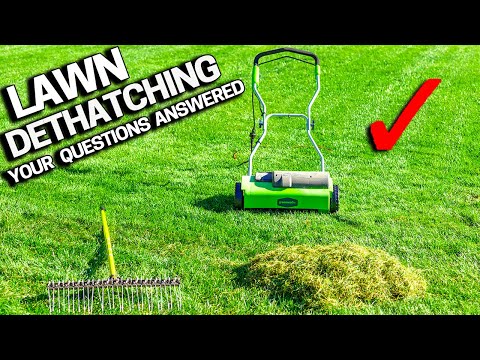
- Measure thatch depth before first launch. Cut a small 2- to 3-inch-deep soil plug with a trowel and inspect the brownish fibrous layer between the green shoots and dark soil. If it exceeds 0.5 inches (or 1 inch on severe cool-season stands), schedule core aeration or vertical mowing in late summer or early fall before deploying the robot.
- Start at the maximum cutting height. Set the mower to its highest deck position for the first one to two weeks so the chassis clears spongy high spots and follows the one-third mowing rule without shocking the turf.
- Step the height down gradually. Once the lawn surface firms up and cuts evenly, lower the cutting height in small increments over several weeks until you reach the recommended height for your grass species.
- Restrict schedules to dry conditions. Wet grass reduces tire traction by roughly 40 to 60 percent, and spinning wheels easily tear grass whose roots sit inside a shallow thatch mat. Enable rain sensors or schedule afternoon runs after morning dew evaporates.
- Clean wheel treads and blades weekly. Damp thatch fibers and soil pack tightly into aggressive tire lugs and around blade pivot screws, reducing grip and preventing blades from swinging freely.
What to check before you buy
Before committing to any model verify five physical and software details against your specific yard conditions so you do not end up with a mower that bogs down in dense turf.
- Grass species vs. deck height range: Confirm the mower’s highest setting matches your turf’s ideal summer height (often 3.0 to 3.5 inches for cool-season grasses like Kentucky bluegrass) with extra room for wheel sinkage.
- Under-deck clearance and blade guard design: Check manual diagrams for how close the protective skid plate or blade guard sits to the ground; wide, low-hanging guards drag across spongy thatch even when the blades are raised.
- Tire width and replacement availability: Wider tires distribute weight better on soft ground, and models offering optional coarse-tread terrain wheels give you an upgrade path if standard tires slip.
- Turning behavior at boundaries: Zero-turn tank-style pivots on two-wheel-drive models scrub soft turf at the end of every pass, whereas wider turning arcs or four-wheel-steer/AWD drivetrains reduce turf scuffing.
- App weather-delay and pattern controls: Look for automatic rain-delay integration plus the ability to rotate mowing angles so wheels do not repeatedly compress the same soft thatch tracks.
Frequently asked questions
Can a robot lawn mower remove existing thatch?
No. Robot lawn mowers use lightweight pivoting razor blades designed only to trim the top tips of green grass blades. Removing an established thatch layer thicker than 0.5 inches requires a vertical mower (power rake) or core aerator with blades or tines that penetrate the organic mat.
Why does my robot mower scalp spots on a thick, spongy lawn?
Scalping on thatched turf usually happens when the mower’s wheels sink into soft pockets of dead organic matter, lowering the cutting disc into the grass crowns. Switching to a higher cutting height setting, choosing a model with a floating deck, and running the mower only when the lawn is dry help prevent uneven cuts.
Do robot mower clippings add to thatch buildup?
Not when the mower runs frequently on a healthy lawn. According to university turfgrass extensions, tiny leaf clippings decompose quickly and return nutrients to the soil, whereas thatch comes from fibrous stems and roots. Clippings only worsen thatch if infrequent mowing leaves heavy clumps sitting on top of an existing thick thatch layer.
Is all-wheel drive necessary for a lawn with thick thatch?
AWD is not strictly required on a flat yard if the mower has large, deep-treaded drive wheels and you avoid mowing wet grass. However, if your thatched lawn also has slopes, bumps, or damp shaded areas, AWD distributes torque across all four wheels and significantly reduces wheel slip that can tear shallow roots.
Sources
- Managing Thatch in Lawns (Penn State Extension): referenced for thatch composition, grass species susceptibility, and mechanical removal thresholds.
- How to control thatch in your lawn (University of Minnesota Extension): referenced for the 0.5-inch thatch threshold, grass clippings decomposition, and aeration/vertical mowing practices.
- Thatch Management in Lawns (HLA-6604) (Oklahoma State University Extension): referenced for cool-season vs. warm-season thatch thickness limits and uneven mowing/scalping effects.
- How to manage thatch in lawns (Husqvarna): referenced for manufacturer guidance on scarifying vs. regular mowing and thatch causes.
 Up next8 min readBest Robot MowersBest Robot Mower for Thick Grass: 5 Things to CheckUpdated Nov 11, 2026
 7 min readBest Robot MowersBest Robot Mower for a Lawn With Thatch BuildupUpdated Nov 13, 2026
 7 min readBest Robot MowersUsed Robot Lawn Mower: Worth It? 5 Expert Checks FirstUpdated Nov 13, 2026
 6 min readBest Robot MowersRobot Lawn Mower Sale: 4 Checks Before You Buy in 2026Updated Nov 18, 2026
 6 min readBest Robot MowersBest 4-Wheel Drive Robot Lawn Mower 2026: What to CheckUpdated Nov 18, 2026
 7 min readBest Robot MowersAre Robot Mowers Cheaper on Black Friday? What to CheckUpdated Nov 18, 2026