
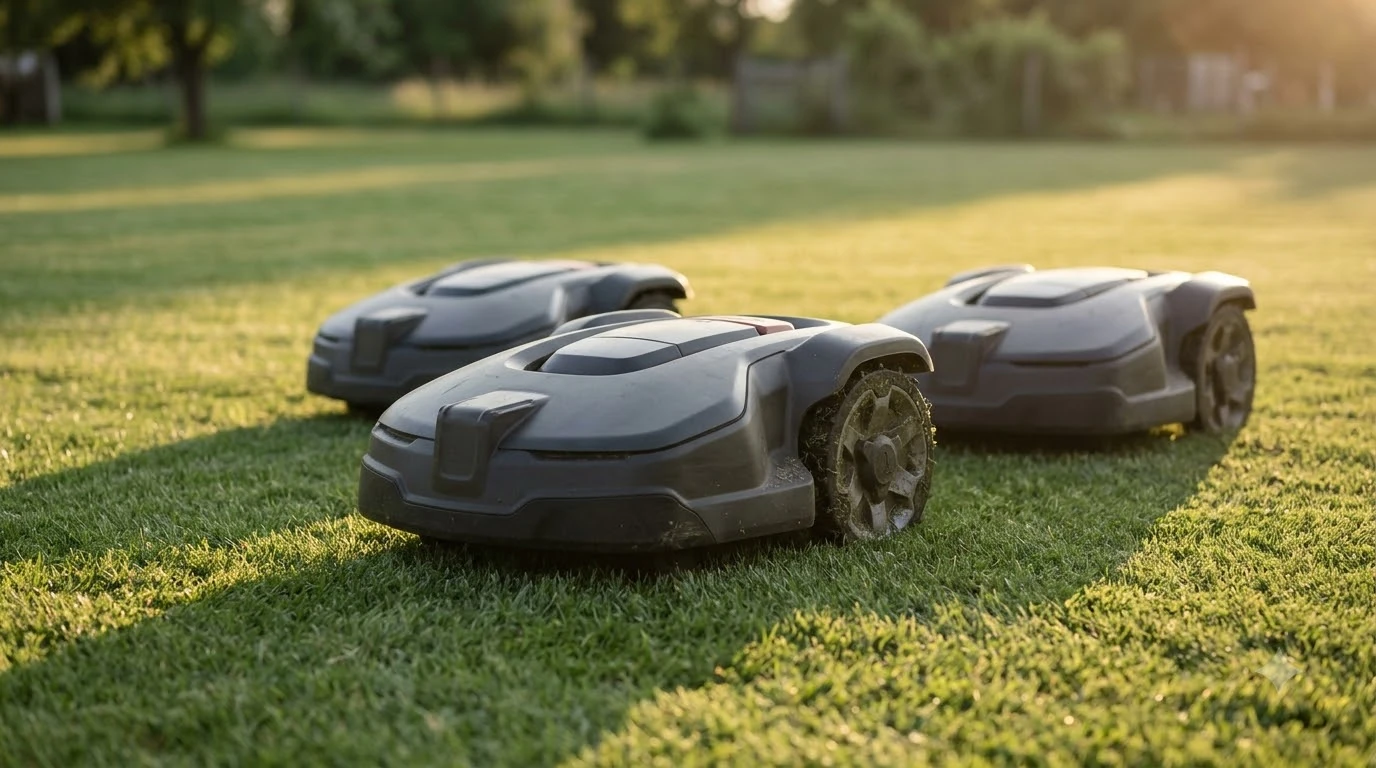

The best robot lawn mower for rural properties is the one whose mowable area, boundary method, slope limit and charging range all fit your lot. Rural lots are usually larger, more irregular and more sloped than a typical suburban yard, so a headline size tells you little on its own. The points below come from manufacturer support pages and university extension sources, and they show what to check before you compare models.
The short answer
- Measure the mowable grass first. Subtract the house, beds, trees and other no-mow zones from the total acreage.
- Read the rated size with a margin. Husqvarna labels its lawn sizes as plus or minus 20 percent.
- Plan long boundaries carefully. Guide wires need 30 cm (12 in) of clearance from the boundary wire and bends under 45 degrees.
- Treat slope ratings as limits. Husqvarna lists 25 to 50 percent for standard models, and the 70 percent AWD figure is a manufacturer claim.
- Estimate charging cycles. Divide your mowable area by the rated per-charge area.
How a rural lot differs from a typical yard
Rural lots tend to be bigger, more irregular and more sloped, with longer boundaries and more obstacles. One acre equals 43,560 square feet, so a half-acre lawn is about 21,780 square feet before you subtract the house, driveway, garden beds and trees. Our arithmetic puts one acre at about 4,047 square meters.
Clemson’s HGIC extension calls measuring the lawn area one of the most crucial steps in lawn management, and its guide to measuring a home lawn covers irregular shapes. Clemson’s lawn area factsheet is a good place to start. For a rectangle, Iowa State Extension’s formula is length times width, and an irregular lot can be split into rectangles and triangles that you add together.
Our reading is that rural properties lose more area to edges, trees and buildings than suburban yards do, so the mowable figure is often well below the total acreage. That gap is the number that decides which model is the best robot lawn mower for rural properties on your land.
Start with the mowable area, not the property size
When you shortlist the best robot lawn mower for rural properties, start with ratings: Husqvarna’s US robotic mowers page rates each model for a lawn size and labels that figure plus or minus 20 percent. The ratings below are as listed on that page when this guide was written, and listings change, so check the current spec sheet before you buy.
| Husqvarna model | Rated lawn size |
|---|---|
| Automower 410 iQ | 0.5 acre |
| Automower 535 AWD EPOS | 1 acre |
| Automower 435 iQ AWD | 1.3 acres |
| Automower 560 EPOS | 1.5 acres |
| Automower 440 iQ | 2 acres |
Because the label is plus or minus 20 percent, a model rated at 2 acres can be expected to handle anywhere from about 1.6 to 2.4 acres under the label. Our reading is to choose a model whose rated size is comfortably above your mowable area, not one that barely covers it. If your mowable area is near that size, see our pick of the best robot lawn mower for 2 acres. Subtract the house, beds, pool and other no-mow zones first, because those areas are not part of the grass the mower cuts.
Boundary wire or RTK on a long, irregular lot
The University of Florida’s IFAS extension says robot mowers navigate either with a boundary wire or with GPS/RTK, and the choice shapes how a robot mower for rural properties is set up on a long, split or irregular lot. Wire works on almost any shape, but a long perimeter takes careful routing. Husqvarna’s guide wire instructions set the rules for wire installs that include a guide wire: keep at least 30 cm (12 in) between the guide wire and the boundary wire, avoid bends sharper than 45 degrees, and use a guide wire for any passage narrower than 2 m (6.5 ft).
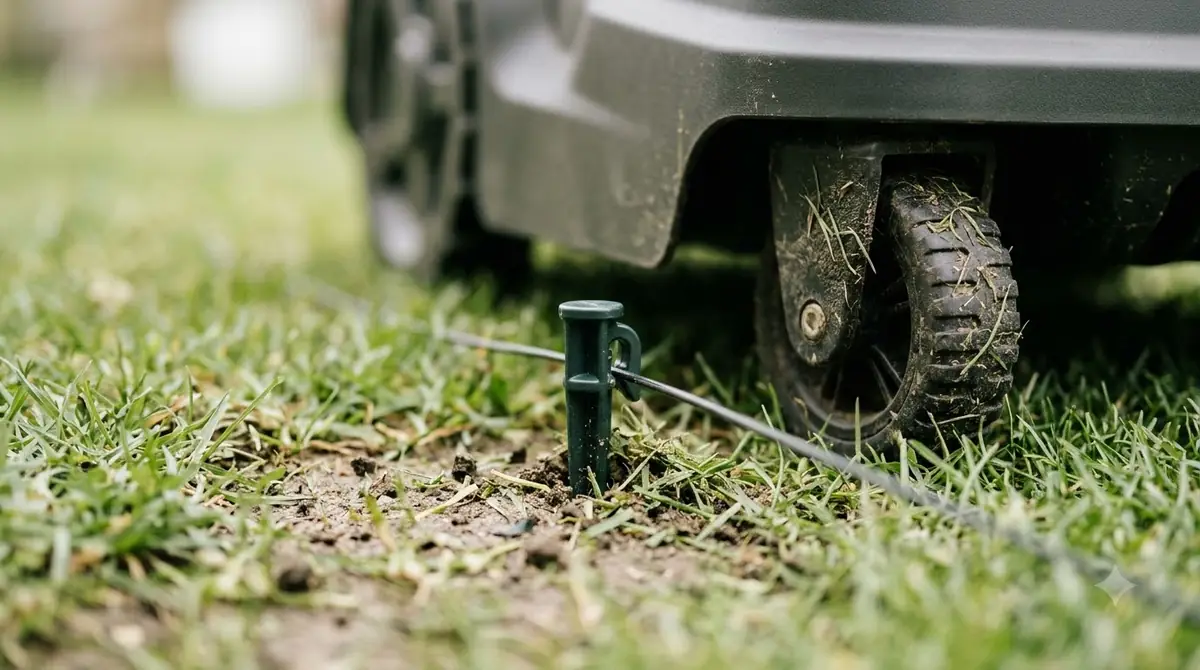
- Wire: the guide wire and boundary wire should be the same type to ensure compatibility, and the two must not cross. Long runs add layout time before the first mow, and our guide on how to install a robot mower boundary wire covers the steps.
- RTK: there is no wire to bury, but mapping depends on satellite signal. One vendor guide says the base station should not be moved after mapping, because shifting it shifts every boundary.
- Narrow side yards: a vendor guide notes that a side yard between a house and a fence can hide low satellites and cause RTK instability. We treat these as vendor views, not independent test data.
Husqvarna also notes that the mower can route through passages as narrow as 60 cm (2 ft) when a guide wire is in place, so a long property with narrow gaps may need more of the lot mapped in detail.
Slopes and uneven ground
Slope ratings are easy to misread. Husqvarna’s steep-slope support article gives 25 to 50 percent as the general range for standard models, though its per-model boundary limits are lower, mostly 15 to 25 percent, while its US page says the AWD 435 iQ navigates slopes up to 70 percent, or 35 degrees, as a manufacturer claim. Eufy’s retailer guide says a maximum slope is an absolute limit rather than a target for daily mowing, and that running at the top of the range strains the motor, drains the battery and increases wheel slip.
All-wheel drive is the layout most often recommended for hills. Sunseeker’s blog says AWD improves grip on steep, wet or loose ground, but that is vendor material and should be read as the company’s view. UF/IFAS also lists uneven terrain among the conditions where robot mowers are less suitable, so a bumpy, sloped rural lawn needs a closer look than a flat one. Our guides to a robot mower for a hillside lawn and to AWD versus 2WD robot mowers for hills go further.
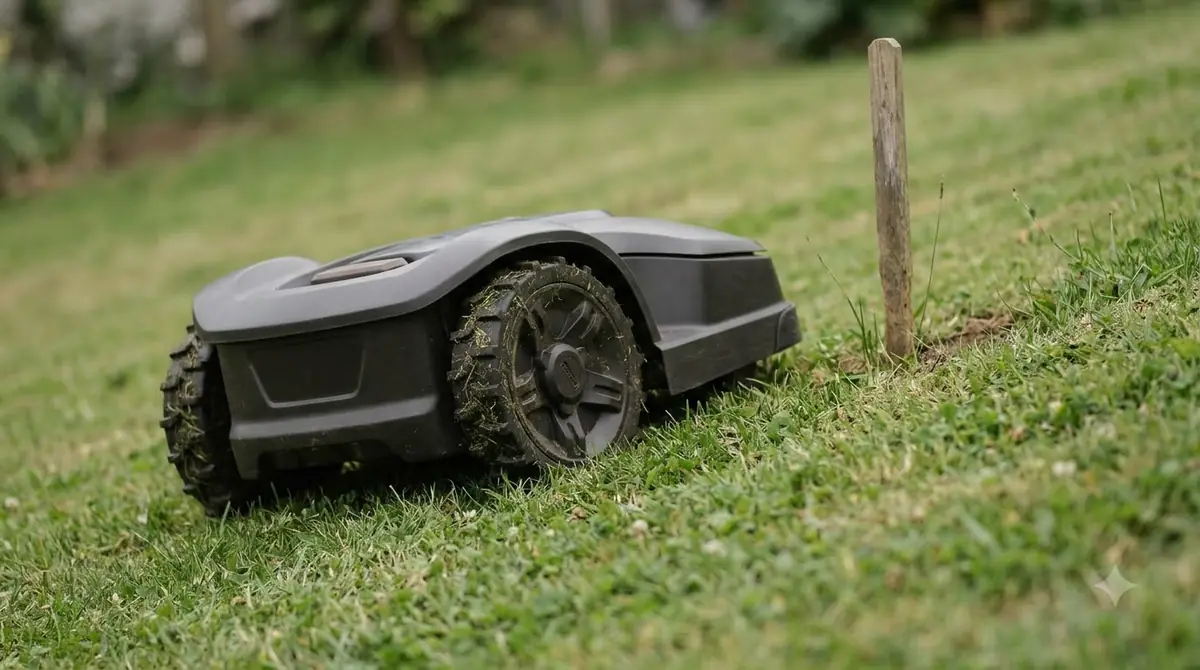
Our reading: on a rural lot, pick a model whose stated slope range sits well above your steepest section, and walk the slope with a tape or a level before you order. Slope is often the limit that separates a workable choice from the best robot lawn mower for rural properties on a hilly lot.
Charging range and per-charge coverage
Per-charge area decides how much grass one cycle can cut before the mower returns to charge. Navimow’s large-lawn guide gives 1,300 square meters per charge for its X450, a vendor claim that should be checked against the model’s own specification. Our arithmetic converts that figure to about 0.32 acre, so a 2-acre lawn would need several charging cycles to complete one full cut.
- Station position: our reading is that a station near the middle of the longest run shortens the trips out and back on a big lot.
- Grass type and height: UF/IFAS says most models are designed for cool-season grass cut below 2.5 inches, so taller or warm-season lawns fit less well.
- Battery and terrain: steep or rough ground uses more energy, so expect shorter cycles on the hilly parts of the lot.
Upkeep and risks on large properties
UF/IFAS advises replacing robot mower blades every 6 to 8 weeks during the growing season. Large properties also bring risks that small yards rarely face, and the same extension source lists four to plan for.
- Irrigation heads: exposed sprinkler heads are listed as a risk to plan around.
- Lightning: open rural land is more exposed, so protect the charging station and its power supply.
- Fire ants: the extension lists fire ants among the pests to watch for.
- Theft: theft is listed as a risk, so check the security options on any model you consider. Our explainer on whether robot lawn mowers get stolen covers the risk further.
What to check when choosing the best robot lawn mower for rural properties
Compare models on the five facts that matter for a large or sloped lot before you compare prices or features. Prices change, so this guide does not list them.
- Mowable area. Subtract the house, beds and no-mow zones, then choose a model rated above that figure.
- Boundary method. Decide between wire and RTK, and check whether long passages need a guide wire.
- Slope. Compare the stated range with your steepest section and treat the top figure as a limit.
- Per-charge coverage. Divide the lawn area by the rated per-charge figure to estimate cycles.
- Grass and cutting height. Confirm the lowest and highest cutting heights match your grass type.
A useful final check is to ask the seller or support team for the model’s rated area, slope figure and per-charge range in writing, then compare those numbers with the measurements you took on your own lot. Because the best robot lawn mower for rural properties depends on the lot itself, these checks matter more than any general ranking.
Frequently asked questions
Can a robot mower handle a 2-acre rural lot?
Some models are rated for 2 acres on Husqvarna’s US listing, and that rating carries a plus or minus 20 percent label. Subtract the house, beds and other no-mow zones first, because the mowable area is usually smaller than the total acreage. A model rated for more than your mowable figure gives you more margin.
Is boundary wire or RTK better for a long perimeter?
Neither is better in every case. Wire needs careful routing, with 30 cm of clearance between guide and boundary wire and bends under 45 degrees. RTK avoids the wire but depends on a clear view of the sky at the base, so trees and narrow side yards can cause trouble.
How steep a slope can a robot mower climb?
Husqvarna lists 25 to 50 percent for standard models, and its AWD 435 iQ is described as navigating slopes up to 70 percent, which is a manufacturer claim. Eufy says the maximum slope is an absolute limit, not a target for daily mowing. Choose a model whose rating sits comfortably above your steepest section.
Does a big lot need more than one charging cycle?
Usually yes. Navimow gives 1,300 square meters per charge for its X450 as a vendor claim, which is about 0.32 acre. A 2-acre lawn would need several cycles per full cut, and steep or rough ground can shorten each cycle.
Sources
- How to lay a guide wire in a boundary wire Automower installation (Husqvarna support): guide wire clearance, bend angle, passage width.
- Husqvarna US robotic mowers (Husqvarna): rated lawn sizes, plus or minus 20 percent label, the 70 percent slope claim on the AWD 435 iQ.
- Optimising an Automower installation for steep slopes (Husqvarna support): 25 to 50 percent slope range for standard models.
- Robotic lawn mowers, ENH1402 (UF/IFAS Extension): navigation options, uneven terrain limits, cool-season grass, blade replacement, risks.
- Measuring the area of a home lawn (Clemson HGIC): measuring lawn area as a first step.
- Robot lawn mower slope limits (Eufy, retailer): maximum slope as an absolute limit.
 Up next8 min readBest Robot MowersBest Robot Lawn Mower for Rental Properties: What to CheckUpdated Nov 11, 2026
 8 min readBest Robot MowersBest Robot Mower with Mulching Blades: What to Check Before You BuyUpdated Nov 11, 2026
 10 min readBest Robot MowersBest Robot Mower With Auto Return to Dock: How to Choose One That Docks ReliablyUpdated Nov 11, 2026
 9 min readBest Robot MowersBest Robot Lawn Mower for Townhouses: What to Check Before You BuyUpdated Nov 11, 2026
 8 min readBest Robot MowersBest Mammotion Robot Mower Model to Buy: How to Choose by LawnUpdated Nov 11, 2026
 8 min readBest Robot MowersBest Robot Lawn Mower for Suburban Homes: What to Check FirstUpdated Nov 11, 2026