
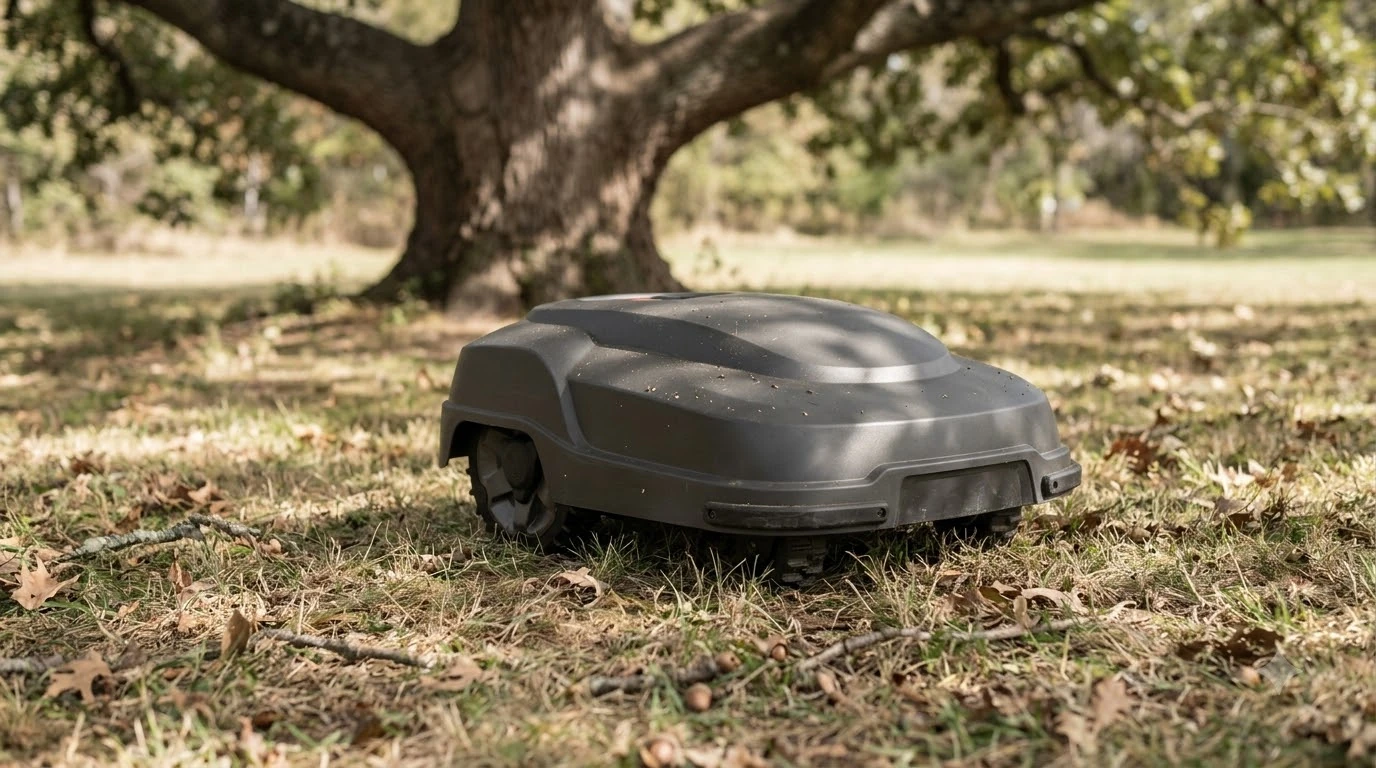

The best robot lawn mower for steep roadside ditches is an all-wheel-drive (AWD) or tracked model rated for at least 70% to 80% slopes, paired with wire-free RTK or LiDAR navigation and a floating cutting deck. Standard two-wheel-drive units lose grip on damp embankments, spin their tires on loose soil, and risk sliding into the road or standing water. Choosing the right machine means matching your ditch’s true grade, edge drop-off, and culvert layout against verified drivetrain and boundary limits.
The short answer
- Measure the ditch first: A 3:1 roadside bank equals a 33% slope, while a 2:1 bank hits 50%, which already exceeds standard 2WD mower limits.
- Prioritize AWD or tracks: According to manufacturer support guides, residential AWD mowers handle up to 70% or 80% grades inside the work area, whereas basic models top out around 15% to 25%.
- Check the edge slope rating: A mower’s boundary slope rating is lower than its interior rating—for example, 45% to 50% at the edge versus 70% to 80% mid-slope.
- Skip perimeter wires near culverts: Wire-free RTK, LiDAR, or vision navigation lets you draw digital stay-out zones around drainage pipes and street curbs without burying cable in rocky soil.
- Require rain sensors and high clearance: Roadside swales collect runoff and road gravel, so rain-return sensors and at least 50 mm of vertical obstacle clearance prevent scalping and water damage.
How to measure your roadside ditch before comparing specs
You must calculate your ditch’s rise-over-run percentage before looking at spec sheets, because mower brands quote maximum slopes in percentages rather than degrees.
According to Iowa State University Extension guidance on slopes, slope percentage equals vertical rise divided by horizontal run multiplied by 100. A bank that drops 1 foot over 5 feet of horizontal distance is a 20% slope, while a 1-foot drop over 3 feet is roughly 33%, and a 1-foot drop over 2 feet reaches 50%. Many homeowners underestimate roadside drainage swales by eyeballing them, which leads to buying a two-wheel-drive robot that stalls halfway up the bank.
Roadside ditches also feature two distinct zones: the sloped side walls and the narrow bottom trough. Even if the side walls measure 40%, the sharp transition at the bottom can bottom out a low-slung chassis or cause the front caster wheels to dig into soft dirt. Measure both the steepest section of the bank and the width of the flat bottom channel before narrowing your shortlist.
Heads up
A 100% slope equals a 45-degree angle, not a vertical wall. When a manufacturer advertises an 80% climbing rating, that converts to roughly 38 to 39 degrees under dry, firm turf conditions.
Drivetrain and traction specs that keep a mower out of the road
Four-wheel-drive hubs or continuous rubber tracks are mandatory on steep roadside banks because rear-wheel-drive robots lose steering authority the moment their front caster wheels lift or slide.
In our reading of residential and commercial slope guides entry-level two-wheel-drive mowers typically manage 15% to 25% grades, while mid-tier 2WD models reach 40% to 45% on dry grass. Once a roadside ditch approaches 50% or steeper, only articulated all-wheel-drive platforms—such as the Husqvarna Automower 535 AWD and Mammotion LUBA 2 AWD series—or tracked units maintain enough upward thrust to turn without tearing up sod. Articulated bodies hinge in the middle so all four wheels stay pressed against uneven ditch contours instead of teetering on two diagonal tires.
Tire tread depth and wheel weight distribution matter just as much as motor count. Deep-lugged off-road treads bite into thatch, while built-in wheel brushes or easy-clean hubs keep wet clippings from packing the tread smooth. If your roadside bank sits under shade trees where morning dew lingers, look for automatic rain detection that sends the robot back to its dock before damp grass turns the embankment slick.
Boundary slope limits and navigation near traffic
Every hillside robot mower has a lower slope rating at its outer perimeter than inside its main mowing zone, which directly affects how close to the road or ditch bottom you can safely mow.
According to Husqvarna’s official steep-slope installation guide, an AWD unit rated for 70% slopes inside the work area drops to a 50% maximum limit along the boundary. Similarly, Mammotion’s published specifications for the LUBA 2 AWD list 80% maximum climbing ability mid-slope but cap the allowable slope at the edge at 45%. Turning at the top or bottom of a ditch puts heavy lateral force on the tires, so asking a robot to pivot on a steep edge risks sliding it onto the asphalt shoulder or into a drainage channel.
| Specification to check | Standard 2WD robot mower | Heavy-duty AWD or tracked mower | Why it matters in a roadside ditch |
|---|---|---|---|
| Max interior slope rating | 15% to 45% | 60% to 80% | Determines whether the mower can climb out of the swale without spinning out |
| Max edge / boundary slope | 10% to 15% | 45% to 50% | Prevents the robot from sliding into traffic or water while turning at the border |
| Navigation method | Buried boundary wire or basic vision | RTK satellite, 360 LiDAR, and AI vision | Avoids burying wire across gravel driveways, culverts, and frost-heaved banks |
| Cutting deck design | Fixed single disc | Floating or dual-disc deck | Prevents scalping the crown of the ditch and missing grass in the trough |
| Obstacle clearance | 20 mm to 35 mm | 50 mm to 80 mm | Clears exposed tree roots, road gravel, and concrete culvert lips |
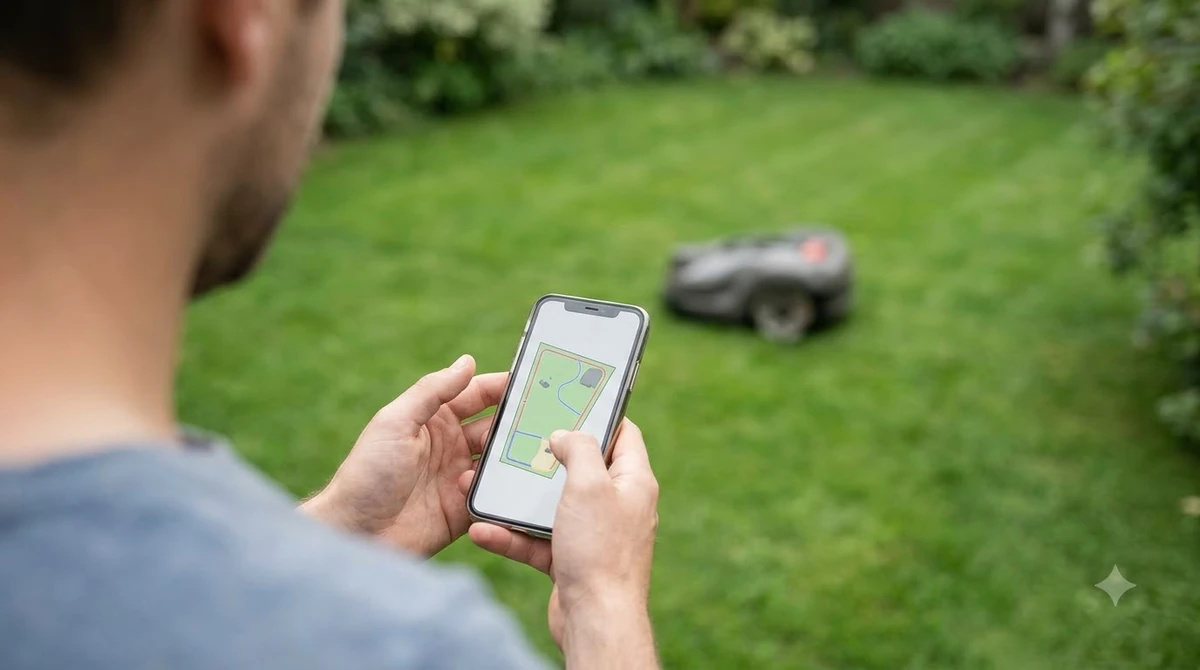
Wire-free navigation using Real-Time Kinematic (RTK) positioning, 360-degree LiDAR, or dual-camera vision simplifies ditch layouts compared to buried copper perimeter wire. Roadside embankments frequently hide utility lines, suffer frost heave, and get scraped by snowplows or delivery trucks, all of which snap buried wires. Virtual mapping lets you set a conservative buffer along the street curb and draw instant no-go zones around open culvert ends without digging.
Deck articulation, cutting height, and debris protection
A floating cutting deck and high ground clearance stop the blades from scalping the top ridge of a ditch or striking washed-in road gravel.
Roadside swales are concave at the bottom and convex at the top shoulder where the lawn meets the slope. A rigid cutting deck bridges across the convex shoulder and shaves the turf down to bare dirt, inviting weeds and soil erosion. Look for a floating deck suspension that tilts independently of the main chassis, paired with an adjustable cutting height up to 70 mm or 100 mm on high-cut variants so you can leave thicker grass to anchor the soil.
Roadside ditches also collect thrown pebbles, branches, and litter washed off the pavement. Pivoting razor blades fold inward when they hit a stone rather than shattering, while ultrasonic radar or multi-camera vision helps the robot steer around larger debris and guardrail posts. Never buy a mower for a roadside swale unless it carries at least an IPX6 water-resistance rating, though you must still exclude standing water puddles so the chassis never submerges.
What to check before you buy
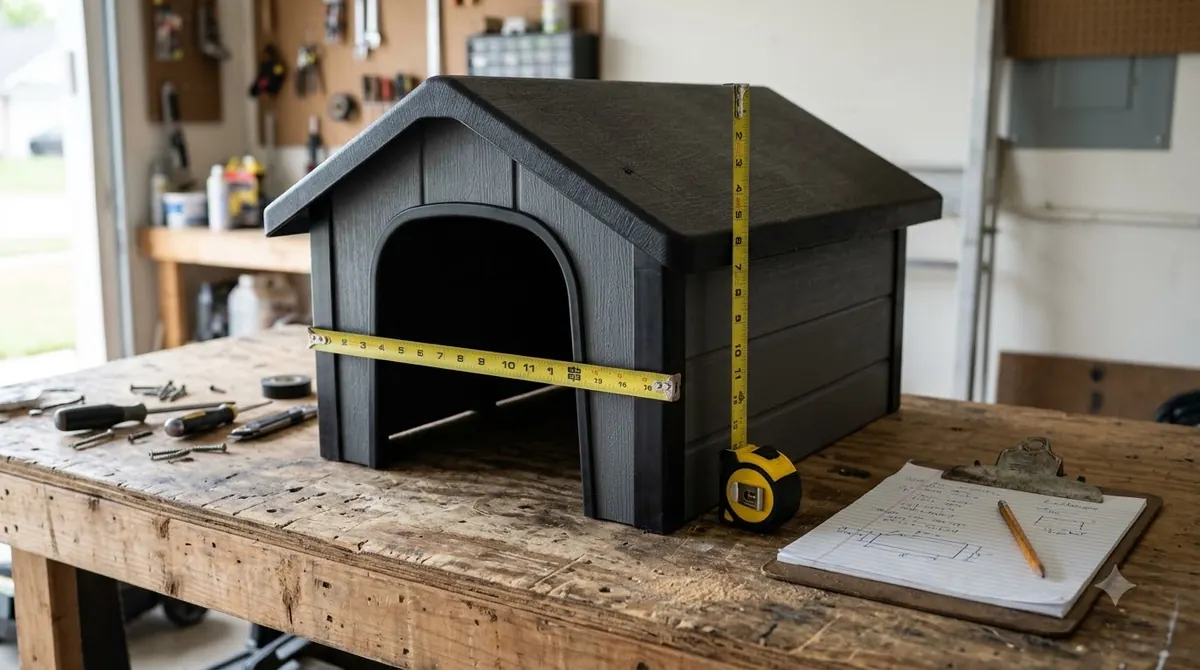
Walk your roadside ditch with a tape measure and a level before ordering so you can verify five site-specific constraints against any model’s manual.
- Confirm the steepest grade and transition buffer. Measure the rise and run at the steepest part of the bank, and check that you have at least 50 cm (1.6 feet) of flat transition ground at the top and bottom if the manufacturer requires a level run-out zone.
- Map your distance from traffic and standing water. Set your virtual boundary or wire at least 1.5 meters (5 feet) back from steep drop-offs, open culverts, or active roadway shoulders where a momentary slip could endanger drivers or ruin the mower.
- Check satellite and cellular reception in the ditch. Deep ditches lined with mature trees or tall embankments can block sky views for RTK antennas, making models that combine LiDAR or vision with RTK far more reliable under canopy.
- Verify obstacle clearance and blade availability. Choose a chassis with at least 50 mm of vertical obstacle clearance to step over exposed roots and gravel, and confirm replacement razor blades are inexpensive and easy to swap after hitting roadside grit.
- Review municipal right-of-way rules. Most roadside ditches sit within a town, county, or state right-of-way, so check local ordinances regarding unattended equipment near public roads and keep high-visibility reflectors or theft-tracking GPS active.
Frequently asked questions
Can a robot lawn mower safely mow a wet roadside ditch?
Most steep-slope robot mowers include rain sensors that automatically send the machine back to its charging dock when moisture hits the sensor, because wet grass reduces tire grip and increases sliding risks. Even with an IPX6 waterproof rating, you should schedule ditch mowing for dry afternoon hours and block off any low spots where rainwater pools.
What slope percentage is too steep for any residential robot mower?
The highest-rated residential AWD robot mowers cap out at 70% to 80% slopes (about 35 to 39 degrees) inside the work area and 45% to 50% at the boundary edge. If your roadside embankment exceeds 80%, or has loose eroded dirt where tires cannot grip, you will need a commercial remote-controlled slope mower or string trimmer instead.
Should I use a boundary wire or wire-free RTK mower along a road?
Wire-free RTK, LiDAR, or vision mowers are generally easier to maintain along roadsides because snowplows, utility work, and erosion cannot sever an invisible virtual border. However, if your ditch sits inside a deep wooded ravine with poor satellite reception, a buried wire or a LiDAR-assisted robot will hold its line better than a satellite-only unit.
How do I keep a robot mower from falling into a culvert pipe?
Create a digital stay-out zone or a physical boundary-wire island around both ends of the culvert pipe with at least a 1.5-meter buffer on steep grades. Adding sturdy wooden stakes or raised edging around exposed concrete headwalls also gives physical bump sensors and vision cameras a clear barrier to detect before the wheels reach the drop-off.
Sources
- Gardening on Slopes and Hillsides (Iowa State University Extension and Outreach): used for rise-over-run slope percentage calculation formulas and hillside erosion considerations.
- Optimising an Automower installation for steep slopes (Husqvarna Support): used for AWD interior versus boundary slope ratings (70% vs. 50%), 1.5-meter obstacle/bottom clearance rules, and 50 cm transition zone guidelines.
- LUBA 2 AWD Series Specifications (Mammotion Tech Support): used for AWD climbing limits (80% / 38 degrees), edge slope limits (45% / 24 degrees), vertical obstacle clearance (50 mm to 80 mm), cutting height ranges, and IPX6 waterproofing specs.
 Up next6 min readBest Robot MowersWhich RTK GPS Robot Mower Is the Most Accurate? What MattersUpdated Nov 18, 2026
 7 min readBest Robot MowersMost Reliable Robot Lawn Mower: What Actually Predicts ReliabilityUpdated Nov 17, 2026
 6 min readBest Robot MowersBest Budget Robot Lawn Mower That Actually Works: What to CheckUpdated Nov 11, 2026
 6 min readBest Robot MowersBest Wire-Free Robot Mower Under $1500: What the Spec Sheets ShowUpdated Nov 14, 2026
 9 min readBest Robot MowersBest LiDAR Robot Mower Under $1500: What the Spec Sheets ShowUpdated Nov 16, 2026
 7 min readBest Robot MowersRobot Lawn Mower Cyber Monday Deals: Compare the Spec Sheet FirstUpdated Nov 12, 2026