


Which RTK GPS robot mower is the most accurate? No single model wins in every yard. Accuracy comes from the RTK fixed solution, your correction source, and the sky above your lawn, so two identical mowers can perform very differently in two gardens. This guide explains what the accuracy figures mean and how to judge them for your own site.
The short answer
- Fixed solution is the goal: RTK fixed gives centimeter-level positioning in good conditions, while float is noticeably less precise.
- Vendor figures are best case: published numbers assume open sky, clean corrections, and a stable base or network link.
- Your yard decides most of it: trees, tall buildings, metal reflections, and the base position can outweigh a model-to-model difference.
- Compare the conditions, not just the figure: ask how the mower behaves when it drops to float and what it does to protect the boundary.
What RTK actually adds to GPS
RTK is not a separate satellite network. It is a correction layer on top of standard satellite positioning. A rover receiver on the mower combines satellite signals with correction data from a garden base station or a network service, and the result can be far more precise than consumer GPS. Consumer GPS is usually described as meter-level, which is too coarse to hold a mowing boundary on its own. GPS corrections are one input to positioning, and the overview of how mower navigation accuracy compares places them next to wire and vision. The pairing of corrections with a camera is covered in RTK combined with vision, which explains where each one helps. Plain satellite systems are discussed in satellite navigation precision in mowers for readers who want more detail on the subject.
The correction data can come from a base you install in the yard or from a manufacturer’s network service over Wi-Fi or 4G. Network-based models avoid a garden antenna, but they depend on a steady data link, so the mower’s connection is part of its accuracy.

Fixed and float: the state that matters
A fixed solution is the state that delivers centimeter-level position. When the receiver loses the fix, it falls back to float, which is less precise. Vendor and independent guides agree on the basic idea, though they rarely publish a float number. The rtkdata accuracy guide puts fixed RTK at roughly 1 to 2 centimeters horizontally near the reference, while float can range from a few centimeters to about a meter. Some designs avoid the extra hardware, a topic covered in mower accuracy without a reference station.
That gap matters for mowing. Frequent switches between fixed and float can leave missed strips or edges that wander past where you expect. When you compare models, ask how often the app reports float, and whether the mower slows, stops, or keeps going when accuracy drops.
Why the same model can perform differently in two yards
Satellite positioning needs a clear view of the sky. Tree canopy, tall fences, and buildings block satellites and can push the mower into float. Reflections from metal sheds, parked cars, glass, and brick walls, known as multipath, can also bias the position or cause sudden jumps. The rtkdata guide advises a clear sky above roughly 15 degrees from the horizon for a reliable fix. Mapped boundaries depend on the same signals, so virtual boundary mowers and their precision offers a useful comparison.
The base or network link matters too. A base placed near tree canopy or metal structures is less reliable, and moving it after mapping shifts every boundary. For network RTK, latency over a second or two can reduce performance, so weak Wi-Fi or 4G at the dock or across the lawn hurts the result as much as the receiver does.
Reading the accuracy claims on a spec sheet
Many manufacturers quote a figure such as 1 centimeter plus 1 ppm, which means accuracy grows with distance from the reference. The rtkdata guide treats centimeter accuracy as a best-case figure, not a guarantee beside buildings or under foliage. A Sunseeker glossary describes the same conditions, though it is a vendor source and gives no mower-specific test data. Spec-sheet accuracy claims are easier to read once you see which LiDAR robot mowers under $1500 are on the market.
Accuracy is also not the only thing that decides the cut. Blade offset from the chassis and the way the mower turns at the edge affect the result even when the position is perfect. A precise position with poor cutting mechanics can still leave an uneven edge, so look at the whole machine.
How to judge which RTK GPS robot mower is the most accurate for your lawn
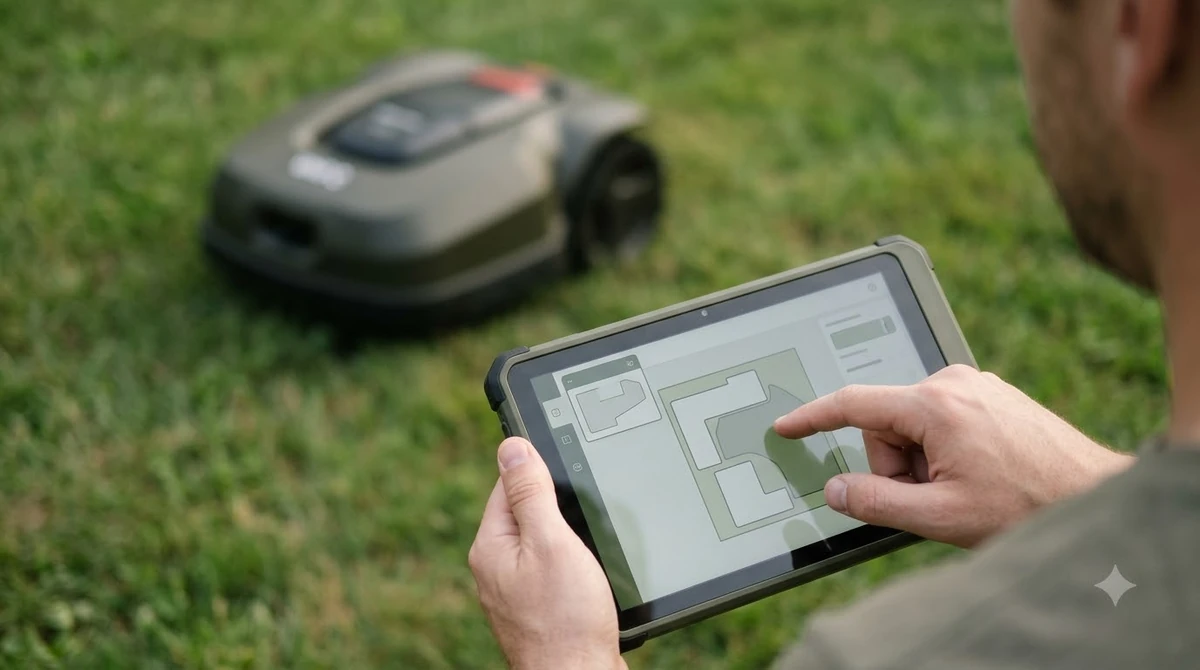
Since there is no universal winner, a practical test is more useful than a headline number. Walk the boundary, note where the sky is blocked, and mark any spots with metal or glass nearby. Then compare models by how they handle those spots, not by how they perform in an open field.
- Map the sky. Stand at the corners and edges of the lawn and note where trees or structures block the view above the horizon.
- Find reflective hotspots. Look for metal sheds, cars, glass, and walls that the mower will pass close to.
- Place the base carefully. Choose an open spot away from canopy and metal, and do not move it after you finish mapping.
- Check the fix in the app. Confirm the mower reports fixed status across most of the lawn during mapping.
- Test the safety behaviour. Start with wider virtual boundary buffers near pools, roads, and drops, and tighten them only after stable runs.

Frequently asked questions
Which RTK GPS robot mower is the most accurate overall?
There is no reliable single answer, because accuracy depends on your yard, the correction source, and the sky above the lawn. Compare models on the conditions in your own garden and on how they behave in float.
What is the difference between RTK fixed and RTK float?
Fixed is the state that gives centimeter-level position. Float is the fallback state, which is less precise and can cause boundary problems if it lasts long or happens often.
Do trees ruin RTK accuracy?
They can, because canopy blocks satellites and pushes the receiver toward float. Gardens with heavy overhead cover often need more careful boundary setup, or a model that handles blocked sky better.
Is a base station better than network RTK?
Neither is better in every case. A local base avoids dependence on a data link but needs a good installation spot. Network RTK removes the antenna but depends on a steady Wi-Fi or 4G connection.
Sources
- RTKdata, wire-free robot mower RTK accuracy guide (2026) (industry guide): fixed and float accuracy, sky-view and multipath conditions.
- Sunseeker, GPS RTK GNSS glossary (manufacturer glossary): RTK definition and the conditions that reduce accuracy.
 Up next6 min readBest Robot MowersWhich RTK and Vision Robot Mower Is the Most Accurate?Updated Nov 13, 2026
 8 min readBest Robot MowersHow to Choose an RTK GPS Robot Lawn Mower in 2026Updated Nov 11, 2026
 7 min readBest Robot MowersWhich Virtual Boundary Robot Mower Is the Most Accurate?Updated Nov 18, 2026
 7 min readBest Robot MowersWhich Boundary Wire Robot Mower Is the Most Accurate?Updated Nov 13, 2026
 7 min readBest Robot MowersWhich AWD Robot Mower Is the Most Accurate? Traction FactsUpdated Nov 18, 2026
 7 min readBest Robot MowersWhich No Base Station Robot Mower Is the Most Accurate?Updated Nov 18, 2026