
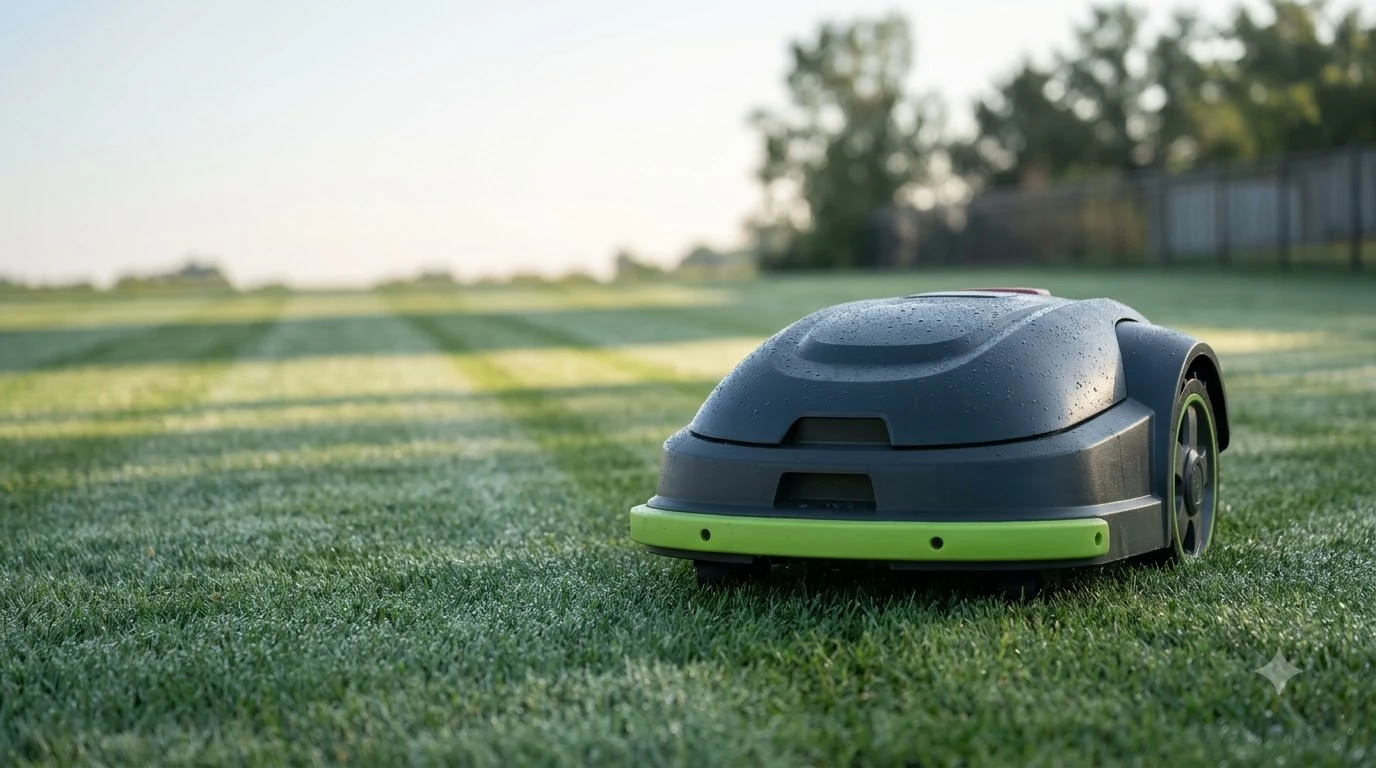

The best robot mower for a home with a home office worker is usually a quiet model that you can schedule outside calls and focus hours. Noise and timing matter more than cutting power here. Robomow’s guidance puts about 60 dB as the level that usually avoids neighbor complaints, and the NIDCD lists lawnmowers among common home noise sources. This guide covers how to judge noise, how to plan the mowing schedule around work hours, and what to check before you buy.
The short answer
- Look at the noise figure: manufacturers list a sound level, so compare models on the same basis rather than on marketing words.
- Remember distance: sound drops about 6 dB each time the distance doubles, so the wall of the office matters.
- Schedule around calls: set mowing for times you are not on a call, and avoid the early morning and late evening.
- Check local rules: some cities set decibel limits and hours for equipment, so look up your own code.
How loud is a robot mower in a working home?
A robot mower is quieter than a gas push mower, but it still makes a steady hum when the blades turn. Robomow’s blog gives a practical yardstick: about 60 dB is the level that usually avoids neighbor disputes, and the same source lists household references such as 40 dB for a quiet library and 60 dB for a television or music. That puts a mower close to ordinary conversation, which is fine for a yard but can be a problem for a call in a room with the window open. Working from home changes the daily routine, and the guide to mowers for everyday households covers the broader lifestyle choices.
Distance changes the picture. Robomow notes that perceived volume drops about 6 dB each time the distance doubles, so a mower at 5 m that reads 60 dB will read roughly 54 dB at 10 m. For a home office, the question is not only how loud the machine is in the yard but how much of that sound reaches the window of the room where you work. Our reading is that a mower working on the far side of the house is a different experience from one cutting under the office window.
Why the mowing hours matter more than the machine
Noise rules usually focus on time of day as much as level. The NIDCD says long or repeated exposure at or above 85 dBA can cause hearing loss, and that sound at or below 70 dBA is unlikely to cause hearing loss even after long exposure. A robot mower in the middle of the day is far below the level where hearing is at risk, but the point for a home office is interruption, not hearing. The Ecovacs blog notes that early-morning mowing can disturb neighbors and may break local ordinances, so the same caution applies to early calls and late evening focus time. If daytime hours are too busy, see quiet mowers for night mowing.
Local rules can be stricter than you expect. Chula Vista, California, for example, sets a residential exterior limit of 55 dB(A) from 7 a.m. to 10 p.m. on weekdays and 45 dB(A) from 10 p.m. to 7 a.m. Its noise code lists lawn mowers as a noise source without a separate rule for electric or automated equipment. Your city may be different, so check the local code before you set hours, especially if the lot is narrow and neighbors are close.
How to schedule mowing around work
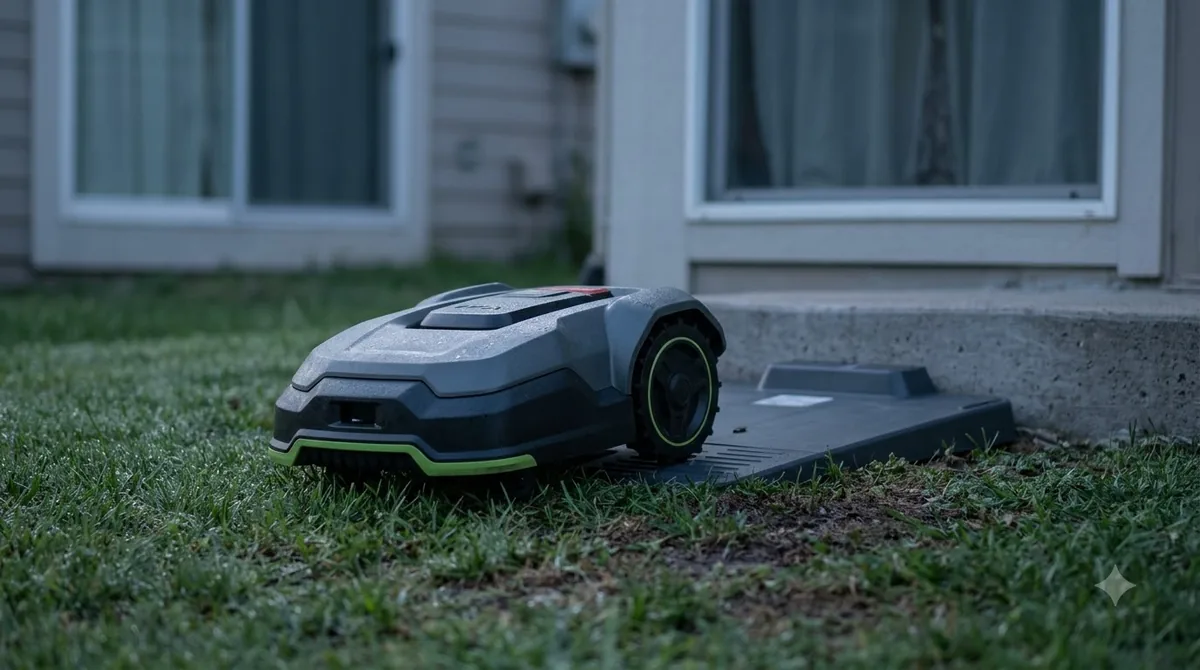
Most robot mowers run on a set schedule and return to the charger when the battery is low, so the schedule is the main control you have. Husqvarna’s guidance says its mowers are scheduled to work rain or shine, and the app steps are short: open Settings, choose Schedule, edit the days and hours, then save. The same guidance notes that the mowing run time rises as grass grows faster, so a schedule that works in spring may need adjusting in early summer. A simple setup helps when time is limited, as mowers that are easy to set up shows. Scheduling for a full household is covered in mowers for busy families. Remote operation matters on the road, as mowers for people who travel often explains. Scheduling around a home office is a common concern for new owners, and this guide to a robot mower for first-time homeowners covers the rest of the basics. Planning mowing around the day is also a point for older owners, and low-effort mowing for retirees is covered in this related guide.
A useful pattern for a home office is to mow in the lunch hour or in a block after the workday ends, and to avoid the first hour of the morning. Keep in mind that a mower can be overridden by a weather timer or by a manual start, so check the app after a storm or a manual change. A schedule that looks correct on paper can still be interrupted by a rain delay, and that can move mowing into a call window.
Best robot mower for a home with a home office worker: what to check
When you compare models for a home office, put noise and scheduling at the top of the list and cutting power lower down. Pollen season shapes the schedule, as mowers for allergy sufferers explains to round out the picture for this topic.
- Listed sound level: compare the manufacturer’s decibel figure on the same basis, and treat it as a guide rather than a guarantee.
- Schedule control: confirm the app lets you set days and hours and override them easily.
- Weather and rain behavior: check what the mower does after rain, because a delayed run can land in a call window.
- Frost and season settings: some models stop below a set temperature, which changes when the mower runs in cold months.
- Maintenance: worn or unbalanced blades raise noise. Sharp, matched blades and a clean deck keep the mower quieter.

Our reading is that the best robot mower for a home office is the one that fits your hours and your lot layout, not the one with the biggest claim. A quiet model that you can schedule around calls does more for your workday than a model that mows faster during the middle of the afternoon.

Frequently asked questions
Is a robot mower loud enough to disturb a call?
It can be, especially if the office window faces the lawn. Robomow’s guidance puts about 60 dB as the level that usually avoids neighbor complaints, and sound drops about 6 dB each time the distance doubles. Schedule mowing for times you are not on a call.
When should a robot mower run around a home office?
Midday or after the workday usually works best. Early morning and late evening can disturb neighbors and may break local rules, so check the code and set the schedule in the app.
Does the mower’s schedule ever change on its own?
Yes. Weather timers, manual starts, and some automation rules can override the schedule, so check the app after storms or after you change settings.
Are there legal noise limits for lawn equipment?
Many cities set decibel limits and hours. Chula Vista, for example, sets exterior limits by time of day, but your local code is the one that applies, so look it up before you choose hours.
Sources
- Robomow, how loud is a robotic mower? (manufacturer blog): 60 dB neighbor point, 6 dB per doubling of distance, household reference levels.
- NIDCD, noise-induced hearing loss (US federal health agency): 70 and 85 dBA thresholds, lawnmowers as a home noise source.
- Ecovacs, best time to mow the lawn (manufacturer blog): early-morning mowing and neighbor disturbance.
- Husqvarna, how to schedule your robot lawn mower (manufacturer): app steps and season effects on run time.
 Up next8 min readBest Robot MowersBest Robot Lawn Mower for Suburban Homes: What to Check FirstUpdated Nov 11, 2026
 9 min readBest Robot MowersBest Robot Lawn Mower for Vacation Homes: What to CheckUpdated Nov 11, 2026
 9 min readBest Robot MowersBest Robot Lawn Mower for New Construction Homes: Setup FirstUpdated Nov 10, 2026
 8 min readBest Robot MowersBest Robot Lawn Mower That Works With Google Home in 2026Updated Nov 11, 2026
 8 min readBest Robot MowersWhat Is the Best Robot Mower for Weekend Homes?Updated Nov 11, 2026
 6 min readBest Robot MowersBest Robot Mower for a Lawn After Hydroseeding: First CutsUpdated Nov 13, 2026