
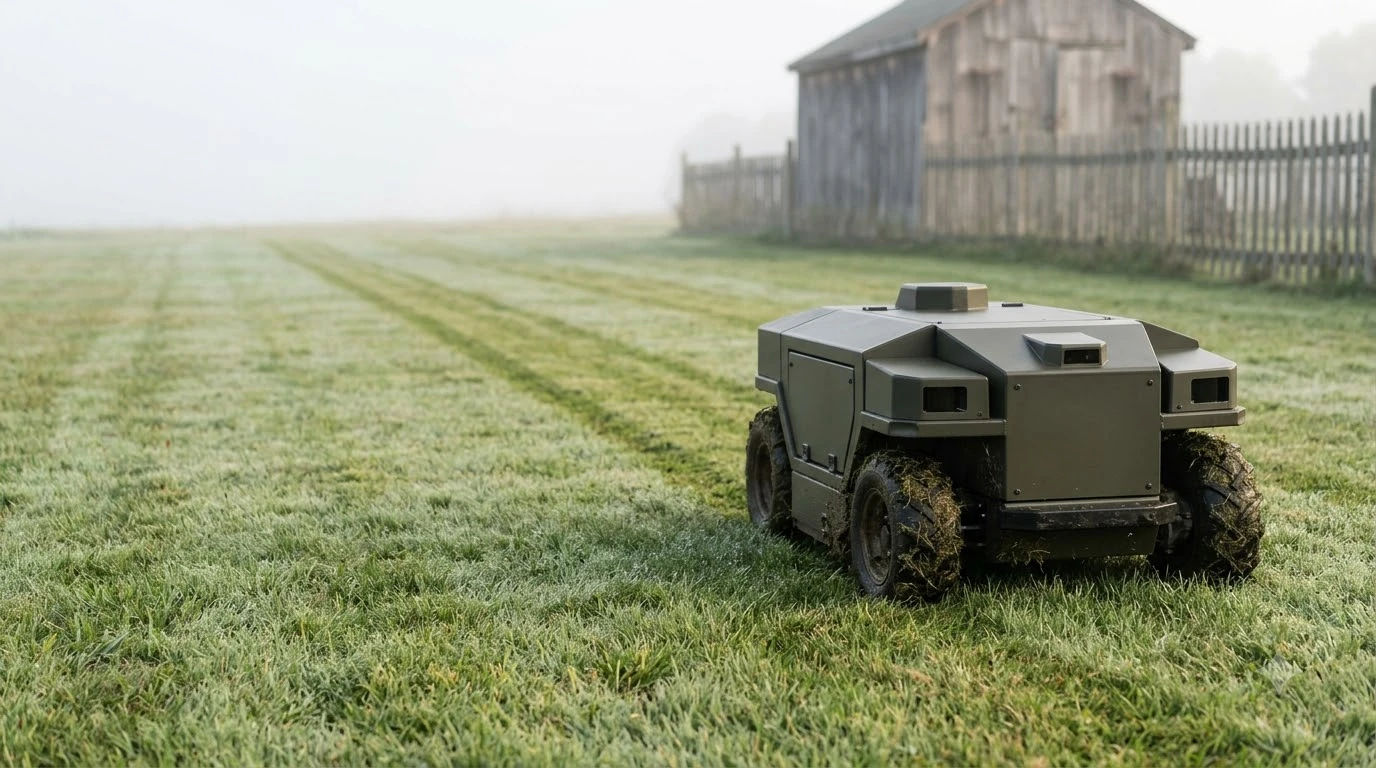

The best robot mower that mows in straight lines runs a systematic pattern on navigation that can hold a line, and no single model is guaranteed to do this in every yard. Many wire-guided mowers use a random path that runs straight until it reaches the boundary wire, an obstacle or a sensor alert, then turns. Systematic modes cut parallel, checkerboard or triangle passes, and manufacturers tie RTK or GPS positioning to repeatable lines. This guide explains the patterns and what to verify before you buy. It does not rank models.
The short answer
- Random paths are the default. Mammotion describes random mowing as the most common method, with more overlap and an unpredictable path.
- Straight rows need a systematic pattern. Look for parallel, checkerboard or triangle modes, or the zigzag and chessboard names some brands use.
- RTK is the usual route to repeatable lines. Vendors describe centimeter-level positioning, but those are manufacturer claims with conditions attached.
- Check edges and obstacles too. Parallel passes can leave edges uncut, so look for a perimeter pass or alternating patterns.
Why most robot mowers do not cut straight rows
Random mowing is the default because it needs little mapping, but it trades visible rows for overlap. Mammotion’s pattern guide describes random mowing as the most common and oldest method, with simple operation and good long-term coverage on small to medium lawns. The mower travels in a straight line until it meets a boundary wire, an obstacle or a sensor alert, and then it turns. Each individual run is straight, but the overall path is not organized into rows.
The same guide lists the drawbacks: the method is less efficient, creates more overlap and gives an unpredictable path. It also says that, despite seeming chaotic, random mowing eventually achieves full coverage when it is performed frequently. For a buyer, the distinction is practical. A random mower can suit a small yard where neat stripes do not matter. If the goal is visible, even rows, a random pattern will not produce them, however good the cutting deck is (our robot mower mowing patterns guide compares the modes). Our reading: the pattern setting matters as much as the cutting hardware.
Systematic patterns: parallel, checkerboard and triangle
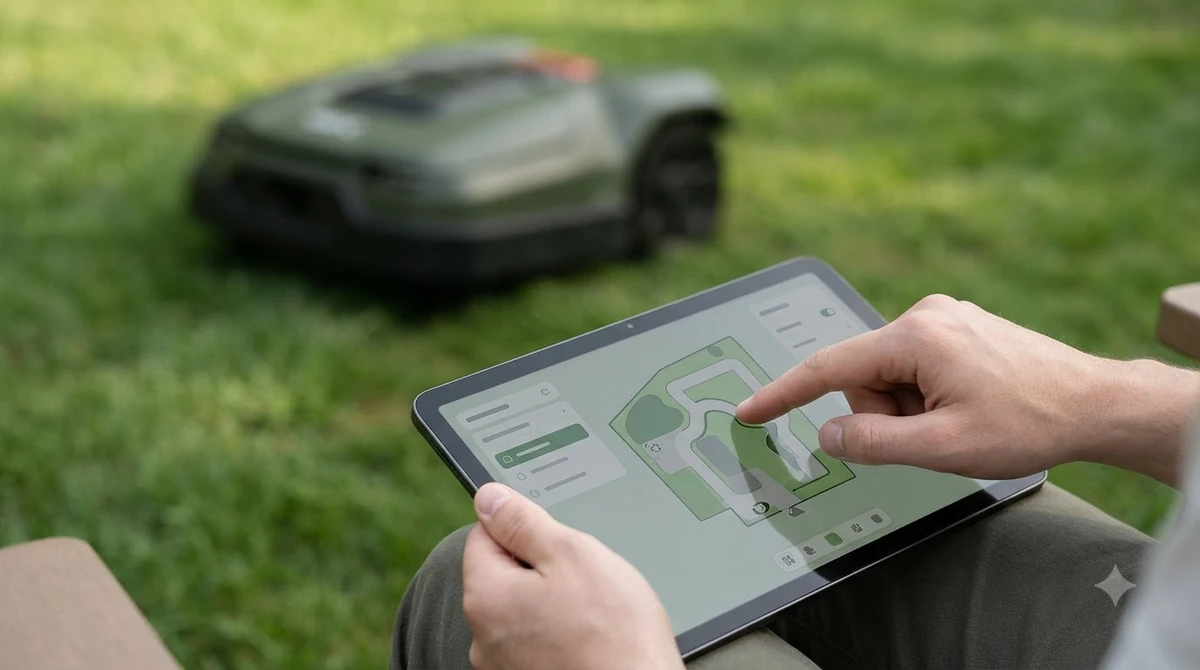
Systematic modes change direction in a set way between sessions, and that is what produces visible stripes, as how to get stripes with a robot mower also explains. Husqvarna’s support page names three systematic patterns. In parallel mode, the mower moves in parallel tracks, starts each session in the same designated corner and moves in the same direction, which creates stripes. Checkerboard turns each session 90 degrees from the previous one. Triangle turns it 60 degrees, and Husqvarna says its stripes are less visible than those of the parallel or checkerboard patterns.
Mammotion’s app offers a similar set under different names. Its zigzag option cuts straight, parallel rows at a consistent angle, and its chessboard option cuts horizontal and vertical passes that form a grid, which the company describes as a double cut for thorough coverage on larger or complex lawns. The app also lets you set path spacing, cutting angle and start location.
| Pattern | Path as the manufacturer describes it | Stripes | Edge note from the manufacturer |
|---|---|---|---|
| Random (wire-guided default) | Straight runs that turn at the wire, an obstacle or a sensor alert | Not a designed stripe pattern | Mammotion lists more overlap and no edge rule |
| Parallel or zigzag | Same direction and same starting corner each session | Visible stripes | Husqvarna says it can leave edges uncut |
| Checkerboard or chessboard | Next session at 90 degrees, or a grid of passes | Visible stripes | Husqvarna recommends alternating patterns for edges |
| Triangle | Next session at 60 degrees | Less visible than parallel or checkerboard | Husqvarna recommends alternating patterns for edges |
The table shows why the pattern name matters more than the mower’s looks. Ask for the exact pattern list for the model you are considering, because some brands expose only one or two of these modes. Husqvarna’s guide on systematic mowing is a useful reference for the angle rules.
Why RTK is the usual route to repeatable straight rows
RTK positioning is the sensor type that manufacturers most often tie to repeatable straight passes, but the claims come from vendors and carry conditions. Mammotion’s systematic pattern article says that systematic mowing relies on advanced navigation, naming GPS or RTK, to cut the lawn in organized rows with less overlap. It states that RTK allows centimeter-level positioning (see how an RTK robot mower works), which it links to perfectly straight, repeatable paths. The page does not give a measured accuracy figure beyond that centimeter-level claim.
Sunseeker, a robot mower brand, explains how the system works. A fixed base station in the yard measures satellite signal error at its own location and sends corrections to the mower in real time. Its blog says RTK can place a position “to within a few centimeters,” compared with “5-10 meters” for smartphone GPS. It also says the base station needs a clear view of the sky, ideally about 160 degrees vertically, and that heavy tree cover, walls and roof overhangs can reduce accuracy. After power-up, the base needs 3 to 5 minutes to acquire satellites. Those figures come from one vendor’s blog, so treat them as a starting point to confirm with the manufacturer’s manual.
Mammotion also lists limits. Its article says standard RTK or GNSS systems can become less reliable in complex terrain, and that vision or LiDAR may handle obstacles better, though with slightly less pattern accuracy. Some systems combine RTK, vision and LiDAR so the mower can choose a guidance method for each section of the lawn. Our reading: in a wide, open yard with a clear sky view, RTK is the sensor type the vendor literature links most closely to straight rows. In a tree-lined or obstacle-heavy yard, ask how the mower handles both the signal loss and the obstacles; RTK vs LiDAR vs vision robot mowers shows how each method copes.
Edges, obstacles and yard shape
Straight passes can leave edges uncut, so a perimeter pass and the way the mower handles obstacles matter as much as the stripe pattern. Husqvarna notes that a parallel pattern, where the mower runs in only one direction, can leave edges uncut. Its recommended fix is a final pass along the perimeter to remove uncut grass along the boundary and obstacles. On its EdgeCut models, Husqvarna recommends alternating patterns such as checkerboard or triangle for edge cutting.
Yard shape changes the choice too. Husqvarna’s irregular mode cuts the lawn from all directions and is recommended for slopes, complex areas and yards with many obstacles, though the page gives no angles for it. On slopes (see robot mower slope rating explained), the same page says that a checkerboard pattern can make the mower cross the slope side to side, which may wear the lawn or cause slipping. It suggests mowing straight up the slope when possible, or setting the pattern at about 45 degrees to the slope on inclines. The page also says that areas less than 1 meter (3.3 feet) between an unexpected obstacle and the virtual boundary remain uncut.

On navigation, Husqvarna’s systematic page describes a virtual boundary and a virtual map, using its EPOS wire-free technology on supported models, and it does not mention GPS or RTK. Straight rows therefore do not always mean RTK hardware. The systematic setting on one model may run on other navigation. Ask the manufacturer which navigation the pattern mode uses on that exact model.
Best robot mower that mows in straight lines: 6 checks before you buy
Use this list to compare any best robot mower that mows in straight lines candidate on the same terms. Confirm the pattern mode, the navigation it needs, and the edge and slope handling before you compare prices, since those specs decide whether straight rows are realistic in your yard.
- Pattern modes. Confirm the model offers a parallel, checkerboard or triangle mode, or the zigzag and chessboard equivalents, and not only random mowing.
- Navigation required. Ask whether the pattern runs on RTK, GPS, vision, LiDAR or a virtual boundary. If it uses RTK, check the base station’s sky-view requirement against your yard.
- Spacing and angle control. Check whether you can set path spacing, cutting angle and start location, since those settings change how the rows look.
- Edge handling. Look for a perimeter pass or alternating patterns, because parallel passes can leave edges uncut.
- Obstacles and slopes. If the lawn has trees, slopes or many obstacles, ask how the mower handles them and whether an irregular mode is available.
- Manual for the exact model. Read the manufacturer’s manual or support page, since pattern and navigation features can differ between models and firmware versions.
This guide does not list prices, because they change often. The specifications here are as read from manufacturer and publisher pages in November 2026. Check current specifications on the manufacturer’s site before you buy.
Frequently asked questions
Is there one best robot mower that mows in straight lines for every yard?
No single model is guaranteed to do this in every yard, so no best robot mower that mows in straight lines fits all lawns. Straight rows depend on a systematic pattern setting, on navigation that holds a line such as RTK, and on conditions like sky view, tree cover and obstacles. Check the pattern list and the navigation specification for the exact model you are considering.
Do I need RTK to get straight lines?
Not always. Mammotion ties systematic mowing to GPS or RTK, while Husqvarna’s systematic page describes a virtual boundary with wire-free technology and does not mention GPS or RTK. Ask the manufacturer which navigation the pattern mode uses on your model.
Do parallel passes cause stripes?
Yes. Husqvarna says the parallel pattern moves in the same direction from the same starting corner each session, which creates stripes. Mammotion recommends alternating the mowing direction weekly to even out coverage and reduce compaction in high-traffic areas, so the stripe look is a setting you can change.
Are straight-line patterns better for the lawn?
The sources here do not provide a verified comparison of lawn health. Mammotion says systematic mowing uses less overlap than random mowing, and it recommends alternating direction to reduce compaction. Our reading is that fewer overlaps and direction changes are the points to weigh, not a guaranteed benefit for the grass.
Sources
- What is systematic mowing? (Husqvarna): parallel, checkerboard and triangle angles, edge coverage, perimeter pass, slope guidance, virtual boundary.
- Lawn mowing patterns for robotic lawn mowers (Mammotion): random pattern behavior, overlap, weekly direction change, app settings.
- Systematic pattern for robotic mower (Mammotion): GPS or RTK for organized rows, zigzag and chessboard options, sensor trade-offs.
- What is RTK technology? (Sunseeker): base station, accuracy claims, sky-view requirement. Vendor blog, figures not independently verified.
 Up next8 min readBest Robot MowersBest Robot Mower for Straight Stripe Patterns: What to CheckUpdated Nov 11, 2026
 7 min readBest Robot MowersBest Robot Lawn Mower for Florida Lawns: 6 ChecksUpdated Nov 11, 2026
 8 min readBest Robot MowersBest Robot Mower That Handles Tall Grass: 5 Things to CheckUpdated Nov 11, 2026
 8 min readBest Robot MowersBest Robot Mower That Works in the Rain: What to Check Before You BuyUpdated Nov 11, 2026
 9 min readBest Robot MowersBest Robot Mower That Does Not Get Stuck: What to Check Before You BuyUpdated Nov 11, 2026
 10 min readBest Robot MowersBest Robot Mower With Auto Return to Dock: How to Choose One That Docks ReliablyUpdated Nov 11, 2026